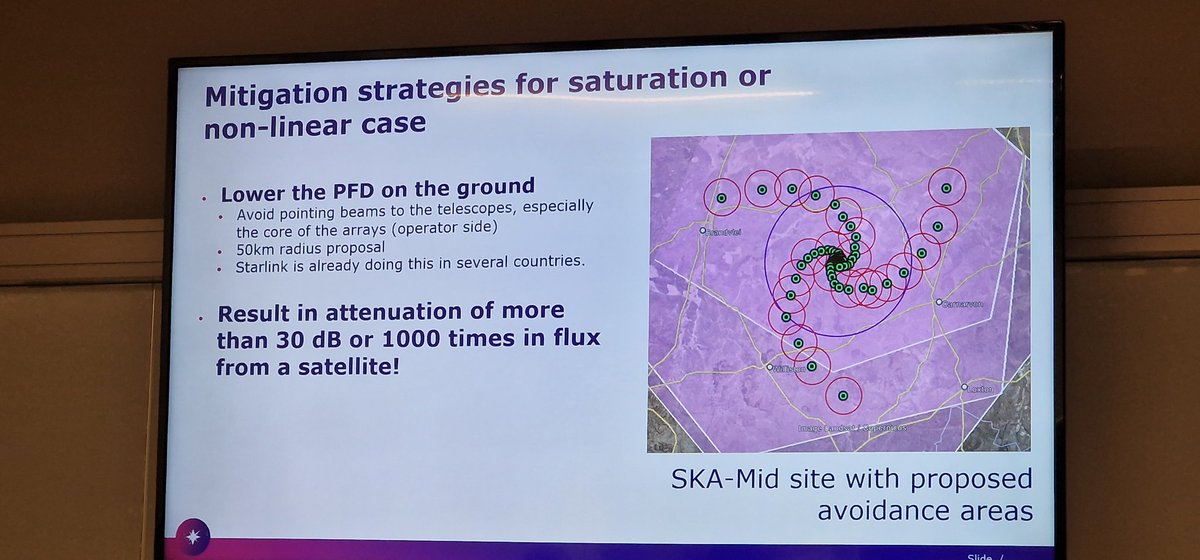
Great work by @FedeDiVruno. There's an urgent need to regulate radio interference from spacecraft. Why would we want to deliberately obscure our view of the universe?
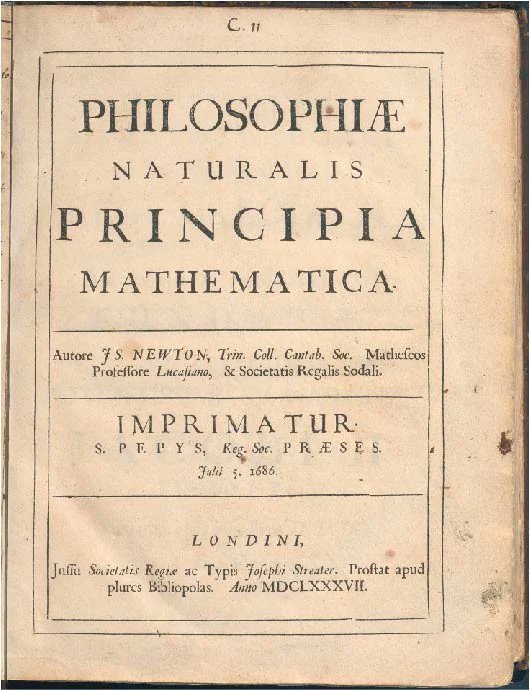
On this day in 1687, Sir Isaac Newton publishes Philosophiæ Naturalis Principia Mathematica (Mathematical Principles of Natural Philosophy), one of the most significant works in the history of science.
The Principia*states Newton's laws of motion, forming the foundation of classical mechanics; Newton's law of universal gravitation; and a derivation of Johannes Kepler's laws of planetary motion (which Kepler had first obtained empirically).
@ESA_Euclid as seen from the Calar Alto Schmidt telescope by ESA Planetary Defence Office @esaoperations , 5.5 hours after launch on its way to L2.
👉🏻 https://t.co/lsszKvbTDq
@JohnBarentine@Andy4Science Don't hesitate to call if you want more info or if something is not clear. Comments are of course welcome (email pls - I'm not often on Twitter).
@GetBAC They are spectacular because they are low and flying together. Once they reach their final altitude, they will be too faint to see. I computed (for ESO https://t.co/NYmklWcJSF) that ~100 will be visible for 1h after twilight, then they drop in the shadow.
@atomicthumbs Don't worry too much: as soon as they reach their final orbit, they won't be visible with the naked eye anymore. I computed (for ESO telescopes) about 100 sat will be visible in twilight when all the 27000 foreseen are launched. All are gone 1h after.
@michael_w_busch Actually, astronomical observations will be essentially unaffected by megaconstellations. I computed the effect (for ESO telescopes): <~1% during the first/last 1-2 hours of the night. It is slightly worse for LSST. See https://t.co/w0CXS8XsWV
@skyglowberlin @Isinlor@ESO@TheNRAO@IAU_org The calculations I made are for 27000 satellites in 19 constellations. Don't ask me about radio telescopes: I know about optical, not radio. Someone else will have to comment. I understand there are already some regulations in place for radio.
@rgrokett @lcjohnso @89Marvaz @cerrotololo@elonmusk Correct, but the occultation will last 0.2-2 ms (depending on the altitude and zenithal dist.), causing an error of the order of 0.1 milli-mag. Even for transit work, that's below the precision of ground-based photometry. Note there are already several thousands of sat up there.
@lcjohnso @89Marvaz @cerrotololo ... I ran some fairly detailed computations on the effect on the ESO telescopes (eg VLT, and soon ELT) considering Starlink and the other constellations: we will be very moderately affected for ~1h after sunset/before sunrise, at ~1% level.