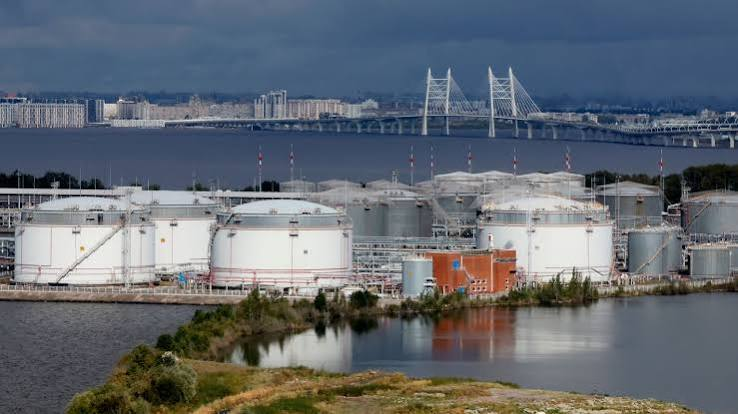
😁 In Irkutsk, Russians began to detain “gasoline speculators.”
In many areas, illegal traders remained the only source where residents could buy fuel, so the authorities effectively left Russians alone with a total shortage.
Meanwhile, propaganda began to convince that filling up a full tank is “dangerous.”
Those who manage to fill up are massively complaining about car breakdowns due to the terrible quality of gasoline, because gas stations began to supply fuel according to the outdated Euro-3 standard.
Russian Telegram channels are buzzing with pure panic right now, and you can practically hear the teeth gnashing all the way to the Kremlin. 😬🍿
After weeks of Ukrainian drone strikes systematically dismantling Russian oil refineries, Moscow quietly and desperately reached out to Kazakhstan, begging for 50,000 tons of AI-92 gasoline. The response? A stone-cold rejection through backchannels. Kazakhstan’s Energy Minister even made it official: "No request received, no deliveries on the way." Translation: You're on your own.
This is what happens when your entire energy infrastructure is turned into smoking ruins. While "Baghdad Putin" is busy claiming everything is running at peak capacity, ordinary Russian drivers are stuck in endless lines at bone-dry gas stations, watching their nerves shred to pieces.
The reality of this catastrophic war is finally hitting the home front where it hurts. Turns out, there aren't many "friendly neighbors" left who are willing to prop up a pariah state that's bleeding out on the battlefield. The fuel crisis is accelerating toward a brutal climax this autumn, and the fossil fuel empire is crumbling faster than they can spin the lies. 🔥🚗📉
Sources: Russian Telegram monitoring and official statements from the Kazakh Ministry of Energy, June 30.
⛽️ Rublyovka. One of the most expensive places near Moscow, where almost the entire Russian elite lives.
There are huge queues and fuel shortages even there.
How Putin Turned from a Petty KGB "Mole" into a Global Devil
The West once asked: Who is Mr. Putin?
After "looking into Putin's eyes," President George W. Bush described him as "a good Christian." Only Hillary Clinton seemed to identify him correctly, saying that "the only three letters you can read in Putin's eyes are KGB."
The bacillus of Nazism had just begun to emerge. At first, the West tolerated its early manifestations: the brutal destruction of Chechnya during the Second Chechen War, the dismantling of Russia's independent judiciary, the selective imprisonment of political opponents and oligarchs, and the redistribution of property to Kremlin loyalists.
Western leaders expressed concern, wagged their fingers, but continued pouring "nutrient broth" into the Kremlin's bowl through investments, military-technical cooperation, invitations to the G8, and other prestigious international forums, pretending this dangerous organism was somehow beneficial.
The West envisioned Russia as a supplier of energy resources that would recycle its profits back into Western economies by purchasing real estate, securities, and other symbols of prosperity. To maintain appearances, Putin was invited once a year to the G8 as a respected partner.
From 2000 to 2007, this arrangement suited nearly everyone—except the growing bacillus of authoritarianism. Fed by Western greed, corruption, and political short-sightedness, it expanded rapidly, infecting every sphere of Russian life.
By the 2007 Munich Security Conference, Putin openly declared that he was no longer satisfied with merely serving as Europe's energy supplier. He wanted a seat among the shareholders of the global order.
Many Western leaders dismissed his ambitions, believing Russia possessed little beyond oil and gas, while Putin and his inner circle depended on access to Western wealth.
Then came the 2008 war against Georgia.
At that moment, determined sanctions and unified political pressure might still have contained the growing threat. Instead, the Kremlin faced only limited consequences. The disease continued to spread.
After 2008, Putin's system grew far stronger. Russian state-controlled corporations and interests attracted numerous former senior European officials, while influential political figures promoted closer ties with Moscow. Leaders such as Angela Merkel and Silvio Berlusconi became symbols of engagement with Russia, believing cooperation would preserve stability.
The annexation of Crimea in 2014 exposed the true nature of the regime. Yet even then, many governments sought to postpone confrontation rather than fundamentally change their policies.
By the end of 2021, the transformation was complete. The former KGB officer had become the leader of an openly aggressive authoritarian state.
On February 24, 2022, Russia launched its full-scale invasion of Ukraine.
The dictator of the 20th century began his war in Poland. His counterpart in the 21st century began in Ukraine.
The world found itself facing one of the greatest security crises in decades, shaped not only by Russian aggression but also by years of complacency, corruption, wishful thinking, and the lack of decisive action by much of the democratic world.
Eighty years after World War II, the free world once again discovered that ignoring early warning signs can carry an enormous price.
‼️ In Crimea, military enlistment offices are already openly saying that a new wave of mobilization will be announced in Russia in September, - Ukraine Context
This should be done after the State Duma elections. Before the vote, the Kremlin simply does not want to annoy Russians once again and spoil its image of “stability.”
Therefore, military enlistment offices are already getting reservists to sign contracts, because they will be sent to the front later anyway.
Data center developers plan to deploy on-site natural gas power plants to avoid waiting for a grid connection.
Nearly 124 gigawatts of on-site gas power is planned for US data centers (BNEF)
Naisiin kohdistuva väkivalta on kasvussa. Vuonna 2025 uhreja oli viidenneksen enemmän kuin 2024.
Siksi on syytä nostaa asia julkiseen keskusteluun. Jokainen lyönti, raiskaus, tai muu väkivallan teko on yksi liikaa.
Olemme yli vuosisadan ajan kehittäneet Suomesta yhä tasa-arvoisempaa ja naisille turvallisempaa maata olla ja elää.
Suurimmalle osalle suomalaisia miehiä naisten suojeleminen on osa minää. Se on syvälle iskostunut, alkukantainen periaate.
Ymmärrän, että on helppoa olla periaatteellinen ja hyveellinen kun asiat ovat hyvin. Se on huomattavasti vaikeampaa kun asiat ovat huonosti.
Työttömyys, päihteet, masennus, stressi, tai yleinen näköalattomuus syö ihmistä ja koettelee periaatteitamme, sukupuoleen katsomatta. Kun olemme kovilla, on yhä vaikeampi tehdä oikein.
Silti. Naisia ei lyödä. Suomalainen mies tietää tämän.
Siksi pidän presidentin ulostuloa epäonnistuneena. Varsinkin kun tiedämme että merkittävä osa naisiin kohdistuvan väkivallan kasvusta on muun kuin suomalaisen miehen tekemää.
Paasikiven sanoin, kaiken viisauden alku on tosiasioiden tunnustaminen.
Myös muutos alkaa tosiasioiden tunnustamisella.
🧵 🇺🇲 The Wall Street Journal’s visual investigation changes the way the Iran war should be understood. The United States inflicted enormous damage on Iran. But Iran also proved something Washington can no longer ignore: America’s Middle East basing architecture was built for an earlier era.
According to satellite imagery, social-media footage and interviews analyzed by the WSJ, Iranian missiles and drones repeatedly targeted Naval Support Activity Bahrain - the nerve center of U.S. naval operations in the region.
Some got through. The damage was extensive.
The headquarters of the U.S. Navy’s Fifth Fleet was hit and is reportedly no longer usable. At least a dozen other buildings were damaged, including warehouses, barracks, emergency facilities, water infrastructure and communications nodes.
Two satellite communications terminals were destroyed.
NSA Bahrain is not a symbolic outpost. It is the anchor of American naval power in the Middle East.
Iran did not need to sink the Fifth Fleet to make its point. It needed to show that the infrastructure sustaining it is within reach.
Image below: Damaged sites include warehouses, a water tank, two satellite communications terminals and a communications management facility, and the headquarters building for the U.S. Navy in the Middle East. Airbus 🧵 2/4 ⬇
Puolustusministeri @AnttiHakkanen on 18.6. valtuuttanut @pvlogl hankkimaan Yhdysvalloista GBU-53 Storm Breaker SDB II -liitopommeja (Small Diameter Bomb).
Niitä voi kuljettaa Ilmavoimien F-35-hävittäjien rungon sisäisissä asekuiluissa.
#turpo
https://t.co/e5ASJW7sty
@TeroTweet Mikäs se olikaan @CharlesLindberg kirjan nimi? Kyllä olisi ollut neukkuaikaan kuin Firefox -leffa. Oli/on edelleen hauska. En nyt heti muista Clintiltä floppia, jopa orangileffat ovat omalla tavallaan hauskoja. Täytynee tunnustaa että olen fani.
Lockheed Martinin stealth-taistelupari!
Ilmavoimien Yhdysvalloissa koulutuskäytössä olevat F-35A Lightning II -häivehävittäjät harjoittelivat tiistaina yhteistoimintaa USAF:n F-22 Raptor -koneiden kanssa Fort Smithissä Arkansasissa.
Kuva: Ilmavoimat
https://t.co/1nVZcUaOoR
Jouko Aakko on voittanut 4 kertaa Vikingloton päävoiton.
Hän kertoo voittavansa vaistolla.
Just joo💩
Minun vaistoni sanoo, että juttu on
uhkapeliyhtiö #Veikkaus'n piilomainos. @iltalehti_fi tapa palkita hyvä mainostulojen tuoja.
https://t.co/TLUEbC75cW
⛽️ The "Gasoline Cloud" Delusion
Because Russia cannot deliver gasoline to the occupied Ukrainian territories, as Ukraine controls all the routes, Russian general and deputy Gurulyov proposed an idea of how to bypass this. A direct quote:
"We have technologies, still Soviet ones. We can heat and evaporate several train cars of gasoline, say, near Anapa, and form a gasoline cloud from it, and then direct it to Crimea with special fans, where we will make it rain. The technology was already tested in 1986—just get your basins ready!"
YES. Exactly. The purpose of the Ukraine War was to add population to Russia -- to force Ukrainians to think of themselves as Russians, so that Russia would have more meat to throw at the next target (Baltics+Poland).
This is how Russia has always operated. It's a Ponzi Empire.
Russian military spending surged by 30% in Q1 2026, reaching 5.9 trillion rubles. The amount of classified spending was absolutely massive (most of it goes to the military). Link to my latest analysis in the comments. 👇