Senator of Kenya - Busia County | Human-rights Activist | Executive Director ~ Kenyans for Justice and Development (KEJUDE)Trust. | Mobile +254722684777 | #REKE
Public participation is not a favour from government. It is a constitutional duty.
Sherry Arnstein’s 1969 ladder of citizen participation still explains why so many “consultations” in Kenya feel hollow. She ranked engagement by the real power citizens actually hold:
Non-participation
•Manipulation: forums used to sell a decision already made.
•Therapy: citizens treated as the problem, not the policy.
Tokenism
•Informing: one-way notices and websites, no reply channel.
•Consultation: hearings and surveys whose results officials may ignore.
•Placation: seats on committees while the final say stays with powerholders.
Citizen power
•Partnership: negotiated sharing of planning and decisions.
•Delegated power: citizens hold the majority authority over a programme.
•Citizen control: full management of policy and funds.
Article 10 and Article 118 of our Constitution demand more than notices and photo opportunities. If the public cannot change the outcome, it is not participation. It is ceremony.
Demand the higher rungs.
https://t.co/79bEdNxzKg
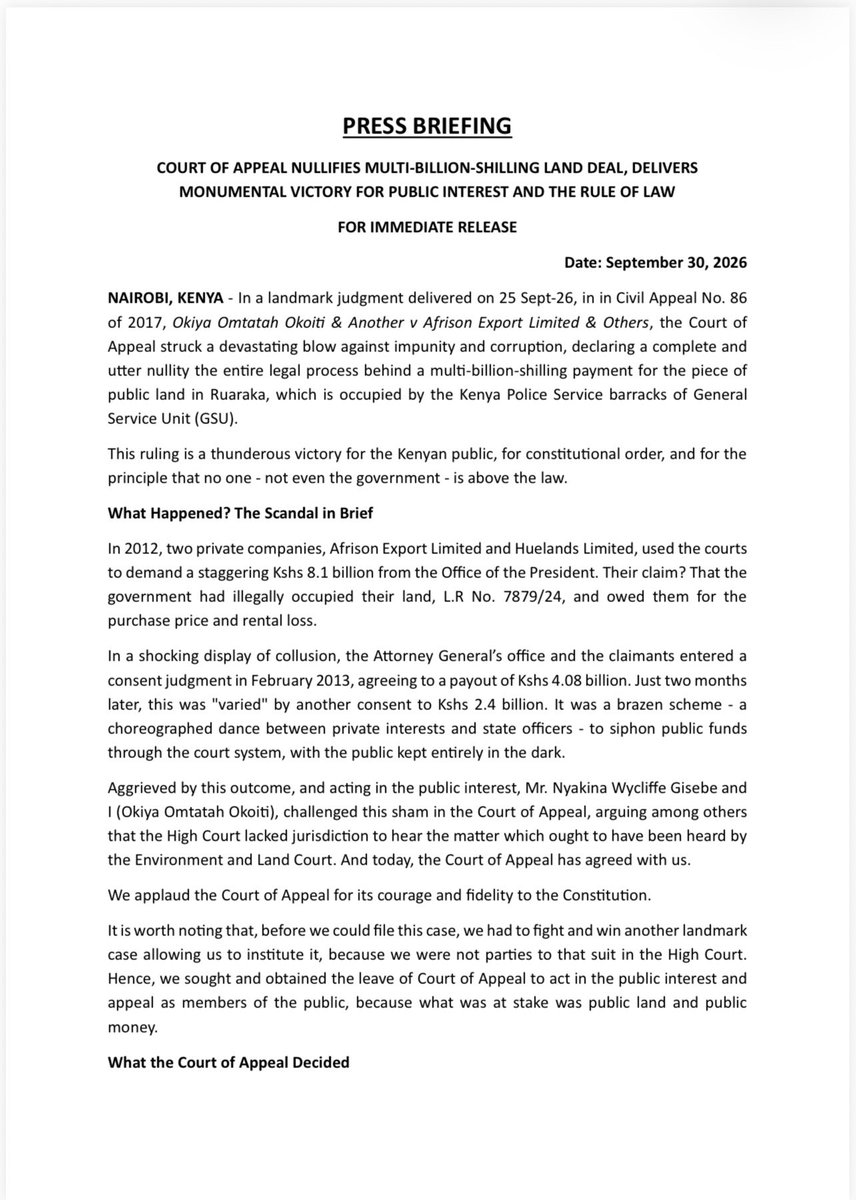
A significant victory for public interest and the rule of law.
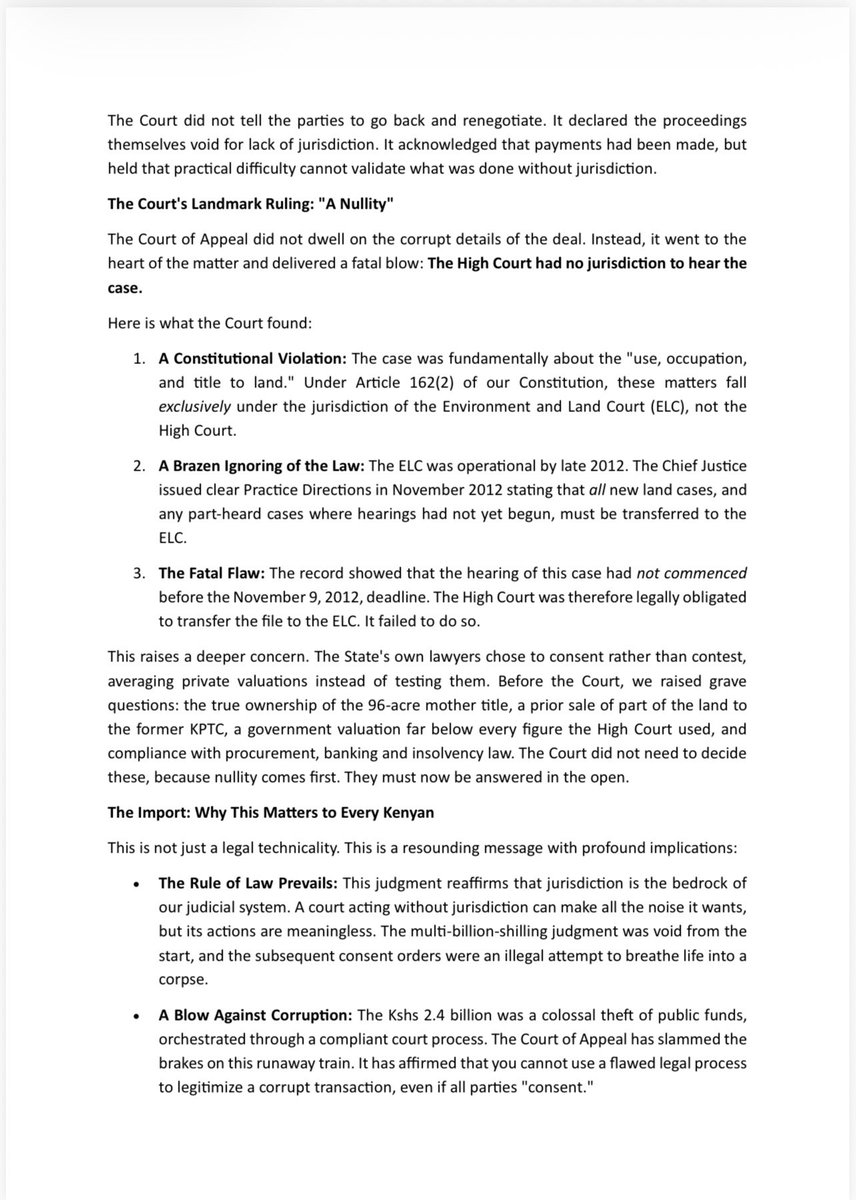
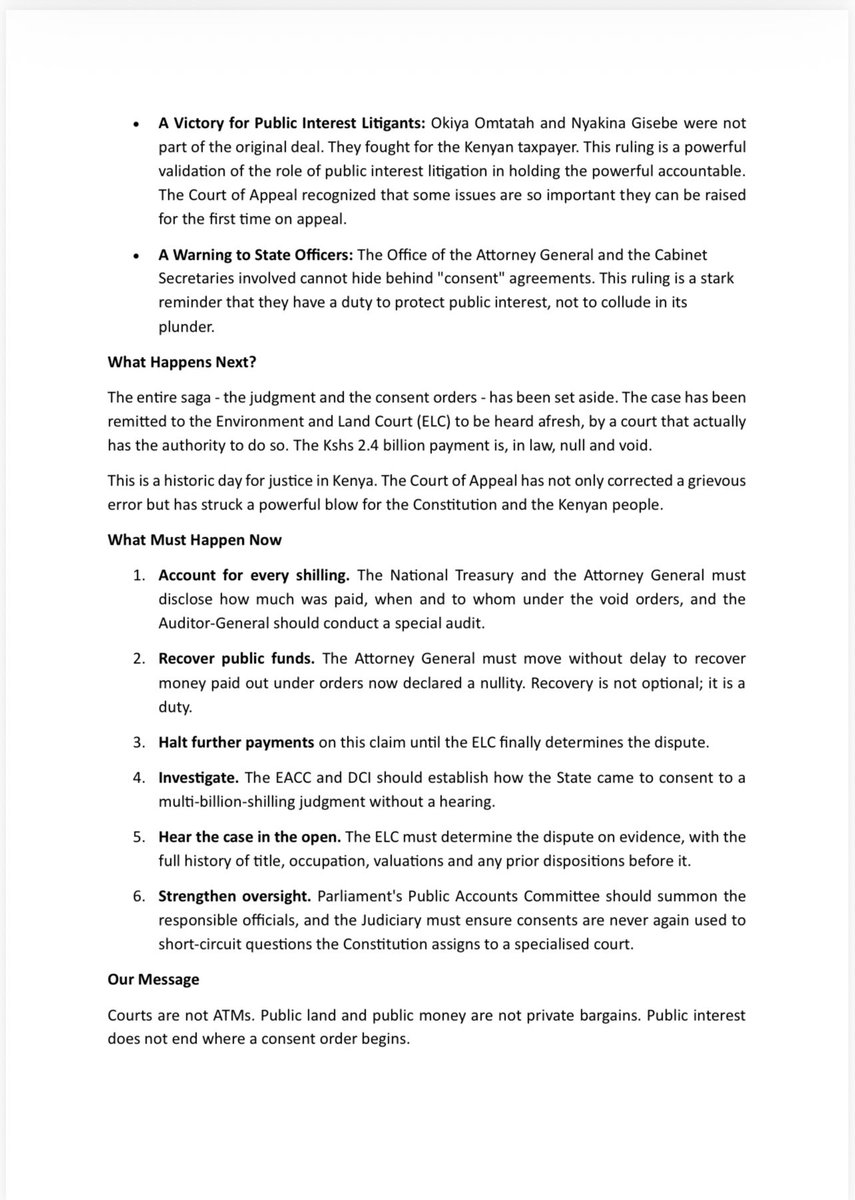
The Court of Appeal has declared null and void the proceedings and consent orders that led to the KSh 2.4 billion payment over the Ruaraka public land dispute, holding that the High Court lacked jurisdiction to hear the matter. The case has now been remitted to the Environment and Land Court for fresh determination.
This judgment reinforces a basic constitutional principle: public land and public money must be protected through lawful and transparent processes.
The next step is accountability. Every shilling paid under the void orders must be accounted for, and the responsible institutions must act on the Court’s decision.
JSC has asked Justices Kimaru, Sila and Okello to respond to a petition against them (Ref: https://t.co/neupHLFc1y.43/2026). Their response will be tabled for deliberation, and the decision communicated to the petitioner.
Please make time to listen to what Senator @OkiyaOmtatah exposes especially in regards to digital voting and budgetary estimates of running a digital election. Transparent & verifiable elections are possible but political goodwill is lacking!
https://t.co/1GFq2BXCiv
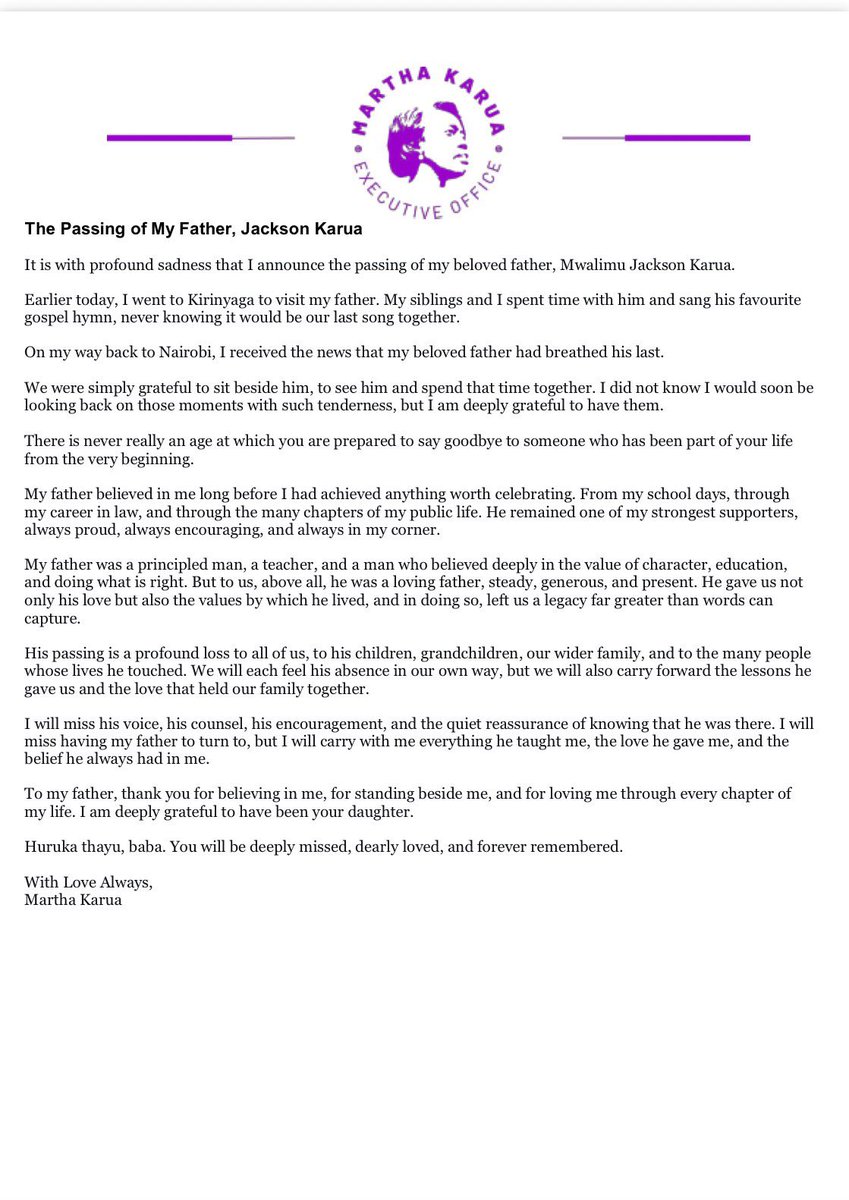
Hon. Martha Karua,
I extend my heartfelt condolences to you and your family following the passing of your beloved father.
May God grant you and your family strength and comfort during this difficult time. May you find solace in the memories of his life, the values he imparted, and the legacy he leaves behind.
May his soul rest in eternal peace.
My thoughts and prayers are with you and your family.
Congratulations, @LizzyEmongor, on this well-deserved achievement. Years of hard work, discipline and perseverance have finally borne fruit.
As you step into this new chapter as a Daktari, may your knowledge serve humanity, your character guide your choices, and your work make a difference. You have made Teso proud.
#USIUClassOf2026
My sentiments on the debate of the Fisheries Management and Development Bill (National Assembly Bills No. 29 of 2023), during its consideration in Kilifi County.
#Kilifilive
THE ORIGINAL SIN: THE CAPTURE OF THE NATIONAL TREASURY
Parliament's decision in 2012, at Section 11 of the Public Finance Management Act, to convert the National Treasury - which is established in the Constitution as an independent constitutional institution - into a department of the National Executive, placed under the political control of the President through the Cabinet Secretary for Finance, is the original sin at the heart of our woes.
It is the moment the architecture of accountability was dismantled. It is the moment the purse was surrendered to the Executive and the Control of public funds was lost. Parliament too lost its power because the President no longer had to govern through the national budget.
And it is also the moment the door was opened to the debt crisis, the opaque borrowing, the concealed expenditure, and the impunity that now strangle our Republic.
To drain the swamp, we must reinstate an independent National Treasury.
The Republic's financial system must return to the design in the Constitution - where a chain of separated constitutional powers ensures that no President, no Minister, no Treasurer, no Parliamentarian, no Governor, no creditor, and no bureaucrat can ever capture the entire life‑cycle of public money.
That is the Constitution's promise. That is the promise we must reclaim.
#GetitDone #ReKe
Okiya is raising the right institutional question, but Kenya has an additional problem: who appoints the watchdogs?
We can create a Controller of Budget, Auditor-General, fiscal council and ten other oversight bodies. But if the Executive has enormous influence over who gets nominated, while the President's parliamentary majority approves the nominees, independence can become stronger on paper than in practice.
This is why Kenya needs more than additional institutions. We need institutional independence that does not depend on the goodwill of the President of the day.
The Parliamentary Budget Office offers an interesting model. It sits within Parliament and is legally designed as a professional, non-partisan office staffed on merit, rather than being another presidential appointment.
We should seriously debate whether future fiscal watchdogs should use multi-institutional appointment mechanisms: competitive recruitment, independent selection panels, meaningful parliamentary scrutiny and security of tenure, rather than concentrating the nomination power in State House.
Because separation of functions means little if the same political centre can heavily influence the people occupying every checkpoint.
Okiya's principle remains powerful: separate who proposes the money, who approves it, who releases it, who spends it and who audits it.
But I would add one more:
Separate who appoints the people watching all of them.
That is how you build institutions designed to survive not just a good President, but a bad one too.
On Friday, 18 September 2026, I filed a Senate Notice of Motion under Standing Order 101(1) seeking to censure President William Samoei Ruto over a recurring practice of governing through oral and roadside declarations instead of constitutional, statutory and parliamentary processes.
The Motion centres on Article 135, which requires presidential decisions in the performance of constitutional functions to be in writing, sealed and signed. It argues that while the President may speak publicly, express opinions and announce policy intentions, such utterances cannot substitute for formal legal instruments where the Constitution or statute requires one.
It cites the 2 September 2026 declaration on foreign nationals in small-scale trade; the 3 September 2026 directive to Tata Chemicals Magadi to “pack up and leave” amid ongoing statutory and court processes; past statements on the Mumias Sugar litigation; the May 2025 Meru County debt pledge; unbudgeted health and development commitments; and pronouncements affecti
Dr. Margaret Nyakang’o: I have no visibility of anything called a ‘fund’ or ‘levy.’ They are not part of the Consolidated Fund, so they are not visible to me
#CitizenTonight
PRESS STATEMENT
WHY KENYA'S ELECTORAL SYSTEM MUST PASS THE CONSTITUTIONAL TEST
Fellow Kenyans,
Yesterday, I appeared before the High Court in a constitutional case concerning the Independent Electoral and Boundaries Commission (@IEBCKenya) and the integrity of Kenya's electoral system.
The petition asks the Court to test the entire chain of our elections - how Kenyans register, how they are identified at the polling station, how their votes are cast and counted, and how results are transmitted, verified and declared - against the standards the Constitution itself sets.
That question is simple to state: Does Kenya's electoral system meet the constitutional test?
Article 81 requires that elections be administered in a manner that is impartial, neutral, efficient, accurate and accountable. Article 86 requires that, whatever method is used to cast, count and transmit votes, that method be simple, accurate, verifiable, secure, accountable and transparent. The Elections Act sets the same standard for the technology IEBC deploys.
The Constitution anticipates an electoral process that is not just free and fair, but one that is also tamper-proof. Free and fair speaks to conduct on the day; tamper-proof speaks to the design of the system itself - whether it can withstand interference at any point in the chain, and whether that can be proven, not merely assumed.
To be clear, this case is not just simply about paper versus electronics.
Kenya's system already combines both - paper ballots, electronic voter identification, and electronic transmission of results. Technology, properly designed and independently verifiable, can be a powerful ally of electoral integrity: it can reduce unnecessary human discretion, create reliable audit trails, make results easier, not harder, to verify, and significantly reduce the cost of elections.
But technology is not self-certifying. It does not become trustworthy simply because it is technology. Like every other part of the electoral chain, it must be shown to satisfy the Constitution's own tests of transparency, verifiability, security and accountability - and, ultimately, to be tamper-proof.
That is the real question before the Court: does the entire electoral chain - registration, identification, casting, counting, tallying, transmission, verification and declaration - give Kenyans sufficient safeguards that their vote, once cast, cannot be manipulated, mishandled, or rendered impossible to verify?
This is not a personal quarrel with @IEBCKenya. It is a constitutional and public-interest matter.
Sovereignty in this country belongs to the people, and the vote is the sole instrument by which that sovereignty is exercised. An electoral system that cannot be meaningfully verified is not one the Constitution permits us to accept on faith.
I want to be precise about where this matter stands. The High Court has not ruled on the merits. The parties were heard, and the constitutional questions remain before the Court. I respect that process fully and will abide by whatever directions and determination the Court makes.
My role as a citizen, a public representative, and the petitioner in this matter is to ensure these questions are placed squarely before the Court and answered according to the Constitution and the law, not according to convenience or assumption.
Kenyans should not have to be told their votes were counted correctly. They should be able to verify it. That is the standard the Constitution sets, and it is the standard we are asking the Court to enforce.
The vote belongs to the people. The Constitution protects it. Our electoral system must do the same - free, fair, and tamper-proof.
We proceed, firmly and within the law.
God bless Kenya.
Okiya Omtatah Okoiti