Ever analyze a scRNAseq dataset and wonder if a specific cell state has been seen before? And if so, where in the human body? Under what conditions? Well, now you can use our lightning fast SCimilarity search and foundational model for that! ⚡️🔎🧬 https://t.co/t8L1xFOffd (1/11)
This is a beautiful paper that introduces the "right" generalization of probabilistic canonical correlation analysis. CCA is the under-appreciated cousin of PCA (and in a formal way closely related), that has many applications in genomics (in this paper genetics is explored).
Alzheimer's GWAS gets a diversity boost with new samples from Hispanics, African Americans and East Asians leading to novel ancestry-specific signals (e.g. PTPRK, GRB14).
A new preprint from Alzheimer's disease genetics consortium (ADGC)
https://t.co/Y0EUwZuAoW
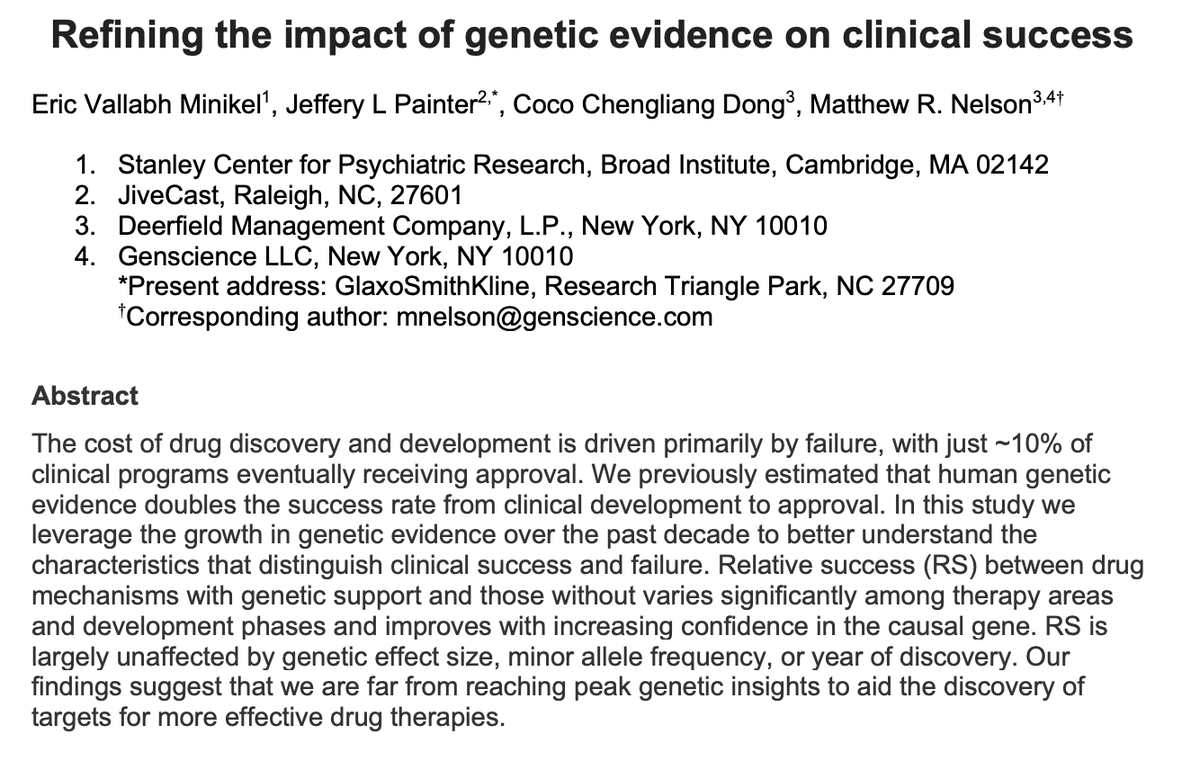
Is having even more gene-disease associations still useful for picking drug targets?
For which types of programs does it matter?
Has pharma shifted focus towards genetically validated targets?
New paper by me, @mnelsonxy, @DongCoco90417, & @jivecast https://t.co/KNUV1MNq3H👇
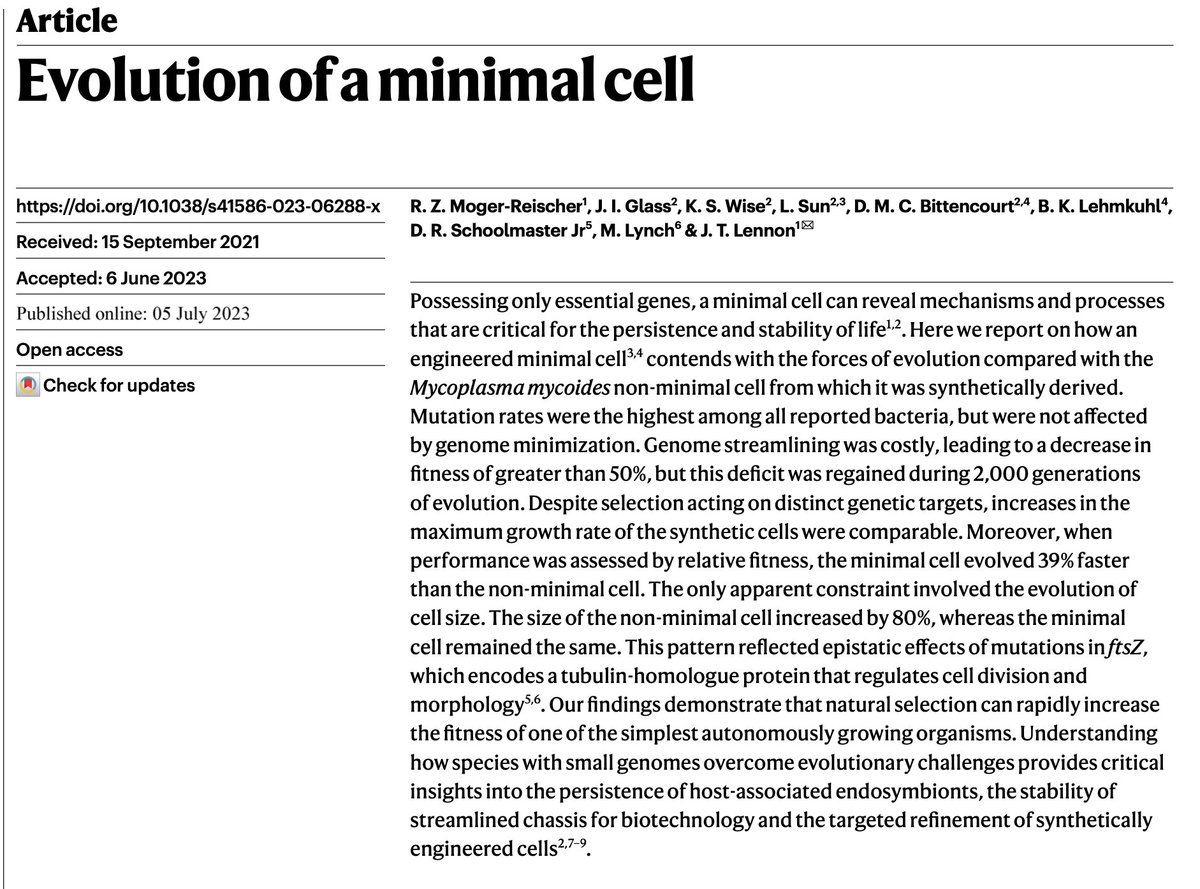
A mind-blowing paper has come out today in @Nature
In 2016, JC Venter Institute scientists trimmed a bacterial genome to its barest minimum required for life to synthesize what they called a "minimal genome" (https://t.co/Rk8oZJ0bUj).
Today, a group of scientists from Indiana University reports how that minimal genome evolved over 2000 generations in comparison to the non-minimal genome.
The authors found that even when you reduce a bacterial genome to its absolute minimum where every nucleotide matters, the genome undergoes mutational events generation after generation as much as the non-minimal genome. One simply cannot stop the evolution.
Just over 300 days of evolution (equivalent to 40,000 years in humans) the minimal cell has gained everything it lacked in fitness on day one in comparison to the non-minimal cell.
When comparing the evolved traits between the minimal and non-minimal cells, the scientists found something striking. The evolutionary process increased the cell size of non-minimal cells but not that of the minimal cell. But that is not the striking part.
The scientists were able to identify the key mutation that resulted in cell size evolution. And it turned out that the mutation that helped the non-minimal cells to grow bigger is the same that helped the minimal cells to stay smaller. Growing bigger had a survival advantage for non-minimal cells and not growing bigger had a survival advantage for minimal cells. So, the mutation had a context-dependent effect. This just demonstrates that the evolutionary effects on traits have no absolute direction. All that matter is what is beneficial for the organism's survival.
The conclusion of the paper is metaphorically a quote from the Jurassic Park movie:
“Listen, if there’s one thing the history of evolution has taught us is that life will not be contained. Life breaks free. It expands to new territories, and it crashes through barriers painfully, maybe even dangerously, but . . . life finds a way". (https://t.co/UlxRlb86CT)
https://t.co/zA9OAqSoAu
SSGG's Spring 2023 #shortcourse organized by George Tseng and Katerina Kechris, with other instructors.
Topic: Introduction to Multi-Omics Analysis
Date/Time: April 11, 13, 18 and 20th 3:00-4:30 ET
Registration: Forthcoming
#Bioinformatics#MultiOmics#Genomics
Congratulations to Sangita Choudhury, @tuihuaorjinhua, @EAliceLee2, @ChrisAWalsh1, and @DrMingHuiChen for this beautiful paper on somatic mutations in aging cardiomyocytes! Highly creative work navigating many complexities to study mutations in the heart.
https://t.co/jm1FzIE6Ln
You may know the GREAT tool (https://t.co/50Y2Gx9NPR) which performs functional enrichment directly on genomic regions. Here the rGREAT package implements the GREAT algorithm. Theoretically it can work with any organism and any type of gene sets. Check https://t.co/pMFKiA7rzd
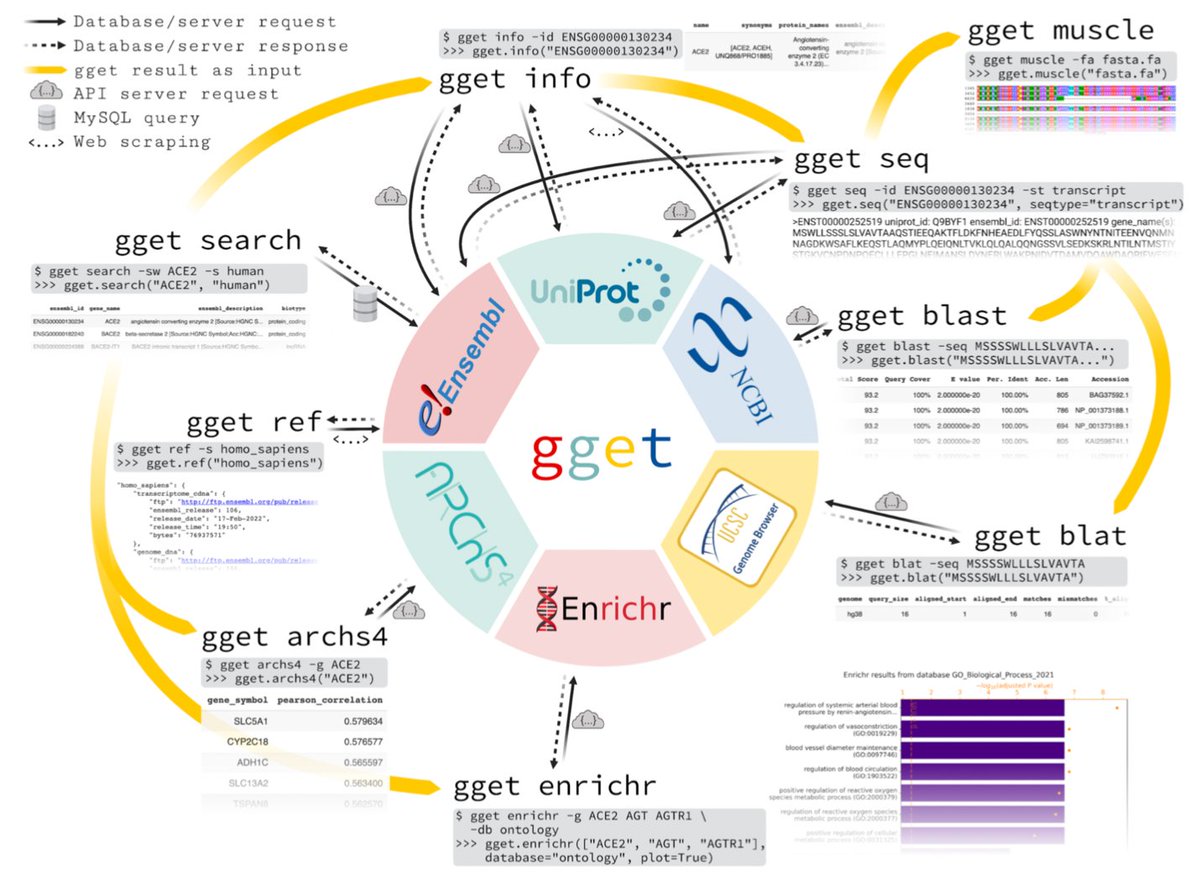
Analysis of #scRNAseq requires constant, tedious, interaction with genomics databases. To facilitate querying from @ensembl et al., @NeuroLuebbert developed gget:
https://t.co/xoaqK9scZo (code @ https://t.co/j5FLp7DyFx).
gget has many uses; a 🧵on the its amazing versatility: 1/
Are you curious about using organic dyes in your microscopy experiments but not sure where to start? This Perspective from @rhodamine110 and @jonathangrimm introduces readers to the world of dyes and their pros and cons for biological applications. https://t.co/3Vm8SWB7Yz
We develop MCML (multi-class multi-label) dimensionality reduction for this purpose. We're far from the first to argue for semi-supervised learning for single-cell genomics applications, we're just jumping on the (right) train. See, e.g. @bidumit et al. https://t.co/gcAiTBEbqu
I love when you find out your paper is out from Twitter:)) This @MethodsPrimers has everything you ever wanted to know about open chromatin and more! Very nice collab with Keji Zhao @LiesbethMin@WJGreenleaf@Schmitz_Lab@BockLab @steinaerts and their top students & post-docs
A paper published in Nature demonstrates the MuZero algorithm from DeepMind, which uses model-based reinforcement learning to achieve superhuman performance in games without knowing anything about their rules. https://t.co/06cPDD7K6a
Our study, funded by an ERC grant, is now out in Cell!
Read how protein structures can be barcoded in situ. The resulting 3D proteome snapshots pinpoint protein functional alterations at high resolution @CellCellPress@ERC_research@ETH_DBIOL
https://t.co/4hGkoTCfCE
Our latest review on lncRNA and its roles in gene regulation is out!
A fantastic collaboration with Ling-ling Chen, and wonderful work of Luisa Statello and Chun-Jie Guo. Check it out in Nature Reviews Molecular Cell Biology @NatRevMCB
https://t.co/NV3xzxDszy
We developed a scalable, quantitative and ultra-high sensitivity workflow for true single cell proteome analysis - one by one. Single cells have a stable proteome but not transcriptome. Great collaboration with @Bruker@EvosepBio@fabian_theis. Preprint: https://t.co/2edZ99u7Xw
Congratulations to Aakash Basu whose postdoctoral work on measuring DNA mechanics on the genome scale has just been published in Nature!
https://t.co/th9crAa4cZ