Add to this the recurring speculation around Bhagwat’s comments on people stepping aside around the age of 75 (Modi turned 75 in 2025) and the Sangh’s historical preference for organizational continuity over personality cults. The cumulative picture, drawn from these cross-referenced reports, is of an ideological parent organization that has grown uneasy with a political arm that, in its view, sometimes prioritizes the leader over the collective.
HOW “FANNING” COULD LOOK IN PRACTICE :
In the plausible scenario, the RSS would not need to invent the CJP or fund its marches. The movement is organic, Gen-Z driven, and fueled by genuine grievance. What the Sangh might do—quietly, deniably—is refrain from fully mobilizing its vast cadre network to counter the narrative, allow affiliated voices to amplify questions of accountability and youth despair, or simply let the protest’s momentum test the government’s resilience. _*A minister’s forced departure could be presented as course-correction; continued escalation could erode the aura of unassailability that has defined Modi’s dominance*_. Either outcome would, in theory, open space for a more collective, less centralized leadership arrangement in the post-2029 or even interim period—precisely the decentralization some earlier analyses suggested the RSS desires.
This is not unprecedented institutional behavior. Political families everywhere manage internal succession through calibrated pressure rather than open revolt. The RSS has repeatedly insisted, through Hosabale and Bhagwat himself, that differences within the “family” are natural and resolved privately, and that there is “no quarrel” with the BJP or the Centre. Those denials remain on the record and should not be dismissed. The scenario sketched here treats them as part of the public posture while noting that the documented pattern of signals—post-election rebukes, appointment delays, economic cautioning—makes strategic patience toward a convenient protest movement analytically coherent rather than conspiratorial.
AN ANALYTICAL OUTCOME, NOT A PROPHECY :
Whether the CJP ultimately claims Pradhan’s resignation, expands into a broader referendum on governance, or dissipates under monsoon rains and negotiations remains to be seen. What the cross-referenced reporting of the past two years does establish is a persistent undercurrent of organizational unease. If the fish is netted and the water around the shark begins to chop, observers will inevitably ask whether Nagpur merely watched—or whether, in the quiet way the Sangh prefers, it allowed the current to do some of the work. That question, for now, stays in the realm of presumption. Politics, after all, rarely announces its deeper calculations in advance.
- Oliver Rayi
Chairman, AP State Christian Leaders Forum
Disclaimer:
_This article is a purely speculative and analytical exercise exploring a plausible political scenario based on publicly available reports of past tensions. It does not claim, allege, or assert any actual strategy, involvement, or intent by the RSS, BJP, or any individual. It should not be read as fact or prediction._
💥MUST READ ARTICLE
@dpradhanbjp Dharmendra Pradhan just a fish - @narendramodi Modithe shark waiting to be netted?*
In the humid July days of 2026, the streets around Jantar Mantar in New Delhi have pulsed with a new kind of energy. What began in May as online satire—the Cockroach Janta Party (@CJP_for_India ), born from a Chief Justice’s ill-chosen comparison of unemployed youth to cockroaches—has swollen into a sustained youth-led protest movement. Its immediate demand is straightforward and pointed: the resignation of Union Education Minister Dharmendra Pradhan over repeated examination paper leaks that have shattered the aspirations of millions of students competing for scarce medical and professional seats. Yet as the chants grow louder, the police clashes continue, and opposition figures join the chorus, a quieter analytical question surfaces among political watchers.
Could this grassroots fury, currently focused on one minister, serve as a convenient current for deeper undercurrents within the Sangh Parivar?
This is not a claim of an orchestrated masterplan. It is a presumption, a plausible scenario pieced together from documented patterns of tension rather than any leaked directive or public admission. In that scenario, the Rashtriya Swayamsevak Sangh (@RSSorg ) might view the CJP agitation not as a threat to be crushed, but as an opportunity to gently net a larger catch— @PMOIndia Prime Minister Narendra Modi himself—while keeping its own hands clean.
THE FISH AND THE SHARK :
Dharmendra Pradhan is, in this framing, the fish: a loyal, high-profile but ultimately replaceable face of the Modi government. Paper leaks have long been a festering wound in India’s competitive examination system; their recurrence under his watch has handed protesters a clear moral and political target. Forcing or accepting his exit would allow the government to appear responsive without conceding systemic failure. But the CJP’s energy—rooted in youth unemployment, dashed meritocratic dreams, and a generation that feels unheard—has already begun to expand beyond one portfolio. Memes, viral videos, and marches toward Parliament have punctured the carefully managed image of invincibility that Modi has cultivated since 2014. In a plausible reading, the shark is the real prize: a leadership style long seen by some in Nagpur as overly personalized, centralized, and insufficiently deferential to the organizational ethos of the Sangh.
WHY THE RSS MIGHT PREFER A DIFFERENT CAPTAIN :
The grounds for such a preference are not invented overnight. They rest on a series of public signals and analytical reports stretching back several years. After the 2024 Lok Sabha elections, in which the BJP fell short of a single-party majority, RSS chief Mohan Bhagwat offered remarks widely interpreted as pointed. A true sevak, he said, works without arrogance or the claim of “I did this,” maintains decorum, and treats the opposition as a counterpart rather than an adversary; Manipur, he added, was still waiting for peace. Media outlets from Reuters to The Print and Frontline read these as a rebuke of Modi’s “Modi Ki Guarantee” campaign rhetoric and claims of near-divine energy.
Subsequent coverage reinforced the theme of friction. A August 2025 Frontline analysis framed the delayed selection of a new BJP national president as a contest of “Modi-Shah Versus RSS,” with the Sangh resisting a rubber-stamp appointment and seeking to decentralize power away from the Delhi duo. India Today’s July 2025 examination of “revamp tensions” described the RSS as no longer content to play second fiddle, insisting on ideological loyalty and cadre discipline over pure electoral machinery. Earlier, in 2022, RSS general secretary Dattatreya Hosabale had publicly flagged poverty, unemployment, and inequality as “demonic challenges”—remarks that opposition voices and some analysts treated as an indirect critique of the government’s economic record.
Add to this the recurring speculation around Bhagwat’s comments on people stepping aside around the age of 75 (Modi turned 75 in 2025) and the Sangh’s historical preference for organizational continuity over personality cults. The cumulative picture, drawn from these cross-referenced reports, is of an ideological parent organization that has grown uneasy with a political arm that, in its view, sometimes prioritizes the leader over the collective.
How “fanning” could look in practice:
In the plausible scenario, the RSS would not need to invent the CJP or fund its marches. The movement is organic, Gen-Z driven, and fueled by genuine grievance. What the Sangh might do—quietly, deniably—is refrain from fully mobilizing its vast cadre network to counter the narrative, allow affiliated voices to amplify questions of accountability and youth despair, or simply let the protest’s momentum test the government’s resilience. A minister’s forced departure could be presented as course-correction; continued escalation could erode the aura of unassailability that has defined Modi’s dominance. Either outcome would, in theory, open space for a more collective, less centralized leadership arrangement in the post-2029 or even interim period—precisely the decentralization some earlier analyses suggested the RSS desires.
This is not unprecedented institutional behavior. Political families everywhere manage internal succession through calibrated pressure rather than open revolt. The RSS has repeatedly insisted, through Hosabale and Bhagwat himself, that differences within the “family” are natural and resolved privately, and that there is “no quarrel” with the BJP or the Centre. Those denials remain on the record and should not be dismissed. The scenario sketched here treats them as part of the public posture while noting that the documented pattern of signals—post-election rebukes, appointment delays, economic cautioning—makes strategic patience toward a convenient protest movement analytically coherent rather than conspiratorial.
An analytical outcome, not a prophecy :
Whether the CJP ultimately claims Pradhan’s resignation, expands into a broader referendum on governance, or dissipates under monsoon rains and negotiations remains to be seen. What the cross-referenced reporting of the past two years does establish is a persistent undercurrent of organizational unease. If the fish is netted and the water around the shark begins to chop, observers will inevitably ask whether Nagpur merely watched—or whether, in the quiet way the Sangh prefers, it allowed the current to do some of the work. That question, for now, stays in the realm of presumption. Politics, after all, rarely announces its deeper calculations in advance.
- Oliver Rayi
Chairman, AP State Christian Leaders Forum
Disclaimer:
This article is a purely speculative and analytical exercise exploring a plausible political scenario based on publicly available reports of past tensions. It does not claim, allege, or assert any actual strategy, involvement, or intent by the RSS, BJP, or any individual. It should not be read as fact or prediction.
Fuel prices increased for 3rd time on May 25th when crude oil was at its lowest. Who is benefitting?
And Pakistan has actually reduced its price by Rs. 22/- the third time.
@nsitharaman@PetroleumMin@HardeepSPuri
https://t.co/tDSrvAdr6u
@IPL blatant attempt of religious imposition of captive audience.
The mid-innings supposed entertainment at the IPL 2026 final (@RCBTweets RCB vs GT @gujarat_titans on 31 May at Narendra Modi Stadium, Ahmedabad) was a live musical performance by Padma Shri awardee @Kailashkher . He sang tracks including the Shiv Tandav Stotram (a classical Sanskrit hymn describing Lord Shiva’s cosmic dance).
The 90,000+ crowd (a cross-section of Indian cricket fans from various religious faiths) were witntess to “Har Har Mahadev” and “Om Namah Shivaya” chants. Previous matches too had chants of Ganapathi Boppa and Jai Shreeram etc.,
A majority opinion or endorsement is never a perfect or accurate interpretation of right and wrong. Carols or other religious chants in public spaces is different from what happened yesterday where people bought tickets with money, paid for live tv subscription to watch the match. In such a scenario with captive audience, having a religious act of one particular religion isn't morally and ethically right.
Popularity, high-energy foot-thumping, or "this has happened before" does not automatically confer moral or ethical credibility.
- Past tolerance doesn't freeze future scrutiny.
If a performance crosses a line, it deserves debate without being dismissed as "routine."
The Kailash Kher mid-innings performance Shiv Tandav Stotram is explicitly a hymn of worship to Lord Shiva — a devotional religious act rooted in one faith. Placing it centre-stage during the innings break of a ticketed, subscription-driven cricket final turned 90,000+ paying fans (and millions watching on TV) into a captive audience expecting a pure sporting thriller, not a platform for religious expression. Fans bought tickets and subscriptions for cricket entertainment, not to be subjected to chants of “Har Har Mahadev” or a high-energy rendition of a specific deity’s cosmic dance.
In a truly secular India, public commercial events like the IPL — funded by corporate money, watched across communities — should maintain strict neutrality on religion. High production values, dancers, lights and drones do not transform a devotional hymn into neutral “entertainment.” They merely package religious content in a palatable, viral wrapper. This risks eroding the “pure sporting” character that draws diverse fans, subtly privileging one faith’s imagery and chants while others are expected to either participate, tolerate, or stay silent.
Questioning such choices is not fringe outrage — it is a necessary defence of secular ethos in paid, shared public spaces. High-energy applause should never silence that debate.
- Oliver Rayi
Fuel prices increased for 3rd time on May 25th when crude oil was at its lowest. Who is benefitting?
And Pakistan has actually reduced its price by Rs. 22/- the third time.
@nsitharaman@PetroleumMin@HardeepSPuri
https://t.co/tDSrvAdr6u
Wonderful advice on saving fuel by our revered @PMOIndia Mr. @narendramodi .
Sir, request you to please ensure your future foreign trips are on an EV plane or maybe you can embrace #WFH yourself and stop your theatrical roadshows.
Note : Pls atleast change your convoy cars to EV.
@airtelindia may I know why my hello tune with my name has been deactiavted? I have been using the same tune for last 10Yrs. My callers are now confused. Please resolve
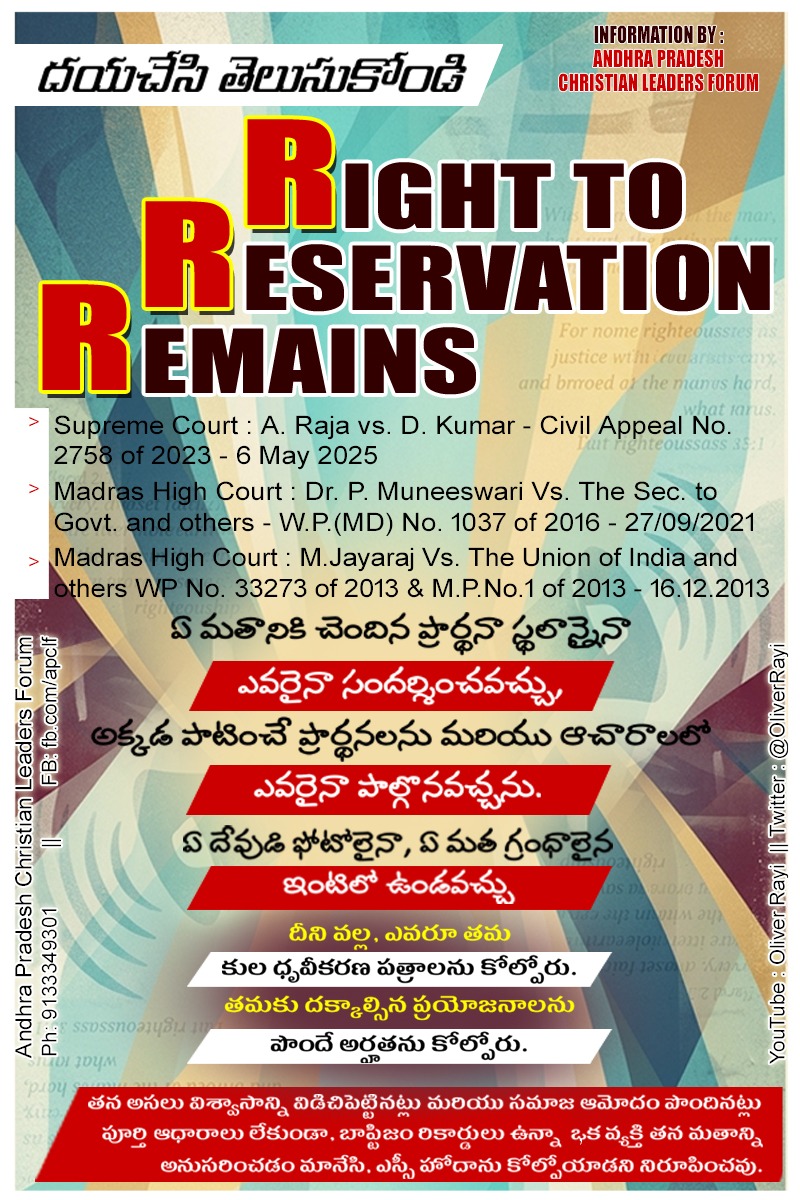
The Constitution recognizes freedom to practice any religion. Visiting places of prayer or worship is a matter of individual choice or preference. Such mobility is available to a person without even changing to any religion from the one in which one is born. Visiting Church, per se would not result in the conversion from one religion to another.
*Burden of proof:* The objector/complainant (or scrutiny committee) must produce credible, unimpeachable evidence of conversion. Mere suspicion or photos of church visits is insufficient.
*Supreme Court : A. Raja vs. D. Kumar - Civil Appeal No. 2758 of 2023 - Date of Judgment: 6 May 2025*
- “Mere observance / performance of a ritual of/associated with any religion does not ipso facto and necessarily mean that the person ‘professes’ that religion.
- ”The Court explicitly held that isolated or occasional Christian rituals, church visits, or even baptism records (without full evidence of abandonment of original faith + community acceptance) do not prove that a person has stopped professing Hinduism and lost SC status.
*Madras High Court : Dr. P. Muneeswari Vs. The Secretary to Government and others - W.P.(MD) No. 1037 of 2016 - Date of Judgment: 27 September 2021*
- “Merely going to church or displaying a Holy Cross cannot be ground to cancel an SC certificate.”
*Bombay High Court (Nagpur Bench, March 2026):*
- Presence of Christian symbols (cross, Jesus statue) or even visiting church cannot be treated as proof of conversion or loss of Hindu/SC identity. Concrete documentary evidence _*(e.g., baptism certificate, formal conversion records)*_ is mandatory.
*HIGH COURT OF JUDICATURE AT MADRAS DATED : 16.12.2013 WRIT PETITION NO.33273 of 2013& https://t.co/eQW52vNmrX.1 of 2013 M.Jayaraj Vs. The Union of India and others*
- The claim that a person is not entitled to a Community Certificate or benefits because of visiting a Church, following religious customs cannot be accepted as long as that person has not embraced Christianity.
@Toyota_India , booked Ebella 2 months ago. The dealer Lakshmi Toyota , Visakhapatnam, Andhra Pradesh after promising delivery in 10 days over the period had called me today offering a refund of the booking amount as they are not sure if and when the car would be available.
Would you please provide and update?
@KirenRijiju
The proposed FCRA Amendment Bill is intended only to regulate the flow of foreign funding into India and to prevent the misuse of such funds for illegal activities that could harm national security?
CAN YOU PLEASE LET US KNOW STATISTICS / DATA OF HARM FROM FOREIGN FUNDS TO NATIONAL SECURITY IN THE LAST 5Yrs. ?
VIDEO | Delhi: Union Minister Kiren Rijiju says, “There are rumours being spread by the Congress Party and Communist Party in Kerala that the Government of India is bringing changes to the FCRA to curb the activities of various religious organisations. This is completely false, fabricated, and misleading. The proposed FCRA Amendment Bill is intended only to regulate the flow of foreign funding into India and to prevent the misuse of such funds for illegal activities that could harm national security. Certain funds enter the country illegally and are used against the national interest. Therefore, this legislation is aimed at safeguarding national interest and security by ensuring proper regulation of foreign funds.I strongly reject these rumours being spread by the Congress Party and Communist Party, particularly in Kerala. The government will not discriminate against any community. As the Minister for Minority Affairs, I have personally visited Kerala. In fact, the Christian community in Kerala is facing several issues due to the apathy of the Left and the Congress...”
The Hon. @indSupremeCourt had given judgement on a case of which the subject matter of contention is pending in a higher court. Isn't it equal to a District court ruling on a matter pending before the High court?
The Hon. Court has also made some very alarming statements on STs.
Conversion alone does not result in automatic loss of ST status.
- ST status depends on whether the person continues to possess and is recognised for the essential attributes of tribal identity i.e., customary practices (idol worship) , social organisation, community life, and acceptance by the concerned tribal community.
- If conversion or later conduct causes a complete severance from the tribal way of life (i.e., adopting Biblical mandates) and loss of community recognition, the foundational basis for ST status “will stand eroded”.
- Conversely, if the tribal attributes “demonstrably subsist or are genuinely re-established and accepted by the tribal community”, the claim cannot be rejected mechanically.
- The assessment is necessarily fact-specific and is left to the competent authority_* (I.e, the authority issuing community certificates or a court in appropriate proceedings) under Constitutional principles.
🛑⚠️ Alarming Statements that are double edged and encouraging whistle blowers to file complaints against Christians forsaking idolatory worship thus ensuring they are stripped of their ST status?
24/03/26 - Chinthada Anand Vs. State of Andhra Pradesh [Criminal Appeal No. 1580 of 2026 arising out of SLP (Criminal) No. 9231/2025]: https://t.co/ONYcSah1Tm #Criminal#Appeal#SupremeCourt