“I put most of my money into the 2–3 best ideas I have. Most portfolios get 70–80% of their returns from just a few positions anyway—despite holding 30 or 40 names. I’d rather focus, watch the basket closely.”
—Stan Druckenmiller
That’s why I went all-in on $VIX in 2022 and finished the year with double-digit gains. This year, it’s the same playbook: $VIX and a few stocks I know better than anyone—driving high-teens returns. Focus is everything.
You may never have heard of Ulrike Guérot — but by the end of this article, you’ll be wondering how that’s possible, given that she stands at the centre of one of the most astonishing cases of political persecution in Europe in recent history.
My latest:
https://t.co/iThC8YQl0K
To illustrate just how nonsensically these tariffs were calculated, take the example of Lesotho, one of the poorest countries in Africa with just $2.4 billion in annual GDP, which is being struck with a 50% tariff rate under the Trump plan, the highest rate among all countries on the list.
Why? Does Lesotho apply extortionate tariffs on U.S. products and the U.S. is merely being "reciprocal" here? Not at all, despite what Trump is saying, it's NOT the way these tariffs are defined.
As a matter of fact Lesotho, as a member of the Southern African Customs Union (SACU), applies the common external tariff structure established by this regional trade bloc.
Which means it applies the same tariffs on U.S. products as South Africa does, as well as the 3 other members of the bloc: Namibia, Eswatini and Botswana.
So since the tariffs charged by these 5 countries on U.S. products are exactly the same, they must all be struck with a 50% tariff rate by the U.S., right? Not at all: South Africa is getting 30%, Namibia 21%, Botswana 37% and Eswatini just 10%, the lowest rate possible among all countries.
So what gives? Again, the way these tariffs are calculated has absolutely zero relationship with actual tariffs imposed by these countries on U.S. products. Instead, they appear to be simply derived from trade deficit calculations.
Looking at Lesotho specifically, every year the U.S. imports approximately $236 million in goods from Lesotho (primarily diamonds, textiles and apparel) while exporting only about $7 million worth of goods to Lesotho (https://t.co/uHvem6nH2o).
Why do they export so little? Again this is an extremely poor country where 56.2% of the population lives with less than $3.65 a day (https://t.co/GEho8xFjAp), i.e. $1,300 a year. They simply can't afford U.S. products, no-one is going to buy an iPhone or a Tesla on that sort of income...
The way the tariffs are ACTUALLY calculated appears to be based on a simplistic and economically senseless formula: you take the trade deficit the U.S. has with a country, divide it by that country's exports to the U.S and declare this - falsely - "the tariff they charge on the U.S."
And then as Trump did in his speech last night, you magnanimously declare that you'll only "reciprocate" by charging half that "tariff" on them.
As such, for Lesotho, the calculation goes like this: ($236M - $7M)/$235M = 97%. That's the "tariff" Lesotho is deemed to charge this U.S. and half of that, i.e. roughly 50% is what the U.S. "reciprocates" with.
It's extremely easy to see why this makes no sense at all.
First of all, there's nothing Lesotho can do about it: they can't change tariffs they allegedly charge the U.S. to reduce the tariff rate the U.S. "reciprocates" with because, again, it's NOT based on any tariff that they charge.
Similarly they can't do much about reducing the trade deficit they have with the U.S. because, again, they simply don't have enough money to buy U.S. products.
Also the main rational Trump gave for the tariffs is to get production back to the U.S., to "bring manufacturing back". 47.3% of Lesotho's exports are diamonds: how do you bring the "manufacturing" of that "back to the U.S."? Anyone can see it makes just about zero sense.
The Lesotho example exposes the fundamental economic incoherence of these tariffs. Rather than addressing actual trade barriers, they punish countries based on trade deficits that arise from structural economic realities. All the more countries like Lesotho which pose zero competitive threat to American industry.
Worse yet, these tariffs will likely make these structural realities even worse: the U.S. is Lesotho's second most important export destination so it's a fair bet that applying 50% tariffs on their products will make people in Lesotho even poorer, and therefore even LESS able to afford U.S. products.
But perhaps the most unfair and detrimental aspect of all this is that these tariffs represent a complete reversal of longstanding U.S. development policy, and therefore a betrayal of countries - like Lesotho - who chose to follow U.S. advice in the past.
For decades the U.S. has used preferential trade access to encourage economic development in the world's poorest nations, recognizing that trade, not just aid, could get them out of poverty and ultimately put them in a position where they too could afford iPhones or Tesla.
They're now effectively penalizing countries for following previous U.S. policy, a lesson which I bet they won't forget anytime soon.
So all in all the irony is painful: in the name of fighting unfair trade, America has just demonstrated what truly unfair trade looks like.
This isn't something designed to address genuine trade issues, but simply a mechanism based on arbitrary math to punish countries for the affront of selling more to the United States than they buy.
This is quite shocking: Jean-Michel Apathie, probably the most famous political commentator on French TV, was suspended for daring to say that France "committed hundreds of Ouradour-Sur-Glane" in Algeria. Ouradour-Sur-Glane referring to a famous massacre of civilians in France by the nazis during WW2.
What Apathie said is a historical truth, France's colonization of Algeria (as all colonizations) was brutal, with hundreds of thousands of deaths among Algerians.
But that's obviously something an increasingly islamophobic France isn't happy to hear, truth and free speech be damned 🤷♂️
Funnily enough, those who most condemned and pressured for Apathie's suspension are Le Pen's camp, many of whom applauded JD Vance's point in Munich that "free speech" was under attack in Europe. This Apathie episode helps clarify what exactly they understand by "free speech"...
DeepSeek is the best AI company in the world right now. Any team would be lucky to have these engineers.
If this was an American company the media would be singing their praises. But because it's China idiots think "they copied everything or they smuggled chips."
Their week of code just proved both of those wrong.
How many AI companies write their own file system and find unknown optimizations at the PTX level and solve the bubble problem in GPU utilization?
I've watched multiple filesystem efforts fail over the years despite a decade of work by major open source masters and big companies. Meanwhile these folks wrote it in their spare time.
You don't optimize this much when you have an embarrassment of riches in GPUs and bandwidth. And that's a damn shame.
The sheer amount of GPU power and bandwidth of the US behemoths have made them fat and lazy by comparison.
Why bother optimizing when you can just hurl more GPUs at the problem and burn cash like you're the freaking Joker in the Dark Knight?
Meanwhile these folks are jamming with a 500% mark up while charging pennies on the dollar.
All the while, American AI companies are bleeding cash while charging premium prices and releasing incremental model upgrades while still saying with a straight face that ASI is two years away.
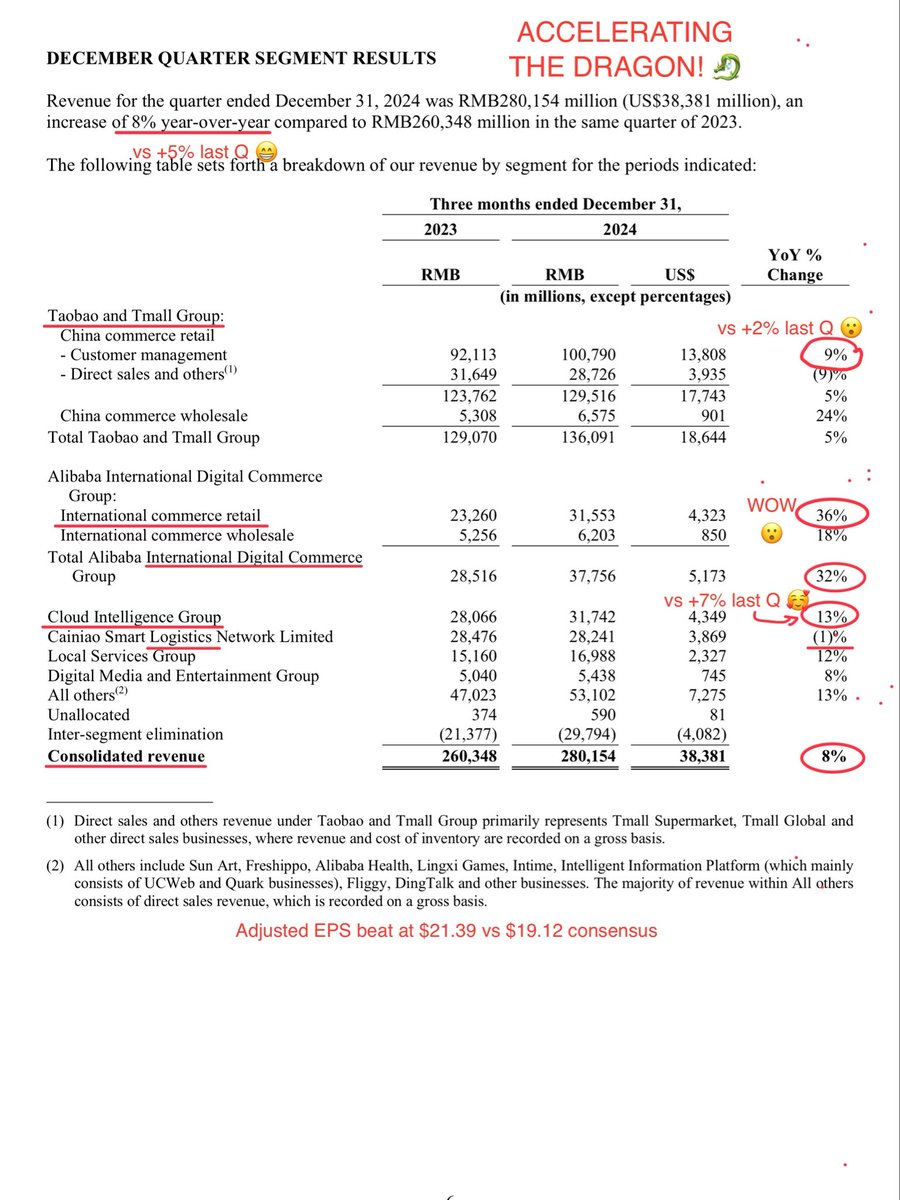
$BABA AI-iBaba (get it?) huge beats & ACCELERATION across the board. 👍 Tmall & Taobao +9% (up from +2%). Cloud +13% (up from +7%!) w/ superb AI growth! 🤪. International ecom +36% 😮 Wowowow! Logistics biz slow (1)%. Cost control 👍. $52bn cash pile.
BABA IS BACK, BABY! 🐉
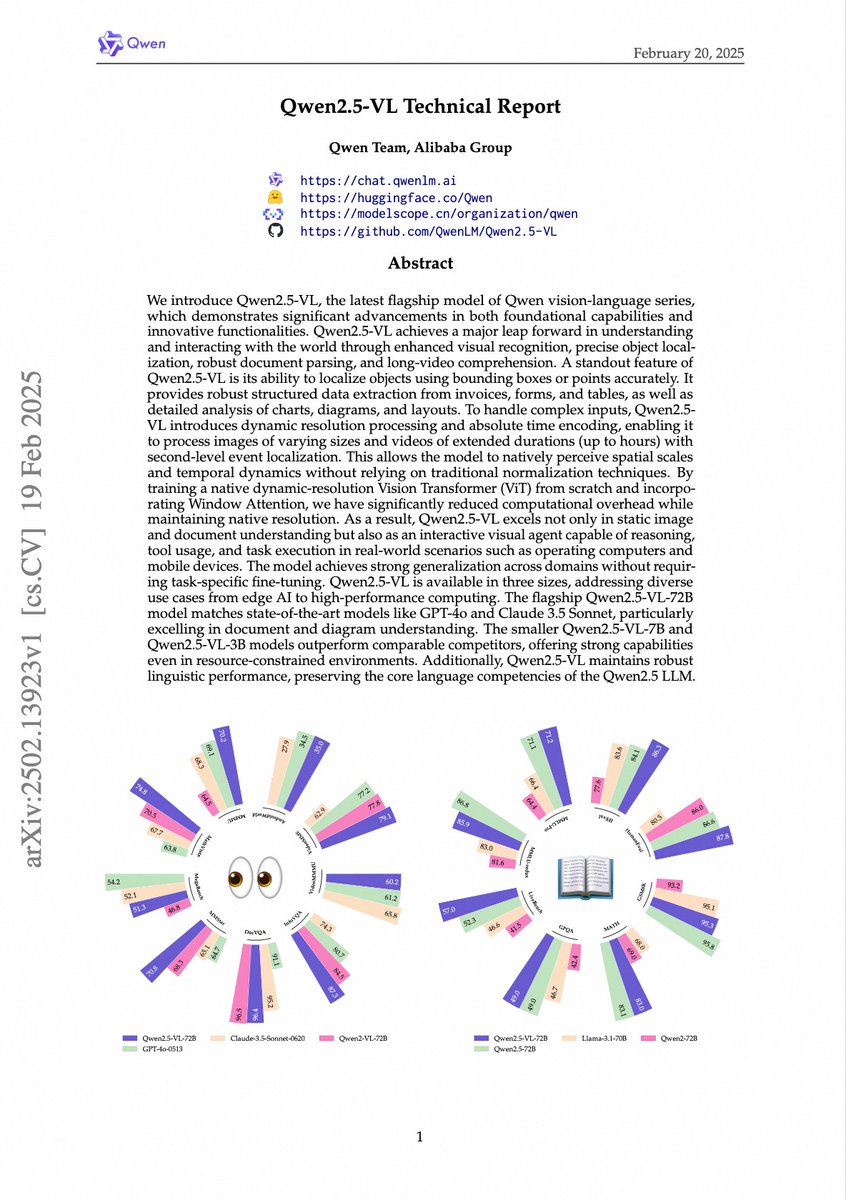
🚀 We released the tech report of Qwen2.5VL (https://t.co/GdMLVNjS4Q)! 🎉
It details our model architecture and training details comprehensively.
Qwen2.5-VL-72B achieves complete capability alignment with the pure text benchmark Qwen2.5-72B. 📈 It not only maintains top-notch text understanding and generation capabilities but also has industry-leading visual semantic parsing ability. 💪
This means we now have a true deep integration of visual and textual multimodal! 😍
Two days ago we released Qwen2.5-Max, and today we update the price of its API:
Input tokens: $1.6 / million tokens
Output tokens: $6.4 / million tokens
We hope this change provides you some help and we'd love to hear your feedback about our new model!
👉🏻 https://t.co/loosG6YoSW