Olukitibi Farms is a Nigerian poultry and agribusiness venture focused on efficient commercial egg production and the use of technology to improve farm exposure
A look inside Olukitibi Farms earlier this month.
We’ll be sharing more of what happens on the farm from caring for the birds to collecting the eggs and everything in between.
Follow along
Welcome to Olukitibi Farms. 🐔🥚
We’re building a technology-enabled poultry farm focused on efficient production and a reliable supply of fresh eggs.
Follow our journey as we combine farming, data and technology to advance poultry production in Africa.
#Agritech
Backpack full of books. Laptop full of code. Head full of ideas. 💻
Just a developer writing the future in lines of code.
Building, teaching, and debugging life.
@vict0ny@joinkuda@kudahelp_ng
Hi
@KudaBank
, I retrieved my SIM 7 days ago but I'm still not receiving OTPs on my number. I can't log into my account. I've waited long enough. I need this resolved urgently. My BVN and ID are ready for any verification needed. Please help
@ChuksEricE@joinkuda@kudahelp_ng Hi @KudaBank, I retrieved my SIM 7 days ago but I'm still not receiving OTPs on my number. I can't log into my account. I've waited long enough. I need this resolved urgently. My BVN and ID are ready for any verification needed. Please help
@Santaklaraaa Funny thing, I really wanted to pursue science back then and picked it deliberately. But the teaching was wild: tell us to make notes ourselves, then just read one aloud in class and call it explanation. That nonsense is why I failed JAMB three times.
Sentient @SentientAGI
At @COLM_conf 2025 in Montréal — in collaboration with @Princeton and @UTAustin — Sentient introduced SPIN-Bench, a unified benchmark for Strategic Planning, Interaction, and Negotiation.
SPIN-Bench evaluates what current AI systems often struggle with:
long-horizon planning, coordination under uncertainty, and reasoning about other agents’ incentives.
It’s designed to push the frontier of multi-agent reasoning — testing not just how models plan, but how they strategize, cooperate, and negotiate.
Frontier AI isn’t just about intelligence in isolation — it’s about intelligence in interaction.
This is the challenge for open AI: proving ownership when anyone can download the model.
Sentient's OML 1.0 is the fix. It gives LLMs an invisible fingerprint (24,576 of them!) that doesn't hurt performance. #SentientAGI#OpenAi
It's a way to build trust into the "free and open" nature of AI. Pretty clever! They're saying the future of open AI needs to be verifiable and accountable. #openai
What do you think the biggest challenge will be for this kind of technology?
The Sentient Economy proves open-source AI wins
Most AI systems are kept out of reach from the very people who power them. We pay to use these systems, share our data, and help them get smarter, but we never get to see how they work or share in the value they create.
These closed models thrive on community input; they learn from our data, our interactions, and our feedback, yet they give very little back.
@SentientAGI is changing this by building an open-source AGI that is community aligned. Artificial intelligence shouldn't be the property of a handful of companies. It should be a shared resource, open to everyone.
However, open-source AI needs an economic infrastructure to sustain itself, and this is where the Sentient Economy comes in, with the $ SENT token at its core.
Here’s how it works 👇
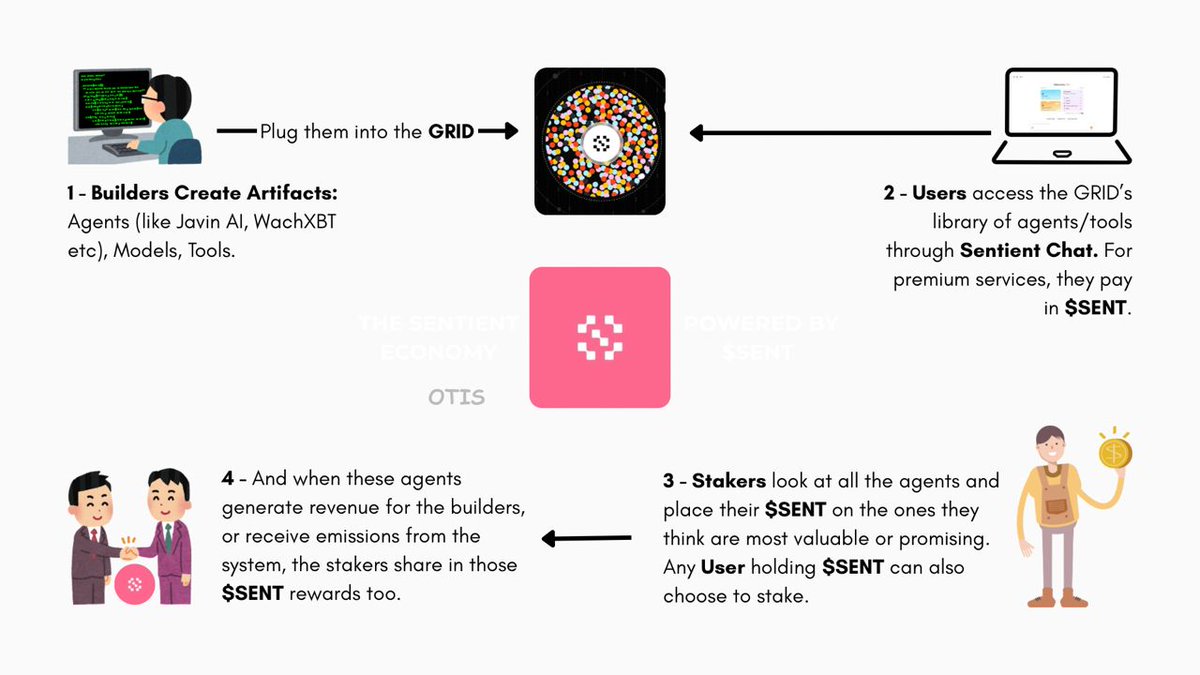
◉ Builders create agents, models & tools, and plug them into the GRID, Sentient’s global directory of intelligence. Whenever people use them in Sentient chat, builders earn revenue in $ SENT plus extra rewards through emissions.
◉ Users enjoy an open collection of community-built agents or tools for any purpose they can think of through Sentient chat. They pay $ SENT for premium services, and if they hold more $ SENT tokens, they can also choose to become stakers.
◉ Stakers take on the role of community curators. They invest their $ SENT in the agents they believe are most valuable. When those agents generate revenue or get emissions, the stakers enjoy the rewards together with the builders.
◉ Emissions keep the ecosystem growing. The network mints new $ SENT and distributes it based on real signals like usage, revenue, staking, and expert votes. This ensures that valuable contributions to the GRID rise and receive adequate compensation.
So, the cycle is simple:
🔹 Builders build and get paid.
🔹 Users use and get access.
🔹 Stakers stake and earn along with builders.
🔹 Emission completes the cycle.
All of it is powered by the $ SENT token.
This is why Sentient is unique. It’s not just open-source, it’s a self-sustaining economy where everyone benefits, including the developers, researchers, users and stakers.
Open-source AI is far better than closed AI because it is transparent, collaborative and self-sustaining, with value going back to the people who create it rather than being hoarded by gatekeepers.
@vivekkolli@shad_haq_@LeaderX_btc@0xsachi
𝐈𝐟 𝐑𝐎𝐌𝐀 𝐟𝐞𝐞𝐥𝐬 𝐭𝐨𝐨 𝐭𝐞𝐜𝐡𝐧𝐢𝐜𝐚𝐥, 𝐈 𝐩𝐫𝐨𝐦𝐢𝐬𝐞 𝐭𝐡𝐢𝐬 𝐞𝐱𝐩𝐥𝐚𝐧𝐚𝐭𝐢𝐨𝐧 𝐢𝐬 𝐞𝐚𝐬𝐲
We’ve been seeing ROMA everywhere since @SentientAGI announced it, and the way it’s described can feel like tech overload for some people trying to understand the framework. But the truth is, it’s not that deep. No big deal.
The best way to picture ROMA is like that one person in a group project at work who takes a huge task, breaks it down and delegates the parts to other colleagues, and then pulls everything back into one final report. That’s basically it, and i feel it’s much more relatable now, right?
I’ll break it down even further so you can really get the idea
𝐖𝐡𝐚𝐭 𝐢𝐬 𝐑𝐎𝐌𝐀 ?
ROMA stands for Recursive Open Meta-Agent. It’s an open-source framework that allows multiple smaller agents and tools to work together on solving complex tasks. Instead of relying on one model to do everything at once, ROMA breaks a problem into smaller subtasks, assigns them to the right helpers, and then pulls the results back together.
Like the workplace scenario where the company needs to prepare a massive report, the team lead is the one who:
➢ Looks at the project and says, “this is too much for one person.”
➢ Splits the work: one colleague gathers data, another writes summaries, another checks facts.
➢ Collects all their work and compiles it into one clean final report.
That’s what ROMA does. A smart organizer that makes sure even the most complex jobs get done smoothly.
𝐇𝐨𝐰 𝐑𝐎𝐌𝐀 𝐰𝐨𝐫𝐤𝐬
To get things done, ROMA follows four simple steps:
◉ Atomizer
The Atomizer looks at your query and decides whether it can be answered directly or if it should be broken into smaller, more manageable parts.
So, for simple queries where a direct answer is required, like
“What’s the capital of France?”
the Atomizer sees this is straightforward and doesn’t need to break it down, because one direct fact is enough: Paris.
But for complex queries that needs breaking down, like
“Plan a one-week family trip with activities for kids and adults including the budget and meals,”
the Atomizer sees this has many layers and it breaks it into subtasks.
This is very important because if it tries to answer the whole thing in one go, details get missed or mixed up. Splitting makes sure each part gets the right focus, and the final plan is complete.
◉ Planner
Once the Atomizer decides a task needs to be broken down, the Planner steps in. Its job is to create a clear to-do list of subtasks and decide which agent or tool should handle each one.
Using the family trip example, the Planner would organize the task like this:
➢ Step 1: Find family-friendly destinations.
➢ Step 2: Suggest activities for kids and adults.
➢ Step 3: Estimate the budget.
➢ Step 4: Plan meals.
Without a plan, things could get messy. The Planner makes sure everything follows a logical sequence, so no detail gets left out.