The importance of patience in the style of Guardiola is crucial, he hates speed Bcoz he knows that he can lose the ball quickly, patience is an important factor in the style of City, for example, see his reaction to Grealish, when he decided to retain the ball and slow down tempo
4/ The verdict
United’s defensive performance was nowhere near the required level for a game of this magnitude.
Their pressing structure had a clear logic, but the execution was disastrous. Liverpool didn’t need particularly elaborate combinations to hurt them; direct balls, runs into the channels and poor defensive decisions were enough.
You cannot defend at this level with such poor coordination and expect to survive.
MANCHESTER UNITED’S DEFENDING WAS CATASTROPHIC. BASIC INDIVIDUAL ERRORS, POOR COORDINATION AND A LACK OF CONTROL COST THEM IN A HUGE GAME.🧵
United were punished by simple balls over the top and repeated defensive mistakes. The poor defending eventually led to a red card, making an already difficult night even worse.
1/ United’s pressing structure
In the first half, United defended in a 4-4-2.
Bruno jumped onto Jacquet, while Cunha shifted across from Van Dijk towards Mac Allister. Tielemans had responsibility for Mac Allister while also keeping Wirtz in his cover shadow.
The idea was to disrupt Liverpool’s central progression and force them into longer passes.
3/ The problem
Having a spare defender doesn’t automatically make a defensive structure secure.
The defenders still need to coordinate their movements, maintain the correct distances and recognise when to follow an opponent and when to protect the space behind.
United’s problems were both collective and individual. Their defensive assignments were repeatedly exposed by basic movements and direct passes, while individual errors compounded the structural weaknesses.
6. Knowing when to accelerate
Perhaps the most important quality is his decision-making.
Pedri doesn’t force vertical passes or accelerate every possession. He understands when to retain the ball, when to attract pressure and when to play forward.
He controls the tempo rather than simply playing at a high tempo.
Why this matters for Barcelona
This connects directly to Barcelona’s positional structure. Pedri is most valuable when he has the freedom to operate between the lines and in the left half-space, rather than being restricted to a fixed position or burdened with excessive defensive responsibilities.
With a midfielder like De Jong or Gavi providing balance behind him, Pedri can focus on receiving between opposition lines, manipulating pressure and connecting the build-up with the final third.
The special thing about Pedri is that he doesn’t just escape pressure. He uses the opponent’s pressure to create advantages for Barcelona.(3/3)
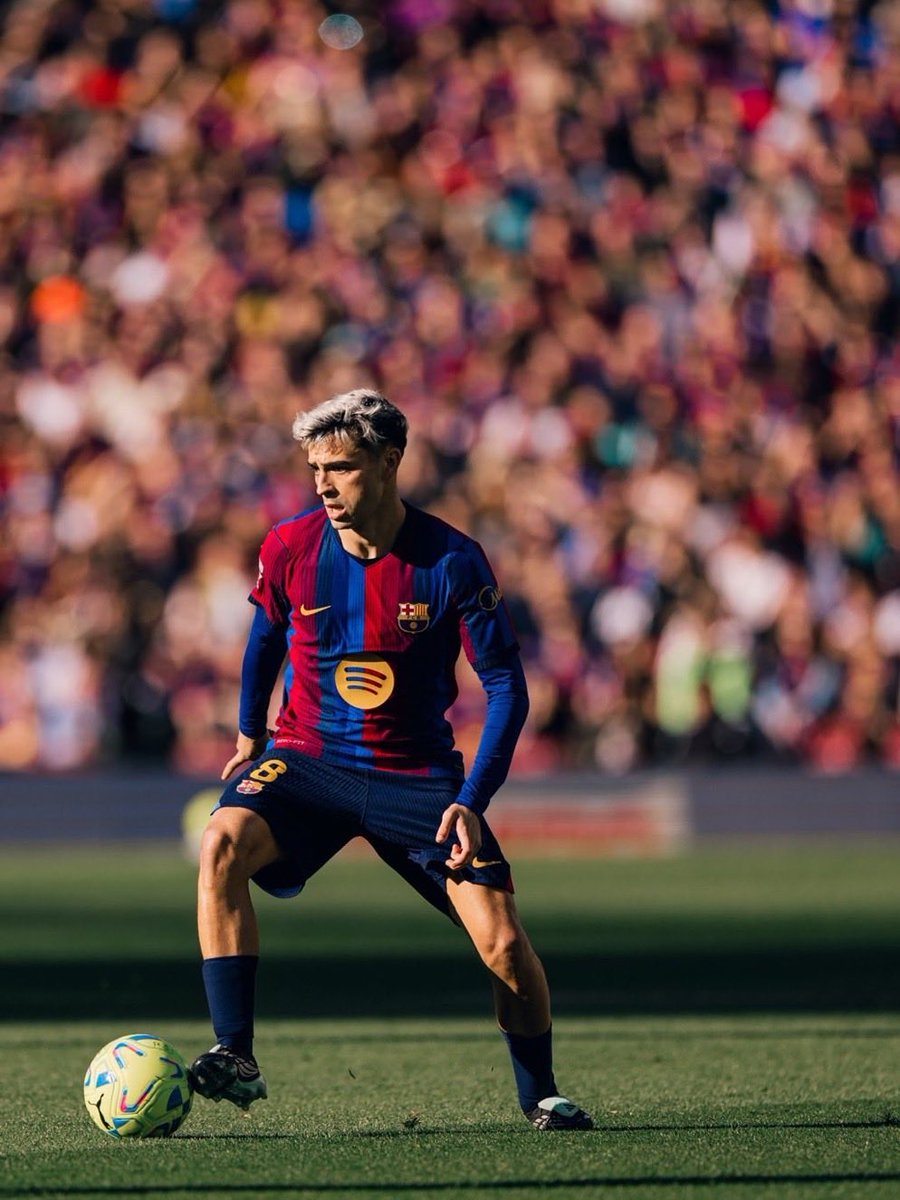
PEDRI IS BARCELONA’S MOST IMPORTANT PLAYER THIS SEASON. HE’S MARKING, CREATING AND DICTATING THE GAME.
For me, he’s been Barça’s best player this season. His influence goes far beyond his creativity: he contributes defensively, controls the rhythm of possession and consistently finds ways to progress the ball under pressure.
He was heavily involved in the first two goals today.
For the first, a brilliant assist with his weaker foot. The technique and execution were excellent, but what stands out is his ability to recognise the opportunity and deliver the pass at exactly the right moment.
For the second, his contribution comes earlier in the build-up. Pedri breaks pressure through a combination of body orientation, scanning, positioning, close control and decision-making. What makes him exceptional is that he often beats the press before receiving the ball. (1/3)⬇️
1. Scanning before receiving
Pedri constantly checks his surroundings before the ball arrives. He identifies where the pressure is coming from, where the free player is and which direction he can turn.
This allows him to receive with a clear next action rather than having to control the ball first and then assess his options.
2. Body orientation
He positions his body to protect the ball while keeping multiple passing options available.
Rather than receiving square to the passer, he often opens his body towards the pitch. This allows him to play forward, turn away from pressure or connect with a third man in one movement.
3. Manipulating the opponent
This is one of his biggest strengths.
Pedri uses small touches, changes of direction and subtle body movements to attract an opponent towards him. Once the defender commits, he releases the ball into the space that the defender has vacated.
He doesn’t always need to dribble past someone. Sometimes, he moves the opponent to create the passing lane.
4. Close control under pressure
His first touch is extremely important. He keeps the ball close enough to evade challenges while creating just enough separation to play his next pass.
He can receive with a defender tight behind him, use his body to protect possession and escape without needing unnecessary touches.
5. Third-man combinations
Pedri understands how to use teammates to bypass pressure.
He can play into a teammate, move immediately into a new position and receive the return pass beyond the opponent’s pressing line.
This is particularly valuable against man-oriented pressing because his movement can pull markers out of position and create space for others.(2/3)
Brilliant goal from Arsenal. Havertz receives in space, drives inside and releases a perfectly weighted pass into Eze’s run. One-on-one, Eze makes no mistake and smashes it past Horníček.
Lewis Hall will get criticism for his mistake, but Dedić’s positioning is arguably the bigger issue.
As Havertz drives inside, Eze is already threatening the space in behind. Dedić’s body orientation is completely wrong: instead of continuing to track the run, he momentarily stops and loses his defensive momentum.
That split-second hesitation gives Eze the time and space to attack the channel and get through on goal.
The decisive mistake wasn’t just losing the duel. It was failing to read the danger before the pass was played.
A deserved lead.
#NEWARS
FULHAM weren’t JUST PLAYING THROUGH CITY. THEY’RE MANIPULATING THEIR PRESSING STRUCTURE.
Their diagonals, pass-and-move combinations and ball-side overloads are exposing City’s weaknesses in horizontal shifting and defensive coverage.
In build-up, when Haaland jumps onto Leno, Foden is left defending a 2v1 against Berge and Charles. Fulham are deliberately creating that numerical advantage to bypass City’s first line.
The problem continues across the pitch. City shift too slowly towards the ball, giving Tete time and space to receive, while King attacks the space behind O’Reilly before he can recover.
In settled possession, Fulham form a 3-3-4, with Iwobi given positional freedom to roam and connect play. It’s a role he knows well from his time under Silva, and he’s excellent at finding and exploiting spaces.
despite the concerns earlier in the season, Fulham were never going to collapse They have an outstanding coach, underrated individual quality and a clear set of attacking principles.
Their positional play is elite. The way they’re dismantling City’s press is proof.
City aren’t pressing aggressively out of possession. They stay compact, narrow their wingers and protect the centre, forcing Fulham wide or long. The full-back becomes the pressing trigger, the nearest players jump to the ball and use the sideline to restrict the available options.
In possession, however, City are struggling to create much. Their build-up is often predictable: progress towards the left-back, play up the line, then rely on Donnarumma to find Doku or Haaland with longer passes.
They need greater flexibility in settled possession. 3-1-6 with Khusanov as RCB very predictable, City need to vary who occupies each space, rather than allowing the same patterns, they need more rotations.
Fulham, meanwhile, defend primarily through a zonal structure but become more man-oriented when pressing higher. Their centre-backs are aggressive, willing to step out and follow City attackers dropping towards the ball.
7/ The bigger tactical takeaway.
This state reflects a clear preference for controlling games through possession and positional manipulation something both Flick and Rodri takes about multiple times.
Barcelona’s positional structure gives them the tools to control games.
But Barca structure must do more than facilitate circulation. When players remain too static, rotations come too slowly or the final line isn’t attacked with enough depth, possession becomes predictable and gives opponents time to recover their shape.
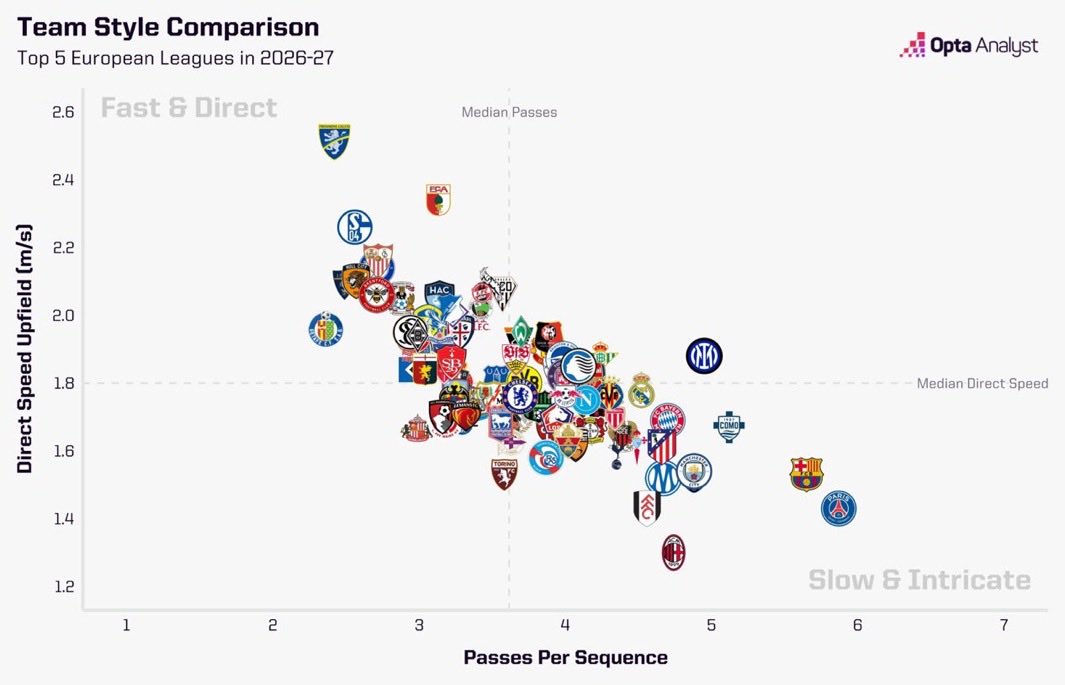
Note: These metrics describe passing behaviour and progression speed. They don’t independently measure possession effectiveness, chance creation or attacking quality.
BARCELONA ARE ONE OF EUROPE’S MOST POSSESSION-ORIENTED TEAMS. BUT COULD THIS BE A PROBLEM THROUGHOUT THE SEASON?
Opta’s 2026/27 data places Barcelona firmly in the Slow & Intricate category, highlighting their preference for longer passing sequences and relatively slow direct progression.
But there’s a deeper tactical story behind these numbers. 🧵
6/ The potential problem for Barcelona
There is a difference between controlling possession and controlling the game.
Barcelona can circulate the ball for long periods, but if the circulation doesn’t generate positional advantages, they risk becoming predictable.
Three potential problems emerge:
Allowing defensive recovery: Slow circulation gives opponents time to reorganise into a compact block.
Insufficient depth: Without enough runs behind the defensive line, opponents can push higher and compress the available space.
Predictability: Repeating the same rotations without changing the tempo allows opponents to anticipate the next action.
Possession needs a purpose beyond retaining the ball.
@united_gj@mufc10utd No mate I think it will be a regular 4231 with yoro or mazroui which I prefer more to be RB to from back 3, dorgu and mbeumo will provide width, I prefer amad who provide width in right flank and mbeumo to be operating in half space with cunha.
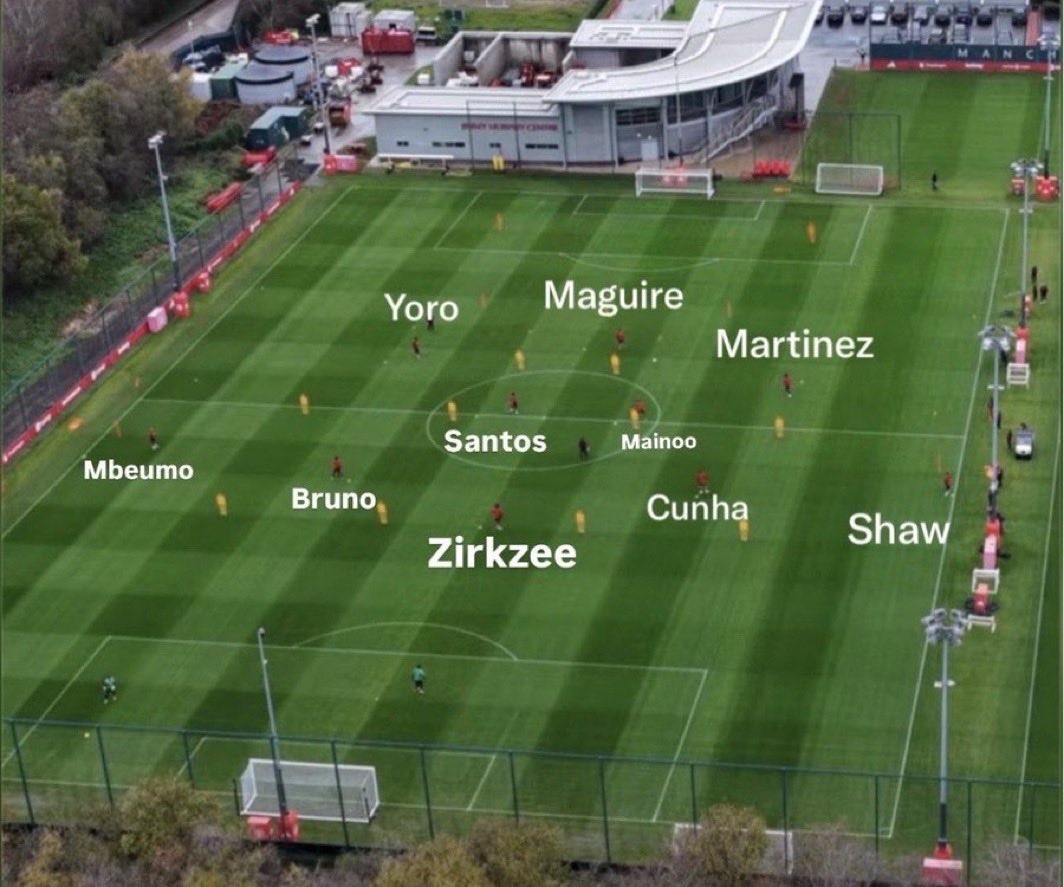
Interesting to see Mbeumo holding the width on the right, Shaw providing width on the left and Zirkzee operating as a roaming number nine.
My predicted setup: 3–2-5 in possession
Yoro at RB, Maguire and Martínez at CB, Shaw at LB; Mainoo and Santos in midfield; Mbeumo RW, Bruno RAM, Cunha LAM and Zirkzee ST.
The most interesting role is Zirkzee’s.
Rather than staying between the centre-backs, he’d drop into deeper areas to receive, draw one of Liverpool’s centre-backs out of position and disrupt their defensive line.
That movement would create space for the runners around him.
Mbeumo could attack from the right, Bruno could make forward runs from the right half-space, while Cunha could attack the space from the left.
This could also explain the type of striker Pochettino might want.
After seeing this footage, I wouldn’t be surprised if he’s looking for a Kane-type number nine: someone capable of dropping between the lines, linking play, attracting centre-backs and creating space for aggressive runners around him.
A creative number nine who creates the space, with runners around him who attack it. That’s an interesting attacking blueprint.