BI-RADS 3, 4A, 4B, 4C and 5: what the score means for mammography and breast MRI.
BI-RADS is the ACR's standardized final assessment for breast imaging, and each category pairs a malignancy likelihood with a management step. The 4A–4C subdivision is standard for mammography and ultrasound but is not formally defined for breast MRI in the ACR atlas, and breast density is reported separately from the assessment category.
#BIRADS #BreastImaging #Mammography #BreastMRI #BreastUltrasound #BreastCancer #BreastCancerScreening #BreastCancerAwareness #Radiology #BreastRadiology #DiagnosticImaging #ACR #ProbablyBenign #BreastBiopsy #CoreNeedleBiopsy #ImagingSurveillance #BreastDensity #EarlyDetection #ScreeningMammography #Oncology #BreastOncology #MedicalOncology #RadiologyReport #RadPath #Pathology #PatientEducation #RadiologyEducation #MedEd #OncologyEducation #HealthLiteracy #ScienceCommunication #BreastHealth #WomensHealth #CancerScreening #Infographic
In 1984, a doctor drank a bacterial culture to break a medical dogma.
Today H. pylori is a Group 1 carcinogen and the strongest known risk factor for gastric cancer. About 44% of adults worldwide carry it.
Detectable. Treatable. Too often untested.
Details: https://t.co/tJ1g4DRGCB
#historyofcancer
Today in Suwon, our work is being presented at the 3rd International Conference of the Korean Society for Head and Neck Oncology (ICHNO 2026).
I would like to begin with a thank-you. Our paper, "DSG2 Expression Marks a Stromal-Immune Organizational State in Head and Neck Squamous Cell Carcinoma", was published in Cancers (MDPI) in August.
It exists because of a team that is generous with ideas and careful with data: Ömer Tarık Çiçek, first author, who carried the analysis from the first hypothesis to the final figure. Okan Cakir, for shaping the question and for steady scientific guidance. Begüm Kurt, for her work in the investigation and the biochemistry perspective. Betul Yilmaz, for supervision and for keeping the science honest. G. Hossein Ashrafi, for his contribution and support throughout. Thank you also to @Marmara Üniversitesi and @Kingston
University London for the environment this collaboration grew in, and to the organizers of ICHNO 2026 for the chance to share it.
This is a computational, hypothesis-generating study. Causality needs testing in organoids with CAF co-culture, and the prediction needs validation in immunotherapy-treated cohorts. That is our next step.
Paper: https://t.co/fb6UfXg6al
#ICHNO2026 #ICHNOKorea #KSHNO #SuwonKorea #HeadAndNeckCancer #HNSCC #HeadAndNeckOncology #Immunotherapy #ImmunoOncology #TumorMicroenvironment #ImmuneExclusion #DSG2 #CXCL8 #IL8 #CXCR2 #CheckpointInhibitors #PD1 #PDL1 #CAF #Biomarkers #TranslationalResearch #BioinformaticsInOncology #SingleCell #SpatialTranscriptomics #CancerResearch #OpenScience #MarmaraUniversity #KingstonUniversity #Oncology #Infographic
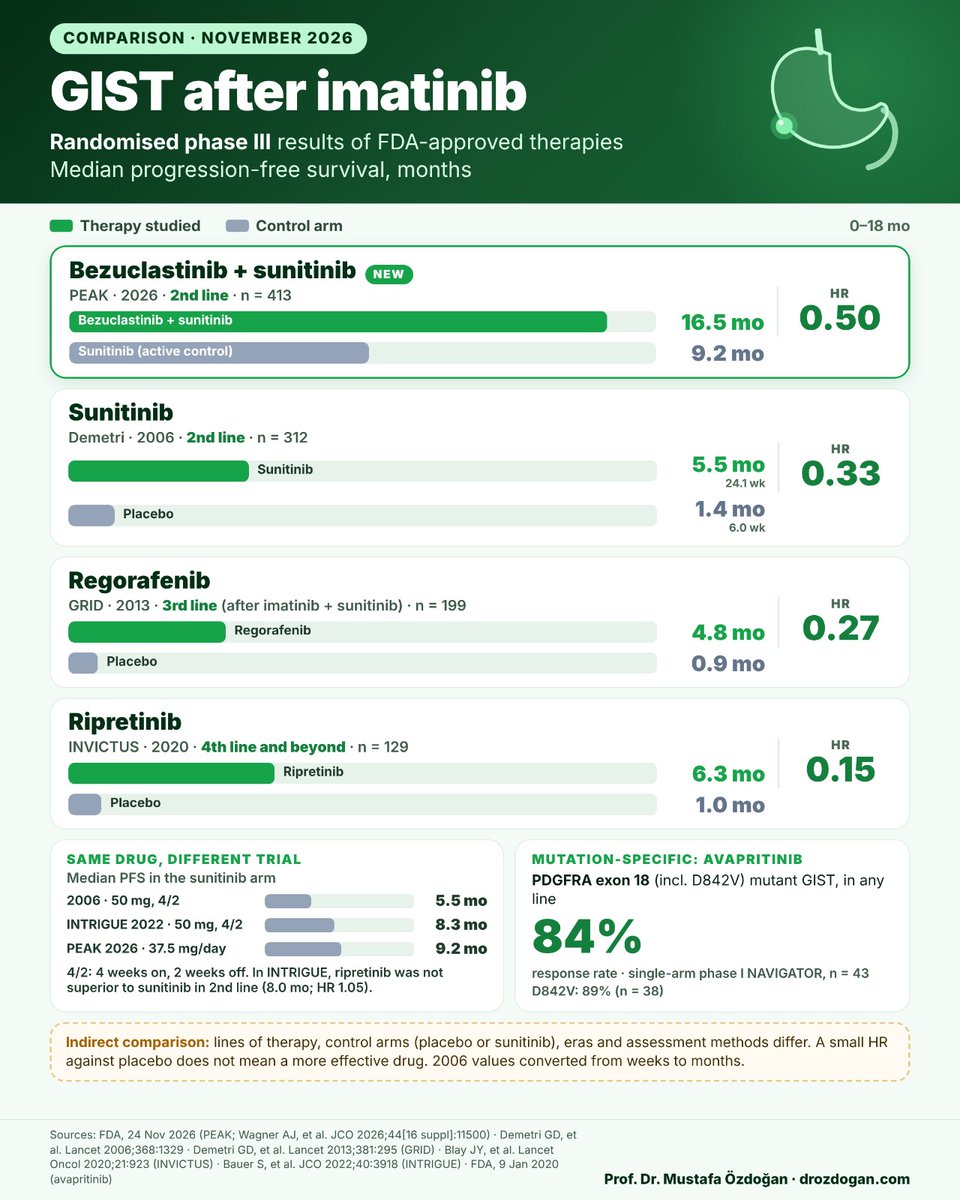
Second-line GIST changes after 20 years: #FDA approves bezuclastinib added to sunitinib
This is also the first treatment for GIST in which two tyrosine kinase inhibitors have been approved together.
Placebo-controlled trials give striking HRs (0.15–0.33); PEAK reached 0.50 against an active drug. The same sunitinib arm went from 5.5 months in 2006 to 9.2 in 2026: patient selection, continuous dosing and era can mislead cross-trial comparisons.
Details: https://t.co/fiSan5DZlb
In the Swedish registry, the link persists in past users (OR 0.87), yet duration-response is inconsistent (null at 3–5 y) and current users show no stage III shift. Biology or user profile? Platelet and F. nucleatum hypotheses need randomised tests, as ALASCCA did.
Details: https://t.co/ymmManT9rk
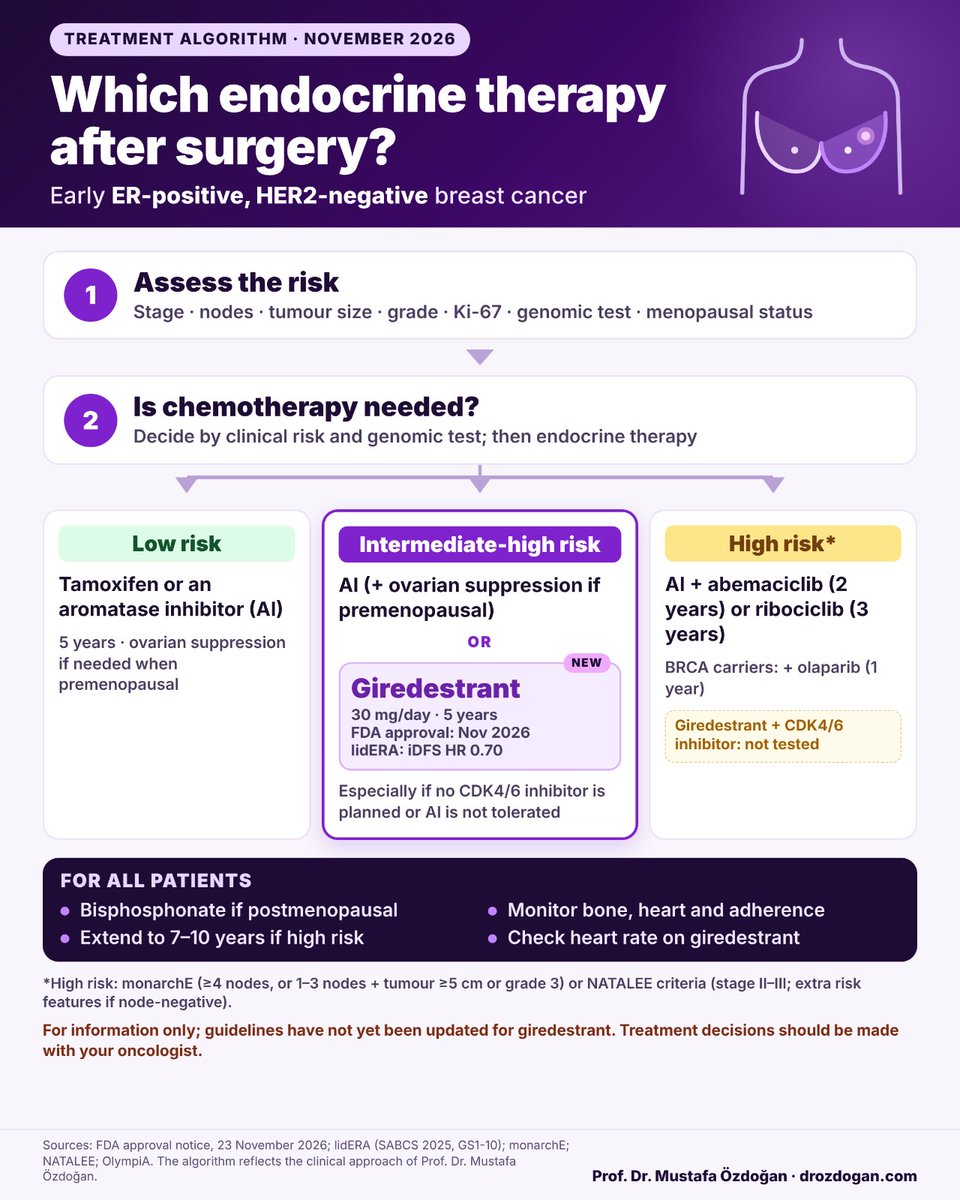
23 Nov 2026: #FDA approved #giredestrant after surgery for ER+/HER2− stage I–III breast cancer at intermediate-high risk of recurrence.
Clearest role: patients not getting a CDK4/6 inhibitor or intolerant of AIs. In monarchE/NATALEE high risk, evidence still favours AI + CDK4/6.
Details: https://t.co/Mn2aYDb9HE
“Physiologic uptake” on your FDG PET/CT report does not mean “nothing to see.”
The usual suspects, in order: brain, liver, bowel, brown fat and skeletal muscle. They can all light up without any disease. What separates normal from real pathology is pattern: symmetry, a matching finding on CT, and whether the uptake is diffuse or focal.
Heads up: this is for FDG only. Other PET tracers have their own normal distribution.
Which pitfall catches you out most often?
#FDGPETCT #PETCT #FDG #NuclearMedicine #PhysiologicUptake #BrainPET #LiverUptake #BowelUptake #BrownFat #MuscleUptake #Metformin #Pitfalls #Radiology #Oncology #MolecularImaging #NuclearRadiology #RadiologyCases #MedTwitter #MedEd #FOAMrad
A ground-glass opacity on chest CT is a descriptor, not a diagnosis.
Infection, inflammation or an early lepidic adenocarcinoma can all look alike on the first scan. Persistence and interval change are what separate them, and the solid component is what raises concern.
Which one do you see more often in your practice: the resolving GGO or the one that stays?
#Radiology #ChestCT #GroundGlassOpacity #GGO #SubsolidNodule #PartSolidNodule #LungNodule #Fleischner #LungCancer #LungAdenocarcinoma #EarlyDetection #ThoracicRadiology #Pulmonology #Oncology #MedTwitter #MedEd #RadiologyCases #FOAMrad #CTScan #LungHealth
Hemangioma or metastasis? One liver lesion, two very different stories.
On a single CT or ultrasound image they can look alike. Dynamic liver MRI adds T2 signal, diffusion and the behaviour of the lesion across contrast phases. Hemangiomas tend to fill in; metastases tend to rim-enhance and wash out.
Have you ever had an “indeterminate” liver lesion settled by MRI? Tell us below
#Radiology #LiverMRI #DynamicMRI #LiverLesion #Hemangioma #LiverMetastasis #Hepatology #AbdominalImaging #BodyImaging #MRI #DWI #HepatobiliaryPhase #Oncology #CancerStaging #IncidentalFinding #RadiologyCases #FOAMrad #MedTwitter #MedEd #LiverHealth
One DNA repair defect, and immunotherapy suddenly works.
When mismatch repair is lost, tumours accumulate mutations and neoantigens, and the immune system can see them. That is why MSI-H / dMMR status predicts the response to PD-1 blockade.
Is MMR/MSI testing routine in your practice?
#MSIH #dMMR #MMR #MicrosatelliteInstability #MismatchRepair #LynchSyndrome #Immunotherapy #ImmunoOncology #PD1 #CheckpointInhibitors #Pembrolizumab #Nivolumab #Dostarlimab #ColorectalCancer #ColonCancer #RectalCancer #EndometrialCancer #TumorAgnostic #Neoantigens #Oncology #PrecisionOncology #PrecisionMedicine #Biomarkers #MolecularPathology #Pathology #CancerResearch #MedEd #OncologyEducation #MedTwitter #ScienceCommunication #Infographic #Oncologist
Same mutation, different organ, different story.
KRAS G12C leads in lung cancer, G12D leads in colorectal cancer, and the same G12C inhibitor behaves very differently in each tissue.
The allele alone does not define the strategy. Tissue context does.
Which part surprised you most?
#KRAS #KRASG12C #KRASG12D #RAS #NSCLC #LungCancer #ColorectalCancer #ColonCancer #CRC #Oncology #PrecisionOncology #PrecisionMedicine #TargetedTherapy #MolecularOncology #CancerResearch #Biomarkers #Genomics #TumorBiology #EGFR #MAPK #Sotorasib #Adagrasib #MedEd #OncologyEducation #MedTwitter #ScienceCommunication #Infographic #HealthcareProfessionals #CancerScience #Oncologist
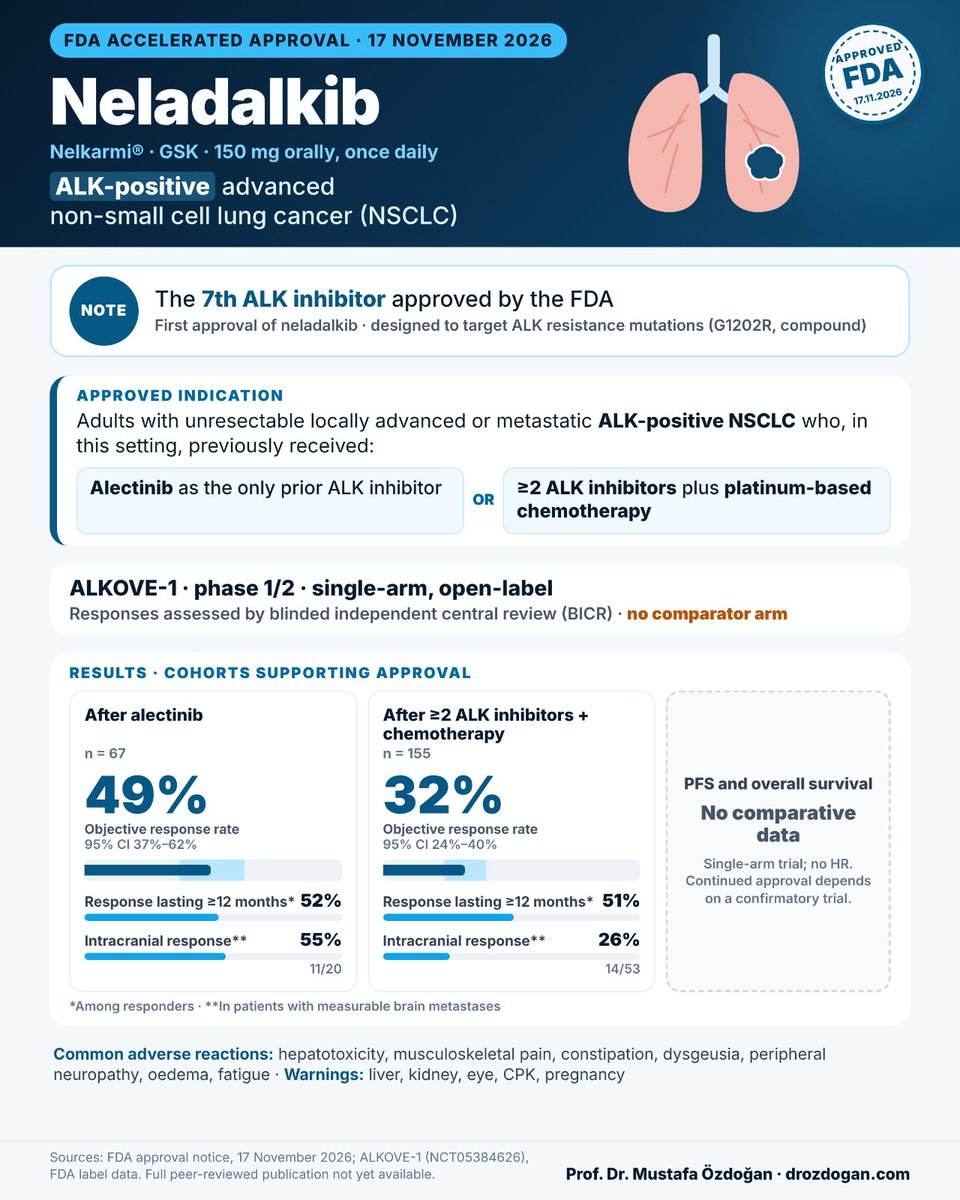
#FDA grants accelerated approval to neladalkib in ALK+ NSCLC.
The key divide is lorlatinib: ORR 46%, mPFS 14.5 mo if naive vs 26% and 4.6 mo if exposed. G1202R ORR 68%. Grade ≥3 ALT rise 20%. Its place will be defined by ALKAZAR vs alectinib in first line.
Details: https://t.co/AunGEBHrtB
AI IS MOVING THE BOTTLENECK IN SCIENCE AND HEALTHCARE
AI can scan and test ideas at scale. But human judgment must decide what matters, what is reliable, and what reaches patients.
Is validation becoming the real bottleneck?
Full analysis:
https://t.co/UABPd5E5Ep
#AI #ArtificialIntelligence #Science #HealthcareAI #MedTech #Research
FDA DECLINES IVONESIMAB APPLICATION
PFS improved, but an OS benefit was not proven.
Is PFS alone enough for approval?
Full analysis:
https://t.co/K7yv1zU6Oh
#EGFR#NSCLC#Oncology#FDA
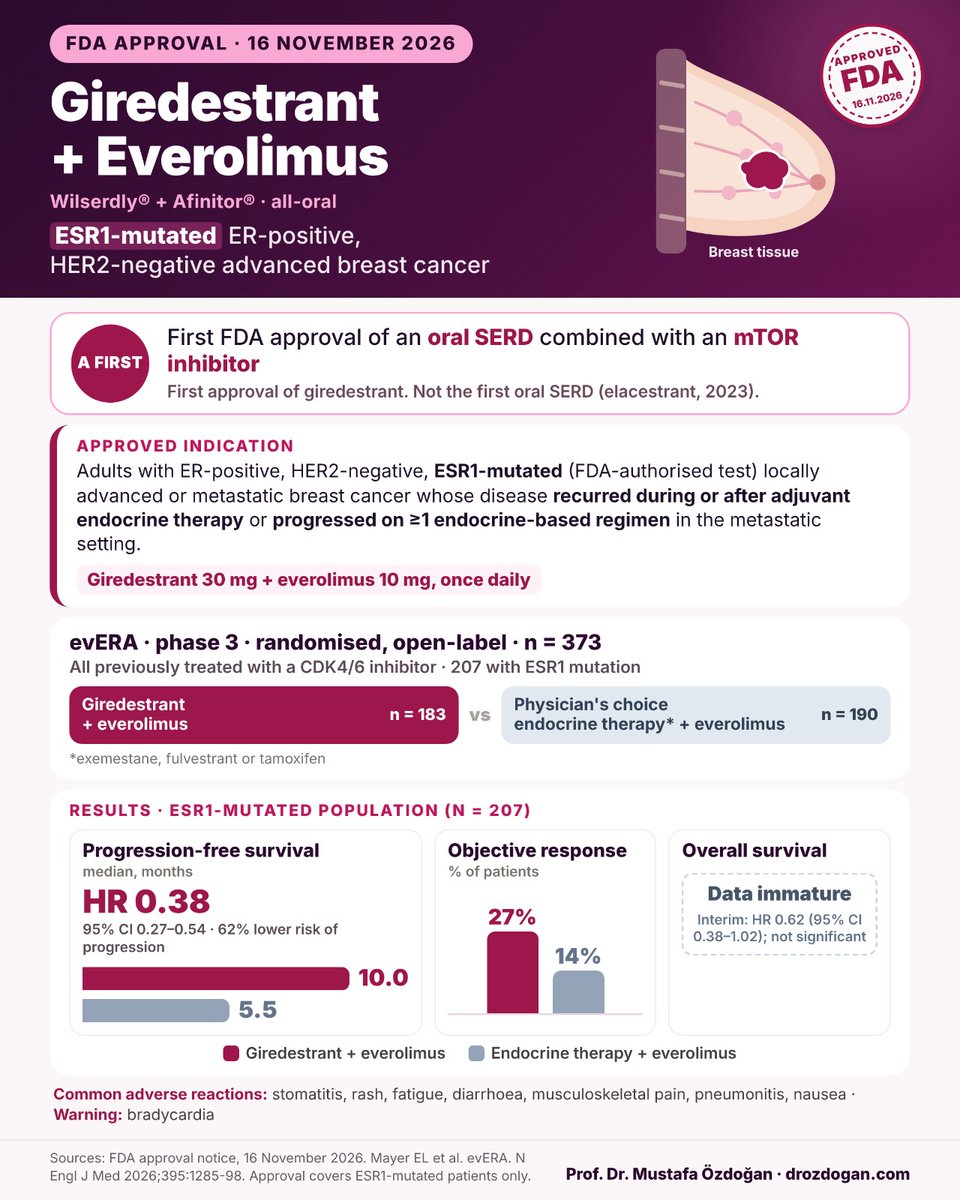
New option after CDK4/6 in ESR1-mutated disease: #FDA approves giredestrant + everolimus.
Both evERA arms got everolimus, so the gain comes from the SERD. No significant benefit without ESR1 mutation (HR 0.84), hence the restricted label. Open question: SERD alone or combo first?
Details: https://t.co/mA1MVdGFwv
Cisplatin-ineligible muscle-invasive bladder cancer now has a second survival-improving perioperative option in a year. No head-to-head data vs pembrolizumab + EV; toxicity profile and treatment length will guide the choice.
More: https://t.co/LitnpXMuvR
#FDA
PERIOPERATIVE IMMUNOTHERAPY IN HNSCC
Perioperative immunotherapy is advancing, but regimens differ. Is added chemotherapy worth the toxicity?
Published on https://t.co/HBQAiC0nYw:
https://t.co/L5NNIL9msp
#HNSCC#Oncology
GLP-1 DRUGS AND VISION LOSS: HOW CONCERNED SHOULD WE BE?
A new FDA safety warning raises questions about NAION, a rare but potentially serious optic nerve condition.
The key distinction: a safety signal is not proof of causation.
Should this change prescribing decisions?
Full analysis:
https://t.co/Zi74NqqAC4
#GLP1 #PatientSafety
CAN CHEMOTHERAPY SAVE LIVES YET ACCELERATE BIOLOGICAL AGING?
A new breast cancer simulation raises a critical survivorship question not a reason to withhold effective treatment.
Should biological aging become a routine clinical trial endpoint?
#BreastCancer
CAN WE DETECT OVARIAN CANCER EARLIER WITH A BLOOD-BASED RNA SIGNAL?
A new Nature Medicine study highlights Tu-stroma, an extracellular-vesicle RNA marker that may help identify premalignant and early ovarian cancer earlier than current tools.
Promising biology—but not a practice-ready screening test yet.
Could this be the kind of signal early detection has been missing?
#OvarianCancer #Oncology