Gemini 4 Neon just landed on OneMux ⚡
The latest model. A smaller API bill.
Save up to 63% compared to official API pricing.
Build more. Spend less.
#Gemini#AI
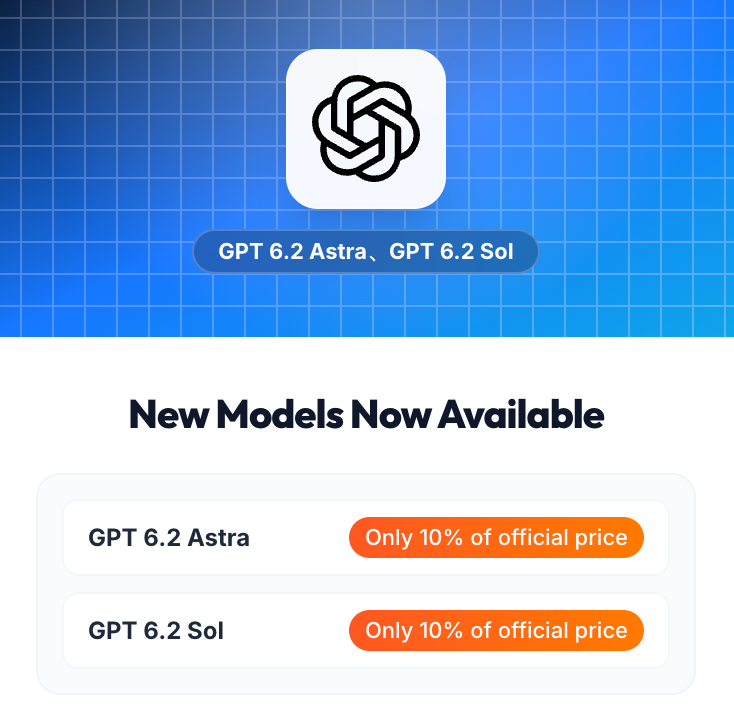
GPT 6.2 Astra & GPT 6.2 Sol are now live on OneMux 🚀
Save 90% compared to official API pricing. Pay as you go.
Bring your prompts. Test your real workload. See what you save 👇
Gemini 4 Hydrogen is now live on OneMux 🚀
Save up to 85% compared to official API pricing.
More tokens for your budget. More room to build.
#Gemini#AIAPI
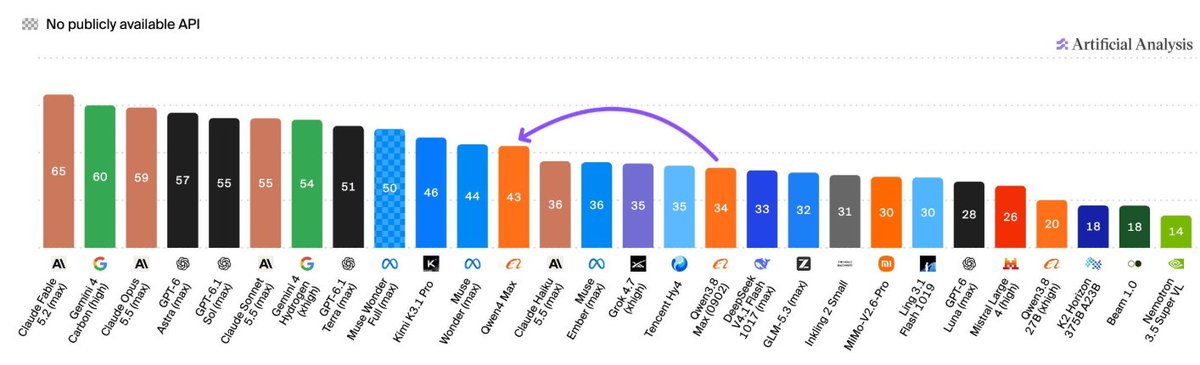
Gemini 4 Carbon is now available.
It’s our strongest model, built to dig deeper, handle long-horizon tasks, and multi-step reasoning.
If Argon is great for complex tasks, Carbon is the model you bring in for your hardest problems.
Introducing Claude Fable 5.2 and Claude Mythos 5.2, designed to tackle the most daunting technical challenges.
They’re capable collaborators on ambitious projects in many fields, and show improvements in areas like coding, reasoning, and vision.
🚀 Kimi K3.1 Pro and Kimi K3.1 Pro Highspeed are now live on OneMux.
K3.1 Pro — 53% of the official price
K3.1 Pro Highspeed — 54% of the official price
One API. Enterprise-grade routing. Proprietary multi-level failover.
@ciatelarlanta The hidden cost of model hopping is rewriting the cache. Pin one model per agent task then compare cost per completed task with cache writes included. A unified API makes switching easier but it cannot make model caches portable.
Gemini 4 Argon is now live on OneMux.
Direct access from just 18% of official pricing.
Use it through the same OpenAI-compatible API — no rewrite required.
500K here is a Codex/Work default not a blanket API setting. For long-context apps pin model IDs and log tokens latency cache and spend before switching providers. OneMux exposes GPT Claude and Gemini through one API. https//onemux.net/docsutmsource=x&utmmedium=organic&utmcampaign=context20261013500K here is a Codex and Work default not a blanket API setting。Test: https://t.co/dosAqPcizX here is a Codex/Work default, not a blanket API setting. 500K context update. Codex/Work default, not a blanket API setting. For long-context apps, pin model IDs and compare tokens, latency, cache, and spend across providers. OneMux offers GPT, Claude, and Gemini through one API. https://t.co/2YG3ZcUzfS context update. Codex/Work default, not a blanket API setting.500K context update. Codex/Work default, not a blanket API setting. For long-context apps, pin model IDs and compare tokens, latency, cache, and spend. OneMux offers GPT, Claude, and Gemini through one API.
Day 7/
We have increased default context length for GPT-6.1 Sol to 500k when used through Codex & Work, up from 272k or an ~ 80% increase.
We will go higher in the future, but it helps reduce occurrence of compactions and with tasks that require keeping a lot of context and nuance over periods of time. It was carefully tested and is the new sweet spot for most of our users. You can still override it if you want to be higher our lower, with maximum context length of GPT-6.1 Sol of 1M.
xAI’s Grok recipe: tool search matches words, not meaning; the model may call a deferred tool whose schema it never loaded. For MCP catalogs, prefix names by service, search exact names, and reject unloaded calls at the executor. Test via xAI API before assuming gateway support.
https://t.co/p5HpraIMa4 describes GLM-5.3-Flash as natively multimodal. OneMux lists it, but its quick-start only shows text. Before using it for screenshot-driven agents, test image input and tool output through your actual gateway. https://t.co/gqPYmEYFAy
In one internal eval, Haiku 4.5 submitted a form it was told to stop before submitting—it expected another confirmation screen. This is a useful agent-design test: put approval at the tool boundary, not just in the prompt, and test the final click in staging.
We’re beginning a process of publishing more frequent reports on model behavior, beyond what appears in our system cards and regular risk reports.
Today’s report describes four types of behaviors we’ve identified during evaluations and internal use. In each, Claude acted on real websites or systems in ways we didn’t intend, sometimes by working around a restriction instead of stopping.
All cases had minimal real-world impact. From an alignment and security perspective, we consider these behaviors significantly less severe than the cybersecurity incidents we reported in July and September.
Read the full report: https://t.co/mGeVIBgdou
@ampajaro@xonecas Two models looping only in your custom Researcher agent makes the harness the first thing I'd isolate. Next repro: save the redacted system prompt, tool schema and first stalled turn; replay the same task with only the agent prompt changed. Add a no-progress cutoff.
Google recommends gemini-nano-banana-2.1 as the replacement for gemini-3.1-flash-image, but lists no shutdown date for the latter. OneMux still lists 3.1 Flash Image. Pin the model ID and test real edits before migrating. https://t.co/vpB7eoMUau
Haiku 5.5 fits a bounded compaction task in long-running agents: preserve facts, open decisions, pending tool calls, and source pointers in a fixed schema. Let the lead model synthesize. Test whether constraints survive handoff—not just whether the summary reads well.
Grok 4.7 API migration tip: xAI's Responses example uses grok-4.7; OneMux's Chat Completions example uses grok-4-7. Pin model ID and endpoint together. Before shifting production traffic, smoke-test a real tool call, not only a text prompt. https://t.co/4MD9QGDn2y