Ocean Network (@ONcompute) lists H200 GPUs at $2.16 per hour. Competitors in the same snapshot charge $4.33, $3.72, and over $2.49. The gap is not a promotional rate. It is structural.
Three mechanics make it possible. First, pay-per-use billing. You are not billed while idle and you are not locked into a fixed instance. You pay only for the compute you consume. Second, the global supply pool. Ocean network taps idle hardware from individual operators worldwide, not just data center inventory. Third, Base settlement. Transactions settle fast and cheap on an Ethereum L2, so overhead does not inflate the price.
For node operators, this is not a race to the bottom. It is a race to utilization. Your hardware earns only when it runs jobs, but it runs jobs that were previously locked behind reserved instance pricing and idle capacity waste.
The cloud model charges you for capacity you do not use. Ocean network charges you for work you actually perform.
https://t.co/I5fqZF1orH
Your GPU loses value every day it sits idle. Depreciation does not pause because you are not using it.
Ocean Network (@ONcompute) turns that idle GPU into revenue.
Install the Ocean Node software. List your machine on the catalog. The Dashboard tracks your earnings and performance in real time. Your node competes on a public leaderboard ranked by benchmarks, not by marketing budget. Deliver consistent, fast jobs and you rise. Visibility follows performance.
You do not need a data center. High-end rigs and smaller operators both participate. A single RTX 4090 or an H200 cluster both earn. The network is inclusive by design. Everyone can run a node and earn rewards.
Your hardware processes compute jobs, indexes metadata, and stores data. It becomes part of the global GPU and CPU pool that data scientists browse when they need exact specs. When they pick your node, you get paid.
The cloud model makes you the customer. Ocean network makes you the provider.
Your GPU is not collecting dust. It should be collecting checks.
https://t.co/I5fqZF1orH
Decentralized compute has a crypto problem.
Most platforms assume you already own ETH, know how bridges work, and enjoy paying gas fees to move money around. If you are a data scientist who just wants to train a model, that friction is a wall.
Ocean Network (@ONcompute)removes it.
Top up with a credit card via their fiat-on-ramp partner. Or fund your wallet directly with USDC. Ocean network runs on base so settlement is fast and cheap. You do not need to manage L1 gas or navigate exchanges to run your first job.
New users can claim $100 in Grant Tokens to unlock high-performance GPU workloads. No upfront crypto purchase required. No locked contracts. Pay only for the runtime you use.
This is by design. Ocean Network is inclusive by design. High-end rigs and smaller operators both participate. Everyone can access the global GPU and CPU pool.
Decentralized compute is not a Web3 novelty. It is just better infrastructure, and you can pay for it the same way you pay for any SaaS.
https://t.co/I5fqZF1orH
Every decentralized compute project before Ocean Network failed for the same reason: strangers don't trust strangers.
You have idle GPUs. I need compute. But I won't send you my model weights if you might steal them. You won't run my job if I might not pay. So we both retreat to AWS and pay the cloud tax.
This is the Coordination Problem. And it's not a hardware problem. It's a trust problem.
@ONcompute solves it with a 5-layer trust stack:
▫️ Escrow on Base. Payment locked before execution. Released only after verified results.
▫️ Isolated containers. Your code never touches the host OS.
▫️ Signed attestations. Cryptographic proof that the job ran correctly.
▫️ On-chain provenance. Immutable audit trail for regulated or scientific workloads.
▫️ Public leaderboards. Nodes ranked by performance. The market filters out bad actors.
The result: you browse ranked nodes, submit from VS Code, and pay only for runtime. No fixed contracts. No cloud console lock-in. No trust in strangers, just trust in the protocol.
AI compute is consolidating around three giants. That's a bottleneck and a tax. Ocean network turns the world's scattered GPUs into one unified supercomputer.
The missing piece was never the hardware.
It was the trust architecture.
@ONcompute built it. The compute can finally flow.
https://t.co/I5fqZF1orH
AWS helped define the cloud era after launching in 2006, and now Ocean Network (@ONcompute) is making a similar move for the AI era, but with a decentralized P2P model instead of a single central owner.
It is not just a new tool. It is a new way to think about compute.
Instead of a centralized cloud where you manage servers, Ocean Network gives you a decentralized, peer-to-peer compute market where you choose a node, send a containerized job, and get the result back. It is pay-per-use, simple to access, and designed to keep outputs local while the job runs in the network.
That is why it's way better for builders. Less infrastructure pain. Less setup. Less time lost before you even start coding. For AI and data workflows, Ocean Network makes compute feel more direct, more flexible, and more usable than the old cloud-first model.
Check it out here: https://t.co/I5fqZF1Whf
Being a GPU owner just got a whole lot better and it's just the beginning
You earn when people use your GPU and also receive weekly rewards for keeping your node active.
Check the post below for more info on how to get started
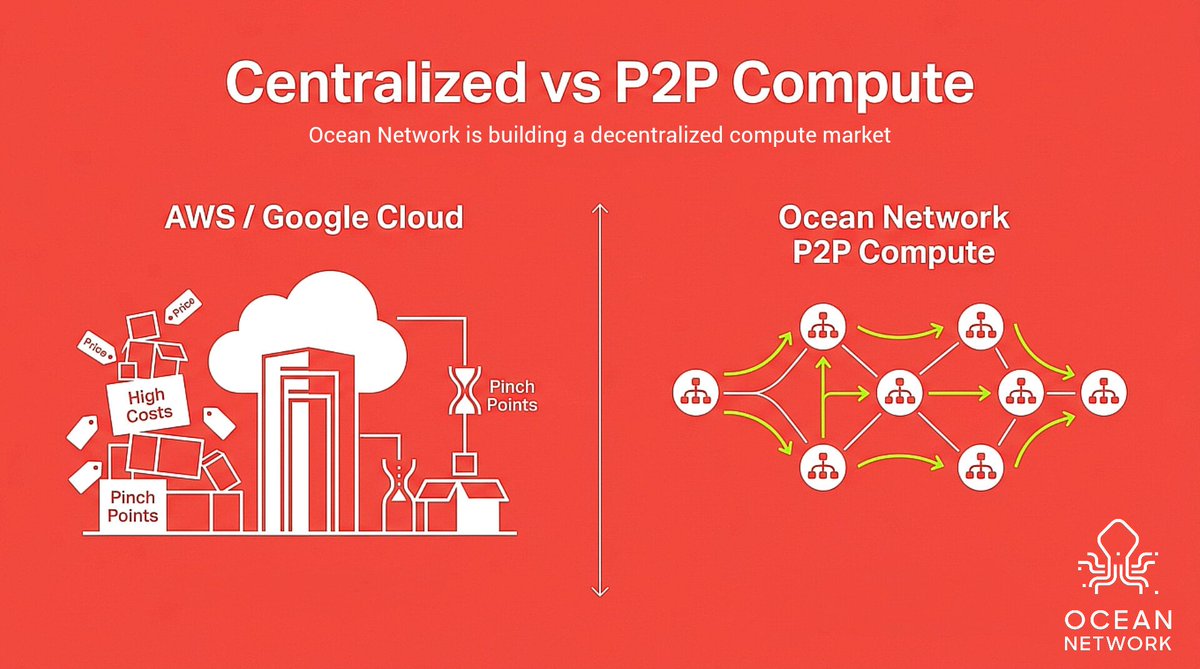
Why Ocean Network P2P compute models beats centralized services like AWS or Google Cloud
Centralized cloud services like AWS and Google Cloud are powerful, but they come with high costs, vendor lock-in, and a single point of control.
But Ocean network (@ONcompute) and its P2P models work differently. Instead of relying on one company, you tap straight into a global pool of idle GPUs & CPUs from real people worldwide and it's way cheaper.
They've built a decentralized P2P compute market where builders can access compute in a more open and distributed way and this means more freedom, better efficiency, and less dependence on traditional cloud systems.
Same power. Way cheaper. Way smarter.
Ocean Network is available to try out right now, and early adopters can get $100 in free computing credits.
It is a simple way to explore decentralized compute without paying upfront. And you can see how @ONcompute makes GPU compute more accessible for builders.
Everyone loves the idea of decentralized GPUs, but the real win is making them actually usable.
That is where @ONcompute stands out. Instead of giving builders a pile of hardware headaches, it gives them an orchestration layer. Pick a node, send a containerized task, and get your result back. Simple.
No SSH wrestling. No endless setup. No wasting half a day before your code even runs.
Ocean Network makes decentralized compute feel practical, fast, and builder-friendly. That shift matters because the best infrastructure is the kind people can use without thinking too hard about the infrastructure at all.
Ocean Protocol will be at Pragma Cannes on April 2, hosted by @ETHGlobal. It is a focused, founder-led gathering for builders and founders sharing what is next for stablecoins, L2s, DeFi, wallets, scaling, interoperability, and the future of Ethereum.
If you are building in Web3, this is the kind of room worth being in. You will get high-signal conversations, meet people shaping the next wave of crypto, and connect with the Ocean team in person. @oceanprotocol is also giving away 15 free tickets ($99 each) using code FRENSOCEAN, so this is a good moment to grab one and come.
Get your free tickets here: https://t.co/ghmhqBRj8O
See you in Cannes.
Ocean Network has officially moved into beta, and the update is simple but exciting: it is turning decentralized compute into something that feels practical, fast, and actually usable for builders.
At its core, @ONcompute is a peer-to-peer compute network that turns idle or underused GPUs into distributed compute resources, with a pay-per-use model built around real jobs, not wasted capacity.
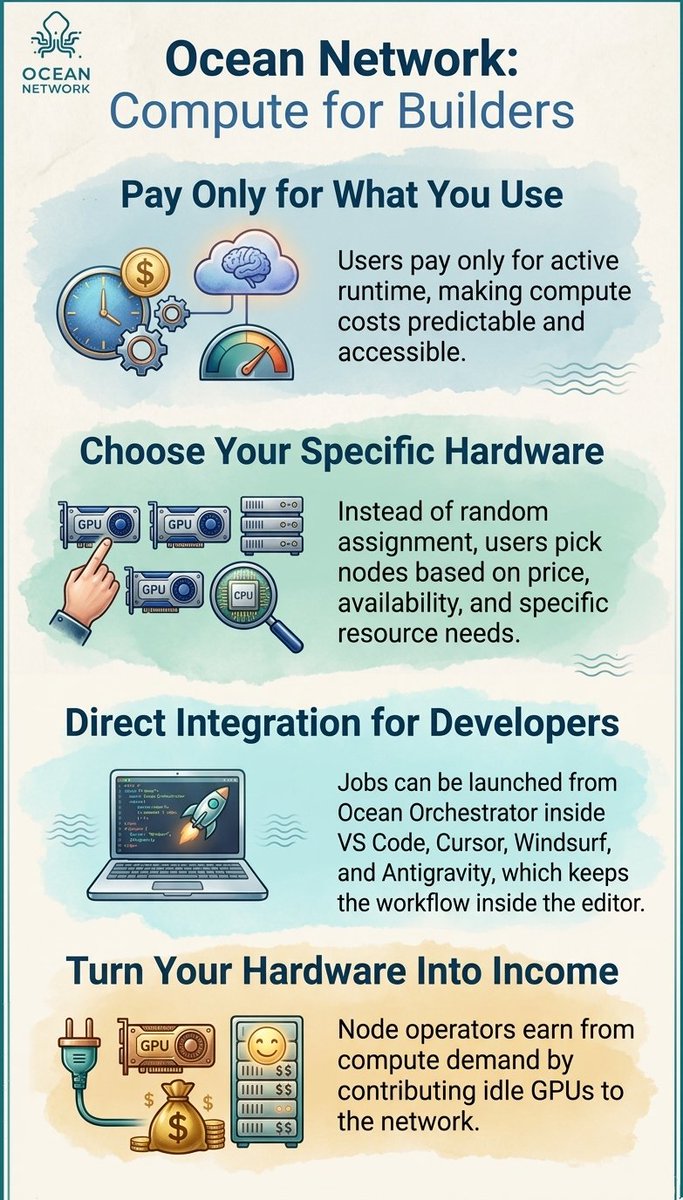
What stands out most in beta is the experience. You can pick the node you want based on GPU, CPU, RAM, price, and region, then launch jobs from a familiar editor workflow in tools like VS Code, Cursor, Windsurf, and Antigravity.
The Orchestrator also supports one-click job runs, real-time logs, and automatic results retrieval, while the Dashboard gives you a clean way to browse resources and monitor jobs.
For builders, that means less infrastructure pain and more momentum. Ocean Network is useful for embeddings, inference, data cleanup, batch processing, and other containerized AI workloads, all while keeping the workflow close to your code. Payments are escrow-protected, outputs are saved locally, and you pay only for runtime.
If you want to try Ocean Network, start small: run the free CPU test or claim the $100 in grant tokens, then launch a simple job and inspect the logs and results inside the Orchestrator. That is the easiest way to feel what the network is trying to make possible.
You can check out Ocean network here: https://t.co/FLQ2MNUWyC
Read more about it here: https://t.co/0CGLakjzFE
In my next post, I’ll share a video tutorial showing how I used the Ocean Network to access the compute I needed to run a text sentiment analysis job using Ocean Orchestrator.
Stop overpaying for compute. Start building on Ocean Network.
Whether you're training AI models or scaling decentralized apps, Ocean network delivers high-performance GPU power that fits your actual workflow.
See why builders are switching to @ONcompute in the infographic below
You can try it out here: https://t.co/JmCL0wrTmi
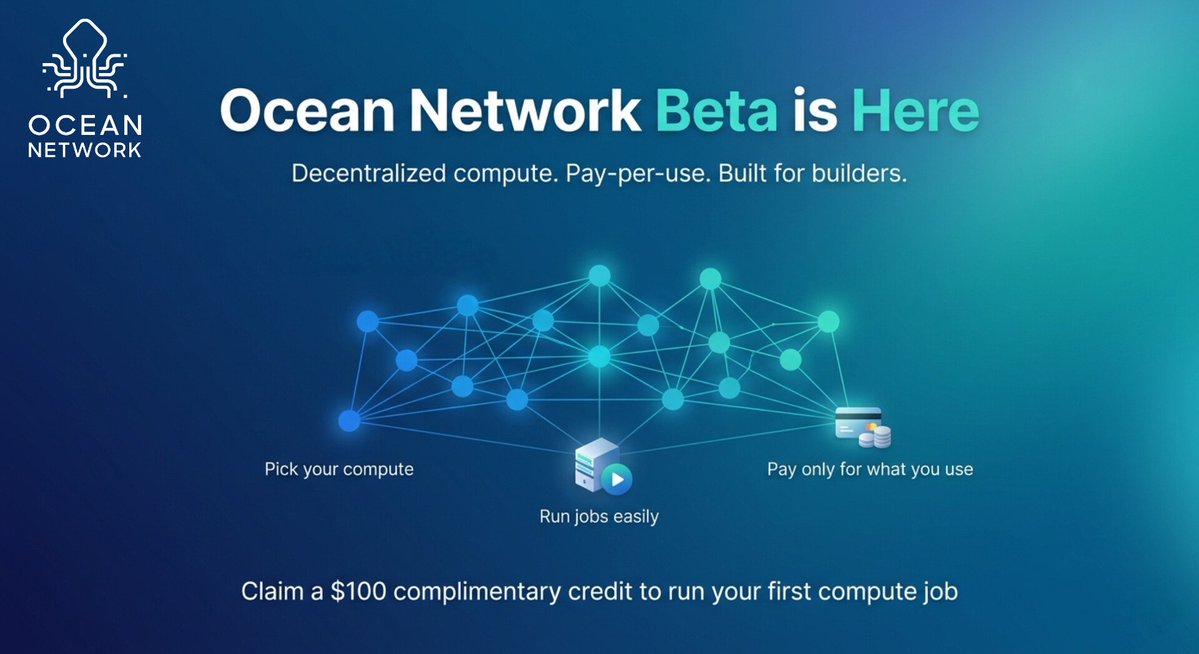
And there's also a $100 complimentary beta credits to claim and run your first job.
If compute was a bottleneck before, it isn’t anymore because the Ocean Network Beta is now live.
You can also claim $100 complimentary beta credits and run your first job today. 👏
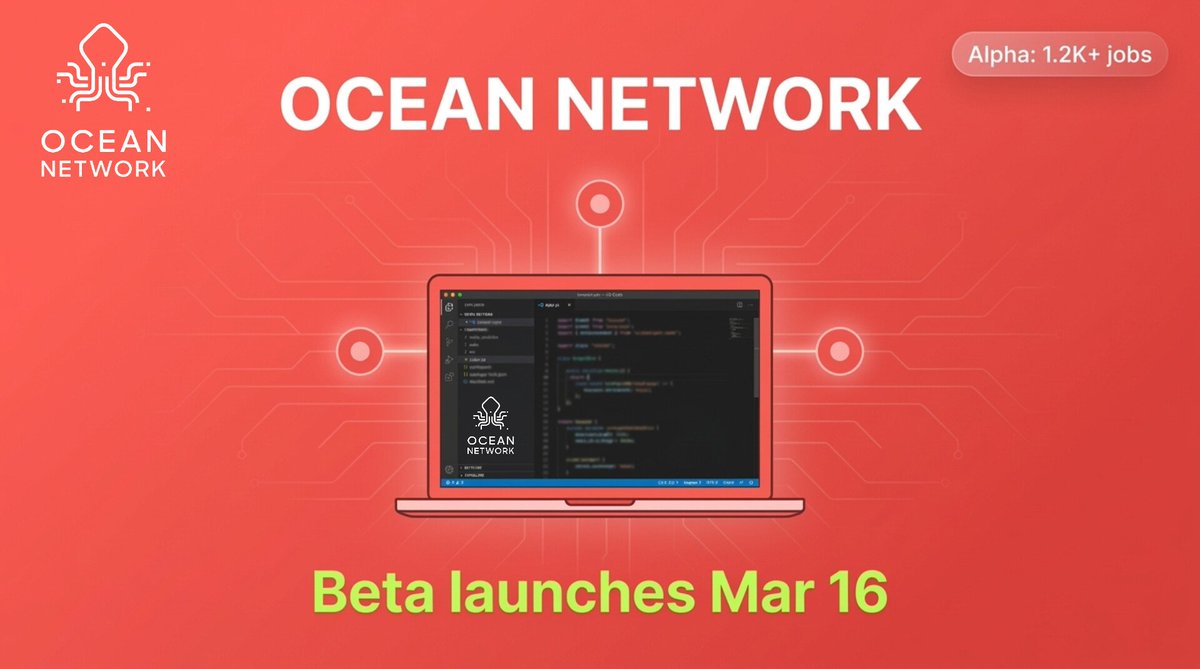
Ocean Network Alpha Results Are In. Beta Launches March 16
@ONcompute alpha phase has delivered its first real signals of activity across the decentralized compute network.
Here are the results of the alpha test:
▫️ 1.2K+ compute jobs executed across the network
▫️ Active nodes across multiple regions including East Asia, Europe, and North America
▫️ High-performance NVIDIA GPU nodes contributing compute power
For an early allowlist-only phase, these numbers show something important: the core system works. Jobs are being routed, compute is being used, and node operators are already earning from their hardware.
Now the next step begins.
Ocean Network Beta launches on March 16, which is tomorrow
The beta phase will open the network further and introduce improvements in usability, tooling, and access. Builders will be able to discover compute resources, run workloads more easily, and interact with the network through improved dashboards and developer tools.
Why this matters:
▫️ Builders get on-demand GPU compute without managing infrastructure
▫️ Node operators can earn from idle hardware
▫️ AI experiments and training jobs become more accessible and scalable
The long-term vision is simple but powerful: turn global idle hardware into a shared compute layer for AI and data workloads.
The alpha showed the foundation works.
Now the beta phase will test how far the network can scale.
If you’re building with AI, data, or distributed systems, this is a good time to explore https://t.co/I5fqZF1orH.
Introducing Ocean Network
@ONcompute is a decentralized compute network designed to make powerful computing resources accessible to builders working with AI, data, and advanced applications.
Instead of relying only on centralized cloud providers, Ocean Network connects a distributed pool of CPUs and GPUs from around the world. Developers can run workloads on this network and pay only for the compute they actually use. The result is a flexible, scalable layer of compute that is open to anyone who wants to build.
As an alpha tester, I recently experimented with Ocean Network to run a small AI project.
Goal: fine-tune a small language model that generates sassy, game-show-host-style roasts. The idea was to create an AI judge with a strong personality that is faster, cheaper, and more consistent.
I used Ocean Network’s decentralized GPU compute to run the fine-tuning job. The process had three simple phases:
1️⃣ Prepare the training data
2️⃣ Create the fine-tuning script as an Ocean Network project
3️⃣ Run the job on Ocean Network and export the trained model
It was a great example of how decentralized compute can support real AI experimentation without needing your own heavy infrastructure.
I'll share more info in my next posts on how I ran the fine-tuning job so you can also try it out yourself.
Ocean Network is still evolving, but the direction is clear: making powerful compute more open, accessible, and flexible for builders everywhere.