Some people just can’t understand that it doesn’t matter at all whether Nolan’s Odyssey does well at the box office. There will always be sheep running after their shepherd. However, Nolan, while he could have created the greatest film of the century, one that no one would ever forget, chose instead to go down in history as a weak man who, in a difficult moment, bowed down to an immoral woke agenda that is slowly dying and ideologically poisoning our societies.
No matter how many Oscars he wins, in the conscience of people, Nolan is someone who brings joy and impresses only the enemies of reason, those who want a world of easy living without values or moral spirituality.
Some of you will never understand why we hated this movie, because you are spiritually bankrupt and dead, you have no morals or values.
I have explained to you in the past, that there is a Greek code called "Homeric Law".
"Always strive for excellence and to surpass the others, and do not bring shame upon the race of your ancestors." (Homer, Iliad Z 208–209)
These words from Homer shaped generations of heroes and glorious men. This phrase lived in our collective memory, at least until today, and we fought to become better than our ancestors and worthy of our heroes. We had role models; we admired our grandfathers. The archetype of the heroic ancestor was born, and the lifelong purpose was always to surpass him through great deeds in one’s own life.
To live without the imperative "aien aristeuein" (Always to excel), is to accept the slow death of the human spirit. When excellence is no longer the measure, when the only sacred thing left is the right to mediocrity and the comfort of never being judged by the shadow of greater men, then man ceases to be a bridge toward something higher and becomes merely a consumer of fleeting pleasures in a rootless present.
> A civilization that teaches its young to surpass their ancestors in virtue, courage, wisdom, and beauty ascends.
> One that teaches them to despise or ignore their ancestors has already begun its long descent into oblivion.
This is what they are trying to take from you.
Homer Pavlos
There's perhaps no better example of how the left uses moral blackmail in the service of the most objectively horrid goals.
The Indigenous people of Latin America were neolithic barbarians whose entire society was oriented around an insane cult of mass death.
"Oh but the astronomy and the pyramids." Yeah they had okay astronomy and they built ziggurats (the bleeding edge tech in 2000 BC Mesopotamia), why? Because they were important in their insane death cult which was literally the ONLY thing that they oriented their entire sick society around.
They didn't have the wheel. They would have been technologically and militarily outclassed by the Ancient Greeks.
Every human culture has *some* positive traits, but if you were to make a list of "civilizations most deserving to be completely wiped out and replaced from scratch" (even if you think no such list should ever be made, if you HAD to), the only question would be whether it should be 1 or 2.
It's fine to criticize Conquistador atrocities--as the Spaniards themselves did abundantly at the time! Because they believed in Christianity and not a mass sacrifice cult!--but to portray that civilization as somehow good is just utter moral depravity.
Consider these words from 1920, written by French author Hilaire Belloc:
“The modern world imagines that it has outgrown religion. It has done nothing of the kind. It has merely forgotten it. And because it has forgotten it, it no longer understands itself. Men do not realize that the whole framework of their moral judgments, their political habits, and even their intellectual methods were formed within a Christian society and cannot exist long outside it. When that framework breaks, they will not find themselves enlightened, but bewildered; not free, but enslaved; not rational, but confused.”
This is properly insane: quite literally the worst example of censorship I've ever heard of anywhere.
I checked the actual ruling (which you can see here: https://t.co/dBKFWZ2ZWm) and, to be clear, it isn't just censorship in the conventional sense - blocking access to a website or removing content from platforms - this is the criminalization of information relayed by private citizens, with prison sentences attached.
And the most insane aspect if that it does NOT matter if the information relayed is accurate or not. It just matters that it originates from RT or other media outlets banned in the EU.
In other words, truth isn't a defense anymore in the EU, it literally doesn't matter. It's purely based on the identity of the speaker.
The ruling is actually explicit about this: the regulation, quoted by the Court says that the prohibition applies to "any content," and they draw no distinction based on what the content actually says. If it originates from banned outlets, it's banned.
It is, quite simply, a complete unraveling of the entire post-Enlightenment legal and philosophical project where entire generations of Europeans fought to move from "who says it" to "is it true" as the operative question.
Think about the absurdity of it: if RT publishes a video saying the sky is blue and you share it on a publicly accessible website in the EU, you'd fall within the scope of this ruling, making you liable to criminal prosecution.
Completely and utterly absurd. But that's the EU today for you 🤷
This is a really important signal by China to Europe.
The social media account Yuyuantantian, operated by China’s state broadcaster CCTV and created in 2019 during China's first trade war with the US specifically to signal China's position, just wrote a long article (https://t.co/hR6OV0mCTj) on the brewing trade war between China and Europe.
Most notably they say the EU's current strategy of dealing with China "can only produce a paper tiger" (meaning it cannot hurt China) and that China is "not afraid" of a "freezing point" in trade and economic relations with the bloc - meaning presumably a complete halt of trade.
This sentence is eerily similar to what China told Trump when he unveiled the tariffs on China (and the whole world) in April 2025. At the time China's Ministry of Commerce said that "if the U.S. insists on its own way, China will fight to the end" (https://t.co/XXN2cwhGFg).
The context is that the EU is currently working on a series of extremely hostile new legislation packages against China, such as the so-called "overcapacity instrument" on which I wrote a long post at the beginning of the month (see quoted post👇).
This instrument is basically a legal tool that says that if China is competitive globally in a given sector in such a way that it exports a lot, that's proof of overcapacity, and legally it'd mean that the entire sector can be restricted from the EU market.
In essence, it's a law that says: if your products are good enough that people want to buy them, that's grounds for banning them. Which is pretty insane!
There's also a so-called "diversification instrument" being developed alongside it, which - according to Maroš Šefčovič, the EU's trade chief himself - is modelled on how the EU reduced its reliance on Russian energy after the Ukraine invasion (https://t.co/eAGThXFANx) and is developed with China in mind.
In their article, Yuyuantantian say that all of this is part of a "escalate first, de-escalate later" strategy - essentially bullying - that the EU borrowed from watching the US, but without any of the leverage to back it up.
As the article puts it: the actors who can pull off extreme pressure tactics can only do so if they have "absolute leading positions in key areas or irreplaceable international influence." The EU, it notes, has neither, hence them concluding that the EU "forcibly pursuing 'escalate first, de-escalate later' can only produce a paper tiger."
Another very consequential framing in the piece is that they characterize Europe as becoming - essentially - a rogue actor in the international system, that doesn't care about rules anymore. Which they say is suicidal for Europe in several ways.
First of all, as they write, the EU's international identity in the international system - its USP, if you will - rests entirely on being a "normative power," a rules-based institutional actor that you can do business with precisely because it won't move the goalposts on you. That's what made European standards worth complying with and European markets worth the entry cost.
As they explain, the EU had gone against China in the past but always within the rules of the WTO (with tools like anti-dumping and anti-subsidy), and always in a way that was somewhat justified and predictable, basically the cost of doing business.
However, the new approach is designed to be essentially unpredictable and arbitrary- and as such makes Europe less and less attractive and more and more risky.
They point out the irony of Europe on one hand saying it wants more investment and industrial cooperation to learn from China but at the same time "constantly raising the bar for attracting investment and maintaining industrial cooperation."
As they write: "the greater the uncertainty, the less likely long-term capital and supply chains will dare to enter, ultimately harming Europe's own sources of growth."
Secondly, the article exposes what is arguably the most self-destructive contradiction in the EU's entire approach: the EU's stated justification for all these new tools is its "unsustainable" trade deficit with China. But when China came to the negotiating table and said "fine, we'll buy more from you," the EU had nothing to offer - because what China wants to buy is high-tech products, and those are exactly what Europe restricts under its export controls policy (largely at the behest of the US).
In essence, Europe's approach is purely punitive, shutting every door simultaneously: you can't export to us (overcapacity), you can't invest here (unpredictable and arbitrary legal risk), and we won't sell you what you want to buy (export controls).
Now you understand why China is becoming frustrated to the point it's contemplating a "freezing point" in trade and economic relations with Europe. When the party on the other side of the table punishes you for exporting, blocks you from investing, and refuses to sell you what would fix the problem they're complaining about, there's not much left to talk about.
My personal opinion is that it is undeniable that Europe is suffering from grave economic problems, but it's mistaking symptoms for cause: it's doing the equivalent of wanting to punish the runner who overtook you instead of asking why you're getting overtaken.
The car industry is a really good case in point: Chinese EVs really are better than German cars at this stage, and it's NOT because of subsidies (quite the contrary in fact, see this: https://t.co/CuL8Gy0KkF). As such, how does punishing China for their competitiveness help the German car industry, specifically? What would help are rather initiatives to learn from the best: stuff like technology partnerships and welcoming Chinese factories on European soil.
The notion that if you ban China the problem goes away is exactly what the Ming dynasty - in 17th century China - did and that's what directly led to the century of humiliation because it became backwards technologically: it's what we call in French the "policy of the ostrich" ("la politique de l'autruche"), putting your head in the sand and hoping that makes things better.
And timing-wise it couldn't possibly be worse: having cut itself off from Russian energy, caved to American tariffs, and destabilized its own industrial base - the logical next step was apparently to pick a trade war with your largest trading partner and the last remaining great power with genuine goodwill towards you.
Because that's the real tragedy of the China-Europe relationship: there is a genuine and frankly almost touching desire for engagement and cooperation from the Chinese side and Europe is doing everything in its power to squander it.
«¿No será que, en realidad, esa libertad religiosa que tenemos instaurada en nuestras sociedades, lo que pretende es que nos dispersemos en cultos rocambolescos y absurdos a cambio de que tengamos una única religión que es el Leviatán? El Leviatán, en el sentido hobbesiano, es decir, el Estado, que te impone su moral, que te impone aquellas cosas en las que tienes que creer. Aquellas cosas que verdaderamente son dogmas de fe, de tal manera que no se te puede ocurrir combatir ninguno de esos dogmas de fe.»
Manuel de Prada dejó esta cita en una tertulia de YouTube que he visto recientemente, y creo que vale la pena detenerse a analizarla, porque señala una cuestión esencial.
La sociedad contemporánea presume de haber superado los dogmas religiosos, pero vive sometida a una cantidad inmensa de dogmas políticos, morales y culturales impuestos desde el Estado, los medios, la educación, las leyes y la opinión pública.
Se critica al catolicismo por tener dogmas, como si el hombre moderno no creyera en verdades obligatorias, incontestables y socialmente sancionadas. La diferencia está en que los dogmas católicos proceden de la Revelación y ordenan al hombre hacia Dios, mientras los dogmas modernos proceden del poder y ordenan al hombre hacia el Estado, el consumo, la ideología y la obediencia al espíritu de la época.
La llamada libertad religiosa liberal ha servido para debilitar la presencia pública de la única religión verdadera, dispersando la sociedad en una pluralidad de creencias tratadas como equivalentes, mientras se impone silenciosamente una religión civil mucho más absorbente: la del Estado liberal contemporáneo.
Ese Estado tiene moral, tiene catecismo, tiene pecados, tiene herejías, tiene ritos, tiene excomuniones públicas y tiene una idea del hombre que exige ser aceptada sin discusión. Quien se aparta de sus dogmas descubre rápidamente que la supuesta neutralidad era una ficción.
El catolicismo, en cambio, reconoce abiertamente la autoridad de Dios, la verdad revelada y el fin último del hombre. El liberalismo moderno habla de libertad mientras forma almas dóciles ante el Leviatán.
Por eso la cuestión relevante no es si una sociedad tendrá religión o no. Esa discusión nace muerta. Toda sociedad termina adorando algo. La cuestión es si adorará a Dios o al poder humano convertido en absoluto.
España no “es” un Estado, así que difícilmente puede ser “un Estado aconfesional”. España es una nación y la patria de los españoles.
Esa nación y patria se organizan políticamente ahora como un Estado. Pero una cosa es lo que eres y otra cómo te organizas.
Men used to make vows. they promised to love someone until death and meant it. they named children after gods they hoped the child would live to honor. they stood at graves and swore revenge over sacred bread. at some point the vow died. we all decided quietly that meaning what you say was too much to ask
“To eliminate suffering entirely would mean, in the end, extinguishing love and desire as well. Those who love and desire cannot avoid passing through trial and suffering; and over the years, we carry within us lessons that leave their mark like scars, the memories of a journey shaped by freedom and failure, dreams and disappointments.
It is only thanks to the interplay of these elements that the wonders of the soul occur within us, allowing us to sense the richness of our humanity.
To renounce this adventure, both tragic and splendid, in the name of a presumed transcendence of all limits, could mean many things, but it would no longer be human.”
Pope Leo XIV, Magnifica Humanitas (par. 120) (May 15, 2026)
The context is Hungary's restriction access to minors to content that celebrates transgender ideology, gender reassignment, or homosexuality has been declared void by the European Court of Justice as discriminatory for breaching EU values, particularly, non-discrimination.
Der EuGH hat in Zusammenwirkung mit der EU-Kommission fast unbemerkt von der Öffentlichkeit mal eben die souveränen Rechte der Mitgliedsstaaten beendet. In einem Urteil (Urt. v. 21.04.2026, Az. C-769/22)hat der EuGH der EU-Kommission eine Generalermächtigung erteilt, die Programmsätze des Art. 2 EU-Vertrag als Eingriffsgrundlage für Sanktionsverfahren zu nutzen. Die Beteiligungsverpflichtungen des EU-Parlamentes und des Europäischen Staates wurden weggewischt, ebenso wie die Quoten (Einstimmigkeit)Die Verfassungsidentität des Art. 4 wurde mitbeerdig. Die EU-Kommission kann jetzt mit diesen unbestimmten Rechtsbegriffen des Art. 2, deren Auslegung dem EuGH obliegt, jedes Gesetz und jede Wahl in den Mitgliedsstaaten verbieten. Das ist ein Quantensprung in Richtung eines totalitären europäischen Superstaats – ein europäischer Richterstaat, in dem die Demokratie zur Farce wird.
Emily Wilson is a kind of a feminist that is truly a bad person that wants to hurt you. Not directly, but in depth, through her profession as a classicist. She is attacking my culture and the Greeks because she hates virtues. She is blatantly lying because most of you don't know to read Greek. But I am Greek and I can read both modern and ancient Greek. So let me tell you why she is purposely lying.
The references with insulting epithets toward the servant/slave women who betrayed Odysseus’s house and slept with the suitors are numerous. The most common ones, however, are "bitches" and "shameless" that were serious insults. Most foreigners translated the word "bitch" as "slut" which is correct to say that this is wrong because it's not what the text writes but in a sense of "non-literal translation" it's not out of context because those women who slept with the suitors and betrayed Penelope were "shameless bitches". Especially the word "shameless" is a strong insult in Greek. It implies sexual shamelessness lack of decency, and moral boldness and this is why foreign translators are using the word "sluts" in English. But Homer doesn't use the Greek word directly to call them "whores".
The following translations I will use are made directly from the ancient Greek text into modern Greek. We Greeks do not read foreign translations. What we call an adaptation (απόδοση) from ancient to modern Greek is not considered a "translation" for us, since it is the same language. In other words an adaptation of a Greek text bridges the gap between ancient or dialectic Greek and the modern target audience.
1. Odysseus to a servant woman (Book 18, line 340):
"Bitch, if I go and immediately repeat your wretched words to Telemachus, he will tear you to pieces, you’ll be smashed into bits."
[ἦ τάχα Τηλεμάχῳ ἐρέω, κύον (=Bitch), οἷ᾽ ἀγορεύεις,
κεῖσ᾽ ἐλθών, ἵνα σ᾽ αὖθι διὰ μελεϊστὶ τάμῃσιν]
2. Penelope to Melantho (the servant who slept with Eurymachus and betrayed them), when Melantho spoke rudely to Odysseus (who was still disguised) (Book 19, line 91):
"Nevertheless, you bold, shameless bitch, you do not escape my notice at all, doing a great deed which you will wipe off on your own head."
[πάντως, θαρσαλέη, κύον ἀδεές (=fearless bitch), οὔ τί με λήθεις ἔρδουσα μέγα ἔργον, ὃ σῇ κεφαλῇ ἀναμάξεις]
3. "Perhaps in foreign lands too, some servant women insult him, every time he enters a famous lord’s house, just like these bitches here who all together insult you, stranger. I imagine that to avoid their reproach, their shamelessness…" (Book 19, around line 370)
4. "Servant women shamelessly dragging themselves here and there." (Book 20, line 318)
5. "Twelve of them appeared completely shameless, who had no regard for me and showed no respect to Penelope." (Book 22, line 422)
Emily Wilson cannot tolerate any criticism of the women who betrayed the man Odysseus and slept like shameless bitches with the enemy, betraying Penelope.
In her worldview, men are always the bad guys, and only women are the heroines. She herself calls the academic translators misogynists. It is inconceivable that there are today "eunuch" academics who defend this malicious and worthless woman.
This woman is in Classical Studies in order to destroy them, so that you, who will read her books, will form a false image of the epics that built Western civilization.
How Odysseus is not a hero, Achilles is not a hero, men are not great and brave but evil, and how the patriarchy must be fought so that women can win. They are trying to convince you that there is no heroism in Homer. Yet the epics were written precisely for this reason: so that you understand what it means to be a hero, what sacrifices are required, what difficulties you will face, and how you will achieve eternal fame. How you will conquer your passions, how anger destroys you, and how moral virtues lead you toward godlike status.
She hates all of this. She wants you spiritually dead. She hates you.
Therefore, it is completely justified for you to hate them too.
It ought to be difficult to sublimate the deceit and corruption of human trust that are at the heart of espionage. Here, Ulysses does it with eloquent ease.
This is a monumental interpretation of the character.
Shakespeare’s Odyssey: the fight for heroism never ends.
Project 39 continues with Troilus and Cressida - Act 2, Scene 3.
Ulysses is advising a sulking Achilles, who has been ignored by the Greek leadership after being manipulated into jealousy of Ajax.
Ulysses’ argument here is clear: time will devour all achievements, so you must fight to remain current. His argument has taken on an ironic significance recently. Ulysses is the Latinized name of Odysseus, who is currently seeing his own fame tampered with by Hollywood in Christopher Nolan’s film.
Some critics have suggested that Shakespeare presents the Greek world as more amoral, abstract and cynical than the Roman world. This is perhaps due to the influence of Virgil, who presents the Trojans as the good guys and progenitors of the Romans.
Ulysses is played by Morgan Watkins
The stories of old are meant to be mulled over, memorized, and shared with friends. Whoever says otherwise is a poor soul, bereft of beauty, goodness, and truth:
"The sun rose from the still, beautiful water
Into the bronze sky, to shine upon the gods
And upon men who die on the life-giving earth." (Odyssey 3, ll. 1-3—Stanley Lombardo translation)
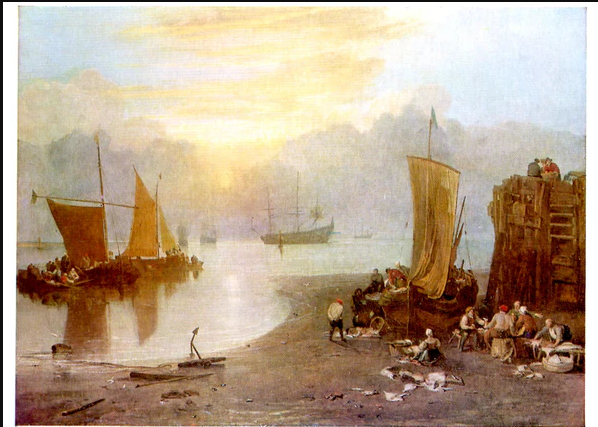
👇Sun Rising Through Vapour by Joseph Mallord William Turner