The person who built Claude Code just showed exactly how to use it.
This single session is worth more than any $1000 course.
30 minutes. Free. Straight from Boris Cherny himself.
Bookmark this before you forget.
INSTEAD OF WATCHING AN HOUR OF NETFLIX TONIGHT.
This 1 hour Stanford lecture by Joel Peterson will teach you more about negotiation and getting what you want than most people learn in years.
Bookmark it and give it an hour, no matter what.
🚨 Anthropic just showed a 27-minute workshop on how to actually do prompts for Claude.
Taught by the people who built it.
Free. No registration. No paywall.
I've seen $300 courses that don't cover what they teach in the first 8 minutes.
Watch it and bookmark it now.
Anthropic pays $750,000+ a year for engineers who know how to build LLMs from scratch.
Stanford just released the exact lecture that teaches it - 1 hour 44 minutes, free, straight from CS229.
Bookmark and watch it this weekend.
It'll teach you more about how ChatGPT & Claude actually work than most people at top AI companies learn in their entire careers.
90% of trading advice is right. The problem is the 10% that sounds right but loses you money.
Here are 7 rules most traders follow that profitable traders broke a long time ago 👇
15 LOSING Traders vs One Of The BEST In The WORLD🚨
15 losing traders sit down with a $30M trader for brutal live breakdowns on overtrading, revenge trading, gambling, and the real reasons they keep losing money. Umar Ashraf holds nothing back.
Full episode👇
Some of my best trades come from these setups.
I am going to show you exactly how to increase your win rate and profit factor:
1. Learn this: Bullish divergence, Bearish divergence.
These will happen over and over.
Timeframe to focus: 1 day, 1 week, 2 hour.
2. Step up your game: Add Bull trap & Bear trap
You went from simply watching the divergences to an added layer rule and entry condition which gives you a better edge.
It is a two step process and your focus needs to be on Setup #3 & #4.
Save it for future 🔖
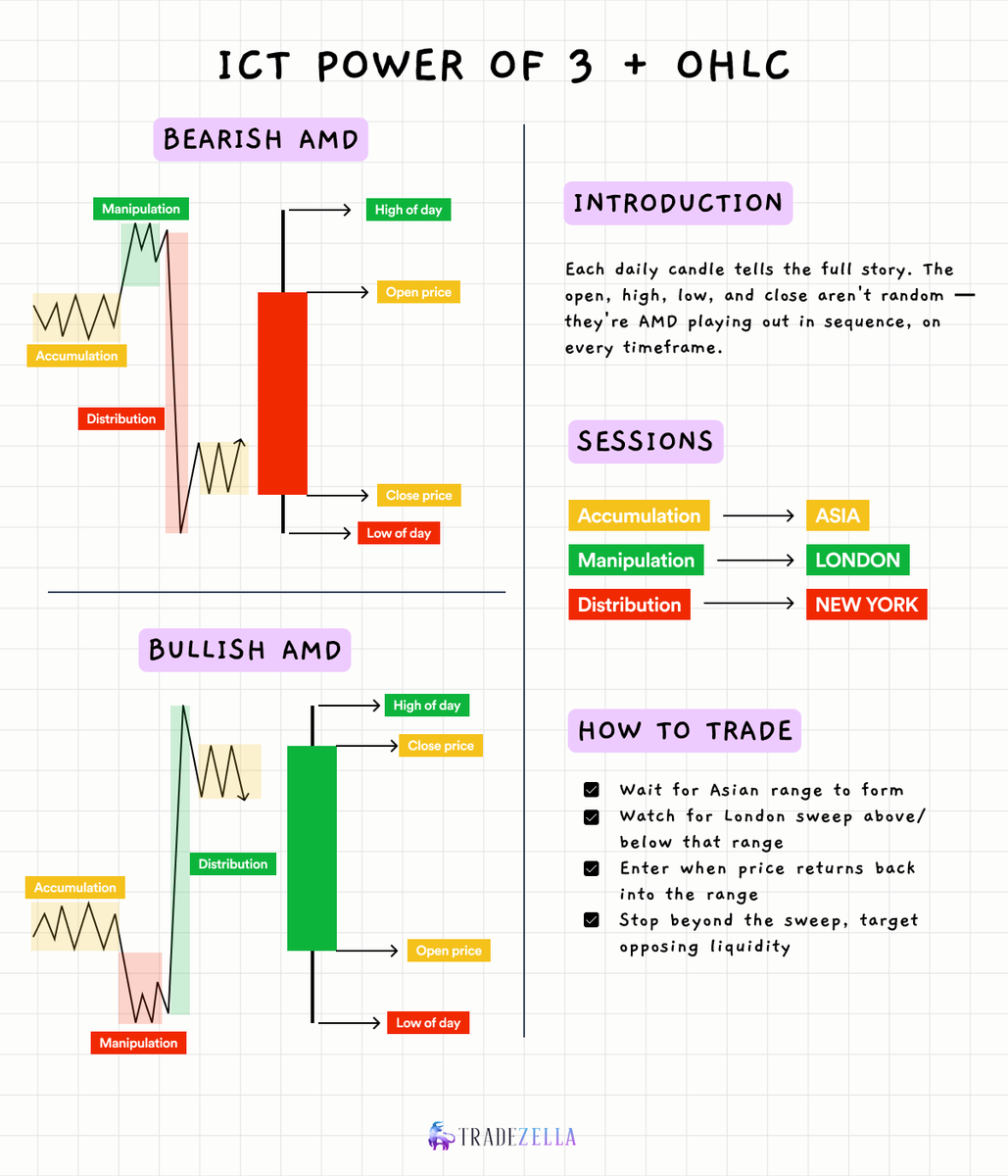
Most traders think they're getting stopped out randomly.
They're actually getting stopped out in the Manipulation phase — every single time.
PO3 + OHLC shows you exactly where that is.
Like + reply "PO3" and I'll send the full training + backtesting to your DMs 👇
BREAKING: ANTHROPIC JUST OPEN SOURCED THE ENTIRE WALL STREET WORKFLOW.
DCF models. LBO models. Equity research reports. Merger analysis. KYC checks.
All of it. Free. On GitHub.
It connects Claude directly to:
-> Bloomberg, FactSet, S&P Global, Morningstar, PitchBook
-> Builds real Excel models with live formulas and sensitivity tables
-> Drafts CIMs, IC memos, earnings reports, and buyer lists
-> Runs PE due diligence, GL reconciliation, and NAV tie-outs
This is not a chatbot wrapper.
These are production agents that own entire financial workflows.
The kind firms pay $50,000 to $500,000 per year in software to run.
Now it is a one-line Claude Code plugin install.
19.8K GitHub stars. Apache-2.0 License. 100% Open Source.
This is what Bill Ackman was going through at the bottom
> Fund down 30%+
> Being sued by Valeant Pharma investors
> Going through divorce with his wife
> Elliot, an activist firm, trying to take over his fund
Here is his advice on how to deal with the tough moments in life
In 1987, Paul Tudor Jones was 32 years old.
He ran a firm of 22 people managing $125 million.
A documentary crew followed him for a week.
What they captured is one of the most raw looks at a trader's mind ever filmed.
One morning, the wires said OPEC was close to a new production cut agreement.
Tudor Jones heard it and immediately started selling oil futures.
"Any time you try to get 13 people to agree to anything, and I have a chance to take a position on it, wild horses couldn't keep me from betting against them succeeding."
The agreement fell apart. He was right. Speed was everything.
He sold so fast and so quietly that the second and third largest crude trading firms in the world had no idea who was on the other side.
"I hope they think it's some wild speculator who thinks the whole agreement is about to fall apart."
How he described the market as a teacher:
"It's graded instantly through the harshest teacher in the world. There's no curve. I can't say I was out late last night and got a 70 but it was the highest in the class. It doesn't work that way."
Every day. Every hour. New information. Instant grade.
His firm's philosophy in one line:
"We're a small, fast boat on a large rough sea."
22 employees. No bureaucracy. Everyone in the same room watching the same tape.
The edge wasn't size. It was speed of decision and clarity of conviction.
The market doesn't care how big you are. It only cares if you're right.
The CEO of the world's largest asset manager just said something that should reframe how every investor thinks about the AI trade.
Larry Fink, managing $11.5 trillion at BlackRock, stood at the Milken Institute Global Conference and said four words that matter, "We just don't have enough compute."
"The United States is short power. We're short compute. We're short chips. And there's going to be shortages in all three and memory, four things. I actually believe a new asset class will be buying futures of compute."
Think about what that means.
Fink is predicting that compute becomes a tradable commodity like oil, like grain, like natural gas where investors buy forward contracts on future capacity because the shortage is so structural and so predictable that a derivatives market will emerge to price it.
That is not a minor observation from a finance executive but rather the chairman of the most powerful capital allocator on the planet telling you that compute scarcity is a multi-year, investable megatrend.
The data backs him up completely.
Data centers will consume 70% of all memory chips produced globally in 2026.
Advanced HBM production from Samsung, SK Hynix, and Micron is sold out through 2026 and into 2027 and a single AI server consumes 10-20x more memory than a conventional workload server.
DRAM supply growth is running at just 16% annually while AI infrastructure demand is growing at 80%+.
The chip crunch, the power crunch, and the compute crunch are not temporary dislocations, they are structural, and they will get worse before they get better.
Fink also said something the bears keep getting wrong: "There is not an AI bubble. There is the opposite. We have supply shortages. Demand is growing much faster than anyone has ever anticipated."
This is why the Milk Road Pro portfolio is built the way it is, long the companies producing and supplying the constrained resources: chips, memory, compute infrastructure, and power.
Check out Milk Road Pro, link below to access our full thesis and plays.