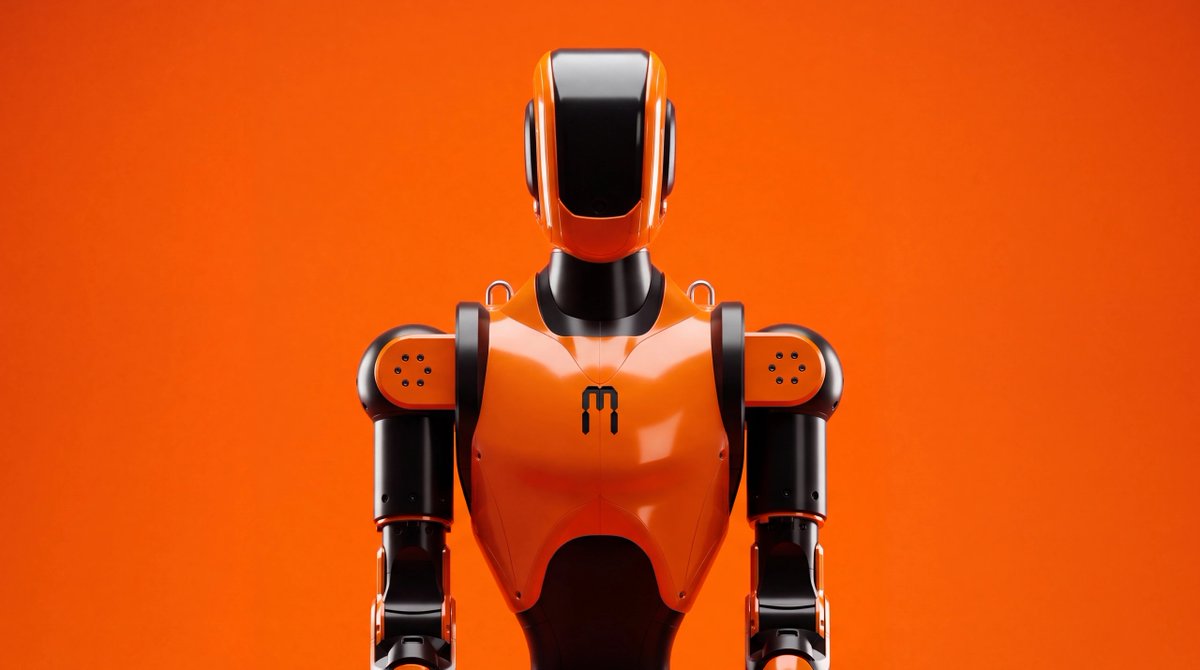
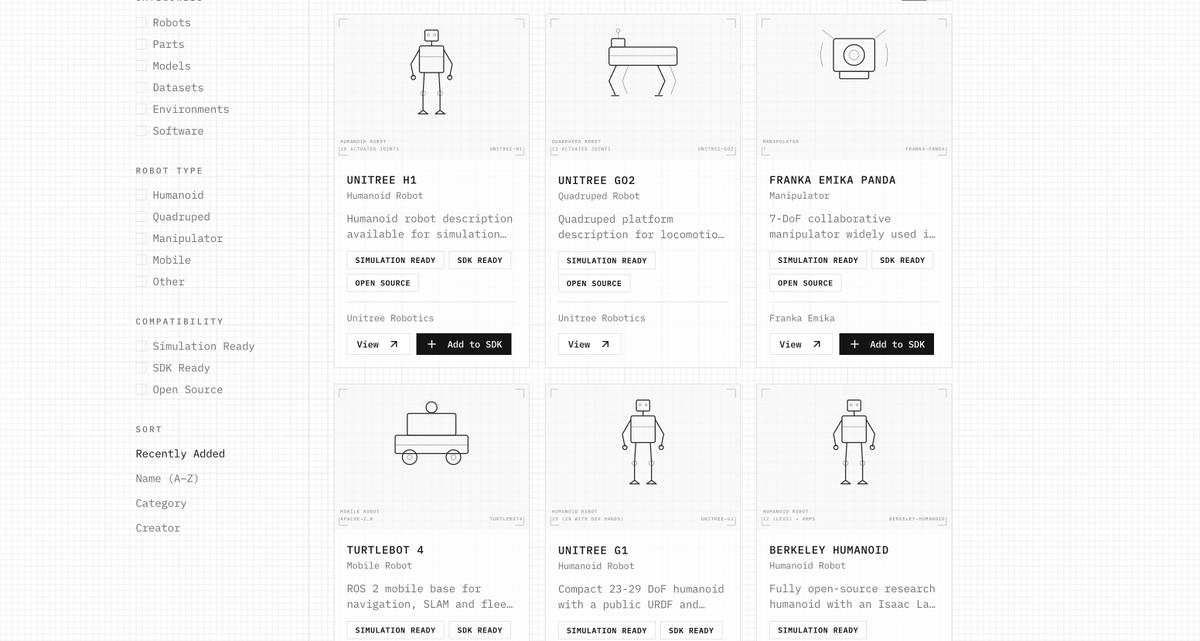
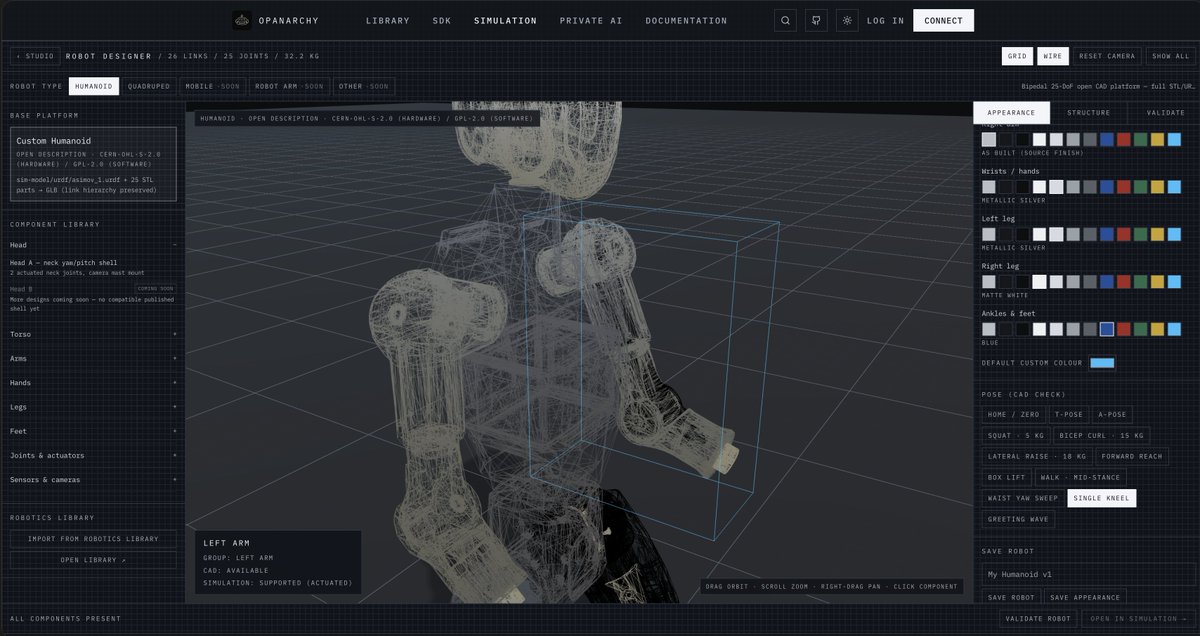
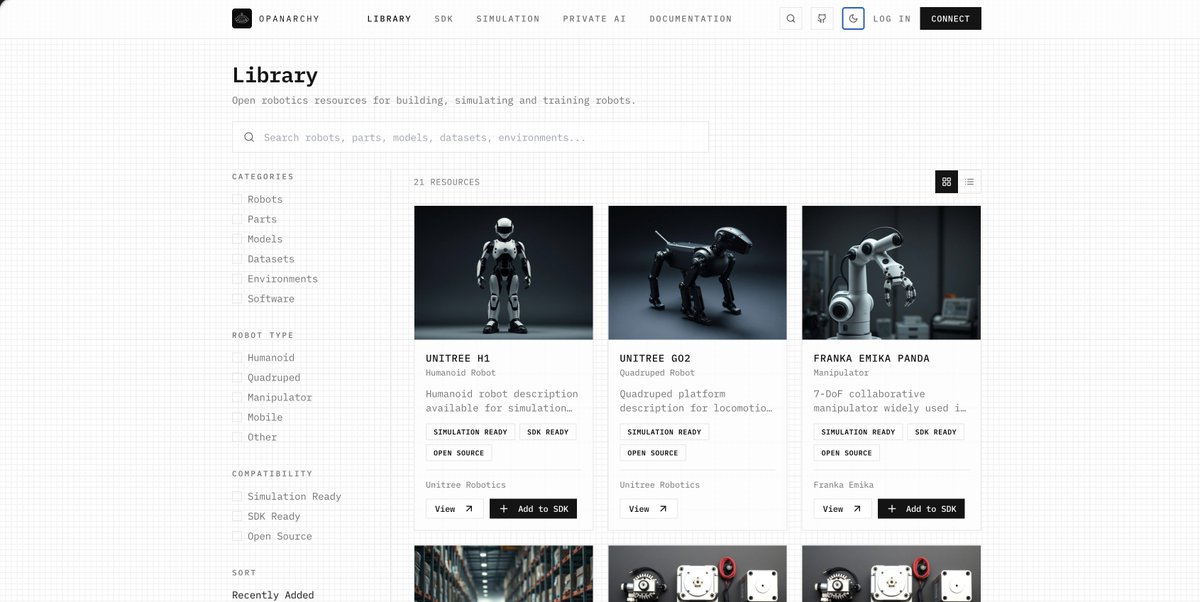
we're adding a new way to build from the opanarchy robotics library.
fork a robot
find an open source robot, create your own version, modify the components, connect the code, cad and take it into simulation.
instead of starting with a blank project, you can start with something that already exists and build from there.
this is the direction we're taking the library:
find → fork → modify → simulate → train
Opanarchy Marketplace v2 is now live
Marketplace v2 is designed as a GitHub for robots: bringing robotics projects, code, libraries, CAD, models, datasets, simulation resources and other open-source components into one place.
Find a project
Explore its resources
Reuse or build on top of it.
As Opanarchy develops further, these resources can move directly from discovery into simulation, training and development.
We’re integrating JEV by @typesafeai into opanarchy
jev brings a different approach to robot intelligence : focused on structured decision making rather than simply generating text.
we’re exploring how jev can sit inside the robotics stack as a decision layer, helping robots choose what to do based on their current state and available actions.
this is an important step for us as we continue building opanarchy into a more open environment for designing, simulating and training robots
DeepMind’s latest VLA gives humanoids full body control from feet to fingertips and adapts to new robot bodies in hours.
Meanwhile closed startups are shipping automated tool changers and stair climbing cleaners.
The demo to deployment gap is shrinking.
opensource.
GITHUB FOR ROBOTS:
the idea for the opanarchy robotics library started with a pretty simple observation: there is already a huge amount of robotics work being built in the open, but most of it is still hard to find, understand and build on.
robots, cad, code, simulation, datasets, models, hardware: all spread across different repositories, labs and platforms.
we thought there should be a better way, so we started building a library for robotics.
we've added 1,000+ projects so far and we're going much further from here.
the next step is making every project more useful, better discovery, richer technical information, versions, dependencies, compatibility, forking and customization, and eventually taking projects directly from the library into simulation and training.
the long term idea is bigger than a library
discover something someone has built, build on it, simulate it, train it, improve it and share the next version with everyone else.
if robotics is going to develop the way software did, we think this kind of open infrastructure will matter.
we're still early but we're building toward a world where you don't have to start from zero every time you want to build a robot
1,000+ robotics projects are now in the Opanarchy Library
Robotics code, controllers, simulation projects, CAD, models and more, all coming together in one place
We’ll keep expanding the Library with thousands more open robotics projects, making it easier to discover existing work, build on it and move from code to simulation and training
open robotics ecosystem is growing
Opanarchy Marketplace v2 is now live
Marketplace v2 is designed as a GitHub for robots: bringing robotics projects, code, libraries, CAD, models, datasets, simulation resources and other open-source components into one place.
Find a project
Explore its resources
Reuse or build on top of it.
As Opanarchy develops further, these resources can move directly from discovery into simulation, training and development.
.@L3HarrisTech says Palantir helped them beat frontier AI models in less than 2 days, at 95% lower cost:
"When we fine-tuned open source models trained on our own data, we were able to outperform the frontier models in less than 48 hours."
"The cost of our fine-tuned open source model was 95% lower than the frontier models we were using."
"AI is a commodity. It's all about the data. We view our data as a corporate asset. It's our unique hard-earned knowledge."
"We believe American defense companies should not be a vassal for frontier AI labs, handing over our data and institutional knowledge, hoping to rent back the intelligence it creates."
" We own the model, we own the compute, we own the advantage."
We just hit 100M ARR within 10 months of starting deployments.
We are in factory lines. On construction sites. In kitchens. In data centers.
Cleaning. Welding. Building. Cooking.
Deploying.
Opanarchy Marketplace v2 is now live
Marketplace v2 is designed as a GitHub for robots: bringing robotics projects, code, libraries, CAD, models, datasets, simulation resources and other open-source components into one place.
Find a project
Explore its resources
Reuse or build on top of it.
As Opanarchy develops further, these resources can move directly from discovery into simulation, training and development.
Opanarchy Marketplace: Alpha Release
we’re releasing the first alpha version of our robotic marketplace, an early look at what we’ve been building.
open to feedback and improvements.
https://t.co/oTaBcEhv7S
Earlier this year, we shared a first look at our robot designer.
Since then, we've taken the idea considerably further
We have now built a complete robotics CAD environment for designing and customising robots from 3D components and assemblies
We're starting with humanoids and expanding into quadrupeds and other robot types
The next step is connecting the design process more deeply with simulation and training.
The Hugging Face acquisition is an important moment for open source AI
Hugging Face has played a unique role in building an open ecosystem around models, datasets, libraries and developers, independent of any single hardware provider.
NVIDIA's involvement brings significant resources and expertise, but it also raises an important question about neutrality.
Open source ecosystems benefit from diversity in models, hardware, infrastructure and the organisations building them.
It is worth preserving that diversity as the industry continues to mature.
Y'all. 🥲 I'm happy for @ClementDelangue and @huggingface for their exit. But this is gonna be a loss for Open Source AI - HF is no longer hardware agnostic. Transformer library will favor nVidia over other hardware. (There is already quite enough of this nVidia favoritism in the OS AI community)
This is an opportunity for a new standard bearer to arise.
We're narrowing our focus around three core products:
- robotics library for discovering and building with open robots, parts, models, datasets and software.
- simulation and training platform for developing and testing robotic systems.
- private AI inference stack built around frontier models.
There's still a lot to build before this becomes the platform we envision.
For now, we're focused on making each layer deeper, more useful and eventually ready for serious enterprise robotics workloads.
Opanarchy Marketplace: Alpha Release
we’re releasing the first alpha version of our robotic marketplace, an early look at what we’ve been building.
open to feedback and improvements.
https://t.co/oTaBcEhv7S
We're going to see a lot more opensource robots being built over the next few years.
Not just research prototypes but robots people can actually build, modify, simulate, train and eventually buy.
We're already seeing the beginning of this shift, with projects publishing CAD, simulation models, software and even complete hardware kits.
As the cost of hardware continues to fall, more independent builders, researchers and small teams will be able to create their own robots.
The interesting part won't just be the number of robots being built. It will be everything built around them parts, models, datasets, simulation environments, training tools and software.
Opan Flash was the beginning.
Now we're working toward the second model in the Private AI ecosystem: Opan Core.
Designed to go beyond fast everyday conversations, Core is being built around deeper reasoning, longer context tasks, research, coding and more demanding workflows.
Flash introduced the first layer.
Core is where we're starting to push the intelligence further.
Coming soon.
China may be further ahead than the US in the robotics race, not necessarily because it has a single company that is far ahead of everyone else, but because the ecosystem around robotics is developing at enormous scale.
It has a huge manufacturing base, dense supply chains, large numbers of industrial robots already deployed, strong hardware production capabilities and an increasingly competitive humanoid robotics industry.
ability to iterate hardware quickly and deploy robots into real environments could become one of China's biggest advantages.
A robot dog you’re actually supposed to take apart.
China’s MirrorMe built Black Panther X as a modular, open quadruped platform rather than another closed robot dog.
200+ components, 12 joints, open interfaces + code, 4 m/s speed, 33 Nm joint torque, and support for third-party sensors and payloads.
You can assemble it, modify it, program it, and build on top of it.
DeepMind’s latest VLA gives humanoids full body control from feet to fingertips and adapts to new robot bodies in hours.
Meanwhile closed startups are shipping automated tool changers and stair climbing cleaners.
The demo to deployment gap is shrinking.
opensource.
Privacy is a core principle behind Opan Flash.
Your conversations are not stored as chat history, meaning we don't keep a personal archive of your conversations for future sessions.
You can use Opan Flash, have a conversation and leave without building a persistent chat history around it.
Private AI should put users in control of their conversations, not treat them as a permanent data source.
our next chapter focuses on two foundations:
• Advancing open robotics infrastructure
• Building the private AI model ecosystem
core to everything we’re creating.
AI security advances when the industry builds in the open, together.
We're introducing the Open Secure AI Alliance with industry leaders to develop new techniques and tools to safeguard software and agents.
By sharing models, tooling and research in the open, we can broaden the community of defenders.
Learn more about the founding members’ contributions: https://t.co/A16oqxs5Ty
Unitree H1 is now added in the opanarchy preset library.
You can load the robot, connect it to simulation environments and begin experimenting with training workflows inside Simulation Studio.