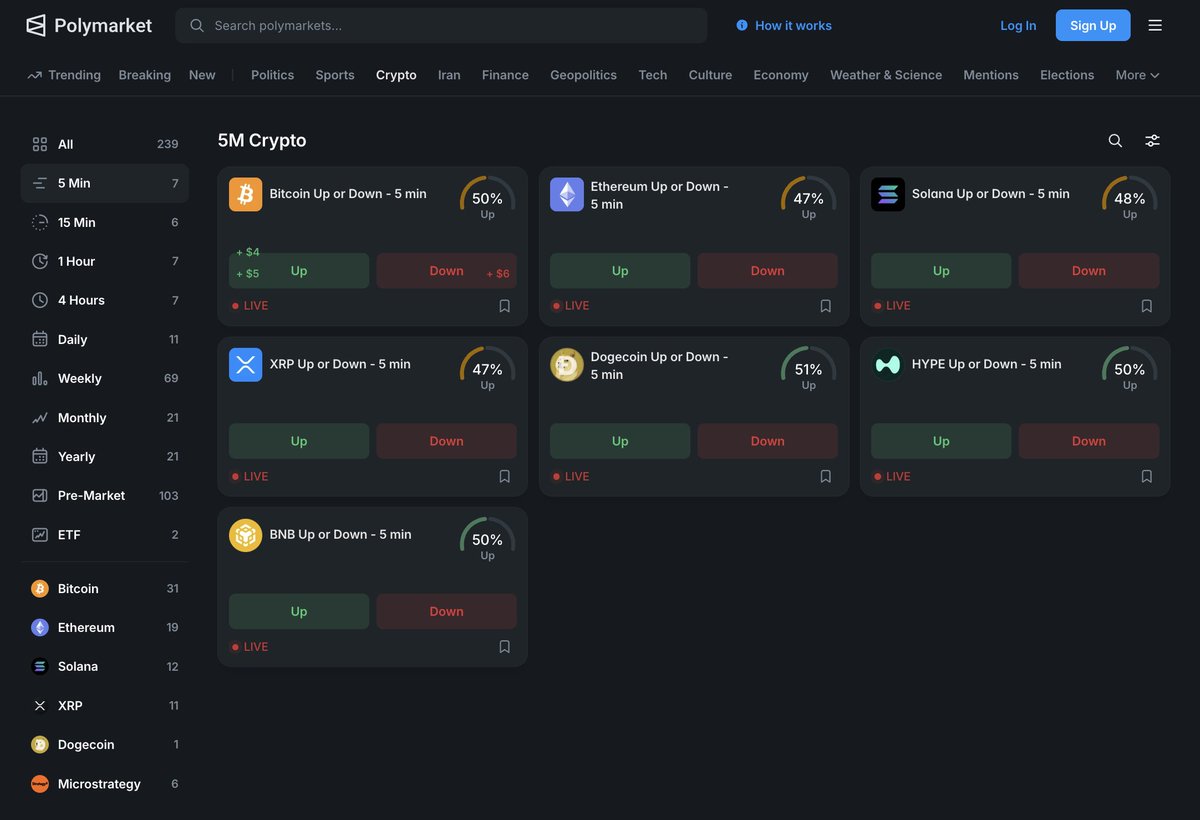
Introducing taker tier rebate program - https://t.co/4FZiXsX4UI
Get rebated up to 50% of all trading fees on polymarket, earn $ level up bonuses, and be eligible for large future rewards.
Will be live starting next week 🙂
Network intelligence and heartbeat of @Logos_network. Now running locally on my own machine — soon on a separate domain with nearly live updates. Made by @bitfalt and me. Inspired by @davidrusu. Propped up by @vrycmfy.
https://t.co/m7AEtzYP6v
Every chain you know has a barrier to entry.
Ethereum wants 32 ETH.
Solana wants an entire data center.
Cosmos wants you to delegate to someone richer than you.
Logos has NO minimum stake.
Not "low minimum."
Not "delegate to a pool and hope they don't rug."
Zero. Zip. None.
You have one token, you are a participant.
You have a lot of tokens, you are a participant.
The protocol does not distinguish between the two except by probability.
Logos Blockchain runs Cryptarchia.
Cryptarchia is a proof of stake consensus engine built on the bones of Ouroboros Genesis research but stripped of the institutional assumptions.
Every slot is a lottery, and your stake is your ticket.
One token, one ticket.
A million tokens, a million tickets.
The math does not care who you are. Your probability of proposing a block scales linearly with your share of total stake.
There is no threshold below which you are excluded.
Zero. Zip. None.
Allow me to say that one more time, for effect.
There is no threshold below which you are excluded.
Every other chain draws a line somewhere.
Below that line you are a consumer.
Above it you are infrastructure.
Logos erased the line, yo.
Straight punted the line.
If you run a node then you participate in consensus and you earn rewards proportional to what you bring.
The Cryptarchia engine uses a slot activation coefficient that determines how many slots get filled.
Your stake feeds into a VRF lottery. If the VRF output falls below your threshold you produce a block.
This means a mass of nodes running on local hardware with small stakes collectively form the same security backbone as a handful of whales.
The standard argument is that minimum stakes prevent spam. Minimum stakes ensure serious participants. Minimum stakes protect the network from being overwhelmed by tiny validators who slow down consensus.
This is the argument of every gatekeeper. You need a license to cut hair, and you need a degree to give advice.
You need 32 ETH to secure the network.
Minimum stakes exist because the consensus protocols were designed for a known validator set.
Byzantine Fault Tolerant protocols need to enumerate participants. If anyone can join with any amount of stake, you need a different kind of consensus. One that does not require committee elections or fixed validator sets. One that works like a lottery where every ticket holder is already a valid participant without registration.
Cryptarchia is that protocol.
If you have a laptop or a Raspberry Pi, or even an old phone, you can stake what you have.
You run the Logos node, the node connects to the peer to peer network. Your traffic gets mixed through the Blend mixnet so observers cannot tell you are running a node.
You participate in consensus.
You earn rewards when you produce blocks.
You also get access to the entire Logos modular stack.
Messaging: Private censorship resistant communication through Logos Delivery and Logos Chat.
Storage: Decentralized content addressed file storage through the storage module. Host a frontend. Serve files. No corporate cloud provider watching.
The Execution Zone: Deploy programs. Run AMMs. Transfer tokens. Create financial primitives with built in privacy. UTXO based so your transaction graph does not leak to chain analytics firms.
All of this runs locally.
Logos is built like a Linux distribution. A core runtime at the base. A privacy preserving networking layer. Pluggable modules on top. Applications that compose those modules.
If you have a machine and a connection you participate.
Most staking economics models assume a Pareto distribution of validators.
A few large stakers secure the network and everyone else delegates.
The protocol reinforces concentration because the minimum stake prices out small participants who then have no choice but to trust larger ones with their capital.
Logos inverts this.
No minimum means the long tail participates directly.
A thousand people staking small amounts across a thousand machines in a thousand jurisdictions is a fundamentally different security model than fifty validators in three data centers.
You cannot sanction a thousand anonymous participants running behind a mixnet.
You cannot serve them with compliance orders because you do not know who they are or where they are.
A network you help secure from your own hardware with whatever you have.
None of this works if the base layer requires a minimum investment that most of the world cannot afford.
The no minimum stake design is the foundation that makes the parallel society thesis coherent.
If you need 32 ETH to participate in consensus you have already recreated the class structure you claimed to be replacing.
Logos Testnet v0.1.2 is running.
315 repositories. 170 active contributors. You can run a node. Developer office hours every Friday at 12 UTC.
The no minimum stake design means you do not need to wait until you accumulate enough capital to matter.
There is treasure everywhere.
We live within systems that no longer serve us.
Money loses value faster than it can be earned. Access to financial services can disappear without warning. Surveillance proliferates like a virus. Institutions grow larger, slower, and less accountable.
While everyday life becomes more expensive, more constrained, and more uncertain.
This is not an accident.
Central banks expand the money. Asset prices rise.
Those who own assets benefit. Those who don’t fall further behind.
The gap widens because the system rewards proximity to power.
Debt fills the gap. Younger generations borrow more, earlier, and for longer, just to access things that were once attainable.
Housing, education, basic stability.
At the same time, surveillance has become infrastructure.
Financial transactions are monitored. Communications are stored. Platforms track, rank, and filter what people see and say.
Systems built to connect us now function as systems of oversight and control.
And they operate on a double standard.
Rules tighten for users. Flexibility remains for institutions.
Trust declines. Participation feels out of reach. People withdraw, bombarded by feeds engineered to drip-feed dopamine, outrage, and all too often, isolation.
But it doesn’t have to be this way.
We can operate outside the constraints.
Communicate without being watched.
Transact without being blocked.
Coordinate without relying on systems that can exclude us for thinking the “wrong” thoughts.
This is why decentralised systems are needed more than ever.
Real decentralisation is more than a blockchain accessed by centralised endpoints via a browser extension.
It’s code running on hardware you control.
It’s peer-to-peer communication networks that can’t be surveilled or censored.
It’s money that isn’t issued on the whim of an unaccountable entity paying for yesterday’s excesses.
It’s social and financial services that anyone can access.
It’s protecting those who run the hardware for these services to exist.
It’s a frontier where the architects of a new civil infrastructure will pioneer the future they want to live in.
Logos Testnet v0.1 is live.
A convergence milestone: Logos modules now run together as a unified stack for the first time.
The initial release is a proving ground for integration and backend validation.
Start experimenting at the new Logos Builder Hub.
https://t.co/LijWPxEM9O
We are back!
After a killer Parallel Society congregation, we're prepped to bring you more Circles intel and a place to discuss pressing issues impacting your communities.
Join us tomorrow.
https://t.co/tB25YmWpNE