Breaking💥Introducing OpenNovelty: An agentic system engineered to redefine how we evaluate academic novelty!
In an era of exponential @arxiv growth, expecting human reviewers to recall every related work is becoming impossible. We need more than human memory. We need a trustable, verifiable agentic system.
That's why we're here:
But wait, OpenNovelty just uncovered an architectural duplicate in this multi-agent design!
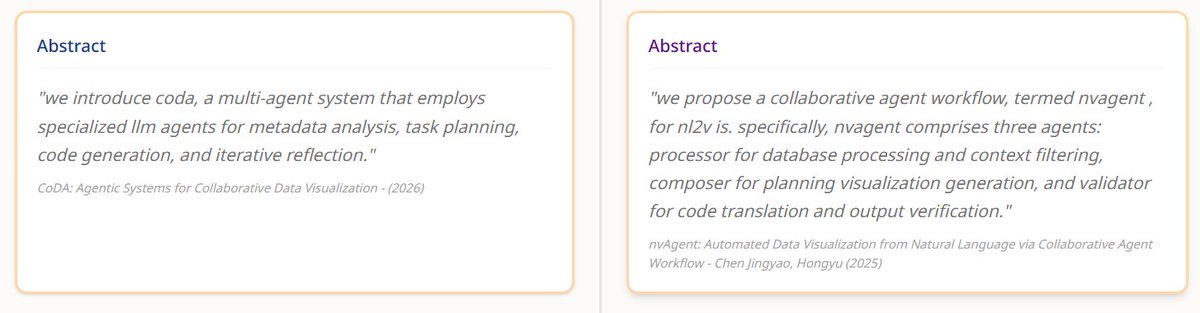
While CoDA claims novelty in proposing specialized agents for collaborative data visualization, our deep-dive analysis reveals that this exact agentic breakdown already exists. Our audit shows:
Both papers introduce multi-agent systems with specialized LLM agents for visualization automation. PlotGen's query planning agent parallels CoDA's query analyzer, and both use code generation agents with iterative refinement mechanisms.
Both systems employ iterative refinement through quality-driven feedback. PlotGen's self-reflection mechanism for refining plot accuracy directly corresponds to CoDA's quality-driven refinement approach.
Both frameworks take natural language queries as input and orchestrate multiple agents to produce visualizations, demonstrating the same fundamental multi-agent collaborative paradigm.
It appears this collaborative pipeline relies on an automation blueprint that was already fully designed by its predecessors.
Check out the full novelty breakdown report: https://t.co/2nlLfQdxUC
To protect your research from unintended conceptual overlaps and ensure your agentic workflows are truly pioneering, use Wispaper to map out existing system architectures before you submit.
#OpenNovelty #AcademicResearch #ICLR #Wispaper
Could collaborative multi-agent workflows completely automate data science pipelines?
Earning a strong 7.3 OpenReview score for ICLR 2026, the submission "CoDA: Agentic Systems for Collaborative Data Visualization" addresses a massive pain point in NL2V (Natural Language to Visualization). The paper introduces a collaborative multi-agent architecture designed to process complex datasets and handle automated code refinement.
By shifting the focus from simple, single-prompt charts to structured agent teams, this framework aligns with major milestones in LLM-based software engineering and analytics, such as MetaGPT and AutoGen. It demonstrates how splitting up specialized operations can boost automation benchmarks by up to 41.5%, promising a smoother interface for data analytics.
#ICLR2026 #DataVisualization #MultiAgentSystems #LLM #DataScience
Evaluating true novelty in massive paper submissions is a significant challenge for reviewers. OpenNovelty, co-developed by Fudan NLP Group and https://t.co/PE7WztNMDj, addresses this by providing an LLM-powered framework for evidence-based novelty decisions.
Core Functionality
· Contribution Extraction: Automatically summarizes each paper's core task and key claims of contributions.
· Prior Work Retrieval: Dynamically retrieves the most relevant prior work to build a structured local context.
· Evidence Validation: Performs full-text comparisons to verify which contributions are covered by existing literature and which are genuinely novel.
The goal of OpenNovelty is to empower the research community with transparent, data-driven insights.
Note: Reports are LLM-generated. Coverage is limited and judgments are approximate; results should serve as an evaluation aid rather than a definitive assessment.
But wait, OpenNovelty just uncovered an architectural duplicate in this multi-agent design!
While CoDA claims novelty in proposing specialized agents for collaborative data visualization, our deep-dive analysis reveals that this exact agentic breakdown already exists. Our audit shows:
Both papers introduce multi-agent systems with specialized LLM agents for automated visualization. PlotGen already employs query planning, code generation, and feedback agents, demonstrating prior work in this architectural approach.
PlotGen explicitly describes iterative refinement via self-reflection using multiple specialized agents, which is the core contribution claimed by the original paper. The presence of query planning, code generation, and feedback-driven refinement in PlotGen demonstrates prior work.
It appears this collaborative pipeline relies on an automation blueprint that was already fully designed by its predecessors.
Check out the full novelty breakdown report: https://t.co/2nlLfQdxUC
To protect your research from unintended conceptual overlaps and ensure your agentic workflows are truly pioneering, use Wispaper to map out existing system architectures before you submit.
#OpenNovelty #AcademicResearch #ICLR #Wispaper
Could collaborative multi-agent workflows completely automate data science pipelines?
Earning a strong 7.3 OpenReview score for ICLR 2026, the submission "CoDA: Agentic Systems for Collaborative Data Visualization" addresses a massive pain point in NL2V (Natural Language to Visualization). The paper introduces a collaborative multi-agent architecture designed to process complex datasets and handle automated code refinement.
By shifting the focus from simple, single-prompt charts to structured agent teams, this framework aligns with major milestones in LLM-based software engineering and analytics, such as MetaGPT and AutoGen. It demonstrates how splitting up specialized operations can boost automation benchmarks by up to 41.5%, promising a smoother interface for data analytics.
#ICLR2026 #DataVisualization #MultiAgentSystems #LLM #DataScience
But wait, OpenNovelty just uncovered an architectural duplicate in this multi-agent design!
While CoDA claims novelty in proposing specialized agents for collaborative data visualization, our deep-dive analysis reveals that this exact agentic breakdown already exists. Our audit shows:
Both papers introduce multi-agent workflows containing specialized roles for metadata analysis, planning, code generation, and validation. This identical framework was explicitly detailed by nvAgent prior to CoDA's submission.
The claimed novelty of separating tasks into metadata analysis, planning, code generation, and reflection mirrors nvAgent's structure exactly, which uses a processor agent for metadata, a composer for planning, and a validator for verification.
The strategy of analyzing metadata to bypass LLM token limits is not a fresh concept. nvAgent's processor agent explicitly performs metadata extraction and schema analysis without loading raw data to achieve the same result.
The mechanism of iterative reflection with feedback loops is a direct parallel to nvAgent, where the validator continuously feeds debugging notes back to the composer for refinement.
It appears this collaborative pipeline relies on an automation blueprint that was already fully designed by its predecessors.
Check out the full novelty breakdown report: https://t.co/2nlLfQdxUC
To protect your research from unintended conceptual overlaps and ensure your agentic workflows are truly pioneering, use Wispaper to map out existing system architectures before you submit.
#OpenNovelty #AcademicResearch #ICLR #Wispaper
Could collaborative multi-agent workflows completely automate data science pipelines?
Earning a strong 7.3 OpenReview score for ICLR 2026, the submission "CoDA: Agentic Systems for Collaborative Data Visualization" addresses a massive pain point in NL2V (Natural Language to Visualization). The paper introduces a collaborative multi-agent architecture designed to process complex datasets and handle automated code refinement.
By shifting the focus from simple, single-prompt charts to structured agent teams, this framework aligns with major milestones in LLM-based software engineering and analytics, such as MetaGPT and AutoGen. It demonstrates how splitting up specialized operations can boost automation benchmarks by up to 41.5%, promising a smoother interface for data analytics.
#ICLR2026 #DataVisualization #MultiAgentSystems #LLM #DataScience
Evaluating true novelty in massive paper submissions is a huge challenge for reviewers. OpenNovelty addresses this by providing a transparent, evidence-based framework to make informed novelty decisions.
💡 Key Features
· Contribution Extraction: Automatically pinpoints the core task and key claims of any paper.
· Smart Retrieval: Instantly finds and matches the most relevant prior work from the literature.
· Full-Text Comparison: Performs deep, structured comparisons to separate genuine breakthroughs from existing work.
⚙️ The 3-Step Workflow
· Contribution Extraction ➡️ Extracts the core arguments and tasks.
· Papers Retrieval ➡️ Builds a local context of related literature.
· Evidence Validation ➡️ Cross-references semantic data for clear novelty insights.
🌟 Our Vision
To empower reviewers and the research community with a structured, transparent framework for fairer and faster academic evaluation.
📊 Note: All reports are LLM-generated. Coverage is limited and judgments are approximate designed to serve as a smart assistant rather than a definitive assessment.
Hold on! OpenNovelty just pulled back the curtain on this integrated guidance approach!
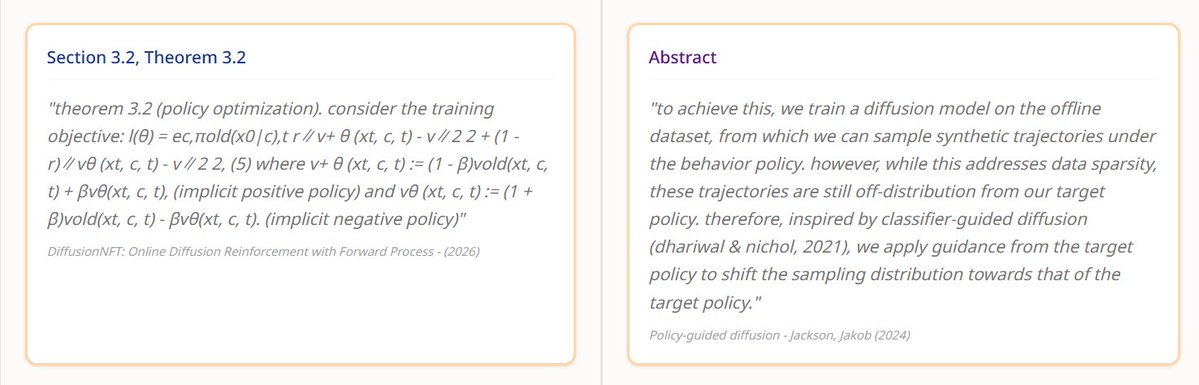
While Diffusion-NFT frames its implicit parameterization and integrated reinforcement guidance as a brand-new leap forward, our audit reveals that the underlying conceptual foundation was already detailed in prior literature. Our analysis shows:
The methodology of defining implicit positive and negative policies through linear combinations with the old policy closely mirrors existing strategies. Policy-guided Diffusion similarly applies guidance to shift distributions, demonstrating that integrating reinforcement signals into diffusion models via implicit parameterization is already an established concept.
The core approach of integrating guidance directly into the model rather than relying on separate guidance models is not unique. Policy-guided Diffusion previously computed policy gradients during the denoising process to augment generation, which is conceptually equivalent to the implicit parameterization method presented here.
It turns out this integrated framework is traveling down a path already paved by its predecessors!
Read the full investigation: https://t.co/AmCbmQ9mI7
To keep your research truly pioneering and avoid duplicating established algorithmic architectures, always use Wispaper to check for overlapping methodologies before you submit.
#OpenNovelty #Research #ICLR #Wispaper
Could this be the ultimate breakthrough that merges Reinforcement Learning with Diffusion Models?
Generating immense buzz with its high 7.3 score on OpenReview for ICLR 2026, the submission "DiffusionNFT: Online Diffusion Reinforcement with Forward Process" tackles one of AI's biggest bottlenecks. It introduces an online reinforcement framework designed to optimize diffusion policies without relying on separate, computationally heavy guidance models.
By aiming to seamlessly integrate reinforcement signals directly into the generative process, this work directly addresses the scalability challenges faced by landmark frameworks like Decision Diffuser and Diffusion-QL. It promises a much more efficient and streamlined pathway for fine-tuning generative policies in complex control tasks!
#ICLR2026 #ReinforcementLearning #DiffusionModels #GenerativeAI #MachineLearning
Hold on! OpenNovelty just pulled back the curtain on this open world pipeline!
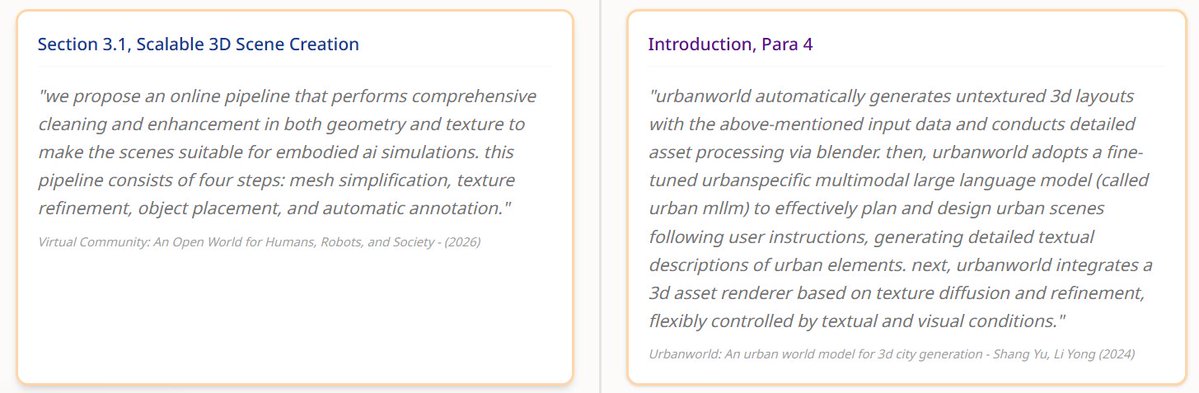
While Virtual Community presents its automated real world to 3D city generation as a major leap forward, our audit reveals that the core methodology is following a deeply carved path. Our analysis shows:
Both papers describe automated pipelines that process geospatial data through multiple stages including geometry processing, texture enhancement, and object placement, demonstrating prior work in this area.
Both systems use OSM data as input for automated generation of 3D urban environments with object placement, showing that this approach existed prior to the original paper's submission.
Both papers describe automated annotation and generation from real world geospatial data sources, demonstrating that this capability was not first introduced by the original paper.
It appears this virtual world is built on foundations already fully laid out by its predecessors!
Read the full investigation: https://t.co/ACY6GdAMVI
To ensure your research environments are truly original and to avoid replicating established data pipelines, always use Wispaper to check for overlapping frameworks before you submit.
#OpenNovelty #Research #ICLR #Wispaper
Are we finally on the verge of generating entire open world cities automatically?
Scoring a highly competitive 7.3 on OpenReview for ICLR 2026, the submission "Virtual Community: An Open World for Humans, Robots, and Society" is turning heads. This paper introduces an ambitious automated pipeline that translates real world geospatial data into massive, simulation ready 3D environments designed for humans, robots, and societal interactions.
By attempting to bridge raw mapping data with hyper realistic simulation spaces, it directly taps into the high stakes domain of next generation digital twins and autonomous driving worlds, echoing the massive scale of foundations like CityDreamer. It promises a scalable sandbox that could drastically cut the overhead for testing embodiment AI!
#ICLR2026 #DigitalTwin #AutonomousDriving #Robotics #AI
Hold on! OpenNovelty just pulled back the curtain on this open-world pipeline! 🔎
While Virtual Community presents its automated real-world to 3D city generation as a major leap forward, our audit reveals that the core methodology is following a deeply carved path. Our analysis shows:
The core methodology of building automated pipelines to generate 3D city environments from real-world data sources was already established by CityDreamer using neural fields.
The specific challenge of processing raw OpenStreetMap data and refining it into simulation-ready environments was explicitly addressed in prior construction pipelines.
The claim of dataset and pipeline scalability via multi-city generation is a concept already thoroughly demonstrated, with CityDreamer previously generating 80 cities from OSM data with automated annotation.
It appears this virtual world is built on foundations already fully laid out by its predecessors! ⚠️
Read the full investigation: 🔗 https://t.co/ACY6GdAMVI
To ensure your research environments are truly original and to avoid replicating established data pipelines, always use Wispaper to check for overlapping frameworks before you submit.
#OpenNovelty #Research #ICLR #Wispaper
Are we finally on the verge of generating entire open-world cities automatically?
Scoring a highly competitive 7.3 on OpenReview for ICLR 2026, the submission "Virtual Community: An Open World for Humans, Robots, and Society" is turning heads. This paper introduces an ambitious automated pipeline that translates real-world geospatial data into massive, simulation-ready 3D environments designed for humans, robots, and societal interactions.
By attempting to bridge raw mapping data with hyper-realistic simulation spaces, it directly taps into the high-stakes domain of next-generation digital twins and autonomous driving worlds, echoing the massive scale of foundations like CityDreamer. It promises a scalable sandbox that could drastically cut the overhead for testing embodiment AI!
#ICLR2026 #DigitalTwin #AutonomousDriving #Robotics #AI
Hold on! OpenNovelty just pulled back the curtain on this 4D tokenization concept! 🔎
While MTVCraft frames its spatio-temporal representation as a major new contribution to character animation, our audit reveals that the underlying conceptual bridge was already built. Our analysis shows:
Both papers describe 4D motion tokens as capturing spatio-temporal information from 3D joint coordinates over time.
The candidate paper proves that this exact tokenization concept was already fully established in prior literature well before this submission.
It turns out the core innovation behind these 4D tokens isn't quite as novel as it appears! ⚠️
Read the full investigation: 🔗 https://t.co/gz3omK5mGC
To keep your research truly pioneering and avoid overlapping with existing technical designs, always use Wispaper to check for prior frameworks before you submit.
#OpenNovelty #Research #ICLR #Wispaper
Is this the ultimate breakthrough for arbitrary character animation? ✨
Scoring a highly competitive 7.3 on OpenReview for ICLR 2026, the submission "MTVCraft: Tokenizing 4D Motion for Arbitrary Character Animation" is catching everyone's eye. This paper introduces a specialized framework designed to bring any 3D character to life by mastering 4D motion tokenization, unlocking seamless and realistic animations.
By bridging the gap between raw motion sequences and deep generative tokenization, it directly channels the high-impact energy of foundational graphics and animation milestones like MotionGPT and VQ-VAE architectures. It promises a universal translator for motion that could streamline game development and VFX pipelines everywhere!
#ICLR2026 #Animation #ComputerGraphics #AI #GenerativeAI
Amid soaring paper submissions and AI-generated text, OpenNovelty delivers fact-based innovation auditing to help researchers and reviewers cut through "AI Hallucinations" and "Vague Clouds" to find TRUE INNOVATION.
Our structured matrix verifies breakthroughs across four core pillars:
🌟Analytical Scan: Moves beyond surface keywords to extract deep scientific intent and verify the authenticity of claimed contributions.
🌟Mechanical Comparator: Replaces arbitrary black-box scores with side-by-side, hallucination-free verification against the 20M+ WisePaper global dataset.
🌟Evidence Mechanism: Provides court-level transparency by delivering direct, verifiable text snippets and auditing data for bias.
🌟Taxonomy Gear-Train: Maps your exact breakthrough coordinates within a multi-tiered taxonomy tree to define your niche and prove uniqueness.
The research maze is complex, but the data remains clear. See you at ICLR 2026.
Check the live audit reports: 👉 https://t.co/EjIaZ07pUL
#OpenNovelty #ScientificAudit #ICLR2026 #FutureOfScience #ResearchAI
Hold on! OpenNovelty just pulled back the curtain on this "new" metric! 🔎
While the submission frames its anatomical consistency checks as a novel contribution, our audit reveals that the underlying logic was already established. Our analysis shows:
🌟Both metrics implement mechanisms to detect and penalize mutually exclusive keypoint predictions. Whether using confidence comparison or adaptive weighting, they enforce the same fundamental anatomical consistency constraint.
🌟The goal of ensuring models produce consistent predictions by preventing simultaneous high confidence for mutually exclusive keypoints was already a core objective in LD metrics.
It appears the mathematical foundation for this "inclusive" metric was already laid by its predecessors! ⚠️
Read the full investigation: 🔗 https://t.co/KlrfVbUU8W
To ensure your research metrics are truly original and to avoid duplicating established constraints, always use Wispaper to scan for overlapping methodologies before you submit. 🛡️
#OpenNovelty #Research #ICLR #Wispaper
Can AI finally master the nuances of inclusive motion analysis? 💪
Scoring a strong 7.3 on OpenReview for ICLR 2026, InclusiveVidPose: Bridging the Pose Estimation Gap for Individuals with Limb Deficiencies in Video-Based Motion is generating serious momentum. This work introduces a specialized evaluation metric designed to ensure AI models remain anatomically accurate when tracking individuals with physical disabilities.
By addressing the specific challenges of limb deficiency, it follows the rigorous path of high impact evaluation research seen in major computer vision benchmarks. It promises to set a new standard for how we measure fairness and accuracy in human pose estimation! 🧬
#ICLR2026 #ComputerVision #InclusiveAI #PoseEstimation #AI
Hold on! OpenNovelty just pulled back the curtain on this keypoint breakthrough! 🔎
While InclusiveVidPose presents its extended keypoint schema as a major contribution to inclusive AI, our audit reveals that the mathematical blueprint was already established. Our analysis shows:
🌟Both papers describe an identical extended keypoint schema consisting of 17 COCO keypoints plus 8 residual limb endpoints at the same anatomical locations.
🌟The specific methodology of extending the COCO schema with 8 residual limb keypoints using identical numbering schemes was already proposed and practiced in LDPose.
It appears the most technical aspect of this new benchmark was already established by its predecessors! ⚠️
Read the full investigation: 🔗 https://t.co/KlrfVbUU8W
To ensure your research is truly pioneering and to avoid duplicating existing schemas, always use Wispaper to scan for overlapping studies before you submit. 🛡️
#OpenNovelty #Research #ICLR #Wispaper
Is AI finally becoming truly inclusive? 💪
The ICLR 2026 submission InclusiveVidPose: Bridging the Pose Estimation Gap for Individuals with Limb Deficiencies in Video-Based Motion is generating significant discussion with its 7.3 OpenReview score. This paper aims to solve a critical blind spot in computer vision where standard models fail to accurately track individuals with physical disabilities.
By proposing a specialized schema to bridge this gap, it aligns with the high impact work seen in major human centric AI research. It promises to empower para athletes and healthcare providers with high precision tracking that traditional systems simply cannot provide. Could this be the definitive step toward universal accessibility in AI? 🧬
#ICLR2026 #ComputerVision #InclusiveAI #Accessibility #PoseEstimation