I'm starting a thread tonight of the good things happening in Nigeria that you might have missed. I'll populate it with more as I find them.
💯❤️🇳🇬
#GoodNewsNigeria
HAPPENING NOW: H.E. Rotimi Amaechi, arrives at Nile University, Abuja. 🇳🇬
He joins the Law Students’ Society (LSS) as the Keynote Speaker for the 2026 Law Week, to deliver insights on governance, policy, and the Nigerian legal landscape. ⚖️
Live updates to follow.
AMAECHI: THE POWER SERIES
Long before power reform became fashionable, Rotimi Amaechi was already building it. He invested in generation plants, turbines, transmission lines, and substations because he believed stable electricity is not a luxury but a right. While others offered excuses, Amaechi offered proof.
His record in Rivers showed that Nigeria’s power problem is not impossible to solve. What is missing is leadership with vision, courage, and relentless commitment to results.
The destinies of over 200 million Nigerians shouldn't be gambled with.
2027 isn't for trial and error. It’s finally time for the Man of Results, Rotimi Amaechi.
@kabirusaje@AmachreeXIV Trust is built over time, and it is strengthened by being put to the test.
Amaechi has passed the test of trust. The north knows he's not using them.
Why we need Amaechi now:
- The rail lines are halfway there.
- The schools he built need a national scale.
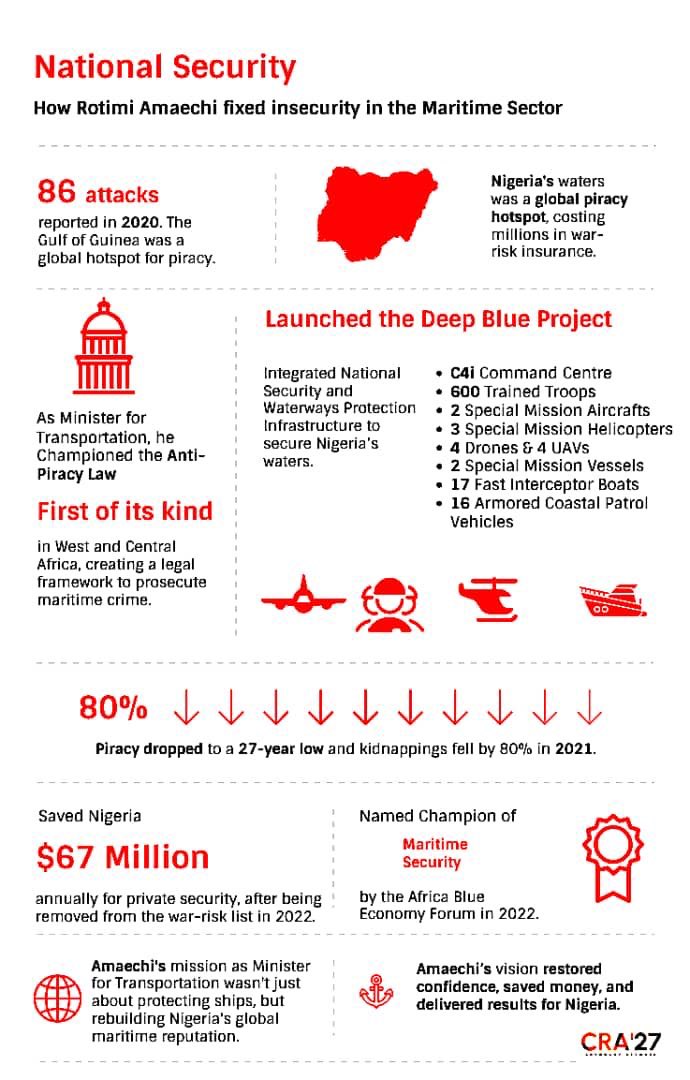
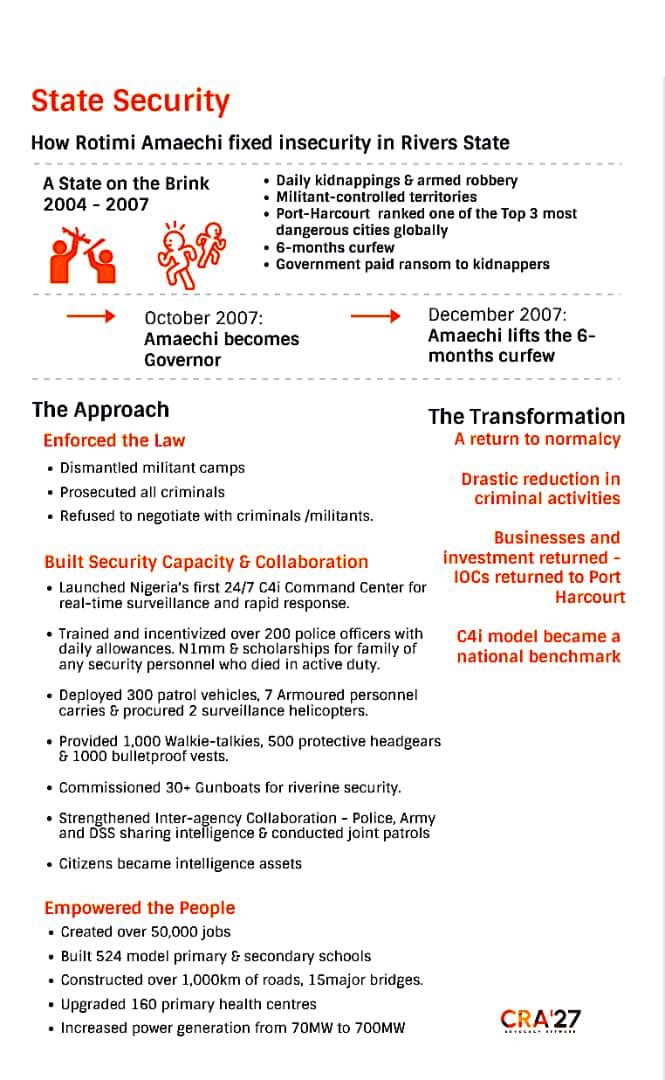
- Security needs a tested hand.
- The courage is already proven.
Nigeria is at a crossroads in 2026, and the path to progress is already paved by Amaechi’s previous works.
The Amaechi Years
by Dr. Chidi Amuta
(2015)
For the people of Nigeria’s oil and gas rich Rivers State, the arrival of the transition year 2015 should mean more than the exit of one state administration and the promise of a new one. For almost eight years, the state was under what was, in all respects, a remarkable administration. Some would even dare to insist that the state witnessed a near revolution in terms of not only the basic philosophy of governance but also a determined commitment to the actual delivery of social and physical infrastructure development.
Even the most determined critics of Chibuike Rotimi Amaechi and his administration would agree that while the Governor may have stepped on many toes, he stepped forward to make a difference in the lives of the people in a rather pragmatic, pointed and almost religious manner. He did so at a time when the desire for change was an imperative. Previous administrations had largely disappointed the people and a tradition of cynicism had become entrenched. What was quite remarkable about Governor Amaechi’s approach to governance and his stewardship over the state was that he was ready at all times to take total responsibility for the policies, programmes and missteps of his tenure as chief executive of Rivers State.
It is perhaps this combination of decisive departure from the past and the readiness to carry the burden of collective responsibility that mark Chibuike Rotimi Amaechi out as both a remarkable politician and a different breed of leader. From the outset, let us establish that here was a young man who set out to be governor of his state. He wanted the opportunity. He worked for it. He knew exactly why he wanted that opportunity. The reasons, as we shall see shortly, were embedded in his beginnings. He underwent the necessary tutelage and ran the political race. Even when the vicissitudes of Nigeria’s peculiar political culture stood in his way, he fell back on one of the time-honoured pillars of democratic culture, a reliance on the rule of law as the ultimate instrument for seeking redress and righting wrongs in a democracy.
The Nigerian legal system vindicated him and cleared his path towards the realisation of his dream of an opportunity to change the Rivers State into which he was born and raised from a back water into the promising ideal that his education and social orientation had created in his head.
In a sense, therefore, the story of Chibuike Rotimi Amaechi’s leadership of Rivers State in the eight years in which he was in office is in many ways the trajectory of his personal dream of public good and its informing vision.
Quite a lot has been said and written about the visible differences which the Amaechi administration initiated and accomplished. The roads and bridges, the multiple interchanges, the numerous state of the art schools, the health centres and hospitals and the bold agricultural projects are everywhere in evidence throughout the length and breadth of the state. Much of this book is replete with elaborate documentation and pictorial representations of these very tangible achievements.
Less visible, however, are the numerous children of Rivers State who have studied and are still studying in institutions of higher learning all over the world and in Nigeria at the instance of the administration. Still not so visible are the thousands of Rivers State youth whose material circumstances were altered for the better because they found work, found opportunity and found hope for a better life by participating or being engaged in the various development projects that the Amaechi administration embarked upon. These are not likely to mount the rostrum to adulate the administration or leadership that made these private enhancements possible…
A thread 🧵