A simple, modern way to digitally sign and timestamp files of any kind. Protect your IP and sign privately with your personal digital ID. Powered by @0xPolygon.
Introducing OpenSig.
Privacy-first IP protection for the digital age.
Timestamp your creative work on blockchain before you share it. Files never leave your device.
Beta is live now on iOS & Android.
First 3 timestamps free.
→ https://t.co/PUoAuBXLhO
The creation date in your file metadata is set by your operating system.
- It changes when you copy the file to a new device.
- It changes when you restore from a backup.
- It changes when you export from certain applications.
It is one of the most unreliable timestamps in your entire digital workflow. It is also one of the first things an opposing lawyer checks, because finding an inconsistency in your own file metadata immediately undermines everything else you present.
A blockchain timestamp does not depend on your file metadata, it exists independently of the file itself.
When a company acquires you, they audit everything.
They want to know what you built, when you built it, that you own it cleanly, and that no prior claim exists against it.
The founders who sail through IP due diligence are the ones who maintained independent records of their creation timeline throughout the building process.
The founders who struggle are the ones who built something real, know they built it first, and cannot produce the evidence to prove it to a legal team that is paid to find gaps.
The time to build that record is not during the acquisition, it is during the building.
In many IP disputes, the difference between winning and losing is measured in days.
- Which version of a design was shared before the client saw it.
- Which commit preceded the alleged theft.
- Which preprint was submitted before the competing paper was drafted.
Priority is not a vague concept. It is a specific date and time on a verifiable record.
The person who timestamped their work the day before the dispute began has a fundamentally different legal position from the person who did not.
One day. Sometimes one hour. Often the entire outcome.
Open source solves the attribution problem for code that is publicly visible. For the work that happens before you make it public, it solves nothing.
The design decisions made in private. The architecture conceived before the first commit. The proprietary method that lives in your head and your notes before it ever touches a repository.
The work that precedes the public record is often the most valuable work. It is also the work with no independent timestamp at all.
A timestamp is only as trustworthy as the infrastructure behind it.
Timestamps on OpenSig are anchored on @0xPolygon.
Records written there are not controlled by OpenSig or the chain itself.
They cannot be edited, deleted, or rewritten by us after the fact.
Polygon powers applications used by millions of people and has become infrastructure for payments, tokenized assets, and other high-volume systems.
When proving that a file existed at a specific point in time, the infrastructure matters as much as the timestamp itself.
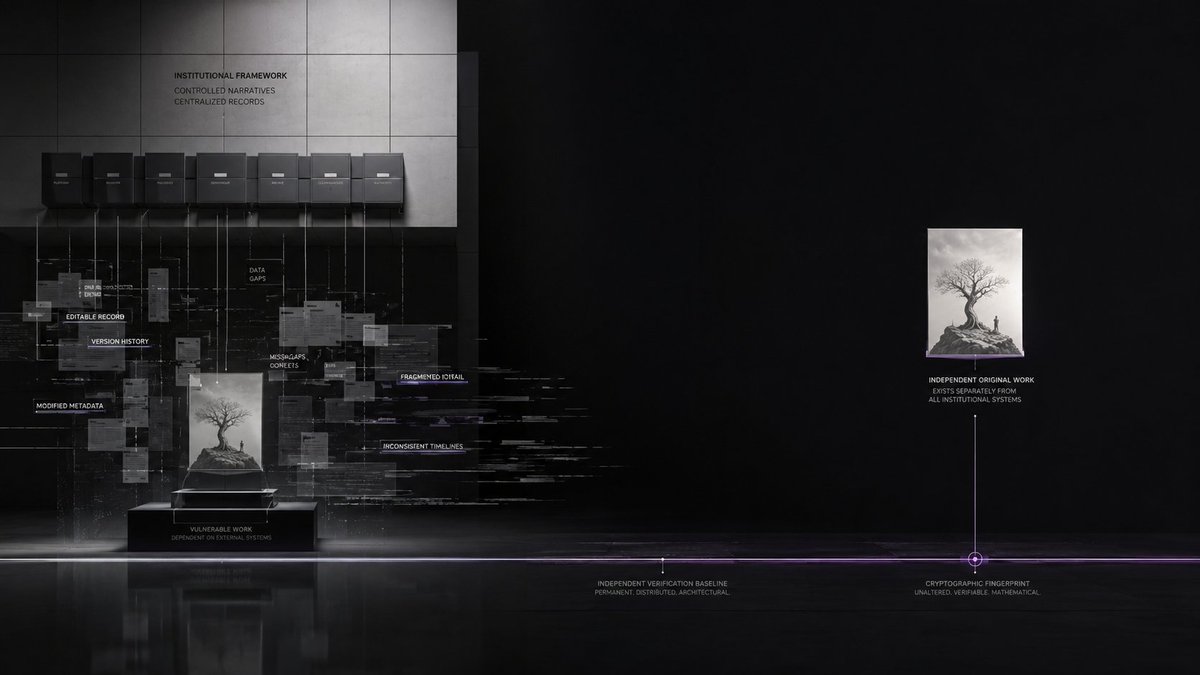
Version history in most tools is not evidence, it is a log that exists on a platform the platform controls.
It can be amended or even deleted. It can be lost when a company pivots, gets acquired, or shuts down.
Figma version history belongs to Figma. Same way Google Docs revision history belongs to Google. GitHub commit history can be rewritten.
These records are useful for your own workflow. They are not designed to survive a dispute.
The version of your work that existed on a specific date needs a record that exists outside every platform you used to create it.
Think about the last piece of work you shared with someone before it was finished.
A draft. A concept. A prototype. An early version. At the moment you shared it, what independent record existed of what it contained and when?
Not a file on your device, not a cloud timestamp.
Something that no third party could dispute, edit, or claim was created after the fact.
The reason most people cannot speak about IP disputes they have lost is that they had no evidence that could hold up independently.
A certificate from OpenSig does not guarantee you win.
It means that if a dispute arises, you have something independent, tamper-proof, and verifiable that no opposing party controls.
It means the conversation starts from a different place.
Do you that most IP disputes never reach a courtroom?
Yes, they end in settlement. And most of this settlement includes a nondisclosure agreement. The person who lost signs it in exchange for a fraction of what their work was worth.
Then they disappear.
This is why you do not hear many stories about people losing IP disputes. Not because it rarely happens.
Because the people it happens to are legally prevented from telling you.
In ten years, timestamping original work before sharing it will be considered basic professional hygiene. The same way backing up files became standard.
The same way using version control became standard. The same way having a contract became standard.
All of those practices felt optional until they didn't. The professionals who adopted them early were not paranoid, they were just ahead of a standard that was always coming.
A startup spent eighteen months building a novel software architecture.
They shared early technical details with a potential enterprise client during a lengthy sales process. The deal fell through.
Two years later, a competitor launched a product with a nearly identical architectural approach. The competitor had been in conversation with the same enterprise client.
The startup had internal documentation, git commits, employee emails with a good timeline they believed was clear. None of it constituted independent, verifiable proof of what their architecture contained on a specific date before the conversations began.
The litigation cost more than the company had raised. They settled for nothing.
When an IP dispute reaches litigation, the most expensive phase is called discovery. Discovery is the process of establishing what existed, when, and who controlled it.
It costs thousands of dollars and takes months because digital records are fragmented, platform-dependent, and hard to authenticate.
Every hour a lawyer spends reconstructing a timeline that should have been documented at creation is a cost that could have been avoided for less than a dollar.
The legal system is expensive partly because the evidentiary habits of the people entering it are poor.
OpenSig is designed to take less than sixty seconds. We built it to be fast and reliable for time-stamping your files.
When you select a file to sign, the app checks if any existing claims or approvals are on record, then creates your proof, or tells you if one already exists.
This is not an app we built just to have another time-stamp tool. We built it for you because it is exactly what the world needs.
OpenSig never accesses the content of your file or stores it. We only help you create a tamper-proof fingerprint and anchor it on a public blockchain using @0xPolygon.
We spent a lot of time making it the simplest app for anyone, regardless of background. We studied existing tools and workflows and understood what good user experience feels like.
There is a precise moment when the ability to create useful proof disappears. It is not when the dispute begins, but the moment the other party becomes aware that a dispute may exist.
After that moment, any timestamp you create is suspect. Any record you establish looks like a preparation. Any evidence you build looks like it was built in response.
The only proof that holds is the proof that predates the possibility of dispute by months or years.
Most people have none of it.
The evidence you need already exists. Every file, design and document you've made in the last five years. Every piece of research. Every version of every idea.
All of it sits on your device right now, unanchored to any independent record of when it existed.
To create proof for only takes minutes.
The work of reconstructing it after a dispute begins is sometimes impossible. You are not waiting for better tools, you are waiting for a reason that hasn't arrived yet.
That reason usually arrives too late to use.
Google Drive timestamp:
- Controlled by Google.
- Editable by Google.
- Deleted if Google decides to.
- Worthless if Google changes their terms.
Blockchain timestamp:
- controlled by a public network of thousands of independent nodes.
- Editable by no one.
- Permanent by design.
- Works regardless of any single company's decisions.
One of these is a record. The other is proof.
A backup is not a timestamp. A backup proves your file exists somewhere, while a timestamp proves your file existed at a specific moment in time.
One protects against loss, the other protects against dispute.
Most workflows have the first.
Do you timestamp your workflows?
Self-sovereign means the record belongs to you, not to the platform that helped you create it.
- If the company that issued your proof shuts down tomorrow, your proof still works.
- If their servers are hacked, your proof is unaffected.
- If they're acquired, pressured, or simply change their terms, your proof doesn't change with them.
That's what self-sovereign actually means. Most tools don't offer it.