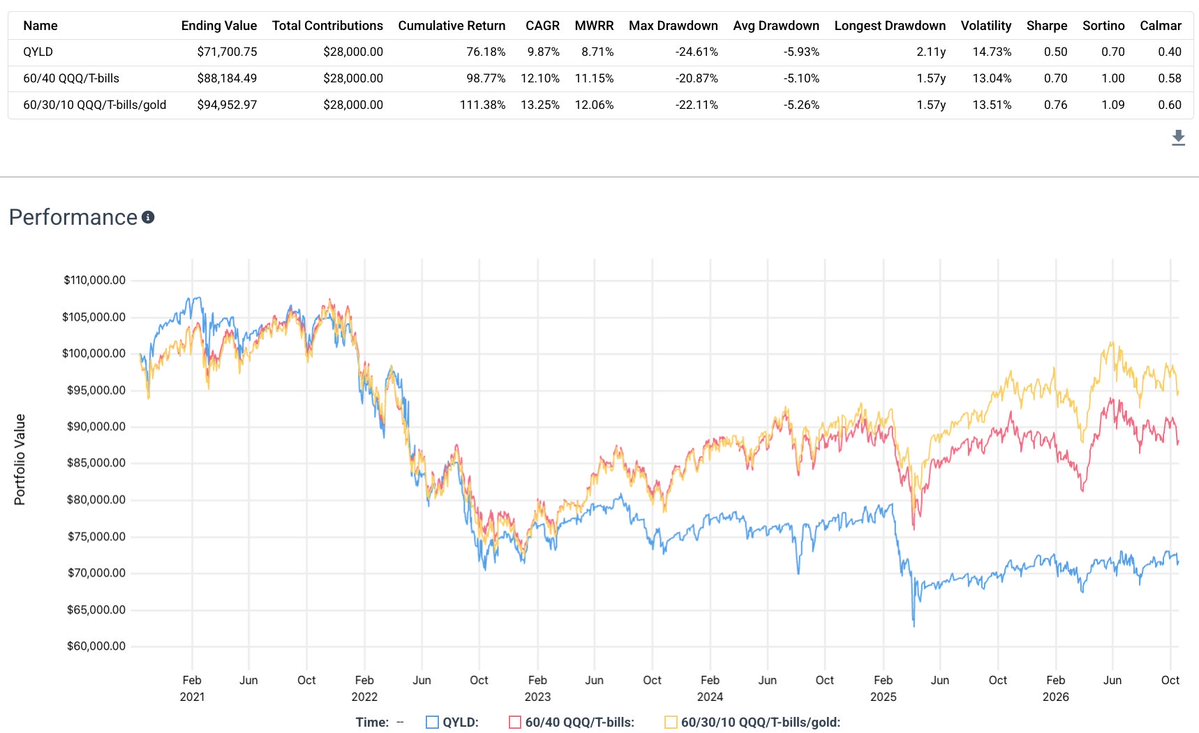
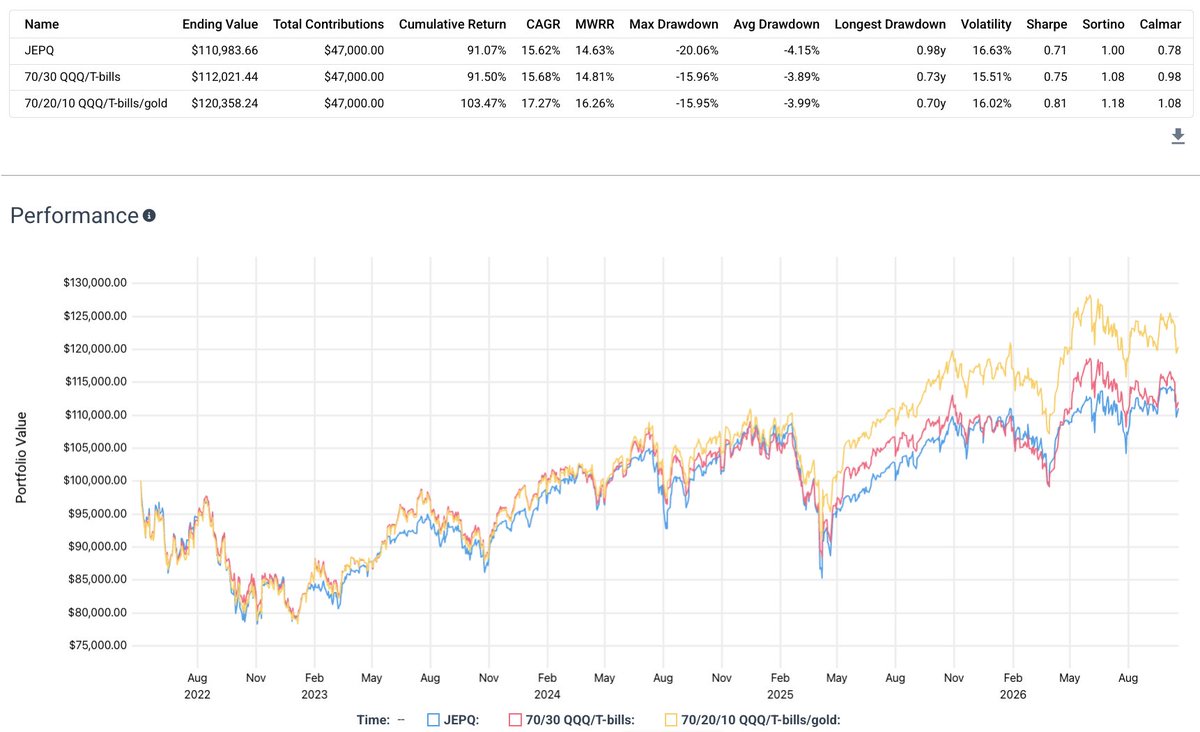
I maintain that one can typically extract any given requisite income more efficiently than a covered call "income" fund, even after taxes, from a simple, diversified mix of traditional low cost index funds.
Long tweet ahead. Strap in.
What do I mean by “more efficiently?” The same income with lower risk or more income at the same risk. Conveniently, we typically see both - more income and lower risk.
There will, of course, be some specific short periods of choppy sideways markets when assets converge where I'm wrong on this but I think on average, for any reasonably long horizon, I won't be (even with the newer, fancier iterations of these products). We care about how the portfolio delivers income across the whole decumulation period, not over a snapshot of a month or 2.
(Let’s also go ahead and get this out of the way - no one is suggesting you just buy the underlying index and come out ahead. That’s not the argument. I’m talking about using a diversified portfolio for current income today. So please don’t come at me with that accusation.)
I've attached a few examples of this concept using older funds with at least a little bit of history.
I've described these older products like PBP and XYLD as comparatively more "blunt" - full overwrite coverage and ATM options - compared to newer iterations like SPYI and GPIX that are more nuanced and active, don't write on the whole equity book, and use OTM options.
Proponents of covered call "Income" funds reflexively say these older ones are the "worst" examples to use and that I'm being unfair and idiotic in doing so. I do so purely to get a longer observable time period for more robust data, i.e. more observations, which is Stats 101. I'm happy to run the numbers with the newer products too, and I've done that, but most of them are only a few years old at most and haven't even seen the environment in which they'd shine. I make sure to explicitly point this out in all my articles on these funds.
The trap the influencers and novices continually fall into is thinking the implementation and management of any given covered call product is what makes or breaks it. It's not. It's the fundamental inefficiency and asymmetry of the covered call trade itself. They think the next iteration of a flashy high-yield covered call product will finally be the holy grail to break the curse and solve the issues. It won't. Ironically, the only way to do so is to remove the covered call trade entirely.
I mentioned this in my first blog post on this topic years ago. First QYLD and XYLD from Global X were the new hot thing among yield chasers. Then they moved on to JEPQ and JEPI from JPMorgan, and QYLD and XYLD were viewed with disdain. Now it's ostensibly GPIQ/GPIX from Goldman and QQQI/SPYI from NEOS, which Goldman is acquiring. Now anyone who even mentions JEPQ or JEPI is labeled a moron.
But NEOS and Goldman can’t change option math. Meet the new boss, same as the old boss.
These products satisfy a psychological desire to avoid liquidating shares. Totally understandable. But appreciate that they are not magically dismissing sequence risk, improving realized Safe Withdrawal Rate, or allowing for earlier retirement. Your favorite finfluencer is probably claiming it’ll do all 3. The marketing materials of these products even sometimes hint at such fanciful abilities.
(Previously, it was admittedly arguably logistically harder to liquidate shares too. Fair. But nowadays, the broker can auto-sell for me and transfer cash to my bank account monthly without me logging in or lifting a finger. Same outcome.)
Those same people will say this is a new wave of retirement products that opens new doors (“this time is different”) and that I’m just not up to date on the recent research. I think this is pretty silly fundamentally even if only for the fact that markets are still markets. But the irony is we’ve had boatloads of research on this type of product because it’s existed for decades, long before NEOS tacked on some tinsel like 1256 treatment and a long call leg. Those are probably improvements, no doubt, but they don’t move the needle on the elephant in the room I mentioned earlier - the CC trade itself. The “research” they’re citing is marketing literature from the fund provider, who probably pays the influencer anyway.
The CC trade necessarily caps upside and doesn’t adequately mitigate the downside proportionately. This is what we mean by “inefficiency” and “asymmetry.” Lower volatility of these products is just less market exposure. You can do that by …owning less of the market.
In point of fact, the behavior of the fund often doesn’t look dissimilar from just holding the underlying + cash, which I’ve shown here, and which many smarter than me have also shown. Appreciate the hilarious irony that despite what content creators in this space will tell you, a naive 90/10 underlying/cash allocation often beats the flashy, complex, expensive “income” product by virtually any measure.
To add insult to injury, these products always carry pretty hefty fees, comparatively, which almost always easily cancel out any purported tax benefit from ROC, which I’ve also shown: https://t.co/XIxDEKk806
I sympathize with the novice investors because I believe they want to believe the empty promises. But these products often don't even pass the sniff test. If it sounds too good to be true, it probably is. If a YouTuber is talking about retiring early on 12% yield with only $300k when the conventional rules of thumb fly in the face of that assertion, your spidey sense should at least be tingling and you owe it to your future financial well-being to at least do more research.
As an aside, sequence risk is a big factor here that every single finfluencer I've seen hawking these products loves to ignore completely: https://t.co/upQDDwHawX
It’s neither obvious nor intuitive that the high distribution rates like 12% are not really returns. Ben appropriately calls it an “illusion.” That’s how you can end up with a fund like QYLD with a distribution rate of 12% and a long term total return of only 9%. The return can be less than the distribution rate. Many don't realize this. In short, these funds often end up having to distribute from their own capital base, because the prospectus says they have to distribute but it doesn't say they must earn more than they distribute.
Don’t get caught up in the mental accounting of viewing yield and price return separately. As always, total return is all that matters at the end of the day. That’s what’s paying your bills.
To keep numbers nice and round, I used $100k starting and $1k/mo. income (12% distribution rate) for all these.
In short, if you want the most income and the most stability thereof, the evidence, even over short recent periods for newer products, shows covered call funds are probably not the way to go (at least not going all in on them). Only time will tell, though, how that claim matches up with one’s personal retirement horizon, but then that’s my argument for diversifying broadly in the first place…
Let me know what I forgot or if I can clarify anything or answer any questions, but you’ll probably find those answers in existing posts where I’ve already broken all this down into even greater detail:
https://t.co/6Vhq9AOjs0
https://t.co/FnxLSJYM4K
https://t.co/yQy5D0eHRJ
Where are you wrong?
1. Thinking and suggesting the "tax efficiency" of these products is anything meaningful. It often doesn't even overcome the higher fee.
2. Thinking and suggesting options trading is objectively a benefit.
3. Thinking and suggesting one needs to be "switching" anything at any point.
4. Thinking and suggesting income funds allow for earlier FI or retirement.
5. Suggesting high payouts are sustainable forever while completely ignoring sequence risk.
6. Similarly, suggesting yield = withdrawal rate.
7. Suggesting future returns and withdrawal rates will be significantly higher than anything we've seen in the centuries since the advent of financial markets.
8. Saying the income product category is a "sector."
9. Saying income products are "new." (They've been around for decades.)
10. Saying no one does the "math" you post, when advisors literally do it daily.
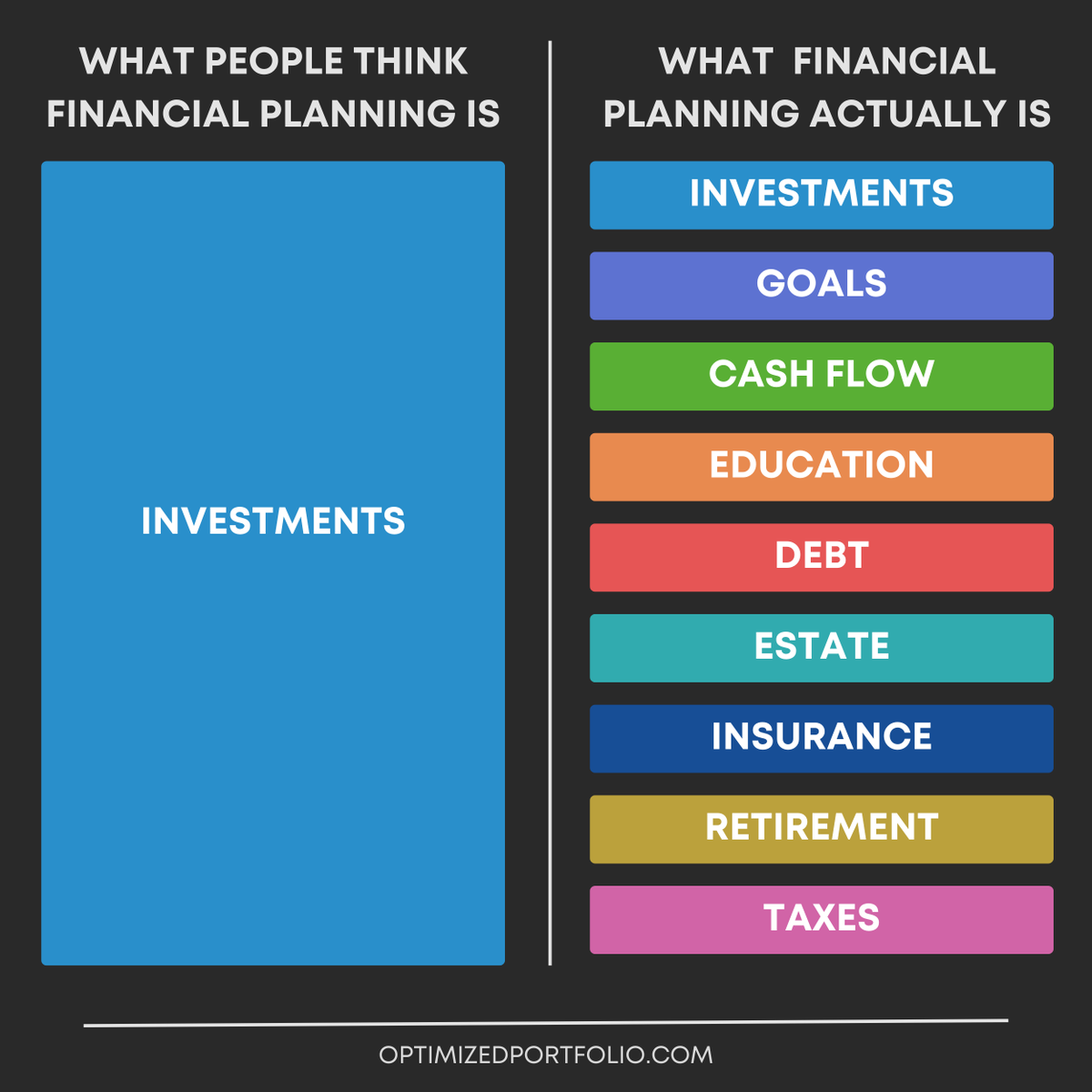
11. Thinking and suggesting advisors only do investments when that's usually one small piece of their offering.
12. Thinking and suggesting number of shares is important and that they pay your bills. (They don't. Dollars do.)
13. Thinking and suggesting liquidating shares for LTCG is objectively inferior to receiving a distribution.
14. Thinking and suggesting the famous 4% Not-a-Rule is a rigid withdrawal protocol.
15. Using illogical false dichotomies incessantly.
16. Thinking and suggesting NAV change of an income product does not affect its monthly payout.
17. Generally, posting authoritatively about things you clearly don't fully understand (or are willfully ignorant about to maintain the brand).
18. Saying income funds used to be "locked behind Wall Street's velvet rope."
19. Feigning innocence while knowingly posting misleading engagement bait.
20. Assuming everyone wants to manage their own finances and shouldn't pay a fiduciary advisor for help.
What did I miss?
Even if income is one's goal, I maintain that they still don't need an "income" ETF.
You're posting opinions on a public forum, dude. Why would it be surprising to you that people are replying with their own opinions that might be different? Welcome to the internet. It sounds like maybe you didn't fully grasp the category you were stepping into and the implications thereof. I understand you've gone all in on these products making them your whole brand, but let's be clear, you're not "confused" on why people are calling you out for posting misleading slop: https://t.co/ndwdmQZmLy
Absolutely there are bad actors on here trolling just to troll, for the love of the game. Or for clicks to some content of theirs. I've run across a handful on my own posts that I've muted. I just don't see that in this particular instance, hence the confusion on the simplistic assessment.
I guess I reserve terms like "haters" and "trolls" for those actual bad actors who are clearly just hating and trolling, not for real people offering up legitimate criticism, whether or not it contains links. Maybe there's gray area there. And maybe I'm naive.
I'd also think that algo change here where the impressions have to be on your own posts and not replies - or whatever it is - would tamp down the spam/troll stuff, but I don't know the specifics of how all that works.
Twitter is objectively a waste of time for me. I'm not monetized and likely never will be, and when I do post a link, clicks to the content are laughably negligible. Wrt ROI, my time would be far better spent on other channels. I get the occasional DM from someone saying they learned something new or that a particular post or reply was helpful for them, so I tell myself that's why I'm here.
Where are you wrong?
1. Thinking and suggesting the "tax efficiency" of these products is anything meaningful. It often doesn't even overcome the higher fee.
2. Thinking and suggesting options trading is objectively a benefit.
3. Thinking and suggesting one needs to be "switching" anything at any point.
4. Thinking and suggesting income funds allow for earlier FI or retirement.
5. Suggesting high payouts are sustainable forever while completely ignoring sequence risk.
6. Similarly, suggesting yield = withdrawal rate.
7. Suggesting future returns and withdrawal rates will be significantly higher than anything we've seen in the centuries since the advent of financial markets.
8. Saying the income product category is a "sector."
9. Saying income products are "new." (They've been around for decades.)
10. Saying no one does the "math" you post, when advisors literally do it daily.
11. Thinking and suggesting advisors only do investments when that's usually one small piece of their offering.
12. Thinking and suggesting number of shares is important and that they pay your bills. (They don't. Dollars do.)
13. Thinking and suggesting liquidating shares for LTCG is objectively inferior to receiving a distribution.
14. Thinking and suggesting the famous 4% Not-a-Rule is a rigid withdrawal protocol.
15. Using illogical false dichotomies incessantly.
16. Thinking and suggesting NAV change of an income product does not affect its monthly payout.
17. Generally, posting authoritatively about things you clearly don't fully understand (or are willfully ignorant about to maintain the brand).
18. Saying income funds used to be "locked behind Wall Street's velvet rope."
19. Feigning innocence while knowingly posting misleading engagement bait.
20. Assuming everyone wants to manage their own finances and shouldn't pay a fiduciary advisor for help.
What did I miss?
Even if income is one's goal, I maintain that they still don't need an "income" ETF.
You're posting opinions on a public forum, dude. Why would it be surprising to you that people are replying with their own opinions that might be different? Welcome to the internet. It sounds like maybe you didn't fully grasp the category you were stepping into and the implications thereof. I understand you've gone all in on these products making them your whole brand, but let's be clear, you're not "confused" on why people are calling you out for posting misleading slop: https://t.co/ndwdmQZmLy
I appreciate the respect. My goal is actually to just stir up conversation on X so more people engage with Income ETFs. There is actually more hate lately so giving them something to talk about gets more eyes on the strategies. If you are in indexed income etfs (like I am for the most part) i dont think this is unrealistic given we continue in a upward trending market.
Definitely. But if I am - or others are - just replying to a post with a different opinion with no links to anything, what, specifically, are we hoping to get clicks to?
Arguably more importantly, if I'm taking the time to write a long tweet and including links to what I'm referencing in a long explanation, is the purpose of writing it really solely to try to get clicks on that link or is it to try to comprehensively explain the thing? I might get 1 click out of a thousand people. Doing so purely for a click would be a waste of time, and there are more effective and efficient ways to get those clicks if that's the goal. And realistically, would we even expect the OP or his followers to click anything housed in a dissenting opinion or follow that account at the end of the day? Probably not.
So I guess I don't understand what you mean when you say people replying are just "hating for clicks." That seems like a silly assessment to me. It makes no sense fundamentally. To me, that description sounds like someone spamming their same YouTube video or something in a vacuous reply to all of this guy's posts. I don't think anyone is doing that. I'm certainly not.
So if, let's say, 90% of replies don't have links to anything, I ask again, what, specifically, are those 90% hoping to get clicks to?
$ROCY is JPM's answer to SPYI and GPIX.
It basically takes JEPI, adds a long call leg, aims for ROC, and drops the ELN's, so notched upside instead of capped, better tax treatment, and less counterparty risk.
New review here: https://t.co/ltUgyl9Rgz
The app says my annual projection is about $76,200.
Most people would treat that like a resignation letter.
I still have a job.
The job buys more shares.
The shares buy back the bills, pay down margin & buy growth assets.
Wild or smart?
@MarkMcGrathCFP@kingpriyom@incomeetfguy I still haven't figured out if this guy is a bot or just a strange, combative, petulant human who can't write legibly.
Great way to mitigate the cognitive dissonance that comes from knowingly posting misleading engagement bait slop for a grift is to just say the people who rightly call you out for it are "HaTeRs."
I appreciate the respect. My goal is actually to just stir up conversation on X so more people engage with Income ETFs. There is actually more hate lately so giving them something to talk about gets more eyes on the strategies. If you are in indexed income etfs (like I am for the most part) i dont think this is unrealistic given we continue in a upward trending market.
@incomeetfguy I'd say this carries more risk than either:
Not understanding options nor income ETFs yet consuming content from someone who also does not fully understand the strategies themselves.
I've seen many advisors already say they've had to review nonsense outputs from AI that clients hand them and point out the inaccuracies. I've had to do this multiple times in my own industry too. If acted upon blindly, things may end badly. At best, the individual probably won't feel 100% confident without a competent human reviewing it. Again, the LLM is often confidently incorrect, and prompts themselves are a skill. So not nearly as "close" as you seem to think.
You seem to be erroneously assuming everyone wants to manage their own finances. Most don't and wouldn't even know how to ask an AI to do it, much less handle the implementation. You are not the target audience. Moreover, the AI is often confidently incorrect, as we've seen from some of your own bogus tweets. Aside from that, a lot of the value is the intangible human part. Nuance exists. The lazy, reductive "AI can replace advisors" take is so tiresome and is not the insult you seem to think it is. https://t.co/i5giqCvKGD
Reminder: An advisor worth their salt can correct the behavioral mistakes that will cost the investor far more than 1%. Those mistakes are how we get the chart below.
Fees matter, but we're usually referring to fund fees. The misplaced advisor fee fearmongering is so tiresome.
Got it. I'm of the mind that one can simply liquidate shares of low cost index funds for the same outcome and typically a superior risk/return profile, but I suppose that's a separate conversation. The income funds are still selling the underlying assets, it's just less visible than you hitting the sell button. Thanks for replying. https://t.co/vOQ0NcdJOo
I maintain that one can typically extract any given requisite income more efficiently than a covered call "income" fund, even after taxes, from a simple, diversified mix of traditional low cost index funds.
Long tweet ahead. Strap in.
What do I mean by “more efficiently?” The same income with lower risk or more income at the same risk. Conveniently, we typically see both - more income and lower risk.
There will, of course, be some specific short periods of choppy sideways markets when assets converge where I'm wrong on this but I think on average, for any reasonably long horizon, I won't be (even with the newer, fancier iterations of these products). We care about how the portfolio delivers income across the whole decumulation period, not over a snapshot of a month or 2.
(Let’s also go ahead and get this out of the way - no one is suggesting you just buy the underlying index and come out ahead. That’s not the argument. I’m talking about using a diversified portfolio for current income today. So please don’t come at me with that accusation.)
I've attached a few examples of this concept using older funds with at least a little bit of history.
I've described these older products like PBP and XYLD as comparatively more "blunt" - full overwrite coverage and ATM options - compared to newer iterations like SPYI and GPIX that are more nuanced and active, don't write on the whole equity book, and use OTM options.
Proponents of covered call "Income" funds reflexively say these older ones are the "worst" examples to use and that I'm being unfair and idiotic in doing so. I do so purely to get a longer observable time period for more robust data, i.e. more observations, which is Stats 101. I'm happy to run the numbers with the newer products too, and I've done that, but most of them are only a few years old at most and haven't even seen the environment in which they'd shine. I make sure to explicitly point this out in all my articles on these funds.
The trap the influencers and novices continually fall into is thinking the implementation and management of any given covered call product is what makes or breaks it. It's not. It's the fundamental inefficiency and asymmetry of the covered call trade itself. They think the next iteration of a flashy high-yield covered call product will finally be the holy grail to break the curse and solve the issues. It won't. Ironically, the only way to do so is to remove the covered call trade entirely.
I mentioned this in my first blog post on this topic years ago. First QYLD and XYLD from Global X were the new hot thing among yield chasers. Then they moved on to JEPQ and JEPI from JPMorgan, and QYLD and XYLD were viewed with disdain. Now it's ostensibly GPIQ/GPIX from Goldman and QQQI/SPYI from NEOS, which Goldman is acquiring. Now anyone who even mentions JEPQ or JEPI is labeled a moron.
But NEOS and Goldman can’t change option math. Meet the new boss, same as the old boss.
These products satisfy a psychological desire to avoid liquidating shares. Totally understandable. But appreciate that they are not magically dismissing sequence risk, improving realized Safe Withdrawal Rate, or allowing for earlier retirement. Your favorite finfluencer is probably claiming it’ll do all 3. The marketing materials of these products even sometimes hint at such fanciful abilities.
(Previously, it was admittedly arguably logistically harder to liquidate shares too. Fair. But nowadays, the broker can auto-sell for me and transfer cash to my bank account monthly without me logging in or lifting a finger. Same outcome.)
Those same people will say this is a new wave of retirement products that opens new doors (“this time is different”) and that I’m just not up to date on the recent research. I think this is pretty silly fundamentally even if only for the fact that markets are still markets. But the irony is we’ve had boatloads of research on this type of product because it’s existed for decades, long before NEOS tacked on some tinsel like 1256 treatment and a long call leg. Those are probably improvements, no doubt, but they don’t move the needle on the elephant in the room I mentioned earlier - the CC trade itself. The “research” they’re citing is marketing literature from the fund provider, who probably pays the influencer anyway.
The CC trade necessarily caps upside and doesn’t adequately mitigate the downside proportionately. This is what we mean by “inefficiency” and “asymmetry.” Lower volatility of these products is just less market exposure. You can do that by …owning less of the market.
In point of fact, the behavior of the fund often doesn’t look dissimilar from just holding the underlying + cash, which I’ve shown here, and which many smarter than me have also shown. Appreciate the hilarious irony that despite what content creators in this space will tell you, a naive 90/10 underlying/cash allocation often beats the flashy, complex, expensive “income” product by virtually any measure.
To add insult to injury, these products always carry pretty hefty fees, comparatively, which almost always easily cancel out any purported tax benefit from ROC, which I’ve also shown: https://t.co/XIxDEKk806
I sympathize with the novice investors because I believe they want to believe the empty promises. But these products often don't even pass the sniff test. If it sounds too good to be true, it probably is. If a YouTuber is talking about retiring early on 12% yield with only $300k when the conventional rules of thumb fly in the face of that assertion, your spidey sense should at least be tingling and you owe it to your future financial well-being to at least do more research.
As an aside, sequence risk is a big factor here that every single finfluencer I've seen hawking these products loves to ignore completely: https://t.co/upQDDwHawX
It’s neither obvious nor intuitive that the high distribution rates like 12% are not really returns. Ben appropriately calls it an “illusion.” That’s how you can end up with a fund like QYLD with a distribution rate of 12% and a long term total return of only 9%. The return can be less than the distribution rate. Many don't realize this. In short, these funds often end up having to distribute from their own capital base, because the prospectus says they have to distribute but it doesn't say they must earn more than they distribute.
Don’t get caught up in the mental accounting of viewing yield and price return separately. As always, total return is all that matters at the end of the day. That’s what’s paying your bills.
To keep numbers nice and round, I used $100k starting and $1k/mo. income (12% distribution rate) for all these.
In short, if you want the most income and the most stability thereof, the evidence, even over short recent periods for newer products, shows covered call funds are probably not the way to go (at least not going all in on them). Only time will tell, though, how that claim matches up with one’s personal retirement horizon, but then that’s my argument for diversifying broadly in the first place…
Let me know what I forgot or if I can clarify anything or answer any questions, but you’ll probably find those answers in existing posts where I’ve already broken all this down into even greater detail:
https://t.co/6Vhq9AOjs0
https://t.co/FnxLSJYM4K
https://t.co/yQy5D0eHRJ
@incomeetfguy@trades_hayes@A1Drizzy1@grok Just saying the people who call out the BS are "hAtErS" is a profoundly lazy attempt at a positive PR spin on the grift. If your own supporters are saying they're tired of it, maybe consider changing course.
@nevermind_bruh@incomeetfguy Market timing tends to be harmful than helpful.
Remember it's also not the same risk/return. Over time, the covered call strategy tends to be less efficient; I've shown as much many times. It's not purely a logistical preference.
@cliffcornell_@incomeetfguy@grok Definitely the shtick and engagement. Guy replies to himself on his other account. Platform manipulation, but who's counting...
Sad, indeed. Guy could be more honest and thorough and provide big value to a big following. The income ETF grift is strong.