Personal update: I've joined Anthropic. I think the next few years at the frontier of LLMs will be especially formative. I am very excited to join the team here and get back to R&D. I remain deeply passionate about education and plan to resume my work on it in time.
Anthropic released Opus 4.7 a month ago. They said the model follows instructions more literally than older Claude versions, and people should rewrite their system prompts to match.
Claude Code didn't.
Its system prompt is roughly the same one Opus 4.6 needed - around 30K characters, shared with Sonnet 4.6 and Haiku 4.5 in one binary. 4.7 reads all of it and follows every line.
I installed skrabe/lobotomized-claude-code yesterday. It cuts ~20K characters of that out. 4.7 feels normal again. Less restating, less acknowledgement, more direct.
Long-term, Anthropic's own product should ship a prompt that matches Anthropic's own guidance. Until then, this is the working version of Claude Code on Opus 4.7.
Anthropic published an audiobook of Claude's constitution. Being helpful section is worth the listen.
Key insight: they trained judgment over rules. Training narrow behavior like "always deflect emotional topics" teaches the wrong lesson - "I protect myself over helping you." Breaks trust systemwide.
So they prioritize helpfulness over liability. Claude should adjust when a rule doesn't serve the user, not default to safe responses.
Most AI teams are about to learn the same lesson crypto learned with MiCA: regulators want immutable audit logs, and your debug tooling isn't built for that.
EU AI Act Article 12 ships August 2. Requirements: automatic event logs, 6-month minimum retention, structured format regulators can query. Same shape as MiCA Article 60 and Travel Rule.
You'll see takes saying Langfuse / Phoenix / Helicone can't satisfy this. Wrong. Practical AI Act Guide lists them as recommended tools. Gap isn't capability - it's config.
Defaults ship for debug: 30-90 day retention, sampling enabled, no tamper-evidence, missing structured fields Article 12 wants.
Crypto builders recognize these primitives. Append-only logs. Hash chains. Content-addressed storage. You already have the substrate if you've built wallet infrastructure or on-chain indexers.
Most AI teams don't. They're running observability stacks optimized for debugging, not compliance-grade audit trails.
MiCA is still messy in 2026. Travel Rule interop breaks across providers. Same pattern incoming for AI log retention - standardized requirements, fragmented tooling, config gaps everyone discovers too late.
Real risk isn't the fine. It's when an EU customer asks for Article 12 evidence and you realize you can't backfill 6 months of retention.
If you're already running append-only logs with tamper-evidence, you're most of the way there. If you're not, check your retention defaults now.
Claude Code has a feature called Auto Dream.
After a session ends, a forked sub-agent reads your auto-memory directory, merges new learnings into existing topic files, resolves contradictions, prunes stale memories, and rewrites the MEMORY.md index. It's the janitor for the auto-memory system.
It fires every 24 hours, once you have 5 new sessions since the last run. While it runs, the bottom status bar shows "dreaming".
Enable it by adding this to ~/.claude/settings.json:
"autoDreamEnabled": true
If you use auto-memory, this keeps it tidy across sessions without you having to manage it.
@BoazWith Interesting fact - Claude Code uses sonnet/opus models for memory retrieval to pick the relevant memory files. Not the classic heuristics you would expect, or classic rerankers for that matter.
And they also enforce limitations on the size of memory files and their content too.
30-line agent-browser recipe outperformed three dedicated webpage-to-PDF tools.
Tried capture-website-cli (text huge and unusable), shot-scraper (blank rectangles for lazy-loaded diagrams), percollate (worked but reader-mode only).
The trick is in percollate's CHANGELOG: remove loading="lazy" before render. Chromium loads everything eagerly. Stole it for agent-browser:
1. removeAttribute("loading") on every img
2. Scroll the page in 400px steps
3. await Promise.all on every img.complete
4. Then pdf
All in one async eval. agent-browser awaits the promise before the next command, so pdf sees a fully decoded DOM. 0 broken images across 6 sites tested.
npx skills add tenequm/skills --skill download-webpage-as-pdf
Right primitive + small skill can beat purpose-built tools. Sometimes.
Claude Code keeps cloning vendor repos into random spots in your project? Annoying.
Fixed it with a CLAUDE\.md prompt. Drop this in your user-scope config:
```
## Third-party Repos
- Clone third-party / vendor repos into `~/pjv/<owner>/<repo>` (mirrors the GitHub URL structure) whenever you need full local source for analysis, grep, or investigation. Always lowercase `<owner>` and `<repo>` for consistency, regardless of upstream casing. Never clone into the current project or scratch locations.
- For lightweight remote inspection (reading a file, browsing structure, comparing), prefer the surf MCP tools instead of cloning.
- Reuse existing clones in `~/pjv/`; `git pull` to refresh rather than re-cloning.
```
Now all vendor deps go to ~/pjv/ with clean naming. No more hunting through nested directories.
If you can't tell if it's Claude Code glitching or you today - it's not you 😉
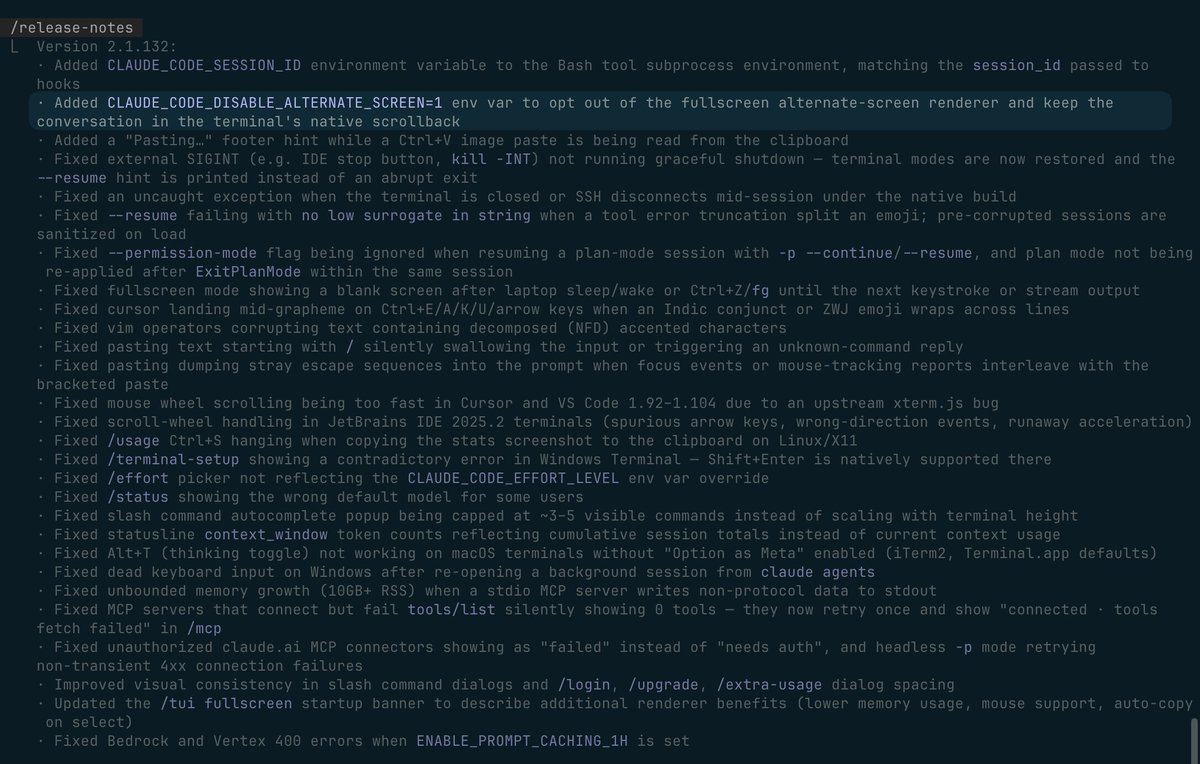
New alternate screen mode from latest release breaks history scroll. Here is the quick fix:
`yq -i -o=json '.env.CLAUDE_CODE_DISABLE_ALTERNATE_SCREEN = "1"' ~/.claude/settings.json`
Brings the interface back to normal.
Spent time with Anthropic's Managed Agents docs.
Agent systems don't stop moving. Every layer evolves on its own clock, so the hard part is picking the seams that let each layer keep evolving without breaking the rest.
They crystallized six core components. Each gets a minimal interface:
- Session: append-only event log
- Orchestration: wake(session_id)
- Harness: stateless loop that yields effects
- Sandbox: executor for tools
- Resources: durable references with credentials bundled in
- Tools: name + input schema
Not new ideas - event sourcing, workflow engines, actor models. But naming the pattern lets each layer evolve independently without breaking the others.
Yes, distributed systems = distributed problems. But without these boundaries you're debugging one giant process where every failure looks identical. The constraints enable fault tolerance, structural security, and lazy provisioning.
It's the first architecture I've seen that gives developers stable contracts without over-specifying too early. Most frameworks tried to predict what agents should be. This one names what already works.
built mpp Playground for @tempo - a single place to test machine payments end-to-end
- inspect any MPP endpoint end-to-end
- pay with a passkey via the accounts sdk
- generate hosted payment links in one click
- html builder for custom payment UIs (coming soon)
built with mppx @mpp
link: https://t.co/iKUcIPlS0X