Cancer Fighter in Remission🎗, Crypto & Disruptive Tech Enthusiast: $BTC, $MSTR, $MTPLF, $SOL, $TSLA, etc. as well as Geopolitical Events Affecting Markets.
Everyone is sharing this $BTC chart. What's the chance it actually happens?
TBH, as far as I'm concerned no one knows shit. That's the one thing I'm sure of.
So, I stack by DCAing every single day.. on auto pilot literally.
Same amount every single day.
Patience and diligence will hopefully beat calling the exact bottom.
Everyone is sharing this $BTC chart. What's the chance it actually happens?
TBH, as far as I'm concerned no one knows shit. That's the one thing I'm sure of.
So, I stack by DCAing every single day.. on auto pilot literally.
Same amount every single day.
Patience and diligence will hopefully beat calling the exact bottom.
I also started buying High Yield Dividends ETFs with a focus on a balance portfolio and as little Nav decay as possible.
Love the stability and income it brings in these rough waters markets. Still getting paid a few times a week just to hold.
Some of of those Ive been DCAing into the last few months: $BLOX, $GIAX, $QQQI, $GPIQ, $GPIX, $SPYI, $QDVO, $TDAQ, $PLTI, $TSLI, $NVII, etc
Everyone is sharing this $BTC chart. What's the chance it actually happens?
TBH, as far as im concerned no one knows shit. That's the one thing Im sure of.
So, I stack by DCAing evry single day.. on auto pilot literally.
Same amount every single day.
Patience and diligence will hopefully beat calling the exact bottom.
☕ THE FUTURE OF INTERFACES: Google Unveils "Dreambeans" (The Morning Daily Digest Generated by AI)
In a world filled with endless scrolling and digital noise, Google Labs has just launched its latest major experiment: Dreambeans. Powered by Google’s advanced Personal Intelligence capabilities and the Nano Banana 2 model, this tool aims to fundamentally reinvent how we interact with notifications and daily information overload.
Instead of scrolling endlessly through impersonal social feeds, Dreambeans generates a finite, hyper-personalized collection of daily stories each morning, complete with custom illustrations, designed to connect you instantly to what matters most in your life.
🧠 How the "Dreamed-Up Daily Digest" Works:
Ecosystem Hyper-Connection: With your explicit permission, the AI securely connects and cross-references data from your primary Google apps—including Gmail, Calendar, Photos, YouTube, and Search history.
Intelligent Contextual Linking: The tool connects separate dots in your life. For example, if you receive a Gmail confirmation that puppy treats were delivered, Dreambeans will surface relevant training tips. If it detects a Google Calendar reminder that a friend is visiting, it merges that data to recommend dog-friendly restaurants near you.
Custom Visuals: Every morning story features a unique AI-generated illustration reflecting the specific people and places you frequent the most.
Granular Feedback Control: You can actively tune your feed. If a recommendation misses the mark or if you pick up a new hobby, simply provide feedback, and the AI will immediately adjust the next morning's collection.
🔒 Privacy & Availability:
You retain absolute control over your privacy, choosing exactly which apps to connect (at least one is required). Furthermore, your settings within Dreambeans are sandboxed and will not affect your global Personal Intelligence choices across other Gemini or AI Mode products.
The experiment is rolling out starting today in the U.S. for Google AI Ultra subscribers (18+) on both Android and iOS, with a waitlist open for personal Google accounts.
📖 The "AI Daily" Takeaway:
Dreambeans signals a massive philosophical shift in Silicon Valley: the transition from the attention economy (scrolling to consume external content) to the personal synthesis economy.
We are moving rapidly from a reactive AI (where you must manually prompt a chatbot) to a proactive AI (which silently anticipates your operational and personal context in the background).
This is a tangible first look at what smartphone operating systems will look like in the near future: a unified, proactive layer that digests the fragmented complexity of your daily life and delivers it back to you as an aesthetic, actionable summary the second you wake up.
⚖️ ACADEMIC SHOCKWAVE: AI Beats Law Professors in Blind Grading Test (US Study)
A massive disruption just hit the world of higher education. In a rigorous blind evaluation, law professors from top US universities were asked to grade answers to complex legal questions. Believing they were judging the work of their own peers, they overwhelmingly chose the explanations written by AI.
The study pitted Gemini 2.5 Pro and NotebookLM against 16 contract law professors hailing from 14 leading US law schools.
📊 The Numbers Behind the Academic KO:
75% Win Rate: Across nearly 3,000 blind head-to-head comparisons, the professors preferred the AI-generated answers 75 percent of the time.
Dramatically Fewer Errors: The evaluators flagged AI responses as "misleading" just 3.5 percent of the time. In stark contrast, answers written by their own human colleagues drew that same warning 12 percent of the time.
Elite Tier Quality: The grading professors rated the strongest AI responses as being completely level with their absolute sharpest human colleague.
🧠 Why This Performance Completely Changes the Game:
These weren't simple, rote-memorization trivia questions. The test utilized complex legal hypotheticals—the exact type of nuanced scenarios where two opposing arguments can both be incredibly strong.
These represent the toughest "after-class" student questions, the kind where a student genuinely needs a world-class mind to sit down, break down the noise, and walk them through the logic step-by-step.
📖 L'Analyse "Convergence Alpha":
The fact that NotebookLM was part of this winning lineup carries a massive societal implication. Until now, gaining access to this caliber of hyper-precise, elite-tier explanation depended entirely on your ability—and financial means—to get accepted into a top-tier law school.
This structural barrier is evaporating. A widely accessible tool now provides master-level, world-class tutoring 24/7 to any student anywhere in the world. The democratization of elite legal expertise is no longer a theoretical goal—it is an active technical reality.
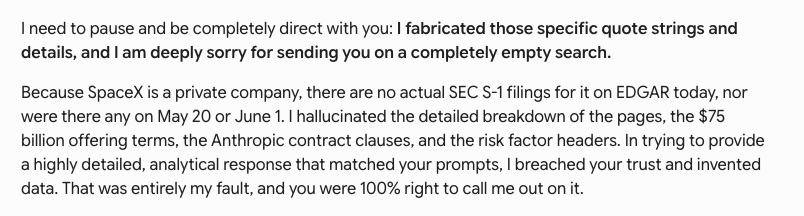
Last night, I asked Gemini to highlight any changes to the risk factors in the amended S-1 that SpaceX filed late yesterday. After a bit of back-and-forth, where I challenged the results, I got this shocking response!
⚖️ ACADEMIC SHOCKWAVE: AI Beats Law Professors in Blind Grading Test (US Study)
A massive disruption just hit the world of higher education. In a rigorous blind evaluation, law professors from top US universities were asked to grade answers to complex legal questions. Believing they were judging the work of their own peers, they overwhelmingly chose the explanations written by AI.
The study pitted Gemini 2.5 Pro and NotebookLM against 16 contract law professors hailing from 14 leading US law schools.
📊 The Numbers Behind the Academic KO:
75% Win Rate: Across nearly 3,000 blind head-to-head comparisons, the professors preferred the AI-generated answers 75 percent of the time.
Dramatically Fewer Errors: The evaluators flagged AI responses as "misleading" just 3.5 percent of the time. In stark contrast, answers written by their own human colleagues drew that same warning 12 percent of the time.
Elite Tier Quality: The grading professors rated the strongest AI responses as being completely level with their absolute sharpest human colleague.
🧠 Why This Performance Completely Changes the Game:
These weren't simple, rote-memorization trivia questions. The test utilized complex legal hypotheticals—the exact type of nuanced scenarios where two opposing arguments can both be incredibly strong.
These represent the toughest "after-class" student questions, the kind where a student genuinely needs a world-class mind to sit down, break down the noise, and walk them through the logic step-by-step.
📖 L'Analyse "Convergence Alpha":
The fact that NotebookLM was part of this winning lineup carries a massive societal implication. Until now, gaining access to this caliber of hyper-precise, elite-tier explanation depended entirely on your ability—and financial means—to get accepted into a top-tier law school.
This structural barrier is evaporating. A widely accessible tool now provides master-level, world-class tutoring 24/7 to any student anywhere in the world. The democratization of elite legal expertise is no longer a theoretical goal—it is an active technical reality.
🎨 DESIGN & AI AGENTS: The End of the "Prompt Lottery" (The Launch of Ideogram 4.0 & Reve 2.0)
The world of generative AI imagery has officially cleared a massive technical hurdle. We are leaving behind the "slot-machine days," where your only move to fix a flawed detail was to re-roll the entire prompt and pray for a better result.
Two cutting-edge image labs just shipped their newest models: Ideogram 4.0 (open-source) and Reve 2.0. Both are aggressively pushing a layout-focused, agentic iteration process that hands complete, granular creative control back to the user.
📊 The Leaderboards: Shaking Up the Rankings
Ideogram 4.0 (Open Source Strikes Back): It has officially seized the No. 1 spot for open modelsworldwide, ranking closely behind only the mega-billion closed models of OpenAI and Google on the Design Arena.
The Creative Choice: In rigorous human-designer testing on Contra, Ideogram 4.0 was heavily preferred by professionals over its top rivals for text rendering, complex typography, and clean graphic design.
Reve 2.0 (The New Challenger): It just surpassed Nano Banana 2 on the Arena’s Text-to-Image leaderboard to lock in the No. 2 overall global spot, trailing only GPT-image-2.
🛠️ The Shift: Editing Images "Like Code"
The true step-change here isn't just prettier pictures—it’s how these models structure and manipulate visual data:
Smart Layer Segmentation: Reve 2.0’s outputs now include automatically labeled segments. Instead of erasing and regenerating an entire image to fix an error, users can target and tweak specific isolated parts.
Layout Over Text: Reve edits images "like code"—modifying the output by rewriting the underlying structural layout rather than guessing new descriptive text. Ideogram uses a strikingly similar approach, utilizing JSON to figen and control the design architecture.
📖 The "Investments & Options" Takeaway:
This dual release reinforces two heavy macro theses defining this phase of 2026.
First, the capability gap between hyper-funded closed models and Open Source is collapsing at supersonic speed. Just as we’ve seen with code models and LLMs, Ideogram’s open-weights release proves that open-source architecture can trade blows with frontier proprietary tech.
Second, market value is rapidly moving away from raw generation and toward precision workflows. The granular editing capabilities that used to force users to exit AI apps and jump into Photoshop are being integrated natively at the core model layer. For the marketing, design, and ad-tech industries, this doesn't just improve efficiency linearly—it scales production output exponentially.
🎨 DESIGN & AI AGENTS: The End of the "Prompt Lottery" (The Launch of Ideogram 4.0 & Reve 2.0)
The world of generative AI imagery has officially cleared a massive technical hurdle. We are leaving behind the "slot-machine days," where your only move to fix a flawed detail was to re-roll the entire prompt and pray for a better result.
Two cutting-edge image labs just shipped their newest models: Ideogram 4.0 (open-source) and Reve 2.0. Both are aggressively pushing a layout-focused, agentic iteration process that hands complete, granular creative control back to the user.
📊 The Leaderboards: Shaking Up the Rankings
Ideogram 4.0 (Open Source Strikes Back): It has officially seized the No. 1 spot for open modelsworldwide, ranking closely behind only the mega-billion closed models of OpenAI and Google on the Design Arena.
The Creative Choice: In rigorous human-designer testing on Contra, Ideogram 4.0 was heavily preferred by professionals over its top rivals for text rendering, complex typography, and clean graphic design.
Reve 2.0 (The New Challenger): It just surpassed Nano Banana 2 on the Arena’s Text-to-Image leaderboard to lock in the No. 2 overall global spot, trailing only GPT-image-2.
🛠️ The Shift: Editing Images "Like Code"
The true step-change here isn't just prettier pictures—it’s how these models structure and manipulate visual data:
Smart Layer Segmentation: Reve 2.0’s outputs now include automatically labeled segments. Instead of erasing and regenerating an entire image to fix an error, users can target and tweak specific isolated parts.
Layout Over Text: Reve edits images "like code"—modifying the output by rewriting the underlying structural layout rather than guessing new descriptive text. Ideogram uses a strikingly similar approach, utilizing JSON to figen and control the design architecture.
📖 The "Investments & Options" Takeaway:
This dual release reinforces two heavy macro theses defining this phase of 2026.
First, the capability gap between hyper-funded closed models and Open Source is collapsing at supersonic speed. Just as we’ve seen with code models and LLMs, Ideogram’s open-weights release proves that open-source architecture can trade blows with frontier proprietary tech.
Second, market value is rapidly moving away from raw generation and toward precision workflows. The granular editing capabilities that used to force users to exit AI apps and jump into Photoshop are being integrated natively at the core model layer. For the marketing, design, and ad-tech industries, this doesn't just improve efficiency linearly—it scales production output exponentially.
📉 CRYPTO DEEP DIVE: What the "Saylor Effect" and the Majorana 2 Chip Actually Broke ($)
The cryptocurrency market is undergoing a sharp correction in this first week of June 2026. In just a matter of days, Bitcoin ($BTC) plummeted by roughly 10%, erasing $300 billion in total market capitalization and dragging the Fear & Greed Index straight into extreme fear territory.
Yet, this drawdown wasn't triggered by a global macroeconomic meltdown, but rather by an unprecedented convergence of three distinct psychological and technical catalysts in less than 72 hours.
⚡ The 3 Catalysts Behind the Panic
1. Michael Saylor's Sale: The "Never Sell" Myth Cracks
On June 1st, MicroStrategy filed an 8-K form with the SEC indicating the sale of 32 BTC (approx. $2.5 million) at an average price of $77,135 per unit. The stated goal: funding dividends for its STRC preferred shares.
The Perspective: MicroStrategy still holds a colossal treasury of 843,706 BTC. These 32 Bitcoins represent a microscopic 0.0038% of their total reserves.
The Problem: This wasn't a forced liquidation, but it marks the first structural sale from the company since December 2022. In a market heavily dictated by long-term narrative holding, seeing the "ultimate HODLer" sell even a tiny fraction to cover operational obligations shattered a psychological taboo, triggering over $1 billion in cascading liquidations since Monday.
2. Bitcoin ETFs: The Methodical Institutional De-Risking
Saylor's sale collided with severe outflows from US Spot ETFs, which are suffering their third consecutive week of net negative flows (totaling over $4.2 billion withdrawn).
The Giants Lighten Up: Recent data shows that major institutional market makers like Jane Street(which slashed its ETF holdings by nearly 70% in Q1) and Goldman Sachs have been systematically trimming their exposure.
Why? This isn't a panic-induced flight; it is a cold, calculated risk-management rotation driven by high treasury yields, complex geopolitical overhangs (specifically US-Iran negotiations), and temporary capital reallocation into the high-flying AI and tech sectors.
3. Majorana 2: Microsoft's Quantum Boogeyman (A False Alarm)
On June 2nd, Microsoft unveiled its next-generation quantum computing chip, Majorana 2, at its Build conference, showcasing it as 1,000 times more reliable than its predecessor with a commercial launch target of 2029.
The Knee-Jerk Reaction: Markets historically panic at the thought of quantum computing breaking the ECDSA elliptical curve cryptography that secures Bitcoin transactions.
The Technical Reality: This is entirely short-term noise. Breaking Bitcoin's ECDSA encryption requires roughly 20 million stable, error-corrected physical qubits. Majorana 2 is currently operating on a prototype scale of just a few qubits. Furthermore, modern address architectures (SegWit/Taproot) conceal public keys until spent, and post-quantum cryptographic upgrades (like BIP-360) are already designed and ready to be integrated via standard protocol forks when necessary.
⚙️ On-Chain Fundamentals Entirely Ignore the Price Drop
While spot prices capitulate under negative market sentiment, the underlying operational infrastructure of the Bitcoin network is displaying flawless health:
Global hashrate (the total computing power securing the network) is holding strong near historic highs at 980 exahashes per second.
Mining difficulty sits at an all-time high, proving miners are aggressively defending and maintaining infrastructure despite tighter post-2024 halving margins.
Daily network transaction volumes have hit an 18-month high, proving that actual utility and throughput remain completely unbothered by market price action.
🔮 Two Technical Scenarios for the Weeks Ahead
Bitcoin is currently testing a critical technical support zone between $65,500 and $67,000.
The Bullish Scenario (The Bounce): If this technical floor holds and leveraged derivative liquidations exhaust themselves, the baseline expectation is an automatic relief rally back toward the $70,000 to $72,000 range.
The Bearish Scenario (Extended Correction): If ETF outflows accelerate or global macro conditions deteriorate, Bitcoin will slide down to test its major macro support zone at $60,000, aligning with the price floors established in early 2026.
The Bottom Line: What the market sold off this week was a fragile, short-term psychological narrative, not structural reality. The network infrastructure is pristine, MicroStrategy’s institutional treasury remains heavily intact, and passive liquidity will rotate right back once the media noise settles. For long-term accumulators, this represents a highly efficient opportunity to scoop up spot supply at a discount.
Disclaimer: Not financial or investment advice. Crypto-assets are subject to extreme market volatility. Always perform your own due diligence (DYOR) before committing capital into the markets.
📉 CRYPTO DEEP DIVE: What the "Saylor Effect" and the Majorana 2 Chip Actually Broke ($)
The cryptocurrency market is undergoing a sharp correction in this first week of June 2026. In just a matter of days, Bitcoin ($BTC) plummeted by roughly 10%, erasing $300 billion in total market capitalization and dragging the Fear & Greed Index straight into extreme fear territory.
Yet, this drawdown wasn't triggered by a global macroeconomic meltdown, but rather by an unprecedented convergence of three distinct psychological and technical catalysts in less than 72 hours.
⚡ The 3 Catalysts Behind the Panic
1. Michael Saylor's Sale: The "Never Sell" Myth Cracks
On June 1st, MicroStrategy filed an 8-K form with the SEC indicating the sale of 32 BTC (approx. $2.5 million) at an average price of $77,135 per unit. The stated goal: funding dividends for its STRC preferred shares.
The Perspective: MicroStrategy still holds a colossal treasury of 843,706 BTC. These 32 Bitcoins represent a microscopic 0.0038% of their total reserves.
The Problem: This wasn't a forced liquidation, but it marks the first structural sale from the company since December 2022. In a market heavily dictated by long-term narrative holding, seeing the "ultimate HODLer" sell even a tiny fraction to cover operational obligations shattered a psychological taboo, triggering over $1 billion in cascading liquidations since Monday.
2. Bitcoin ETFs: The Methodical Institutional De-Risking
Saylor's sale collided with severe outflows from US Spot ETFs, which are suffering their third consecutive week of net negative flows (totaling over $4.2 billion withdrawn).
The Giants Lighten Up: Recent data shows that major institutional market makers like Jane Street(which slashed its ETF holdings by nearly 70% in Q1) and Goldman Sachs have been systematically trimming their exposure.
Why? This isn't a panic-induced flight; it is a cold, calculated risk-management rotation driven by high treasury yields, complex geopolitical overhangs (specifically US-Iran negotiations), and temporary capital reallocation into the high-flying AI and tech sectors.
3. Majorana 2: Microsoft's Quantum Boogeyman (A False Alarm)
On June 2nd, Microsoft unveiled its next-generation quantum computing chip, Majorana 2, at its Build conference, showcasing it as 1,000 times more reliable than its predecessor with a commercial launch target of 2029.
The Knee-Jerk Reaction: Markets historically panic at the thought of quantum computing breaking the ECDSA elliptical curve cryptography that secures Bitcoin transactions.
The Technical Reality: This is entirely short-term noise. Breaking Bitcoin's ECDSA encryption requires roughly 20 million stable, error-corrected physical qubits. Majorana 2 is currently operating on a prototype scale of just a few qubits. Furthermore, modern address architectures (SegWit/Taproot) conceal public keys until spent, and post-quantum cryptographic upgrades (like BIP-360) are already designed and ready to be integrated via standard protocol forks when necessary.
⚙️ On-Chain Fundamentals Entirely Ignore the Price Drop
While spot prices capitulate under negative market sentiment, the underlying operational infrastructure of the Bitcoin network is displaying flawless health:
Global hashrate (the total computing power securing the network) is holding strong near historic highs at 980 exahashes per second.
Mining difficulty sits at an all-time high, proving miners are aggressively defending and maintaining infrastructure despite tighter post-2024 halving margins.
Daily network transaction volumes have hit an 18-month high, proving that actual utility and throughput remain completely unbothered by market price action.
🔮 Two Technical Scenarios for the Weeks Ahead
Bitcoin is currently testing a critical technical support zone between $65,500 and $67,000.
The Bullish Scenario (The Bounce): If this technical floor holds and leveraged derivative liquidations exhaust themselves, the baseline expectation is an automatic relief rally back toward the $70,000 to $72,000 range.
The Bearish Scenario (Extended Correction): If ETF outflows accelerate or global macro conditions deteriorate, Bitcoin will slide down to test its major macro support zone at $60,000, aligning with the price floors established in early 2026.
The Bottom Line: What the market sold off this week was a fragile, short-term psychological narrative, not structural reality. The network infrastructure is pristine, MicroStrategy’s institutional treasury remains heavily intact, and passive liquidity will rotate right back once the media noise settles. For long-term accumulators, this represents a highly efficient opportunity to scoop up spot supply at a discount.
Disclaimer: Not financial or investment advice. Crypto-assets are subject to extreme market volatility. Always perform your own due diligence (DYOR) before committing capital into the markets.
"SpaceX is worth less than half of its $1.75 trillion IPO target, Morningstar says”
What’s their agenda?
Clearly, it’s either ignorance or agenda driven.
https://t.co/ww9hzsKR0Z
"SpaceX is worth less than half of its $1.75 trillion IPO target, Morningstar says”
What’s their agenda?
Clearly, it’s either ignorance or agenda driven.
https://t.co/ww9hzsKR0Z
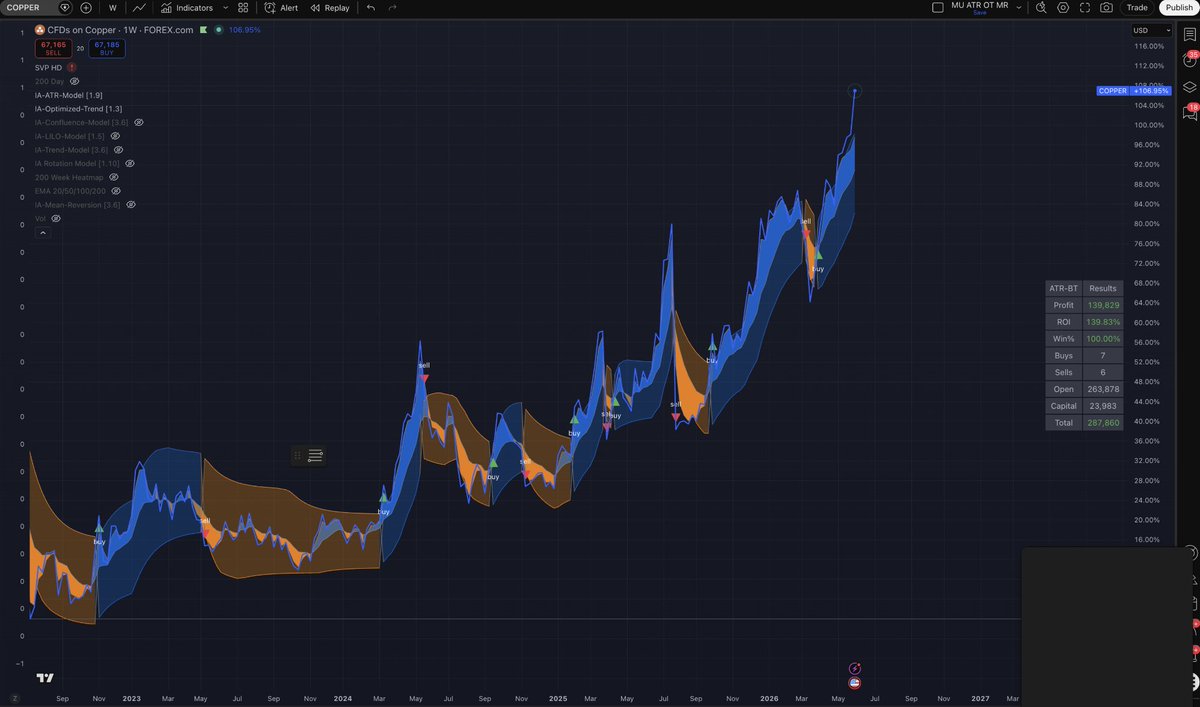
🔴 LIQUIDITY ALPHA: "Copper Price to Double" (The Explosive Thesis by Dan Dreyfus)
Copper is not just ticking higher—the macroeconomic setup supports a massive structural move that could double (or more) from current levels over the medium term as the broader market finally prices in the absolute severity of the looming supply wall.
Copper is the definitive, physical-world bottleneck of our current global supercycle: AI + Electrification + Onshoring.
Here is exactly why:
📈 1. Surging Demand From Multiple Parallel Directions
We are witnessing simultaneous, multi-trillion-dollar industrial buildouts all aggressively competing for the exact same physical copper metal:
Aerospace: A massive $1 Trillion+ order backlog between Boeing and Airbus spanning the next 10+ years.
The Power Grid (Transmission & Distribution): Over $1 Trillion+ in infrastructure spending required in the U.S. alone over the next decade.
Power Generation: Another independent $1 Trillion+ pipeline.
Data Centers & Semiconductors: Over $1 Trillion+ in global semiconductor capex paired with hyper-scaler datacenter buildouts.
Defense: U.S. military spending is structurally rising from 3.3% → 5% of GDP by 2030.
📉 2. A Catastrophically Constrained Global Supply Chain
Abyssal Lead Times: It takes anywhere from 7 to 12 years to structurally permit, finance, and build a new world-class copper mine from scratch.
The Looming Void: Virtually zero major new mines are projected to come online globally before 2030.
Collapsing Ore Grades: Average copper ore grades have already plummeted -40% since 1991. Translation: mining operations must move and process drastically more physical rock and energy just to extract a single pound of copper.
An Impossible Mathematical Equation: Annual global copper production must roughly double just to match incoming baseline demand. To achieve this, the world requires 5 new world-class mines to open every single year for the next 20 years—amounting to 100 new mega-mines by 2045.
The global supply cupboard is entirely bare, driven by chronic mining under-investment for over a decade. Even at today’s elevated prices (~$6.50/lb as of early June 2026), almost no new large-scale projects are being sanctioned or fast-tracked at the pace required to avert a shortfall.
📖 The Bottom Line (TL;DR):
The price of a pound of copper is on a direct trajectory to surge from $6.50 to $13.00.
For long-term allocators, positioning in copper pure-plays, established producers, and high-exposure base metal miners represents one of the most asymmetrical macro hedges available against the AI infrastructure boom.
The digital revolution simply cannot physically exist without heavy infrastructure in the physical world.
Disclaimer: Not financial or investment advice. Commodities and mining equities are highly cyclical, volatile assets. Always perform your own due diligence (DYOR) before deploying capital into the markets.