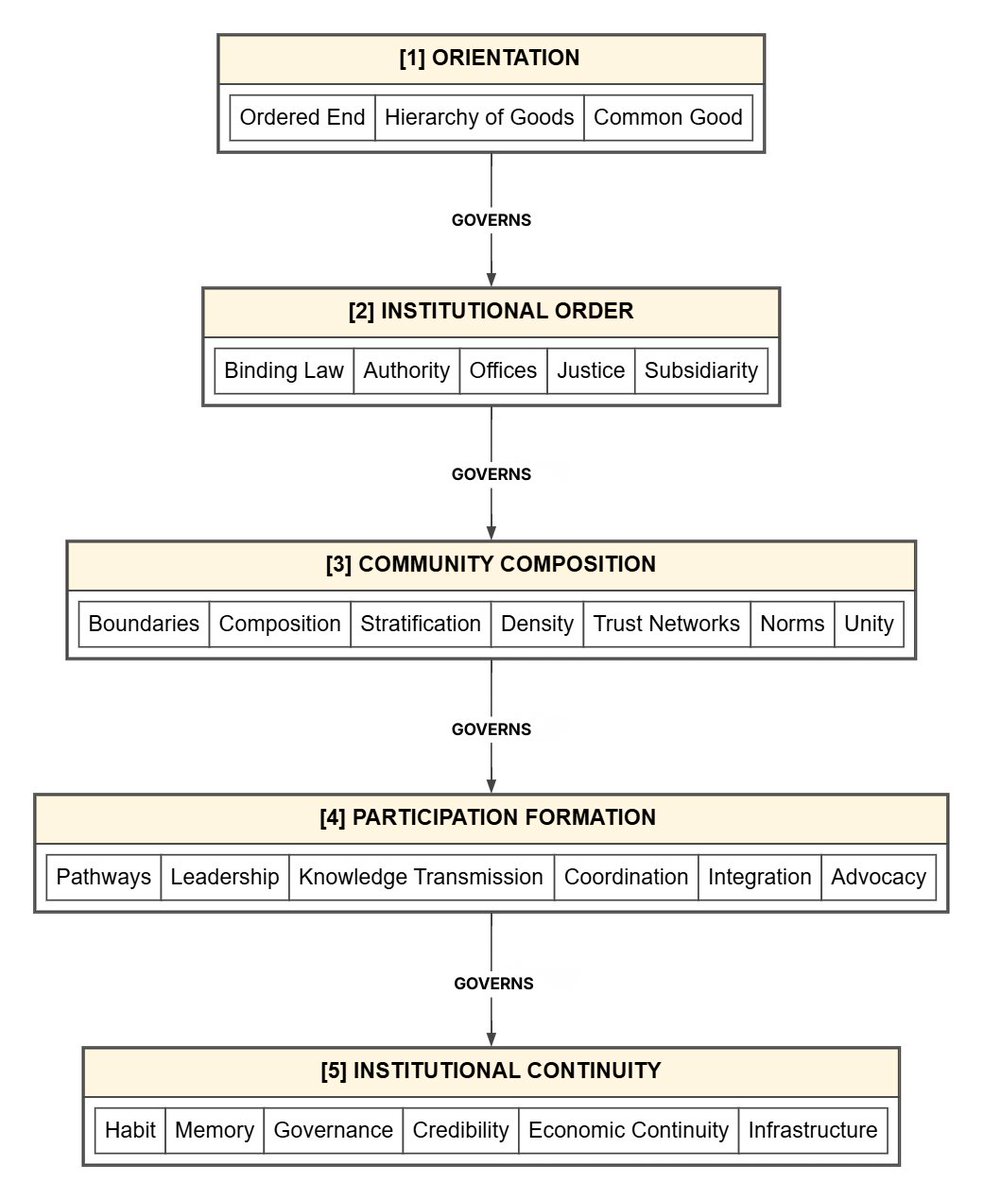
750 years ago, Aquinas set out the mechanics of human order & they haven't changed. Ordo Framework applies them to handle every institutional upside & downside.
Here's a structural map of a solution.
Orientation at the top. Thomistic in logic: ordered ends, hierarchy of goods, common good, law, authority, justice, participation & continuity.
A basis for resisting managerial capture & reordering systems toward metaphysical alignment.
I don’t think you miss the point. But both SNS and LA reveal the same deeper problem: highly organized systems without intrinsic orientation to truth, love, or communion. Even solutions more aligned with restoration can be absorbed into bureaucratic, managerial, and incentive-driven structures.
So the real challenge may not be fixing entrenched soulless systems, but designing systems that better serve the soul—and forming souls capable of remaining metaphysically aligned within alien systems.
Ordered End is the institution’s actual purpose & it's revealed, when push comes to shove, by what it sacrifices for. If that end is clear & true, it can succeed coherently. But if it's false or unclear, success becomes unstable & failure becomes harder to diagnose.
Ordered End
Every agent, of necessity, acts for an end. For if, in a number of causes ordained to one another, the first be removed, the others must, of necessity, be removed also. Now the first of all causes is the final cause.
ST, I-II, Q.1, A.2
Apparently that's true about Buddhist temples ordaining AI monks. As far as I understand it, Buddhism has room for this designation b/c Buddhist metaphysics generally denies that beings have an eternal self-substance. So, identity is conventional & functionally dependent.
The Vatican just took the first major religious position against AI personhood. Meanwhile, Buddhist temples in South Korea are ordaining AI monks. We're split as a society on what it means to be alive.
read this book years ago when i was hospitalized for schizophrenia &c and it was eye-opening. gallimore maps precisely how psychedelics switch ur brains reality channel. the world u normally see isn't more "real" than what dmt shows u, it's just the most energy-efficient model of the world. consensus reality is a local minimum, not the truth, truths whatever we agree on .. and other drugs tune the brain into other channels of reality, which leads to all these crazy experiences that cant even be classified as hallucinations; they were real, the users actually experienced this shit. their eyes were open and they felt it.
so why tf wouldnt all this be a simulation then
@Snowshi4@iammethankyou That's why I thought this table was interesting. Their metaphysical assumptions are further removed from moderate realism than Hossenfelder.
Is it just me or do the giants of science tend to be metaphysical realists? The more renowned, the more likely they are to believe reality has a deep intelligible order & that the mind can discover it. The least renowned treat science as models, methods & useful descriptions.
@iammethankyou Oh, I see. I thought grifter meant Nazi b/c most of the time I hear people say those words, they usually appear to mean the same thing: 'I don't like you' or 'I disagree with your position.' 😆
@iammethankyou I suppose a scientist would be someone working in the hard sciences (maths, physics, etc.). A realist meaning metaphysical realism (Plato, Aristotle, etc.). What is a grifter?