Organized children are not born, they are raised! We offer practical age-appropriate solutions for parents and teachers to boost executive function skills.
It was our book publishing anniversary last week!
If @OrganizedChild has been on your bookshelf for a while, now's a good time to take it down for a refresher! It's never too late (or too early) to encourage organized thinking & build executive function skills. @healthychildren
Don't be afraid to let your child be bored -- it is a good exercise for the brain! Instead of solving the problem for them, encourage your child build their own "drop down menu" of things in their brain that they can do when they are bored at home or in class.
#executivefunction
Do you have a preschooler in your life? Listen to @DrKorb talk on Thursday all about child behavior for this fun stage!
The presentation is hosted by Learn and Play Montessori Schools and the registration link is below.
Please register in advance to hear tips/strategies from @DrKorb, to help your child learn to regulate their emotions and improve their behavior outcomes. Hosted by Learn And Play Montessori Schools. March 16, 7pm PT. https://t.co/hCavYieckd
Today's tips are for step five, which is to "Promote Problem Solving." Encourage your child to think about/figure out for themselves what is the "big picture" in a variety of situations. Parents can actually stunt their child's cognitive growth by doing too many things for them!
Forward thinking is organized thought about the future. To help your student's executive functions in this area, practice recommendations from "Step 4: Practice Forward Thinking," and see their skills in anticipating, predicting, planning and estimating improve.
#parenting
When you teach your child the third step in Raising an Organized Child, "Give Everything a Place," you are helping to build critical skills like their spatial awareness and spatial working-memory. This type of processing is essential in reading, math, music, and athletics.
The 2nd step in @OrganizedChild is Introduce Order. School-age kids have a huge potential for growth in this area. Parents can help build their students' skills by prompting and nudging them along as they create schedules, lists, and plan how to manage homework & other projects.
It's never too late to improve your student's executive function skills! This week, we will share daily tips for boosting your child's "organizational toolkit" - systems & strategies that they can use to be more successful in their school and home life. First up: Be Consistent!
Yes! Every mom/wife and dad/husband can learn some helpful tips to teach kids of all ages about organized thinking skills in Raising an @OrganizedChild 😉
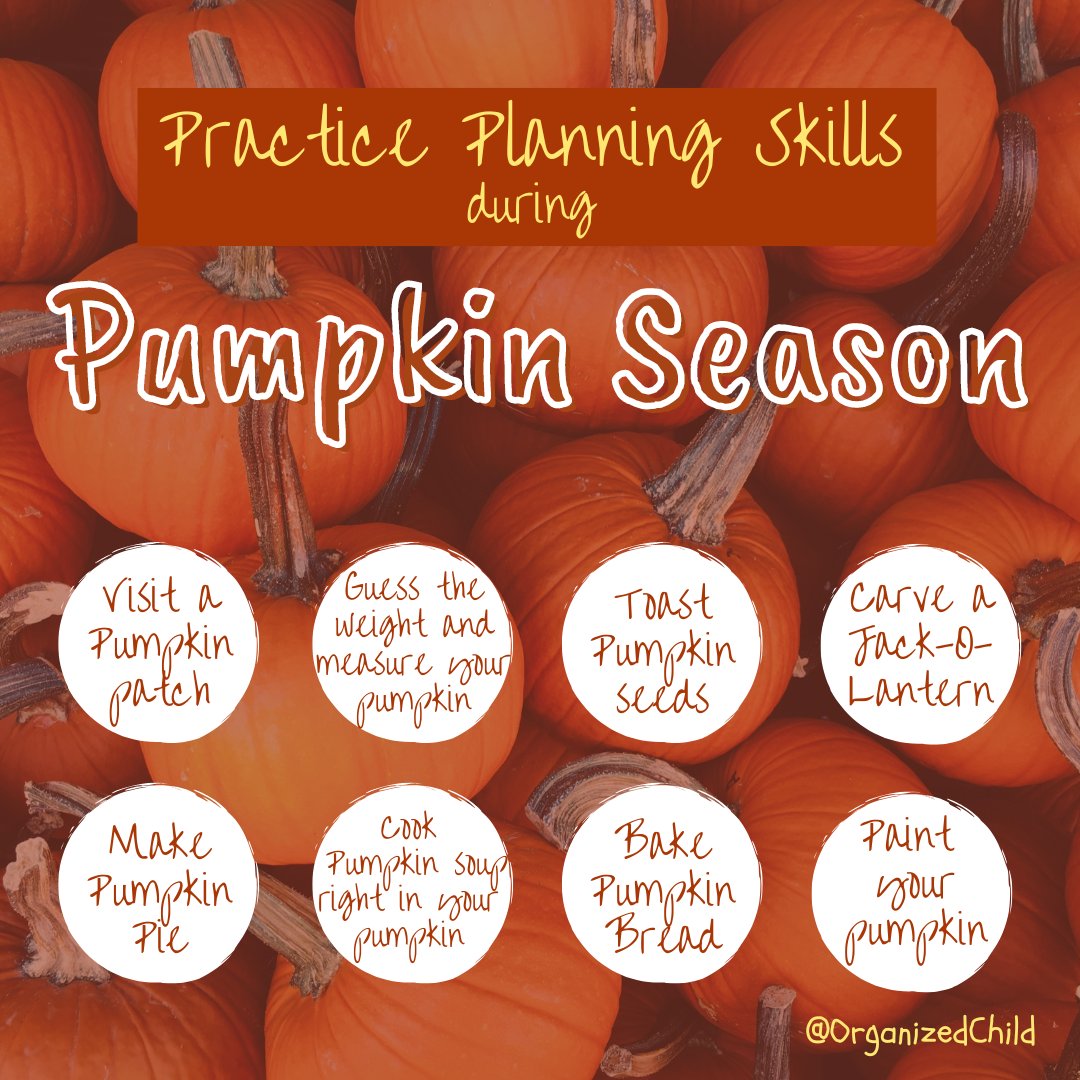
Plan some baking and crafts with colorful fall pumpkins & practice executive function skills along the way! Make the most of pumpkin fun with your family by being thoughtful and planful with your prep and design, and include your child in all of the steps - from setup to cleanup!
Being consistent forms the foundation for all the steps to raising an organized child. Practice is key when learning, whether it's how to walk, write, hit a ball, or behave. When your child takes steps in right direction, give positive feedback & they will learn what is expected!
Some nice tips and reminders from @joinparallel_us about getting your family organized and ready for the regular school routines. Hope you have a successful start to the school year! https://t.co/Xd5v93oL1z
As the new school year begins, it's important to establish routines to help your children thrive! Resharing this @whithonea article that features advice from @DrKorb. https://t.co/WvdifdbmHk
When children practice and develop their executive function and organized thinking skills they learn how to thrive as adults, which helps benefit your family and your community!
Join us May 12th at 8PM EST for our "Developmental-Behavioral Pediatrics: A Secret No More" webinar with Damon Korb, MD and Neelkamal Soares, MD, registration link below!
https://t.co/TCo2lg55Xk
@OrganizedChild@AmerAcadPeds@SDBPeds#pediatrics#pediatrician
Earlier this week, @DrKorb joined @KTLAMorningNews to talk about proposed guidelines that would recommend children as young as 8 years old be screened for #anxiety. https://t.co/Zs3CmMEBsZ