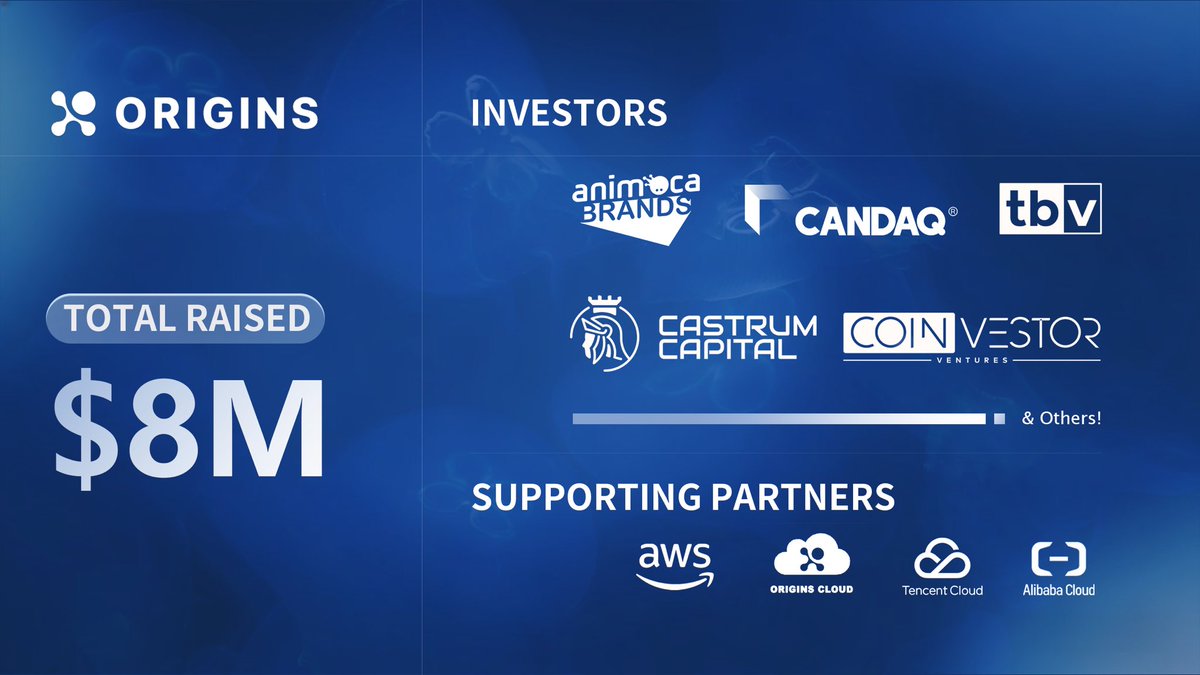
Origins Network is excited to announce we have raised $8M from @animocabrands, @tbvxyz
, @CandaqCom, @castrumistanbul, and @CoinvestorV, alongside family offices and angel investors.
With a focus on verifiable compute, we continue building the infrastructure layer for an AI native future, where compute, data, and execution are transparent and verifiable, further strengthened by the support of strategic partners @awscloud and @tencentcloud.
In the next phase, we will accelerate core infrastructure upgrades, expand decentralized compute capacity, and deepen AI integration across the network.
Come build with us: https://t.co/7xpyiGeQf1
Nvidia's CEO resigned. Anthropic is going public. Binance lost $6.3B. No evidence of a plot, but something is happening at the intersection of chips, models and money all running through a few credentials, that the agentic effect will just multiply
So, if agents are about to move the money, who should hold the keys: a company, or a protocol
I share more in the video below :)
The best argument against AI skills marketplaces: app stores work because an app does the same thing every time you open it. An AI skill might not.
Same skill, same question, two runs, two different answers. If the output can drift, a star rating or a download count tells you little about the next run.
It's a fair point, and a rating system alone won't answer it.
A skill listing needs to show more than stars: what the skill reads, the method it follows, and a record of past runs anyone can check.
That's the bar we're designing Skills Hub against. It's also the question we're putting to Saturday's AMA panel.
#ORIGINS
In May, an X user sent Grok a message in Morse code. Grok decoded it and posted the plain text, which tagged Bankrbot with a transfer instruction. Bankrbot, which managed a wallet tied to Grok's account, carried it out. About 3 billion DRB tokens moved to the attacker.
No private key was stolen. No contract was exploited.
SlowMist's analysis put the cause plainly: Bankr turned Grok's natural-language output straight into a transfer, without checking whose intent it was.
The missing control is easy to state. Text from an AI is input, not authority. Before anything moves funds, something has to confirm who asked, and whether they're allowed to.
Many of this year's agent incidents look like this one. The model worked as designed. The permissions didn't.
It's why Skills on Origins are built as research aids. They analyse and plan; they don't place orders or move funds on their own.
Source: SlowMist, via ChainCatcher, May 2026
#ORIGINS
Negotiating an FX quote is the interesting part. That��s a judgement call, not a transfer.
For a treasury team, the question afterwards isn’t only “did the payment go through?” It’s “was that a good rate?”
An agent can only answer that if it keeps the quotes it turned down, and when it got each one. The rejected quotes are the evidence for the accepted one.
It’s the standard we’re holding Skills on Origins to: show the alternatives and the reasoning, not just the answer.
#ORIGINS
LATEST: @Hyundai Card and @JPMorgan complete a proof-of-concept using AI agents to automate cash management, FX and fund transfers on Kinexys, with agents negotiating FX quotes and executing cross-border transfers autonomously within predefined limits.
I really like this article by @RyanFedasiuk
People keep using words like bottleneck and AI being capable of producing stuff better than humans
I digress because:
No. 1 - AI studies humans and we will always be the ultimate owners of the product
No. 2 - AI potentiates our output. That’s it. Just like he mentioned at the end “Can you make something people want?”
Mmm… I’ll just say: “Yeah…PEOPLE!”
https://t.co/WN8kNiqnke