A tokenized asset has two layers of data.
The first layer is sensitive: holder identity, position data, balance records.
The second layer must be usable by others: eligibility, backing, policy checks, rule adherence.
The mistake is treating both layers the same.
zkDatabase is built for the split: private inputs stay controlled, while verifiable outputs can be checked through Zero-Knowledge Proofs.
→ Verifiable Data for tokenized assets: https://t.co/FSbGPESNGJ
6/
Reported data tells you what was true at the last checkpoint. Verifiable Data lets anyone check it's still true now. That's the base RWA needs to become usable financial infrastructure.
→ Verifiable Data for RWA: https://t.co/ypCWmKPJxn
RWA is moving on-chain faster than the data behind it. A token can settle in seconds while its asset state - custody, reserves, eligibility, collateral still lives in off-chain ledgers and quarterly reports.
That gap is the case for Verifiable Data: RWA only becomes a real on-chain primitive when the state underneath it can be proven, not just reported.
5/
This is why Verifiable Data matters for RWA beyond any single asset class. The same off-chain trust gap repeats across stablecoins, tokenized treasuries, private credit, and commodities - reserves, NAV, collateral, ownership.
zkDatabase turns that off-chain state into something contracts, counterparties, and compliance workflows can verify without pulling the full dataset on-chain.
The data institutions need to prove is often the data they cannot expose.
zkDatabase turns private off-chain data into Verifiable Data with Zero-Knowledge Proofs, so smart contracts and counterparties can verify the condition while the underlying data stays private.
If you're building in RWA, stablecoins, or agentic finance and think data should be verifiable, let's talk.
For teams building in this space, more here:
https://t.co/43GBQMvNgi
Why did zkDatabase choose Groth16?
It fit the technical requirements zkDatabase was built around.
An older piece, but still a useful read:
https://t.co/iJ5hlMgqlY
RWAs bring real-world value onchain.
But the data behind those assets must be verifiable from the source.
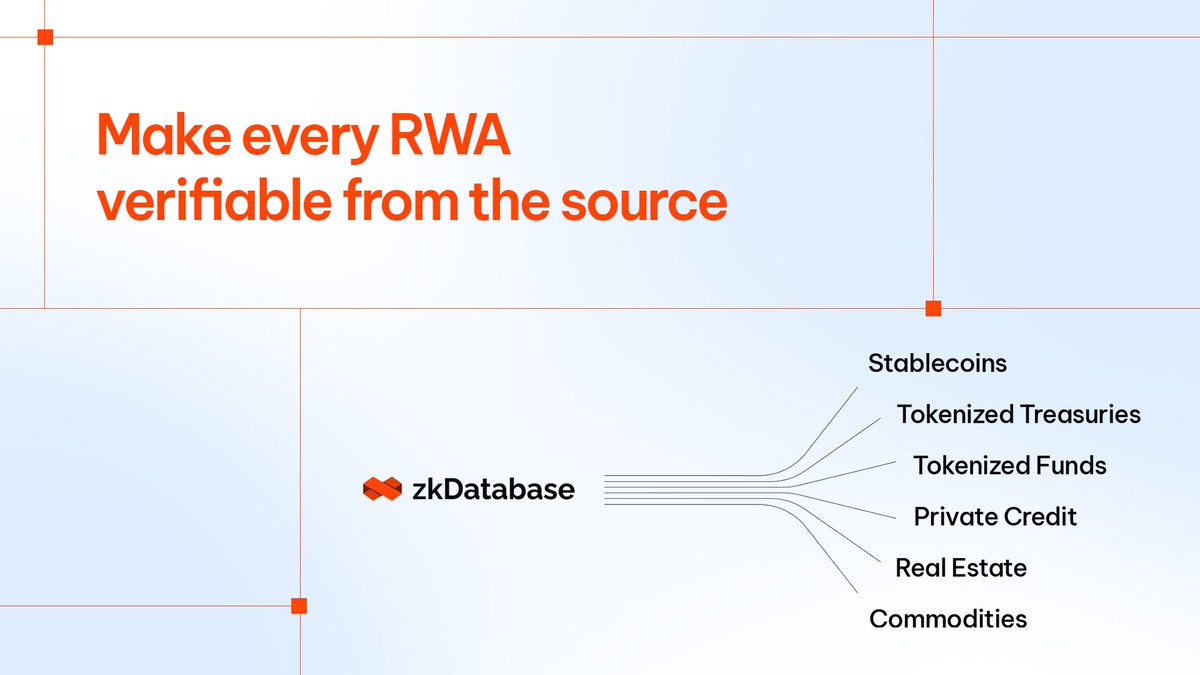
zkDatabase helps turn RWA data into private, auditable, and verifiable infrastructure for stablecoins, tokenized treasuries, funds, private credit, real estate, and commodities.
→ Build with verifiable data infrastructure: https://t.co/VZLujAPTHy
“Digitization” is the right word.
A tokenized asset can be represented on-chain while the asset state behind it still depends on off-chain ledgers, intermediaries, and periodic reports.
For tokenized assets to become natively onchain financial building blocks, the underlying asset state has to become Verifiable Data.
The institutional stack is full of sensitive data:
reserves, loan books, asset ownership, custody records, settlement states.
Putting all of it on-chain is not realistic.
Proving it is.
zkDatabase.
The biggest bottleneck in RWA is not tokenization infrastructure.
It is the gap between offchain asset data and onchain token data.
zkDatabase helps close that gap by turning private asset data into Verifiable Data that smart contracts and third parties can verify.
https://t.co/VzXR6GSB0K