Oryx—The International Journal of Conservation publishes leading research on biodiversity, conservation practice & the socio-economic dimensions of conservation
Oryx is no longer posting on X.
This account is now inactive but will remain accessible🌿
Stay updated on research published in Oryx by finding us on Bluesky, LinkedIn, Facebook and Instagram (Links threaded below)🦌
@AibekMB1 Hello, and thank you for wanting to stay in touch! 🤩You can find us on Bluesky, LinkedIn, Facebook and Instagram. All the links are on our website (in the top banner): https://t.co/KwGsOtGJN6
Oryx will no longer be posting to X. This account is now inactive but will remain accessible for now.
🐾Stay updated on our issues and publications by finding us on Bluesky, LinkedIn, Facebook and Instagram (links available via our website)🌱
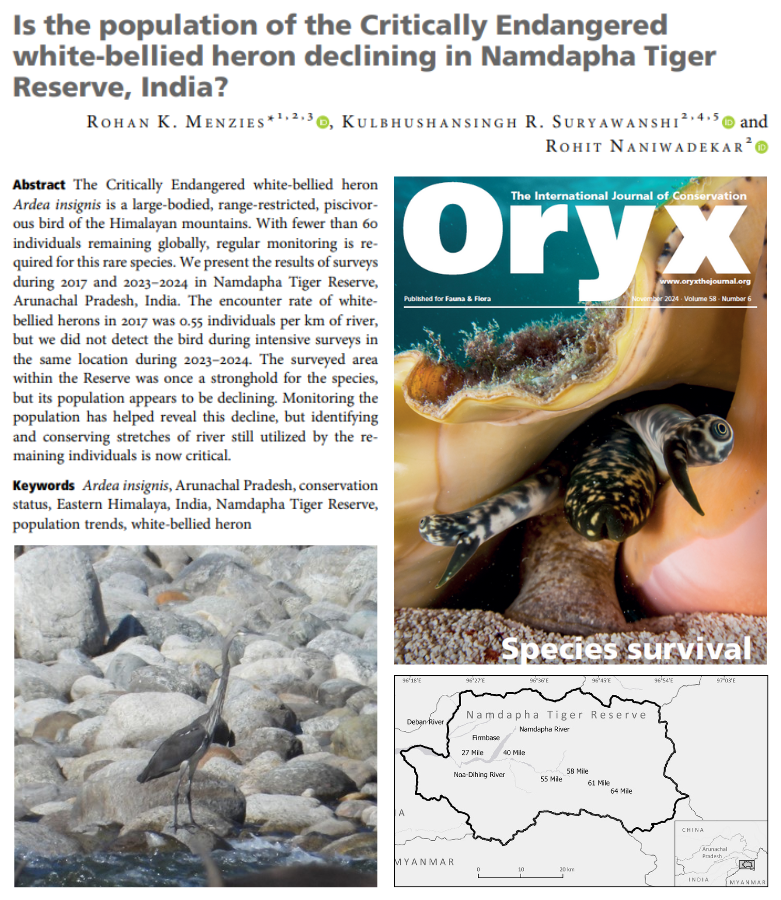
Menzies et al. detected no white-bellied herons in their 2023–2024 surveys in Namdapha Tiger Reserve, India, down from 7 individuals in 2017. The area was once a stronghold for the Critically Endangered species but its population appears to be declining 🚨https://t.co/mLaSvMibFa
In the lead article of our latest issue, Kough et al. discuss the pros and cons of queen conch aquaculture. Whilst useful for research, community engagement & education, protecting natural breeding aggregations of conch is a priority for species recovery 🐚https://t.co/7PsHnQB4Te
Fichera et al. examine the ecology of the Sardinian long-eared bat: it is closely associated with dry broadleaf forests but negatively affected by pastures, urban & coniferous habitats. Protecting known roosts is key to conserving the remaining colonies: https://t.co/Aaywp6FrVQ
In the lead article of our latest issue, Kough et al. discuss the pros and cons of queen conch aquaculture. Whilst useful for research, community engagement & education, protecting natural breeding aggregations of conch is a priority for species recovery 🐚https://t.co/7PsHnQB4Te
📣 Our latest issue highlights our partnership with the @IUCNssc, including an editorial by Chair Jon Paul Rodriguez and articles on topics such as the use of seahorses in Malaysia and conservation of the northern muriqui in Brazil. Discover these & more: https://t.co/GlRiuyBKSu
Flatt et al. report that 65% of camera traps were stolen during their study in Costa Rica, despite locks, cases & signs. Such theft leads to data gaps, impairing research potential in the region and highlighting the need to limit financial & data losses 📷 https://t.co/rKeWeT0fPH
Ding et al. captured 2 camera-trap images of the clouded leopard in Qomolangma National Nature Reserve, China. These are the first records of the Vulnerable species in Jilong County & could suggest there is more potential habitat for the species in China: https://t.co/udOE7jcRw5
Oleynikov et al. studied Amur tiger traffic collisions in the Russian Far East during 1980-2023. 46% occurred since 2020, due to prey scarcity following an African swine fever outbreak. Wildlife-friendly road planning is vital for the species' survival 🐅 https://t.co/02JCwhaCet
🚨 Exciting opportunity to join the Oryx team!🐾
We are hiring an Editorial Officer. The role focuses primarily on providing comprehensive editorial support and managing the journal's social media & communications.
Learn more: https://t.co/PTtnV8IzxK
📅 Deadline: 30 March 2025
🚨 Exciting opportunity to join the Oryx team!🐾
We are hiring an Editorial Officer. The role focuses primarily on providing comprehensive editorial support and managing the journal's social media & communications.
Learn more: https://t.co/PTtnV8IzxK
📅 Deadline: 30 March 2025
Sharp & Gray analysed data on 296 Critically Endangered island-endemic arthropod species & the threats they face. Their findings highlight the importance of tiny habitats like caves, high elevation areas, isolated pools & sea stacks for their conservation🪲https://t.co/JX0gdZd2pC
Conservation News 📣 Riffo & Aedo captured a camera-trap image of a guiña in Huentelauquén, in the Coquimbo region of Chile. This is the first record in the area and extends the range of the subspecies Leopardus guigna tigrillo 43 km northwards 🐾 https://t.co/cleKnWIWV3