Bosses ‘can’t afford to pay themselves minimum wage FSB survey finds
“It is becoming a major structural issue within small firms where the costs of employment, including the national living wage, employer NICs, and auto-enrolment, makes it harder for a small business owner to make sufficient profit to pay themselves a living wage – let alone to fund a pension.”
https://t.co/27gHVmbkIj
Everyone who cares about climate should understand this. Texas, with no pro-climate policies, has blown passed California in clean energy. In large part because Texas has less red tape and makes it easier to build.
Sir Keir Starmer's war with Olly Robbins just went to a whole new level
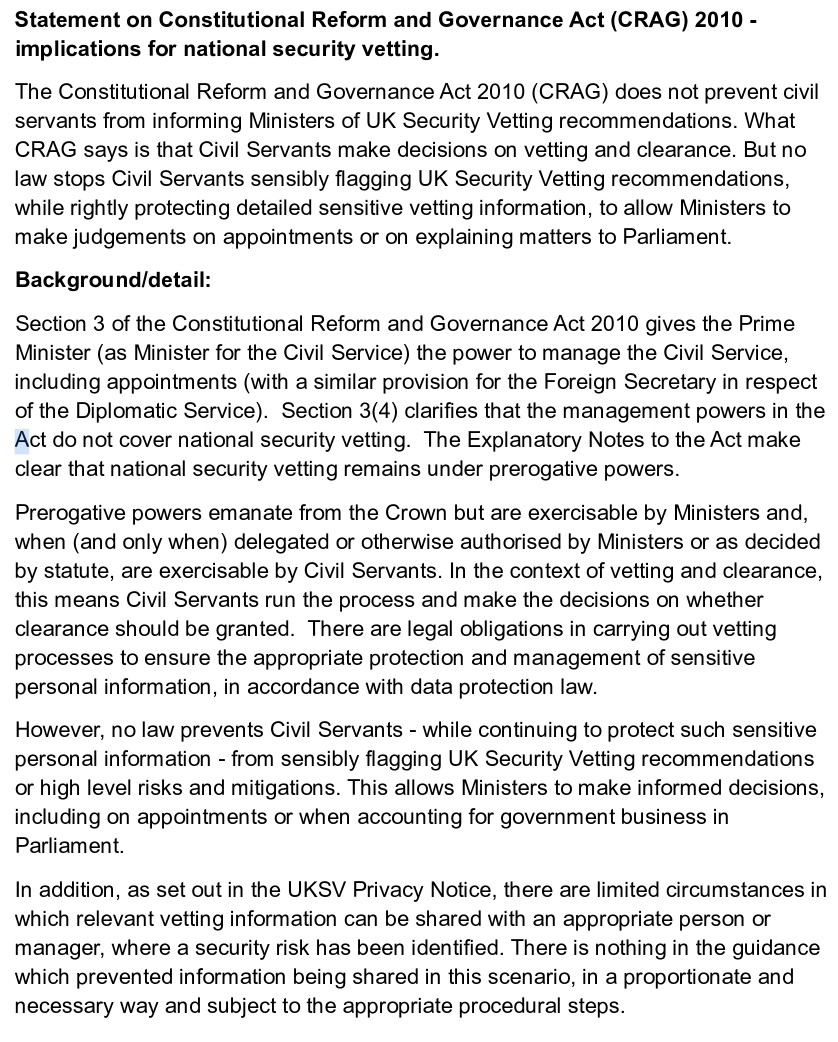
The government has tonight taken the pretty extraordinary step of publishing what appears to be* a new legal opinion on the legislation surrounding national security vetting
Allies of Robbins have cited the Constitutional Reform and Governance Act, which states that ministers do not oversee the national security vetting system
Robbins is using this as part of his argument for not informing Starmer that Mandelson had failed his initial security vetting. The process, they say, is 'rightly independent' - something ministers have also said in the Commons
But the government appears to have commissioned new legal advice which states: 'No law stops civil servants sensibly flagging UK Security Vetting recommendations'
The government appears to have commissioned an ad hoc legal opinion as ammunition for Starmer ahead of his appearance in the Commons tomorrow
Allies of Robbins point out two things. 1) This appears to be new legal advice - it didn't exist when Mandelson was appointed 2) It doesn't demonstrate that Robbins *should* have informed Starmer. It is effectively passive
They say that the government appears to be attempting to retrofit a legal opinion to make Starmer's argument against Robbins
* I say appears to be as it doesn't seem to have been signed off by a government lawyer, but that's v much the suggestion I'm getting from inside Govt
I’m old enough to remember when the Trump administration eased US sanctions on Iranian oil.
“In essence, we will be using the Iranian barrels against Tehran to keep the price down,” US Treasury Secretary Scott Bessent said at the time.
That was 3 weeks ago. Now a blockade.
More restrained than Trump’s blanket Hormuz blockade announced this morning.
CENTCOM: “The blockade will be enforced impartially against vessels of all nations entering or departing Iranian ports and coastal areas, including all Iranian ports on the Arabian Gulf and Gulf of Oman. CENTCOM forces will not impede freedom of navigation for vessels transiting the Strait of Hormuz to and from non-Iranian ports.”
The economic and financial headlines this morning would be screaming about another surge in oil prices if the markets weren't closed for the weekend.
Overnight, both sides signaled willingness to cross a red line: the direct, significant targeting of oil infrastructure.
Specifically,
The US bombed Kharg Island, Iran’s primary oil export hub.
President Trump stated he has directed the Pentagon to "totally obliterate" military forces on the island.
Additional US troops are being deployed to the region, fueling speculation of a potential occupation of the island.
Iran has countered with threats that all "oil, economic, and energy facilities … in the region ... will be immediately destroyed and reduced to ashes."
Adding to the stagflationary winds already blowing through the global economy, the market impact of these latest developments in the Middle East War would not have been limited to oil. We likely would have seen significant losses across many other market segments.
What actually happens when markets reopen on Monday is, of course, a function of developments over the next 48 hours.
#economy #markets #oil #inflation #middleeastwar
You've got to hand it to Iran: that's masterful asymmetric warfare.
If they pull this off and suddenly oil transiting through Hormuz is traded in Yuan, we're talking potentially close to $1 trillion less in annual demand for dollars (20% of the world's oil + LNG). It'd be insanely impressive to achieve this simply by controlling a 30-mile strait with a few missiles and drones.
And it'd have compounding effects: $1 trillion less in demand for dollars means less foreign buying of US Treasuries, higher borrowing costs in the U.S., more inflation, etc.
Heck even if this doesn't materialize, the mere fact they're suggesting it and that it's taken seriously by mainstream media like CNN is impactful in and of itself: at the end of the day dollar supremacy is also very much based on inertia. But inertia works both ways: once enough people start questioning it, the questioning itself becomes self-reinforcing.
Imagine you're a central banker and you're seeing this: you're undoubtedly telling yourself "mmm, maybe it's time to hold a bit more yuan, just in case."
It's also pretty ironic: the U.S. has weaponized the dollar against others countless times - including, of course, against Iran - but I can't think of a precedent of a country actively at war with the U.S. using the dollar's dominance as a weapon against them. Literally flipping the playbook, which sets an interesting precedent.
All in all, in this war you really have the feeling to witness Sun Tzu's maxim about "knowing the enemy and knowing yourself" in real time: Trump obviously completely failed to understand what he was getting into.
Iran, on the other hand, clearly studied its enemy's vulnerabilities, be it hitting Gulf countries until they question whether being a U.S. ally protects or endangers them, choking oil supply to inflict economic pain the US can't bomb its way out of, or now attacking the dollar itself.
The U.S. only has bombs to reply, but hard to see how they could bomb their way out of problems that were entirely predictable consequences of their bombing in the first place, if anyone had spent five minutes thinking about what Iran might do in response.
BREAKING: The US Navy has refused near-daily requests from the shipping industry for military escorts through the Strait of Hormuz, per Reuters.
Details include:
1. The US Navy says the risks of attacks is "too high" for now
2. The US Navy has held regular briefings with shipping and oil industry counterparts
3. During those briefings, the US Navy has said it is unable to provide escorts for the time being
4. Sources say that as of Tuesday's briefing, this risk assessment has not changed
The Strait of Hormuz remains largely closed.
BREAKING: US stock market futures open sharply lower as oil prices extend their rally to +53% since March 1st.
1. S&P 500: -1.7%
2. Nasdaq 100: -1.7%
3. Dow Jones: -2.0%
4. WTI Crude: +14.5%
5. Brent: +10.5%
6. Natural Gas: +5.0%
US gas prices are now set to rise toward $5.00/gallon.
The Telegraph is recruiting a Business Night Reporter - a great opportunity for an ambitious young reporter looking to get into national media.
The role involves ranging widely across sectors, so good chance to learn and develop.
Apply here 👇
https://t.co/IcwZ4IgR4F
Quite funny that during Iraq when the US was still a massive net oil importer it was at pains to say it wasn't about oil. Now it's a net exporter and abundant global oil supply isn't obviously in US interests, the government says it is actually about the oil.