Bayesian data analysis is a fundamental concept in data science. But it took me 2 years to understand its importance. In 2 minutes, I'll share my best findings over the last 2 years exploring Bayesian Modeling. Let's go.
1. Why Bayesian Data Analysis? Bayesian modeling is a powerful tool in statistics and data science, especially where traditional approaches fall short. It avoids arbitrary assumptions and provides distributions of possible values instead of just point estimates.
2. Bayes Theorem: Bayesian modeling is based on Bayes’ theorem. Bayes' Theorem provides a mathematical formula to update the probability for a hypothesis as more evidence or information becomes available. It describes how to revise existing predictions or theories in light of new evidence, a process known as Bayesian inference.
3. Simplification of Bayes’ Theorem: Since X (data) is not dependent on θ (the model) and can be hard to calculate, Bayes’ theorem is often simplified to P(θ|X) ∝ P(X|θ) × P(θ), meaning the posterior distribution is proportional to the likelihood times the prior.
4. From Bayesian Theorem to Bayesian Modeling: Bayes’ Theorem provides a process for constructing a Bayesian model. Combining key ingredients: Likelihood and Prior distributions to produce Posterior Distributions.
5. Calculating the Posterior Distribution: There are two main methods: direct calculation using complex equations, and simulation methods which create samples from the posterior distribution for summarizing information about parameters. Many software programs like PyMC, Brms, and Stan use sampling methods such as Markov Chain Monte Carlo (MCMC).
6. Advantages of Bayesian: The Bayesian approach allows for direct inclusion of prior knowledge, transparency in modeling steps, and provides broad information about the problem, including risks, uncertainty, and variability.
7. Business Cases: Any time knowledge of uncertainty is a business requirement, Bayesian modeling can benefit the business. This includes Demand Forecasting, Pricing Strategy Optimization, Customer Analysis, Credit Scoring and Financial Modeling. Businesses need to know not only a point estimate but the risk or confidence of the prediction.
===
Interested in applying Bayesian, Data Science and Machine Learning to Business. I’d like to help.
I put together a free on-demand workshop that covers the 10 skills that helped me make the transition to Data Scientist: https://t.co/LR39RJ5XKB
And if you'd like to speed it up, I have a live workshop where I'll share how to use ChatGPT for Data Science: https://t.co/EaMpKrJiqX
If you like this post, please reshare ♻��� it so others can get value.
Hi #EconTwitter! 📘📈
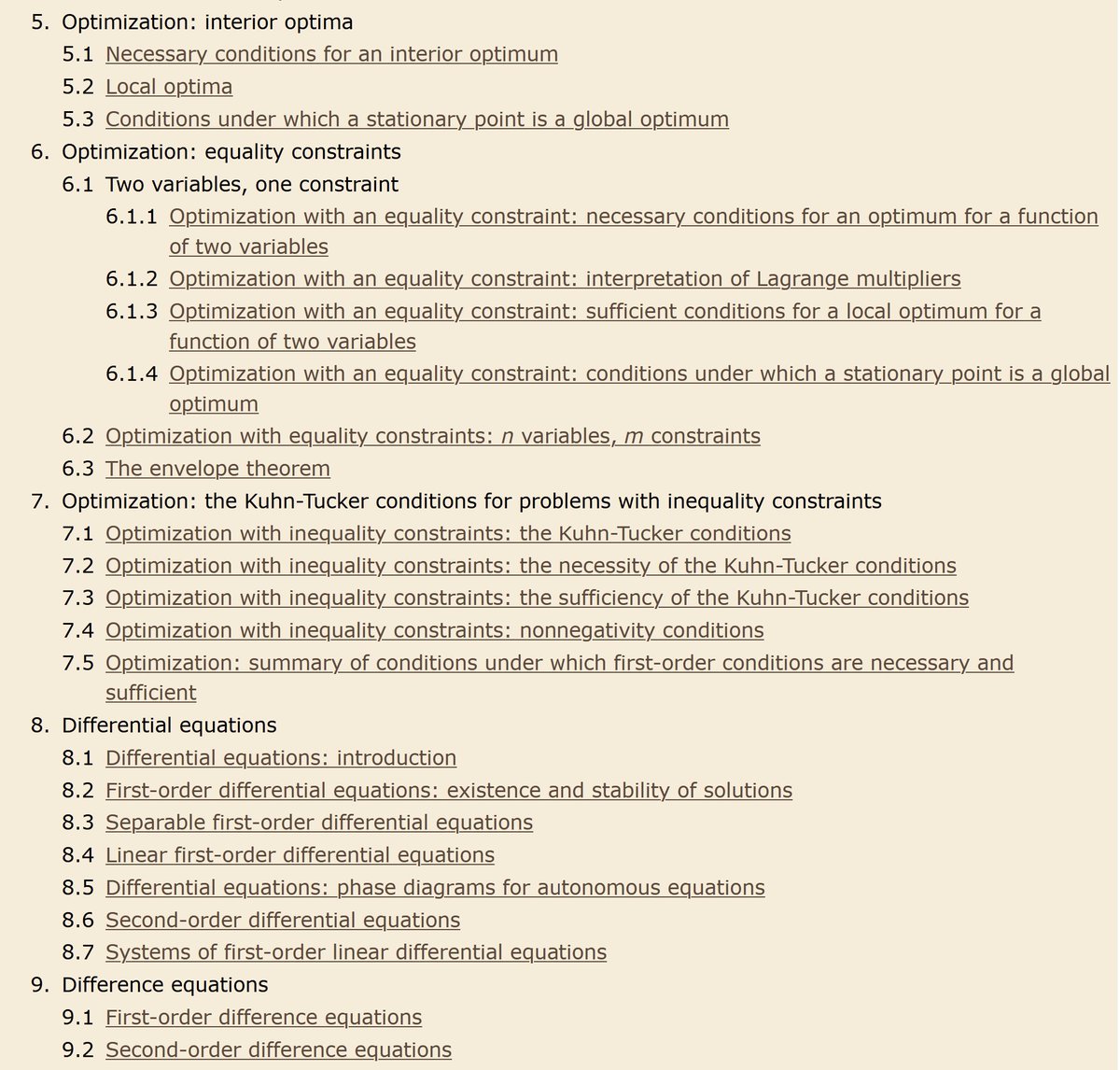
Looking for a clear and engaging guide to undergrad-level mathematics for #economics (specifically, for economic theory)?
Check out 👇this fantastic online resource by Martin J. Osborne (@UofT). From multivariate calculus to optimization and differential equations – it's all there!
Perfect for students and instructors alike! Don't miss out! ⭐️
Link: https://t.co/sMZBRx3K31
Hi #EconTwitter!
Are you an applied economist, searching for an in-depth guide on statistical tools for causal inference?
Check out👇this insightful online book by @SylvainCF (@TSEinfo). From the basics of encoding causality to advanced #econometric methods, it's got you covered.
Key features: 🔹 Emphasis on intuitive understanding (though the math's there!) 🔹 Numerical examples & simulations to bring clarity.
Have fun! ⭐️
Link: https://t.co/zFZ56FleTb
Econ PhDs are struggling with symptoms of anxiety and depression at rates more than twice that of the general population, says @vbolotnyy of @Stanford. We spoke with him about why that is and what can be done about it. #ResearchHighlight https://t.co/Kg6sERMf7a
Avoir pour patrie le monde et pour nation l’Humanité…. Les mots de Victor Hugo résonnent comme jamais dans ce moment de tragédie infinie et de solidarité. #turquiesyrie
We should be taxing wealth at a higher rate because much of it is inherited. Especially when almost two-thirds of new wealth accrued since the start of the pandemic has gone to the top 1%, per @Oxfam's new report. https://t.co/K0XBMMSbCs
Efficient R programming refers to increasing the efficiency of tasks with R. This encompasses both computational efficiency and programmer productivity. Check out this awesome #bookdown to learn more - it's free! https://t.co/5efg3YcQBn
#rstats#rmarkdown#quartopub#rstudio
A vos agendas. Notre UMR SMART @INRAE_BzhNdie @agrocampusouest organisera le 17eme congrès européens des économistes agricoles pour l'EAAE @AgriEconEurope
Soumettez vos papiers!