Resolvi pedir um cartão de credito corporativo no Inter. Pra organizar despesas de PF e PJ. Foi negado, sem maiores justificativas.
Deve ter uns 4 anos de utilização da conta como principal já.
Sera que vou ter que ir pra bancão?
Resolvi seguir um caminho próprio e deixei a Varos.
Confesso que tive uma bela experiência, por lá, como parte da equipe que construiu a research.
Sei que meu trabalho foi reconhecido, a ver pelas mensagens que recebi dos assinantes.
Mas, às vezes, o coração fala mais alto.
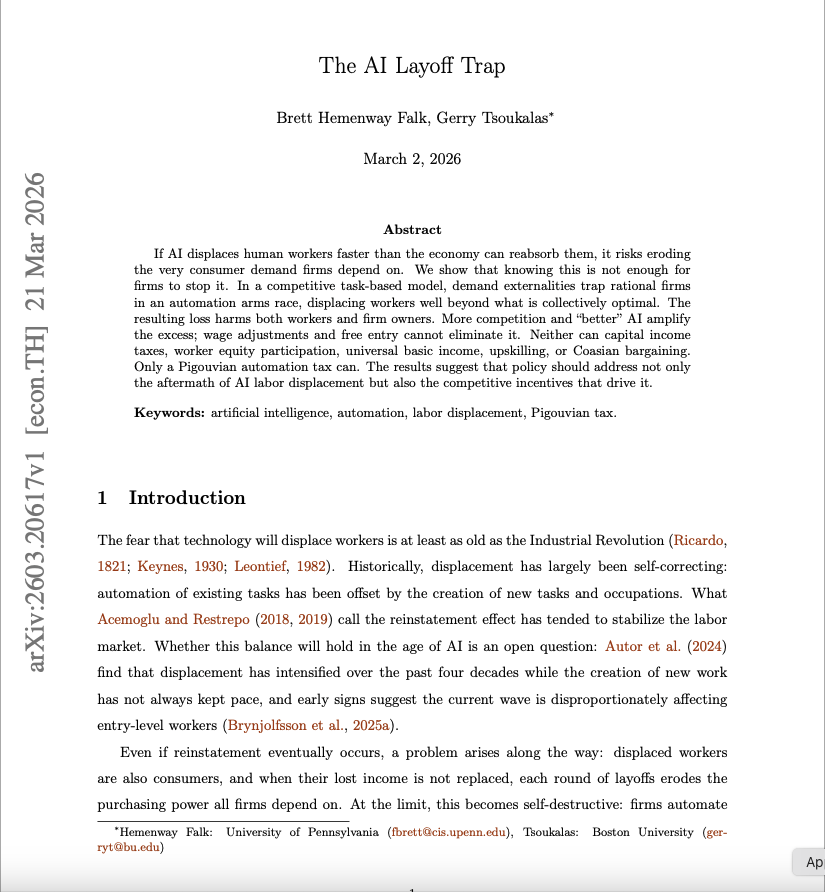
Two economists just published a mathematical proof that AI will destroy the economy.
Not might. Not could. Will — if nothing changes.
The paper is called "The AI Layoff Trap." Published March 2, 2026. Wharton School, University of Pennsylvania. Boston University. Peer reviewed. Mathematically modeled.
The conclusion is one sentence.
"At the limit, firms automate their way to boundless productivity and zero demand."
An economy that produces everything. And sells it to nobody.
Here is how you get there.
A company fires 500 workers and replaces them with AI. A competitor fires 700 to keep up. Another fires 1,000. Every company is behaving rationally. Every company is following the incentives correctly. And every company is building a trap for itself.
Because the workers who were fired were also customers.
When they lose their jobs faster than the economy can absorb them, they stop spending. Consumer demand falls. Companies respond by cutting costs — which means automating more workers — which means less spending — which means more falling demand — which means more automation.
The loop has no natural exit.
The researchers tested every proposed solution. Universal basic income. Capital income taxes. Worker equity participation. Upskilling programs. Corporate coordination agreements.
Every single one failed in the model.
The only intervention that worked: a Pigouvian automation tax — a per-task levy charged every time a company replaces a human with AI, forcing them to price in the demand they are destroying before they pull the trigger.
No government has implemented this. No major economy is seriously discussing it.
Meanwhile the numbers are already tracking the curve. 100,000 tech workers laid off in 2025. 92,000 more in the first months of 2026. Jack Dorsey fired half of Block's workforce and said publicly: "Within the next year, the majority of companies will reach the same conclusion."
Nobody is doing anything wrong. Companies are following their incentives perfectly. That is exactly the problem.
Rational behavior. At scale. Simultaneously. With no mechanism to stop it.
Two economists built the math. The math leads to one place.
Source: Falk & Tsoukalas · Wharton School + Boston University ·
https://t.co/4m8E9jQNYm
A Ser Educacional (SEER3) entregou um 4T25 que confirma a virada operacional.
Lucro Ajustado: R$ 76,9 mi (+112%)
Dívida Líq./EBITDA: 0,90x
Dividendos: R$ 61 mi aprovados
Os gatilhos que apontamos no início de cobertura estão se materializando.
Segue o fio 🧵👇
@FernandoMorq nao fui entendido. Nao acho que vai ter uma dominante geral. Acho que vai ter uma melhor pra cada atividade. E acho que vão ser muitas. Cada uma com sua vantagem em seu nicho. Veja o grok, começou gratuito. Vai ser mais competitivo quem tiver + acesso a + e melhores IAs.
Ja pararam pra pensar no momento que as techs de IA decidirem que já tem dependentes o suficiente e resolverem subir o preco?
Qual vai ser o limite?
A separação de classes vai ser entre aqueles com capacidade de pagar pela tecnologia e aqueles sem!