Over the past two weeks, I have spent a great deal of time studying a category often described as the “free mobile mining app.”
To be completely honest, I came into this with very little knowledge of the sector. My background is in artificial intelligence, not cryptocurrency. After researching the market, studying several projects, and observing their communities, I have formed a few initial views. I would genuinely appreciate feedback from people with more experience in this space.
1. The Legend: Pi Network
At the top of the category, I would place Pi Network.
I cannot say with certainty whether Pi was the first project to introduce this model, but it clearly played a major role in popularizing the concept. Founded by two Stanford PhDs, Pi presented a compelling idea: make digital assets accessible to ordinary people and introduce a new form of payment with an extremely low barrier to entry.
Whatever opinions people may have about its execution, Pi demonstrated that millions of users were willing to participate in a digital economy through a simple mobile experience.
2. The former market leaders
The second group includes projects that once attracted significant attention but struggled to maintain the same level of activity over time.
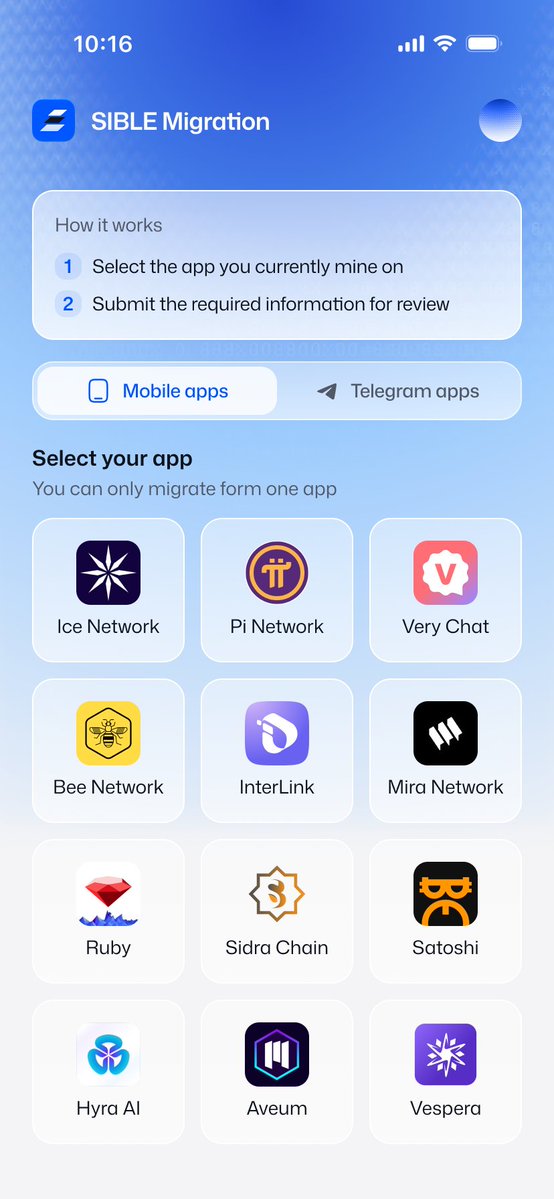
Examples include Bee Network, Sidra, Ice Blockchain, Ruby Network, and Satoshi.
Many of these projects built large communities during their early stages. However, some appeared to struggle with maintaining a consistent direction, delivering a clear product roadmap, or giving users enough reasons to remain active.
When the direction becomes unclear, both the team and the community gradually lose momentum.
3. Today’s active mobile mining apps
The next group includes mobile mining applications that remain popular today, such as InterLink Network, VeryChat, and several others.
These platforms continue to maintain sizable user communities. However, they also face familiar challenges, including delayed KYC processing, slow on-chain distribution, and the absence of core features capable of creating a meaningful breakthrough.
A large user base creates an opportunity, but user numbers alone cannot sustain an ecosystem. The product must eventually provide real utility, reliable infrastructure, and a clear economic reason for people to remain involved.
4. Smaller applications
The final group consists of smaller applications with fewer than one million users.
I will not name them individually. In many cases, projects at this scale struggle to secure the capital, technical resources, liquidity, and distribution needed to build a sustainable token economy.
Community size does not guarantee success, but insufficient scale can make long-term development significantly more difficult.
5. The biggest problem I discovered
One major bottleneck appears across the entire category.
Whenever users move to a new application, they often have to start again from zero, even after spending months or years building activity, reputation, referrals, and rewards in another ecosystem.
That creates an enormous psychological barrier.
People do not want to abandon everything they have already built simply to begin mining another token in another application.
We believe a new platform should respect a user’s previous effort instead of asking them to erase it. A better mobile mining ecosystem should provide continuity and allow users to carry meaningful progress into the next stage.
This is one of the principles behind the Sible Network App.
We are working to launch the application as soon as possible. The schedule has been affected partly by a necessary name change following a trademark issue, and we apologize for the delay.
If we move fully into compute mining, Sible Network will focus on several core principles.
6. Clear technology and a real product
Our main competitive advantage will be an enterprise AI and data analytics platform.
We are building technology designed to help organizations connect fragmented data, deploy AI securely, identify operational patterns, and transform intelligence into action across multiple industries.
The mining application should connect with a real technology platform, rather than exist as an isolated reward system.
7. Revenue connected to the ecosystem
We intend to allocate 20% of eligible revenue received from enterprise contracts to a reserve supporting the token ecosystem.
The objective is to connect token utility with real commercial activity generated by the underlying technology platform.
The exact governance, reporting, eligibility, and use of this reserve will need to be communicated clearly and transparently.
8. Fair distribution
Ambassadors will remain an important part of the ecosystem, but they will not receive a disproportionate share of the distribution.
Referral growth should support the platform, not dominate it. Product participation, verified contribution, and long-term community activity must also matter.
9. Simple verification and faster distribution
We want identity verification to be straightforward and predictable.
Our target is to complete each KYC and on-chain distribution cycle within a maximum of two to four weeks, subject to verification requirements and exceptional cases.
Users should not have to wait indefinitely without knowing the status of their assets.
10. A community that has a voice
The core team will always be responsible for setting the strategic direction of the project.
At the same time, listening to the community must remain a priority. Feedback should influence product design, communication, reward mechanisms, and the overall user experience.
A strong community should be treated as a participant in the ecosystem, not simply as a source of downloads or referrals.
11. Responsible technology
Our technology may be reviewed or approved for use by recognized organizations, but community participation will not provide access to restricted systems or compromise national security infrastructure.
Users should be able to participate in training, testing, and experiencing the platform within clearly defined and responsible boundaries.
This is still an early vision, and many details will need to be refined.
However, our direction is clear. We want to build a mobile participation platform that respects users’ previous efforts, connects rewards with real technology, distributes value fairly, and gives the community a credible reason to remain involved for the long term.
I would sincerely appreciate your thoughts, criticism, and suggestions.