Two AI agents. One says "delivered," the other says "garbage." Code can't judge that.
GenLayer can: a leader proposes, validators check with their own AI, appeals widen the jury.
GEN: fees, stake, appeals, rewards, slashing. It keeps the jury honest ⚖️
@GenLayer
Two AI agents. One says "delivered," the other says "garbage." Code can't judge that.
GenLayer can: a leader proposes, validators check with their own AI, appeals widen the jury.
GEN: fees, stake, appeals, rewards, slashing. It keeps the jury honest ⚖️
@GenLayer
AI agents are about to run the economy.
They’ll make deals. Some will end in disputes.
Who decides who’s right?
GenLayer is the judge: AIs reaching consensus on what’s fair.
GEN will power every verdict.
Coming Soon
Thrift taught us that trust comes from showing up, not from being the richest.
GenLayer's Pre-Mainnet Staking works the same way:
1 GEN = 1 point a day for everyone, and the leaderboard decides the node seats.
Consistency is the credential.
@GenLayer
Thrift taught us that trust comes from showing up, not from being the richest.
GenLayer's Pre-Mainnet Staking works the same way:
1 GEN = 1 point a day for everyone, and the leaderboard decides the node seats.
Consistency is the credential.
@GenLayer
75 years for one debt case. £321,000 in legal costs over a computer error. Nearly 30 years for a crime he didn't commit.
Slow. Expensive. Wrong.
@GenLayer's idea: independent AI validators read the evidence, settle if they agree, appeal if not.
#JusticeNeedsAnUpgrade
75 years for one debt case. £321,000 in legal costs over a computer error. Nearly 30 years for a crime he didn't commit.
Slow. Expensive. Wrong.
@GenLayer's idea: independent AI validators read the evidence, settle if they agree, appeal if not.
#JusticeNeedsAnUpgrade
@wale_net 17k 4years ago was roughly $21.75 to $22.97 and 83k today is $61.63 as at the time of this post....so truthfully, e no really go far like that
Imagine the 5x was directly in USD, anyway ahead ahead💪🏽
Every online deal runs on “trust me bro” 🤝😅
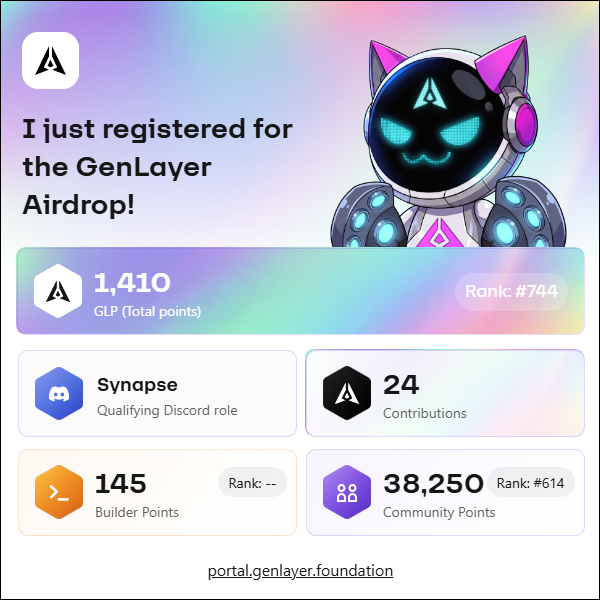
@GenLayer is replacing that with actual verdicts, and I’m registered for the airdrop🔥
Wish I’d come earlier, and honestly the vesting has me a bit unhappy 😤 but court is still in session, so let’s see how it goes 🏛️
Every online deal runs on “trust me bro” 🤝😅
@GenLayer is replacing that with actual verdicts, and I’m registered for the airdrop🔥
Wish I’d come earlier, and honestly the vesting has me a bit unhappy 😤 but court is still in session, so let’s see how it goes 🏛️
GEN Airdrop Registration is open.
You've been building GenLayer with us since the start. Now it's time to register.
Open until Monday, October 26.
https://t.co/vgzh2EIjtV
Imagine say your AI pay for something online, the person no deliver, and nobody dey to judge una matter. No be wahala be that.
I dey do tech and dev work for clients, so I dey see how fast the internet dey grow. Soon, AI agents go dey buy, sell and sign deals for us. As dem start to quarrel, which court go settle am?
Na here @GenLayer talk say "we don land." Dem don see this problem before e blow, and dem don dey build the solution: A court for the internet. Their Intelligent Contracts fit understand wetin people dey argue about and judge am through AI validators wey dey agree together. For me, na that part sweet me pass.
@TheSamuelAA, this one na for you. Abeg no sleep on am, come check wetin dem dey build.
Start here: https://t.co/zhJPDxpJjQ
Join the Discord make you meet the community: https://t.co/GebkOsh6kJ
how do agents trust each other when they don't know who's on the other side?
for humans the answer is courts. i was the claimant in a pretty hefty lawsuit, and it took $1m just to get a judge to look at it
we're building @GenLayer as a global jurisdiction where anyone can get a dispute decided
more from my livestream with @robinhanson
@kstellana on Unchained you described escalating disputes to up to 1,500 AI validators, with a verdict in minutes.
My question: how do you make sure 1,500 votes aren't really 3 opinions repeated 500 times?
If most validators run the same few LLM families, they could share the same blind spots. An adversarial agent that finds one prompt that fools one model might fool all of them at once.
Is validator diversity (different models, prompts, operators) enforced at the protocol level? And how would you detect collusion or lazy copy-the-majority voting?
I'm curious because "more validators" only means "more security" if the errors are independent.
@GenLayer
Imagine say your AI pay for something online, the person no deliver, and nobody dey to judge una matter. No be wahala be that.
I dey do tech and dev work for clients, so I dey see how fast the internet dey grow. Soon, AI agents go dey buy, sell and sign deals for us. As dem start to quarrel, which court go settle am?
Na here @GenLayer talk say "we don land." Dem don see this problem before e blow, and dem don dey build the solution: A court for the internet. Their Intelligent Contracts fit understand wetin people dey argue about and judge am through AI validators wey dey agree together. For me, na that part sweet me pass.
@TheSamuelAA, this one na for you. Abeg no sleep on am, come check wetin dem dey build.
Start here: https://t.co/zhJPDxpJjQ
Join the Discord make you meet the community: https://t.co/GebkOsh6kJ
𝒀𝒐𝒖𝒓 𝑨𝑰 𝒂𝒈𝒆𝒏𝒕 𝒑𝒂𝒊𝒅 𝒕𝒉𝒆 𝒅𝒓𝒊𝒗𝒆𝒓 𝒃𝒖𝒕 𝒉𝒆 𝒏𝒆𝒗𝒆𝒓 𝒔𝒉𝒐𝒘𝒆𝒅 𝒖𝒑, 𝒏𝒐𝒘 𝒘𝒉𝒂𝒕?
𝑯𝒐𝒘 @GenLayer 𝒕𝒂𝒄𝒌𝒍𝒆𝒔 𝒘𝒉𝒂𝒕 𝒉𝒂𝒑𝒑𝒆𝒏𝒔 𝒏𝒆𝒙𝒕
On March 2, 2026, Santander and Mastercard completed Europe's first live end-to-end payment executed by an AI agent within a regulated banking framework.
This clearly shows how AI agents are moving beyond just answering questions to executing real-world transactions.
But here's the thing: 𝐣𝐮𝐬𝐭 𝐛𝐞𝐜𝐚𝐮𝐬𝐞 𝐚 𝐩𝐚𝐲𝐦𝐞𝐧𝐭 𝐠𝐨𝐞𝐬 𝐭𝐡𝐫𝐨𝐮𝐠𝐡 𝐝𝐨𝐞𝐬𝐧'𝐭 𝐦𝐞𝐚𝐧 𝐭𝐡𝐞 𝐬𝐞𝐫𝐯𝐢𝐜𝐞 𝐡𝐚𝐬 𝐛𝐞𝐞𝐧 𝐝𝐞𝐥𝐢𝐯𝐞𝐫𝐞𝐝 𝐚𝐬 𝐚𝐠𝐫𝐞𝐞𝐝.
Let's consider this scenario...
You ask your AI agent to book an airport transfer. It finds a driver, makes the booking and processes the payment.
Everything seems fine until the driver never shows up.
Here, your money has been paid but the service you requested was never delivered.
Now what?
Who determines whether the driver breached the agreement and should you receive a refund?
This is where genlayer plays a vital role
Through its intelligent contracts, genlayer enables smart contracts to handle situations that require interpreting information rather than simply executing predefined code.
In this scenario, an intelligent contract could evaluate the booking terms, agreed pickup time and available evidence to help determine whether the driver failed to fulfil their obligation.
Based on the contract's rules and the evidence available, the outcome could guide the appropriate resolution, including a refund where justified and supported by the relevant payment infrastructure.
And of course, this depends on how the contract is designed, the reliability of the evidence and whether the payment system can act on the outcome.
Note that genlayer does not automatically reverse bank payments or replace existing legal and regulatory processes.
𝐇𝐞𝐫𝐞'𝐬 𝐭𝐡𝐞 𝐤𝐞𝐲 𝐝𝐢𝐬𝐭𝐢𝐧𝐜𝐭𝐢𝐨𝐧:
- Santander provides banking infrastructure
- Mastercard provides payment network infrastructure that helps facilitate transactions
- GenLayer is building technology to help resolve disputes by evaluating agreements and evidence when things don't go as planned
These technologies address different challenges within the emerging agentic economy.
Because the future of agentic finance isn't just about enabling AI to pay. We also need mechanisms that can help determine what happens when agreements are broken.
We need genlayer!!!
𝐒𝐭𝐚𝐤𝐢𝐧𝐠 𝐢𝐬 𝐧𝐨𝐭 𝐚 𝐬𝐞𝐭-𝐚𝐧𝐝-𝐟𝐨𝐫𝐠𝐞𝐭 𝐚𝐜𝐭𝐢𝐯𝐢𝐭𝐲.
One thing I have learned from staking JUP is that the experience goes beyond locking up tokens and waiting for rewards.
With Jupiter, the ASR (Active Staking Rewards) system makes staking more interesting because there is a reward mechanism tied to active participation. It gives me another reason to pay attention to the ecosystem instead of treating my stake as something I can forget about.
That got me thinking about GenLayer.
If I delegate my GEN to a validator, I want to know more than how much I could earn. I want to understand how that validator performs over time, whether it remains reliable, and what happens when its performance changes.
For me, an effective staking strategy would look something like this:
• Choose carefully. Research validators before delegating. Reputation, reliability, commission, and performance matter.
• Keep an eye on things. A validator performing well today is not guaranteed to perform equally well tomorrow. Regular checks help me make decisions based on evidence.
• Pay attention to changes. Downtime, changing commission rates, or declining performance should prompt a closer look, not an emotional reaction.
• Be willing to reassess. Delegation should remain a conscious choice. If the evidence suggests a validator is no longer the right fit, I should understand my options and the applicable unstaking rules before making a move.
Jupiter's ASR experience has made me appreciate how staking can encourage users to stay involved rather than simply chase yield.
And honestly, I would love to see GenLayer explore something along these lines too, whether through active participation incentives, staking rewards that recognize meaningful contributions, or other mechanisms that encourage delegators to stay engaged with the network.
Of course, GenLayer would need to design such a system around its own consensus model and network needs. The goal should be to reward useful participation without encouraging people to chase incentives blindly.
I'm interested in seeing how GenLayer's staking ecosystem develops. For me, the bigger opportunity is building a system where delegation, validator accountability, and community participation all work together.
Stake with intention. Stay involved. Let performance guide your decisions.
@GenLayer