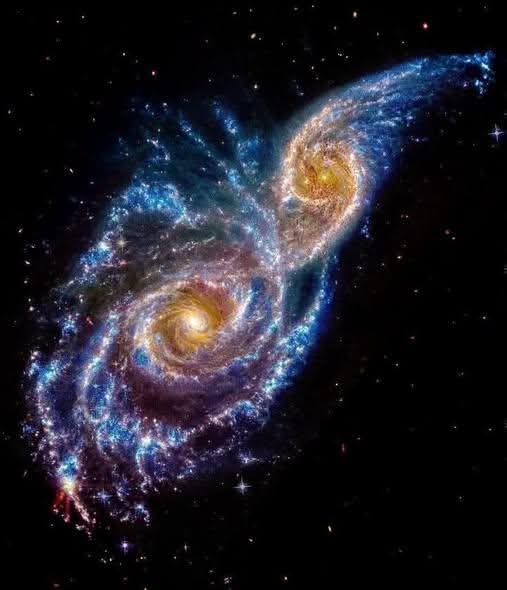
Behold the cosmic yin and yang of spiral galaxy NGC 1566—sliced cleanly on the diagonal in this stunning composite.
On the upper left, the Hubble Space Telescope paints the galaxy in its familiar visible and ultraviolet hues: a glittering swirl of stars where dark, shadowy lanes mark the dusty highways that swallow starlight.
Flip to the lower right, and the James Webb Space Telescope flips the script entirely. In near- and mid-infrared light, those same dark dust lanes blaze to life—glowing, intricate rivers of warm cosmic smoke. Dust that once hid the light now becomes the light, re-emitting the energy it absorbed.
What looks like emptiness to Hubble becomes a luminous tapestry to Webb. Darkness and radiance trade places, revealing the hidden architecture of a living galaxy in exquisite, opposite detail.
Credits: NASA, ESA, CSA, STScI, Janice Lee (STScI), Thomas Williams (Oxford), Rupali Chandar (UToledo), Daniela Calzetti (UMass), PHANGS Team
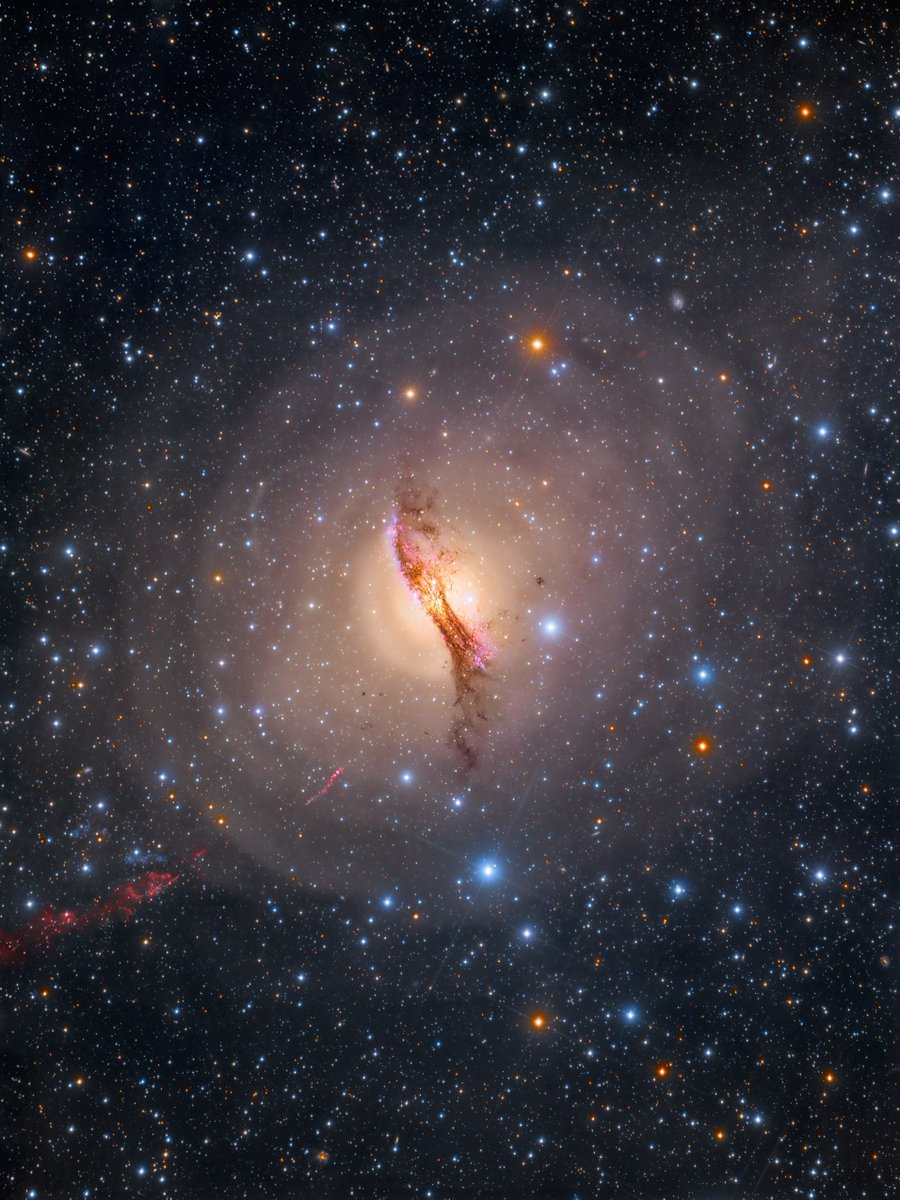
Centaurus A (NGC 5128) is one of the nearest active radio galaxies to us, located approximately 12 million light-years away in the constellation Centaurus. Its diameter is estimated at around 60,000 light-years, and at its center lies a supermassive black hole with a mass of about 55 million times that of the Sun. Centaurus A emits powerful radio jets stretching over a million light-years, making it one of the brightest radio sources in the sky. The galaxy features a distinctive dark dust lane—the result of a collision with another galaxy about 200 million years ago.
Centaurus A should not be confused with Sagittarius A*—the compact supermassive black hole at the center of our own galaxy.
🌙