Kinépolis $KIN, a movie theatre group, reported its best 1H results ever, with a 68% increase in EBITDAL and a 280% rise in EPS, even after accounting for forex headwinds. Those results beat consensus by a wide margin. This might not seem surprising, as many people went to the cinema to watch films like Spider-Man or The Odyssey. However, you may be surprised to learn that these movies are in Q3 earnings, while Kinépolis is currently reporting for 1H. With upcoming releases like Avengers, Dune, and other major titles in the second half — a seasonally stronger period due to summer, Thanksgiving, and Christmas holidays — I anticipate the company will again post blowout results in the upcoming semester.
We’ve been buying Kinépolis shares since late 2025 and continued doing so early this year, reaching about 1.5% of the company. The narrative that streaming would kill the cinema industry was very strong, driving the company's decline. It was trading at COVID lows despite its impressive track record and arguably the best margins in the industry, thanks to strict cost control by the controlling family, which holds a 50% stake. They are continuously optimizing the break-even point, reducing it each year in proportion to a hypothetical 5% decrease in visitors since 2008. Notably, Kinépolis acquired 44 cinemas in Canada in 2018, which generated 15 million EBITDAL; last year, with 72% of visitors, they achieved 37 million EBITDAL. This strategy drove the company's earnings to all-time highs in 2023, despite a 20% drop in visitors.
I really liked the investment thesis, as the stock was very depressed because the market believed this business was finished due to streaming. I saw things differently. From 2014 to 2019, streaming platform usage surged significantly —Netflix's stock increased over 400%—yet Kinépolis' stock also rose 200%, indicating the cinema business remained highly profitable. When the market thought streaming was disrupting this sector, we examined studio behavior, as they are the content suppliers. The major studios—Disney, Warner Bros, Universal, Sony, and Paramount—shifted focus to streaming around 2020. By then, investors favored streaming users above all else, with Warner Bros announcing in 2021 that all its movies would debut simultaneously in theaters and on streaming. However, 2022 brought reality checks. As interest rates rose, the market shifted its focus from users to profitability. It became clear that producing films with $200 million budgets was unprofitable if reliance was solely on streaming. Consequently, the big five resumed the traditional model—prioritizing theatrical releases to generate revenue before streaming, allowing an extended exclusive theatrical window, reminiscent of the VHS/DVD era. Additionally, companies like Amazon, Apple, and even Netflix have recently adopted this approach. Notably, studios are now expanding the theatrical window again, signaling a major strategic shift for Hollywood.
While the market focused on streaming, I believed the real issue was the quality and quantity of movies released in theaters. Before COVID, around 95 films were released each year globally, excluding regional films, whereas last year, only 65 were released. This is significant because fewer films mean lower chances of blockbuster hits. As mentioned earlier, Hollywood studios had decided to return to theaters by 2022/2023, but producing a film takes approximately 2.5 to 3 years, and there was also a Hollywood strike during that time. However, the 2026 lineup looked very different, with 80/85 releases like Michael Jackson, Toy Story 5, Super Mario, and Project Hail Mary, along with well-expected blockbusters like Spider-Man, Avengers, and Dune.
2026 indicates that cinemas are resurging because of content, not as a one-time event but as a fundamental shift. The industry has primarily been dealing with a content supply shortage rather than a lack of demand. While streaming is popular for passing time, those seeking a true cinematic experience prefer the theater.
I’m long Kinépolis, so do your own due diligence.
Hablemos de los Bonos.
Los intereses a largo plazo en todo el mundo están disparados. Siguen subiendo. En Alemania, el Bono alemán a 10 años ya alcanza un interés del 3,25%. En EEUU, el interés a 30 años ya supera el 5,3%. El 10 años estadounidense, el 4,73%... En fin, todos los intereses de los tramos largos disparados.
Pero, primero: ¿por qué se disparan los intereses?
Sabemos que los intereses a largo plazo se derivan de los bonos de esos gobiernos a esos plazos. Por ejemplo, si quiero saber cuál es el interés a 10 años del bono estadounidense, lo que se hace es mirar el bono liquido con ese tenor (el on-the-run). De su precio de cotización se deriva el interés a vencimiento (YTM) que está ofreciendo ese bono. Así puedes saber qué tipo de interés se está dando por ese plazo.
Ahora bien, ¿qué hace que el interés suba? El interés de un bono a vencimiento y su precio son inversos. ¿Por qué?. Pues porque un bono paga unos Flujos Conocidos. Lo compras a un precio (llamemos a ese precio X) y al finalizar el bono (vencimiento) recibes el principal, que es conocido. Además, muchos bonos pagan cupones, y esos son fijos durante toda la vida del bono, no cambian. (Excepto si están ajustados a la inflación o son de cupón flotante)
Sería muy fácil por tanto saber qué rentabilidad te da un bono por esos flujos, siempre y cuando el precio al que compres sea el mismo que el principal que recibes a vencimiento, ¿verdad? Si yo compro por 1.000$ y recibo 1.000$ a vencimiento, mi rentabilidad depende de los flujos, que son conocidos. El interés a vencimiento sería entonces fijo, ¿NO?
Ahora bien, lo difícil de los bonos es que cotizan en mercado: su precio durante su vida se va moviendo, y como todo activo, depende de la DEMANDA y la OFERTA. Entonces, si el precio cambia, ya no solo tienes la rentabilidad de los flujos conocidos, sino que debes incorporar también la rentabilidad del cambio entre el precio que compras y el principal que recibes.
Veamos un ejemplo. Si compro un bono a 1.000$ a 5 años, recibo 1.000$ a los 5 años y me paga un cupón anual del 5%, pues mi rentabilidad a vencimiento es la del cupón = 5% anual. Los flujos son conocidos, y la ganancia la obtengo por los cupones. Ahora bien, imaginemos que ese BONO en mercado cae a 900$ y sigue manteniendo el mismo vencimiento. Si ahora lo quiero comprar, ¿cuál es la rentabilidad? Pues será superior al 5%. Porque no solo me llevo los flujos conocidos, sino que también me llevo la diferencia entre el precio de compra y el principal.
Por eso la rentabilidad a vencimiento de un bono es inversa a su precio. Cuando el precio del bono baja, su rentabilidad a vencimiento sube. Y cuando el precio sube, su rentabilidad a vencimiento baja. Y la magnitud (sensibilidad) depende de la duración del bono. Para mantenerlo simple asumamos que cuanto más plazo tiene un bono, más duración tiene. (Aunque no solo depende de eso)
Ahora bien, ¿qué hace que el precio de un bono baje? Pues que haya más oferta que demanda. Y recordemos que ahora mismo hay un montón de emisiones de BONOS, no solo de los gobiernos, que se están endeudando a SACO, sino también de las empresas de IA. Google, Amazon, META... todas están emitiendo bonos a largo plazo y compitiendo por ese capital.
El capital, al fin y al cabo, NO es infinito. Es decir, la OFERTA está creciendo mucho más rápido que la DEMANDA. Se estima que las emisiones corporativas alcanzarán 2,46T$ en 2026.
Entonces, puede que esta oferta esté generando más presión sobre una demanda que debe repartirse.
¿Y por qué preocupa a la gente que el interés suba? Pues porque dispara los costes de financiación de los gobiernos y genera un bucle: más gasto, más deuda, y el tipo de interés sigue incrementando. Por eso el Tesoro estadounidense y otros, llevan años cambiando las emisiones a tramos cortos, para no financiarse en los tramos largos que son mucho más caros. El problema de eso que tienes un mayor riesgo de refinanciación, debes refinanciar más a menudo.
Otro tema es porque el interés a largo plazo es referencia para el mercado hipotecario: si los tipos de interés a largo plazo suben, los tipos hipotecarios que se referencian ahí también. Hace más difícil el acceso a la vivienda y congela la nueva compra. En teoría una de las agendas de Trump era la asequibilidad de la vivienda, y que los tipos a largo suban va en contra de su objetivo.. Pero bueno también la gasolina, los últimos meses su política de asequibilidad se le ha girado o ya no le importa tanto.
Ahora bien, luego están los catastrofistas que dicen que el tipo de interés alto es malo porque entonces puede haber una SUBASTA FALLIDA. Pero eso es complicado que pase. Sí que puede haber subastas con baja demanda en las que se exija un interés mayor, pero EEUU siempre podrá colocar su deuda por ser papel de la máxima calidad y por la demanda que hay de este papel.
Ahora bien, el tipo de interés alto también presiona los activos más sensibles a los tipos de interés, y por eso el mercado está más preocupado. Pero en mi opinión el mercado realmente no le preocupa el nivel del tipo de interés (aunque esto da para debate) sino la velocidad a la que sube: la volatilidad en el mercado de bonos. Si hay mucha volatilidad, eso es es lo preocupante. No tanto el nivel.
Aunque muchos argumentan que esto incrementa el coste de capital y por ende las valoraciones se comprimen.
Pero la razón que veo yo detrás de la subida de los intereses a largo plazo es más bien FISCAL. El mercado está exigiendo un tipo de interés mucho más alto por exponerse a deuda de largo plazo. Porque tiene miedo e incertidumbre sobre estos gobiernos. Ningún gobierno está siendo disciplinado con el gasto fiscal: todos están gastando a lo loco y llevando a cabo una expansión fiscal. Vimos en EEUU el otro día el déficit otra vez en récord (gasto que supera al ingreso). Y en Europa el gasto fiscal también se está disparando por la inversión en defensa.
Eso hace que el inversor exija una mayor prima por exponerse a tramos largos (un mayor interés) por exponerse a esa deuda. Esto tiene nombre técnico: la prima por plazo (term premium).
La visión de Nartex Capital sobre el mercado de inteligencia artificial.
Compartimos con vosotros nuestra visión actual sobre la industria de la inteligencia artificial, la explosión en los ingresos, su sostenibilidad y los detalles que nos alejan de poder invertir en esta cadena de suministro.
#AI #IA #nartex #fondosdeinversion #inversion #inversionencalidad #qualityinvesting #finanzas
El primer trillonario en la historia de la humanidad
- Elon Musk
- Nacido en Sudáfrica
- Acosado sin piedad de niño
- Inmigró a Norteamérica
- Llegó con una mochila y un sueño
- Construyó Zip2 con su hermano
- La vendió 4 años después por $300 millones
- Cofundó PayPal con las ganancias
- Revolucionó los pagos digitales
- Vendió PayPal a eBay por $1.5 mil millones
- Apostó todo por Tesla y SpaceX
- Se burlaron de él por los autos eléctricos
- Se rieron de él por los cohetes reutilizables
- Casi quebró en 2008
- Siguió construyendo de todos modos
- Convirtió a Tesla en la automotriz más valiosa del mundo
- Hizo que los vehículos eléctricos fueran mainstream y transformó la industria automotriz
- Hizo realidad los cohetes reutilizables
- Redujo el costo de llegar al espacio en un 95%
- Desató la carrera espacial comercial moderna
- Construyó Starlink y conectó a millones alrededor del mundo a internet de alta velocidad
- Convirtió a SpaceX en la compañía privada más valiosa de la historia
- Compró Twitter por $44 mil millones
- El mundo dijo que pagó de más
- Lo llamaron imprudente, estúpido y loco
- Los anunciantes huyeron, los medios declararon que estaba muerto
- Los críticos lo llamaron la peor adquisición en la historia de la tecnología
- Lo renombró ��
- Reconstruyó la plataforma de todos modos
- La convirtió en una de las plataformas más influyentes de la Tierra
- Lanzó Grok y aceleró la carrera global de IA
- Envió astronautas al espacio
- Está intentando llevar humanos a Marte
- Creó millones de empleos
- Generó cientos de miles de millones en valor
- Inspiró a toda una generación de constructores
Antes:
- Falló repetidamente
- Trabajó horas insanas
- Dormía en fábricas y oficinas
- Fue acosado, se rieron de él y se burlaron
- Le decían constantemente “es imposible”
- Siguió construyendo de todos modos
- Lo hizo posible
Hoy:
- La persona más rica de la Tierra
- El primer multimillonario en la historia de la humanidad
- La mayor OPI en la historia $1.77 billones
La mayoría de la gente renuncia cuando el mundo se ríe de ellos.
Elon Musk construyó el futuro en cambio.
Ámelo o odíelo…
Nadie ha cambiado más industrias en una sola vida.
Pagos. Autos. Energía. Espacio. Redes sociales. Comunicaciones. IA.
La historia no recordará a las personas que dijeron que no se podía hacer.
Recordará a las personas que lo hicieron de todos modos.
Felicidades Elon.
El primer trillonario... 🚀
Investment thesis: The moment has arrived for the oil services supercycle.
For the past decade, I’ve listened to permabulls predicting the start of the oil capex supercycle. I always laughed because the right conditions weren’t there. However, this is changing now. Despite what you might think, it’s not driven by the Middle East conflict, as it wasn’t affected by the Russian war. Let me explain:
Oil service companies saw substantial growth before 2014, particularly between 2010 and 2014, as the global economy bounced back quickly following the financial crisis, with offshore oil supply attracting major focus. During this period, oil prices remained above $100, and market sentiment focused on oil scarcity. Consequently, O&M companies prioritized expanding and securing reserves, with little concern for costs or CAPEX. As a result, the oil services sector expanded quickly, and stocks traded at higher multiples, reflecting optimistic long-term prospects. However, this trend reversed sharply after 2014 when the US introduced fracking technology, unlocking unconventional reserves and establishing the US as a leading global energy supplier. This disruption killed the offshore sector, which was the marginal supplier, and triggered a wave of bankruptcies. Most offshore producers exited the market because their breakeven costs were too high to compete. In contrast, US shale could bring oil to market much faster and with less investment, unlike offshore drilling, which requires many years and significant capital expenditures before producing its first oil.
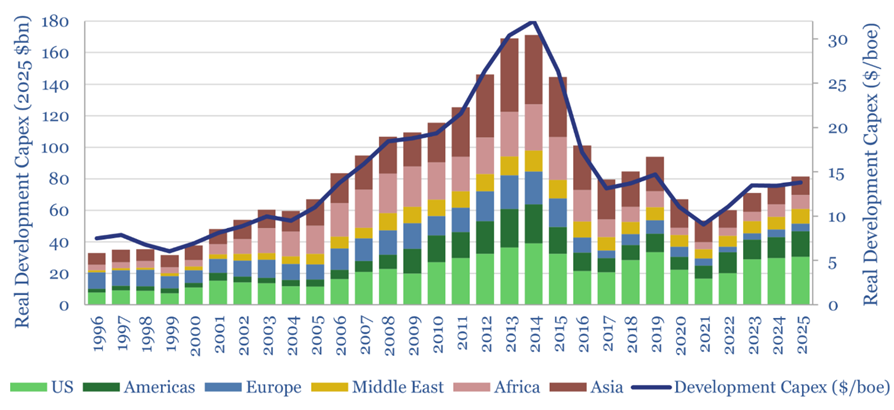
As shown in the graph below (first picture), capex declined sharply starting in 2014, and we are currently at just 50% of that year's oil investment level. Interestingly, this graph is often used by permabulls as an investment case, arguing that insufficient global investment will lead to prolonged periods of high oil prices. However, over the past decade, this prediction has repeatedly failed, leading to many failed claims of an upcoming oil supercycle. They overlooked the impact of the US shale revolution and the fact that US output now meets market needs with much lower investments, rendering this graph less relevant.
Returning to the story, the offshore sector somewhat adapted to the new oil environment, with lower prices driven by the US's infinite supply. Thanks to technological efficiencies and industry consolidation, the offshore space was revived in 2019. Oil demand was strong, and for the first time since 2014, prices exceeded $80, prompting new offshore investments to develop oil reserves.
However, this was short-lived as COVID emerged in early 2020, disrupting not only oil demand due to widespread closures but also supply, as Saudi Arabia initiated a price war against Russia, flooding the market with oil. Inventories soared, and demand weakened, requiring significant time for the world to adjust. Who was willing to invest in developing reserves in this environment? Perhaps even more critical for the sector was the irrational behavior during 2020/2021. Suddenly, oil faced harsh criticism while the world shifted to green energy. Oil majors were pressured to redirect investments toward renewables, further reducing investment in the oil sector, including oil services. By then, the consensus was that oil demand would peak by 2030, killing any hope for investments in the offshore space, which requires large, long-term commitments. Additionally, investors grew frustrated with oil companies' stock performance and demanded that firms prioritize shareholder payouts over reserve development. Consequently, oil services endured another wave of downturns, with increased scrapping, bankruptcies, and layoffs.
I also want to highlight that during that period, we achieved significant profits in the oil sector, primarily by investing in oil producers. In 2020, core investments like Devon Energy and IPC yielded extraordinary returns, as did recent ones like Kosmos. Our idea was simple; we differ from the consensus on the oil demand outlook. I believe oil demand was healthy and growing, driven by emerging markets, yet the world was well supplied by US shale. Therefore, investing in oil producers was a smart move, as these investments were carefully sanctioned, with a focus on cost control and short-term payback periods. Oil suppliers require investment enthusiasm, which was not the case in our scenario.
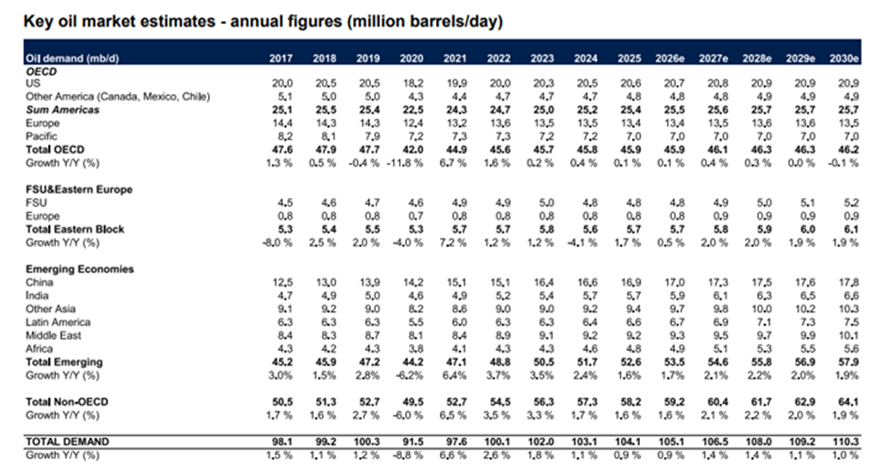
As shown (second and third pic), oil demand grew steadily over the years. It has never been a demand issue, except for short-term impacts, making the narrative about peak oil quite unfair.
However, the US supplied nearly all new oil demand, rendering OPEC insignificant. Notably, OPEC's production has remained stagnant for the past 30 years. (pic 4 and 5 in the following post)
Finally, the environment is undergoing significant changes:
1. The consensus on peak oil demand has shifted from the late 2020s to the 2040s. Irrational behavior in green investments has notably slowed, and major companies have redirected their focus back to oil.
2. US oil production seems to have peaked. Last year, the US shale industry warned that the era of abundant free oil supply was behind us as first-tier reserves were exhausted. US shale oil output was known for its rapid responses, spiking when oil prices rose. However, despite oil prices surpassing $100 this time, there hasn't been a corresponding increase in production. Key indicators such as Frac Spread Counts and other metrics point to the conclusion that US shale supply growth has ended.
3. The Middle East situation has highlighted the importance of energy security.
4. Investor sentiment has shifted – investors now place a higher value on oil companies with longer production profiles.
In this environment, with demand continuously increasing and the US supply struggling to meet this new demand, I see companies once again investing in the offshore sector, since it’s the only way to balance global supply. Moreover, the offshore industry has seen a significant reduction in supply due to considerable challenges, so even a small increase could make a meaningful difference.
Based on that, I made Constellation Oil Services ($COSH) my largest equity position. I'll explain in a future post why I chose COSH. As a conservative investor, likely influenced by my management of a fixed-income fund, I believe that if my outlook is correct, COSH may not be the top gainer, even though it will be a home run. However, it offers better safeguards if my view proves less accurate. Its strong backlog, healthy balance sheet, and dividend focus give us a substantial margin of safety.
I see many catalysts, including the uplisting, dividend increase, and debt refinancing in November. That last will significantly lower interest costs, improve covenant flexibility, and enable higher dividends.
Do your own diligence
Novo Nordisk $NVO : The Market Is Missing The Bigger Picture Behind Q1
Novo Nordisk’s $NVO latest earnings report created exactly the kind of market reaction I usually pay attention to because, in my opinion, investors are focusing on the wrong part of the story.
At first glance, the quarter looked messy. Adjusted sales declined, operating profit slipped, and management is still guiding for weaker profitability in 2026 despite massive global demand for obesity drugs. On the surface, that sounds like the growth engine is breaking down.
But I think the market is confusing pricing pressure with demand destruction, and those are two very different things.
When a company loses pricing power but demand continues accelerating, it does not necessarily mean the long-term thesis is broken.
Sometimes it simply means the business is transitioning from an early-stage scarcity model into a scaled global volume business.
And that is exactly what I believe is happening with Novo Nordisk $NVO right now.
The market is acting as if GLP-1 demand is peaking. Yet prescriptions for Wegovy continue to explode, international demand is still ramping, and obesity treatment penetration globally remains incredibly low relative to the size of the addressable market.
To me, this looks less like a structural collapse and more like a temporary margin compression phase during a massive commercial expansion cycle.
That distinction matters because the stock is now trading like a mature pharmaceutical company facing stagnation rather than the dominant player in what could become one of the largest drug categories in modern healthcare.
And frankly, I think the market may be underestimating just how early we still are in the global obesity treatment cycle.
The Quarter Looked Strong Until You Looked Closer
Novo reported headline Q1 FY26 revenue growth of 32% at constant exchange rates, with operating profit surging 65%. On paper, those numbers looked phenomenal.
But the real story underneath the surface was much more complicated.
A large portion of that strength came from a one-time reversal tied to the U.S. 340B Drug Pricing Program.
Once you strip that out, adjusted sales actually declined 4%, while adjusted operating profit fell 6%.
That changes the entire interpretation of the quarter.
This wasn’t a case of demand weakness. The real issue was pricing pressure, particularly inside the United States where reimbursement dynamics and competitive intensity are starting to compress realized pricing.
And honestly, I think investors are struggling to separate those two realities.
Because if you only focus on margins, the quarter looks concerning. But if you focus on actual patient demand and prescription growth, the picture still looks remarkably strong.
Wegovy’s oral launch in the U.S. crossed more than 200,000 weekly prescriptions within months and generated roughly 1.3 million prescriptions during Q1 alone. That is not what a collapsing growth story looks like.
In reality, Novo is facing a very different problem: demand is scaling faster than the market’s willingness to pay premium pricing forever.
That may hurt near-term profitability, but it does not invalidate the long-term opportunity.
In fact, this transition was probably inevitable.
Healthcare systems eventually push back once blockbuster therapies become mainstream.
We saw it with insulin. We saw it with hepatitis drugs. And now we are seeing the early stages of it with GLP-1s.
The important question is whether volume growth can eventually offset pricing compression.
And personally, I believe it can.
The Obesity Market Is Still In Its Infancy
I think many investors forget how small obesity treatment penetration still is globally.
The narrative around GLP-1s has become so dominant that people assume the market is already mature.
But when you zoom out, we are probably still in the first few innings.
Globally, hundreds of millions of people qualify medically for obesity treatment, yet only a tiny percentage are actually receiving therapy today.
That matters because Novo’s long-term opportunity is not dependent on charging exceptionally high prices forever. It is dependent on scaling treatment adoption worldwide.
And the international numbers are already showing signs of that shift.
While U.S. adjusted sales declined, international operations grew 6% at constant exchange rates, driven largely by volume expansion rather than aggressive pricing.
That is important because it shows the growth engine is gradually becoming more diversified geographically.
I also think investors underestimate how powerful oral obesity drugs could become over time.
Injectables are effective, but they still create psychological and logistical barriers for many patients.
Oral therapies dramatically expand the potential patient pool because they feel more familiar and accessible to mainstream consumers.
That is why Novo’s oral Wegovy rollout matters so much.
If obesity treatment eventually evolves into something closer to a chronic maintenance category like cholesterol or diabetes medication, the long-term revenue opportunity becomes enormous even with lower pricing per patient.
And that is the part of the thesis the market currently seems unwilling to price in.
Investors Are Debating The Wrong Thing
Right now, the entire debate around Novo revolves around margins.
Bears see declining adjusted profits and assume the GLP-1 opportunity is starting to deteriorate.
Bulls see explosive prescription growth and argue the company is simply moving through a temporary normalization phase.
I lean much closer toward the second view.
Because when I look at the quarter, I do not see a business losing relevance.
I see a company trying to balance unprecedented demand growth against a healthcare system increasingly pushing for affordability.
Those are not the same thing.
In fact, the strong demand trends arguably make pricing pressure more likely because payers know these drugs are becoming unavoidable over the long term.
Management’s updated guidance reflects that tension.
Novo slightly raised its outlook, but the company still expects adjusted sales and operating profit to decline somewhere between 4% and 12% this year excluding the one-time 340B impact.
That guidance sounds weak relative to the excitement surrounding obesity drugs.
But I think investors need to understand where Novo currently sits in the cycle.
The company is transitioning away from scarcity-driven hyper profitability toward scaled global adoption.
That transition may temporarily compress margins, but it can also create a much larger and more durable long-term revenue base.
And honestly, I would rather own the dominant platform scaling globally than the company maximizing short-term pricing at the expense of broader adoption.
The Valuation Has Completely Reset
This is where things start getting interesting to me.
Novo now trades around 13x forward earnings, well below both healthcare peers and its own historical averages.
Not long ago, the market treated Novo like one of the highest-quality growth stories in global healthcare.
Today, the stock is being valued more like a company entering permanent decline.
That disconnect feels excessive.
Yes, near-term earnings pressure is real. Yes, pricing dynamics are becoming more challenging.
But we are still talking about a company dominating two of the largest chronic disease markets globally: obesity and diabetes.
And importantly, demand is not slowing.
The market appears to be pricing Novo as if current earnings pressure represents a permanent impairment to the business model.
I do not think that assumption fully reflects the scale of the long-term opportunity.
Even revenue-based valuation metrics still imply skepticism.
EV/sales sits near 4.8x forward revenue despite Novo controlling one of the most important pharmaceutical franchises in the world today.
Meanwhile, consensus expectations already assume weak earnings growth through 2026 before stabilization begins.
In other words, a lot of bad news already appears priced into the stock.
And historically, some of the best long-term opportunities emerge when markets start extrapolating temporary pressure too far into the future.
My Take
I think Novo Nordisk is going through a difficult but ultimately healthy transition phase.
The easy part of the GLP-1 boom is over. Scarcity pricing, explosive early demand, and investor euphoria are fading.
Now comes the more complicated stage where these drugs become integrated into broader healthcare systems globally.
That process creates pricing pressure, reimbursement battles, and margin volatility.
But it also creates scale.
And scale is what ultimately builds dominant long-term healthcare franchises.
To me, the market currently looks overly focused on short-term margin compression while underestimating how large the global obesity treatment market could become over the next decade.
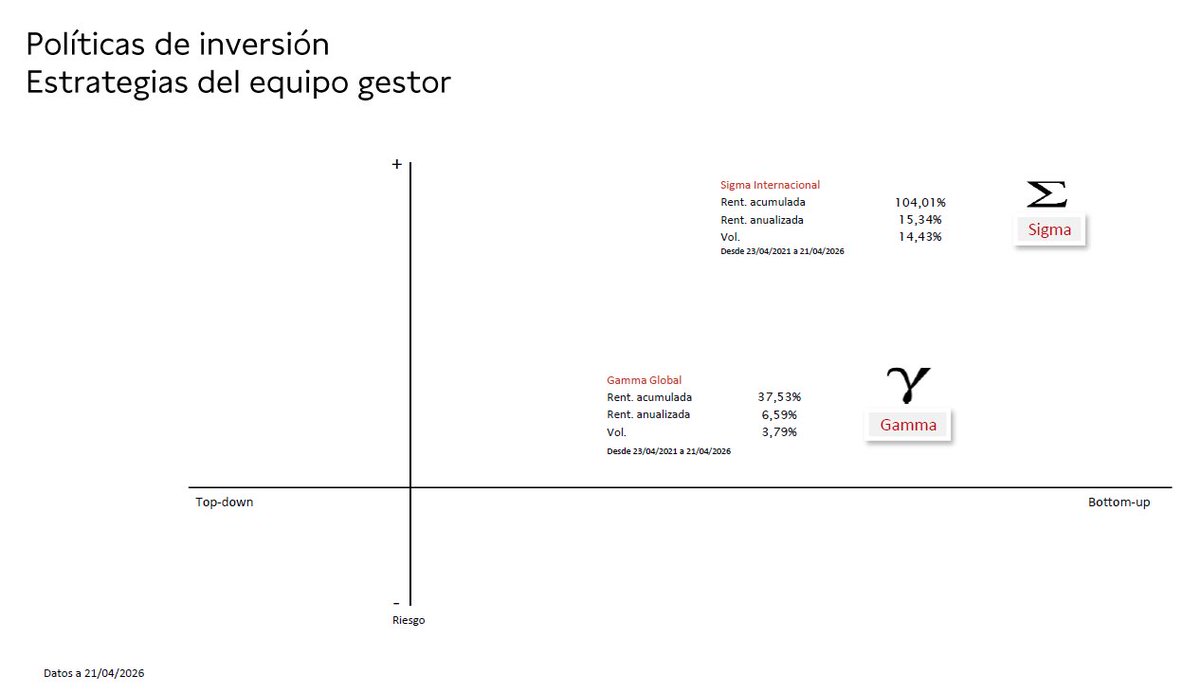
Hace cinco años, José Ramón y yo comenzamos oficialmente el proyecto en Singular Bank, aunque solo en términos administrativos, ya que el primer inversor no pudo entrar hasta el 19 de mayo. Así, el 23 de abril de 2021 lanzamos dos fondos con apenas 10 millones de euros y 200 partícipes. Creamos dos vehículos con estrategias distintas pero complementarias para solucionar los problemas de generación y preservación de capital de nuestros amigos y familiares.
Hoy, cinco años después, hemos ampliado el equipo a cinco personas y ambos fondos se sitúan entre los mejores de sus respectivas categorías. Sigma Internacional acumula una rentabilidad del 104% (15.3% anualizado) y Gamma Global del 37.5% (6.6% anualizado), con una volatilidad inferior al 4%. A pesar de las guerras, la rápida subida de la inflación y las políticas arancelarias, los fondos han logrado resultados excelentes, sin ningún año negativo.
No obstante, lo que más nos enorgullece son los más de 14.100 coinversores que confían en nosotros, con un capital total de 530 millones de euros.
Aunque las rentabilidades pasadas no garantizan resultados futuros, puedo asegurar que seguiremos con la misma pasión, autoexigencia, compromiso y rigurosidad que desde el primer día.
Por último, solo quiero agradecerles su confianza y seguir trabajando para que los próximos cinco años sean iguales o incluso mejores que estos últimos.
Se habla mucho últimamente de los riesgos del crédito privado/direct lending (fondos que prestan dinero directamente a empresas, sin pasar por los mercados tradicionales). Pero se comenta como si fuera un problema aislado, que solo afecta a quien invierte en esos fondos. Y eso es un error fruto del desconocimiento.
Pensadlo así, el sistema financiero no tiene paredes. Todo está conectado.
Esos fondos de crédito privado prestan a miles de empresas medianas. Las mismas empresas que también piden prestado en mercados abiertos a través de bonos o préstamos sindicados. Si el crédito privado se endurece, la presión se traslada a esos mercados. Los inversores en bonos y préstamos cotizados lo notan.
Los grandes gestores de crédito privado (Ares, Apollo, Blackstone) cotizan en bolsa. Si sus carteras de préstamos empiezan a ir mal, sus acciones caen. Y con ellas, el sentimiento hacia todo el sector financiero.
¿Y quién pone el dinero en estos fondos de crédito privado?
Fondos de pensiones, aseguradoras, grandes fortunas. Si sufren pérdidas relevantes en crédito privado, quedan sobreasignados a activos líquidos y necesitan compensarlo vendiendo lo que sí pueden vender rápido (acciones, bonos cotizados). Ya vimos en 2022 cómo funciona este mecanismo en sentido inverso. Cuando cayeron las bolsas y la renta fija, muchos inversores institucionales acabaron sobreasignados a mercados privados y tuvieron que frenar nuevos compromisos y vender posiciones en secundario con descuentos de hasta el 20%. El mecanismo funciona en ambas direcciones.
Los bancos también están en medio. Prestan dinero a estos fondos para que puedan a su vez prestar más. Si los préstamos van mal, los bancos cierran el grifo. Y cuando los bancos cierran el grifo, no lo cierran solo para un sector, lo cierran para todos.
Y lo más básico, estamos hablando de dinero que financia empresas reales. Empresas que contratan gente, que invierten, que generan beneficios. Solo en EE.UU., las empresas medianas representan un tercio del PIB y emplean a casi 50 millones de personas. Si ese dinero deja de fluir, el impacto lo nota toda la economía.
La historia financiera nos enseña siempre lo mismo, los problemas de crédito nunca se quedan donde empiezan. No hay asientos de espectador.
Nosotros en los fondos llevamos meses hablando sobre los riesgos de direct lending, con una exposición del 0% y haciendo ajustes en los activos de riesgo tanto cotizados como no cotizados.
¿Y tú, piensas que estás de espectador o estás haciendo ajustes en tu cartera?
$KOS Kosmos raised $182 million yesterday at a price of $1.90, which is a 21% discount to the closing price. The offering has generated strong demand, and the management team participated by purchasing approximately 3 million shares (the first insider purchase in a long, long time). For full transparency, I also participated in this capital raise.
I believe this offering was forced by the RBL banks to extend the 1.35bn facility. During the earnings call, the company stated they plan to seek an extension over the summer, ahead of the September 2026 deadline, when the liquidity test could trigger early repayment.
I don’t believe this raise was necessary, but banks forced them to act. Banks that have been very supportive of Kosmos—extending the RBL facility and granting numerous waivers in recent months—are now trying to reduce risks through this move. I wonder whether they are facing issues with many other companies, given reports of turbulence in the US private credit market.
Some people argue that $182m is insignificant compared to the around $3bn net debt reported in Q4, but they overlook key details. As of December 31, the RBL total was $1.35bn, with $1.20bn drawn and $150m undrawn. In January, they issued a $350m Nordic bond and repaid $100m of the RBL. Then, in February, they announced the sale of assets in Equatorial Guinea to Panoro, expected to close by mid-year, which should lead to an additional $200m repayment, as those assets were collateral for the facility. As a result, the existing bank debt is now approximately $900m, making this capital raise quite significant to this number. It’s fair to say that banks lost EG collateral, and GTA and GoA are now secured against different loans, leaving them with little safety margin outside Ghana. Nevertheless, Jubilee's performance remains robust, and its asset value should exceed $1 billion, even if oil prices stay low.
This is why companies often prefer bond financing to bank loans, even though bonds are generally more expensive. Bondholders were not asking the company to raise funds today, unlike banks, which often do. This has occurred several times; for instance, Golar raised $100 million in December 2020 (∼10% dilution) after banks pressured it, even though the company was already under control. Be aware that Golar's stock price tripled over the next two years, clearly indicating that the capital raise was unnecessary. Similarly, Kosmos has achieved control over its operations through GTA and Ghana, which are performing above expectations. The company also hedged effectively for the second half of 2026 and 2027, securing high free cash flow that will significantly reduce its leverage.
Although I believe the raise was unnecessary, the dilution isn't significant and doesn’t harm the investment case. Even with the greenshoe option (standard in all brokered equity issuances), the dilution remains minor and it only slightly lowers the long-term target price. However, it helps mitigate downside risk if oil prices fall back to $60 or below. This move reduces the company's risk and could attract institutional investors who previously stayed away due to the weak balance sheet. Starting with nearly $3 billion in net debt, I believe that through the EG sale, this equity raise, and free cash flow, they could reduce net debt by almost one-third by the end of the year — potentially driving the stock's valuation higher rather than trading like a distressed company.
Understanding that they couldn't control the equity issuance movement was not something they could control (better now than when it was trading at very depressed levels), perhaps my only surprise is the large discount. I would have expected a smaller discount compared to the last price, given the current outlook. They could have put in more effort to show that the company's 2025 numbers are significantly different from today's numbers, making it more convincing to investors involved in this capital raise.
Overall, as in other cases, I think the stock might take time to absorb this equity raise, particularly with the greenshoe active, but then, it will definitely trade higher due to an improved balance sheet and better FCF generation outlook. All else equal, I'd be surprised if the stock trades below the price issuance level.
$KOS Kosmos reported excellent results yesterday. Although the stock didn't continue climbing, I believe this is mainly due to investors taking profits rather than concerns about earnings—unless I underestimate the market's intelligence. Since KOS has already gained 2.7 times its value in just about two months, it’s normal for some investors to want to lock in gains. However, I maintain that the company's fundamentals are significantly stronger than its current trading price suggests.
Initially, focus on algorithms; earnings might appear as a miss and there's small cash burn, but a deeper look reveals a beat. One cargo from Jubilee was shifted into early 2026, resulting in production of about 67,9 Kboepd, while sales were only 62,9 Kboepd. This is expected to normalize in Q1 and is just a timing issue. When modeling production instead of sales, earnings and cash flow look strong. However, our main focus should be the 2026 guidance, as the company is making a complete turnaround thanks to GTA and Jubilee.
In production, the company forecasted a strong Q1 at 73 Kboepd, at mid-range estimate. Recent updates show that the fields that caused issues last year are now performing very well (Jubilee and GTA), surpassing consensus expectations. GoA is alright, but significant activity is expected this year on Tiberius and the strategic alliance with Shell, likely leading to a notable increase in production over the coming years. While Q4 and the outlook for Equatorial Guinea are somewhat underwhelming, that situation has changed since the assets were sold to Panoro. Be aware that the company will continue consolidating Q1 and Q2 results, but in reality, Panoro will be the one that collects profits/losses since January 1st.
One key point to highlight is that Senegal is set to begin constructing its domestic gas pipeline network next quarter. This is crucial for two reasons. First, it boosts production with minimal capex and no opex, significantly lowering the breakeven and making the asset highly free cash flow positive even at tough Brent prices. Second, it initiates a scheduled repayment timeline for Senegal and Mauritania. KOS provided a $400 million loan to develop the GTA, a figure that is not reflected in most models. Management plans to monetize part of this when the schedule becomes clearer, possibly at a small discount, thereby generating additional cash to further reduce debt.
The auditor loudly affirmed my previous statements. 1P reserves cover 10 years of production, while 2P reserves last 20 years. Excluding EG, reserve replacement exceeds 100%, and concerns about the status of Jubilee/TEN reserves should be disregarded.
Furthermore, as I have been asserting, the banks (RBL) provided the company with a covenant waiver to account for lower oil prices and the initial costs of the GTA under the company's net debt/EBITDA covenant. All rating agencies and analysts were very concerned about this, but I remained quite confident based on the relationship's historical performance. Indeed, Kosmos is preparing to initiate discussions to extend the Reserve Based Lending (RBL), meaning the bank loan.
The most crucial aspect is opex and cash flow breakeven. Opex per barrel has been decreasing over recent quarters, from $36.5 in Q2 to $26.8 in Q3 and $26 in Q4. As expected, we will see a substantial reduction in the next quarter and into next year. The company forecasts $19 per barrel for Q1 and $21 for the full year, but these figures include TEN and EG assets, which have the highest operating costs. Since they are acquiring the TEN FPSO and divesting EG, the opex per barrel will drop further, enhancing the company's resilience to lower oil prices. Capex and G&A expenses are projected to be low, encouraging analysts to significantly upgrade free cash flow estimates, given lower breakeven and higher oil prices. Additionally, the company is capitalizing on the current environment by hedging some production at favorable prices. I’m still surprised that I have a notably different FCF figure compared to most of them. They were assuming a $65 breakeven and $60 Brent prices, which led to a substantial FCF burn. It’s never too late to adapt, guys!
Overall, the results are positive and continue the strong momentum the business has shown this year. Given the current oil outlook, operational performance, and a fixed balance sheet, I still believe the stock is significantly undervalued at its current price. But please do your own due diligence!
PS. I saw yesterday that someone sent me a DM some time ago asking if I attended the Jubilee expert call that JPM organized. I don’t know how I deleted all the DMs… It’s crazy how many bots we have on X nowadays… it’s a shame. Well, I couldn’t read the message, so please reach out again here or on LinkedIn. Anyway, I want to share my thoughts. I was expecting more from this call, but it was enough for the JPM analyst to realize that all their estimates were wrong, as their main base case assumes that banks will panic and force Kosmos to raise capital or liquidate. These experts guys proved that the banks are overcollateralized (as the management confirmed yesterday) because the value of Jubilee alone is much higher than the amount they lent, even in mediocre scenarios.
$GLNG
Board Chairman Comments
"That Golar franchise, I don't think anybody fully understands the value, but I'll illustrate a little bit. We have been approached by one of the largest oil companies in the world who has effectively said, we cannot do this (meaning FLNG buildout). Can you be our service arm to deliver all activities going forward? I think that's a question to take. Those kind of things are probably a limited return compared to a lot of the other things we can do, but I think in many ways, it illustrates the value of the franchise we have built, which I think people are grossly under-estimating when they're trying to do the value when it comes. To the way we and the board look at the value, I think so far it's represented by the fact that we're buying back stocks. And that's a reflection of the fact that we think the value,we think it's almost better to buy back our own stock at an undervaluation than to effectively do anything else."
$GLNG My notes from the call
Revenues up 52%
Net Income up 40%
1- Board seeking strategic alternatives.
2- Highest ROIC right now is buying back shares.
3- We can finance Hilli and Fuji at same terms as Gimi which will provide 3.5B of capital (2.985B net) on top of the 1.2B of cash on balance sheet.
4- Mgmt stated they can do $5 of EPS in 2028.
5- "We have been approached by one of the largest oil companies in the world who has effectively said, we cannot do this (meaning FLNG buildout). Can you be our service arm to deliver all activities going forward?"
6- They stated the commodity upside option on Argy gas (would be incremental $200mm EBITDA this year) and is not being recognized by the market.
7- Gimi is operating at 2.8MTPA well above the 2.4mtpa that is contracted
8- Fuji new build has been funded by cash on hand (1.1B spent) and is on schedule and on budget.
9- SESA / Argentina is on schedule and all buildout capex is coming into place and they will disclose the terms of 1st 20yr contract with German Govt next month.
Buy HALO- Heavy Asset Low Obsolescence companies
I'm adding to my already insanely large position today!
Lets see if Goldman Sachs can help them unlock shareholder value.... Good luck to all.
$KOS Big news!
Panoro Energy is purchasing the Kosmos Equatorial Guinea asset (40.375% stake in Block G) for $180 million, with potential earnouts of $39.5 million tied to Brent prices and production levels over the next three years.
I believe this is a significant win for both companies. Please note that I am involved in the bond amendments, tap issue (bond) and the equity raise.
On one side, Panoro Energy is acquiring a great asset at an excellent price. Panoro is boosting its pro forma production by 85% and its 2P reserves by 110%. Be aware that Panoro does not incur additional overhead costs, as it already owns 14.25% of the asset. To accomplish this, the company is raising $150 million via a tap issue and a minor capital raise, resulting in only about 10% dilution at current prices (no discount required!), which shows strong support from major shareholders.
On the other side, Kosmos is raising liquidity from a non-core asset that has little effect on production or free cash flow going forward. Simultaneously, it is countering the bearish argument that the company cannot manage the maturities coming in the next 24 months and that it is highly dependent on oil prices, which would inevitably require a significant capital raise. They proved to be wrong! Rating agencies and research analysts should promptly update their ratings based on this deal and the most recent production update.
I estimate that this asset is worth approximately $300 million with some optionality, while Panoro is purchasing it for $180 million plus potential earnouts. Keep in mind that these earnouts depend on Brent prices and production levels exceeding my valuation estimates, so if Panoro pays an additional $39.5 million, the asset's fair value will increase substantially. This transaction is a significant win for Panoro, as the difference between the fair value and the purchase price is considerable, given the market cap ($270 million) and the Enterprise Value ($377 million). It also lowers the cash breakeven and notably enhances the company's capacity to pay dividends and buybacks in the future. However, for Kosmos, this is less impactful on valuation, since their market cap exceeds $1 billion and their EV is around $4 billion. For Kosmos, raising liquidity is more beneficial, as it demonstrates to the market that the company is significantly more resilient than the current price indicates. Additionally, Kosmos could repurchase some debt at a significant discount, creating far more value than what was left in this deal.
I think Kosmos still has some ways to raise liquidity this year, such as monetizing the $400m receivable from Senegal/Mauritania and receiving McDermott litigation proceeds. However, although I believe these are very likely given the proceeds from this deal, the current Brent price, and production levels, I think the company doesn’t need them to fix the balance sheet and trade at much higher levels.
I think both companies will trade up, including Kosmos bonds.
As I mentioned, we hold Panoro bonds and equity, as well as Kosmos bonds and equity; please do your own due diligence.
$KOS Significant news regarding Kosmos:
The company shared an update on production, licensing, and operational improvements.
Last year, GTA and Jubilee were the main issues, causing the stock to fall from 4 to under 1 due to Jubilee's underperformance and GTA's overcosts and delays. With this PR, KOS demonstrates that those problems have been resolved.
GTA:
The field’s January output exceeded expectations, reaching 2.9 mtpa compared to the 2.7 mtpa nameplate capacity and 2.4 mtpa contracted. While colder weather is a major factor in facilitating easier gas freezing, this performance demonstrates that maintaining nameplate capacity throughout the year is achievable. This is just the beginning, given the gas field's 45 TCF of resources and the company's plan to eventually produce up to 10 mtpa. I anticipate some domestic gas offtake commitments from Mauritania and Senegal this year (Phase 1+), which should boost production from 2028 or 2029. A subsequent FLNG project is also expected to optimize the asset. Most importantly, the asset is now generating cash at current Brent prices, a notable shift from the cash burn experienced over the past five years.
Ghana:
The government confirmed that the extension, combined with the drilling campaign, will lead to an increase in 2P reserves. Additionally, Tullow Oil has signed a binding lock-up agreement with holders of approximately 66% of its $1.28 billion 10.25% senior secured notes, and Glencore to execute a refinancing deal that extends the debt maturity to November 2028. This should alleviate market concerns about potential impacts on Jubilee/TEN if Tullow were to fail. We are not worried because the contracts specify that if the operator becomes insolvent, the asset's operation will be transferred. Furthermore, the drilling campaign is already contracted and cannot be reversed.
Jubilee:
The company confirms that the last well (J74) is producing approximately 13,000 bopd, raising the average gross Jubilee oil production to over 70,000 bopd in February. This rate significantly exceeds consensus estimates and Tullow's guidance. Most importantly, the company indicates that the next well (J75) appears similar to the previous two, both producing over 10,000 bopd, and is expected to come online around the end of March. Wasn’t Jubilee considered dead? It seems my earlier assessment of drilling and production rates was correct. The company should aim to produce 80,000 bopd and drill three or four wells annually to sustain these levels. If so, this asset is a cash cow!
TEN:
The company confirms that they have signed an agreement to purchase the FPSO for $205 million, with $40 million net to Kosmos. This is highly significant because the asset previously had a high breakeven due to substantial operating costs of $200 million annually. As a result, they effectively recover the asset's cost within one year, removing the leasing expenses. This transaction will substantially lower cash costs and enhance the asset's profitability at lower oil prices.
Overall, this update is very positive. It’s puzzling why stocks and bonds are trading at these levels despite the improvements and Brent at $70. The company is generating substantial cash and has no upcoming debt maturities after refinancing. By mid-2025, Kosmos was valued at $2.5 per share despite weaker production, a worse outlook, and lower Brent prices.
The main bearish case centers on whether RBL banks can meet covenants if Q3 liquidity tests fail, specifically whether they have enough cash ($600m) to cover obligations over the next 18 months, including the 2028 bond and RBL amortization. However, given the RBL lenders' relationship, there is little cause for concern. Credit agencies and research firms are assuming much higher cash breakevens and lower Brent prices than I do, leading to significant differences in FCF estimates. I remain highly confident in my model.
As always, please conduct your own due diligence, as I might have biases. We own 1.5% of the company and nearly $40 million in bonds.