Web3 Operational Security researcher 🥷
@opsek_io founder 🕵
@_SEAL_Org member 🦭
@SecuritySeries host 🎙️
We train and audit teams so they don't get hacked 🥷
Threat actors are leveraging from the tech job market. Are you sure about that interview you have tomorrow? Did you ask for any reference?
Check this article and learn how to detect this stuff
@Cypher1984 Habiendo sido y siendo aun domainer te digo que valen cada vez menos. Si tenes oportunidad, yo lo vendería. Tengo muchos muy buenos y no es tan simple que te lo compren
Es menos peligroso de lo que se estima. Podrían pasar muchas cosas, si, pero la realidad es que el 99.999% de los casos es por que te bajas algo, lo ejecutas e infectas el dispositivo. Ataques vía WiFi (a no ser que hablemos de captive portal fake con phishing), casi no hay reportados. Si haces todo sobre SSL y con DNS elegido por vos (Google, Cloudflare) estás genial y medio que ni necesitarías la VPN.
Following an investigation into an infrastructure compromise, MetaMask Staking (ex Consensys Staking) has taken precautionary steps to protect client assets related to its operated Ethereum validators.
These steps include exiting its Ethereum (ETH) validators in the Lido protocol, and will likely incur foregone rewards as well as possible downtime penalties should validators be taken offline in the near future to reduce risks related to potential network penalties. Relevant validators have begun the exit process, with the final validators expected to be exited (but not fully withdrawn) by the end of October 7th, 2026.
No action is required from stETH holders. ETH exited from MetaMask Staking-operated validators is expected to return to the protocol gradually as the relevant validators complete the exit, withdrawal, and re-entry cycle, which is estimated to take approximately up to 45 days due to the extended entry queue. As a reminder, staking operations are non-custodial in nature and MetaMask does not manage withdrawal keys for staking on behalf of clients.
As always, the Lido Protocol’s diverse Node Operator set and other security systems including the ad hoc reserve fund (of over 6,750 stETH), are designed to contain and mitigate disruptions to the normal operations of the protocol, in addition to other potential routes.
https://t.co/bZZU5oNlWp
A full investigation is underway, and further updates will be shared as they become available. For further details, please refer to the MetaMask Staking release linked below.
Security Update: We are responding to a security incident affecting part of our infrastructure.
At this time, we have identified no immediate threat to MetaMask wallets.
As a precaution, we are proactively exiting affected validators within our non-custodial staking operations, in coordination with clients, partners and security advisors.
We’ll share further updates as appropriate. https://t.co/0wmhnVFSIL
"We still have too much code written by humans out there and that means that it's full of stuff that hasn't been exploited yet, but will get exploited for sure," @PabloSabbatella on the risk vectors in the wake of the Bitget hack.
https://t.co/q5PLDbKYVD
Bitget's $387.5M hack has reopened the debate over whether permissionless networks should block stolen funds.
THORChain declined to block the addresses; NEAR Intents blocked $50M+ in transfers.
Uneasy Money with @pablosabbatella, today, Wednesday at 4pm ET.
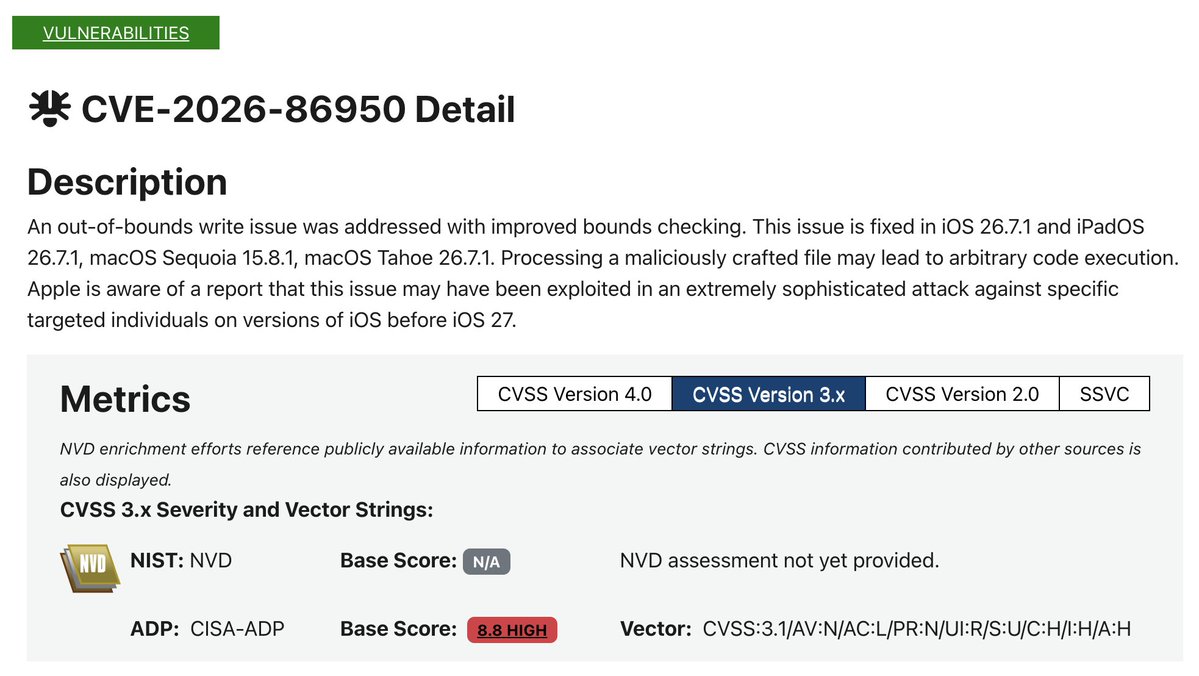
🚨Apple users: update your iOS and MacOS right now🚨
There's a Zero-Day vulnerability being actively exploited in the wild right now, in “extremely sophisticated” attack (CVE-2026-86950)
A fix for the flaw is included in iOS 26.7.1, iPadOS 26.7.1, macOS 26.7.1 and macOS 15.8.1.