SB19 submitted two of their boldest tracks for Grammy FYC, clearly demonstrating their goal as artists—something that goes beyond just creating music—using art for a higher purpose.
• Asian Pop Music Performance – VISA
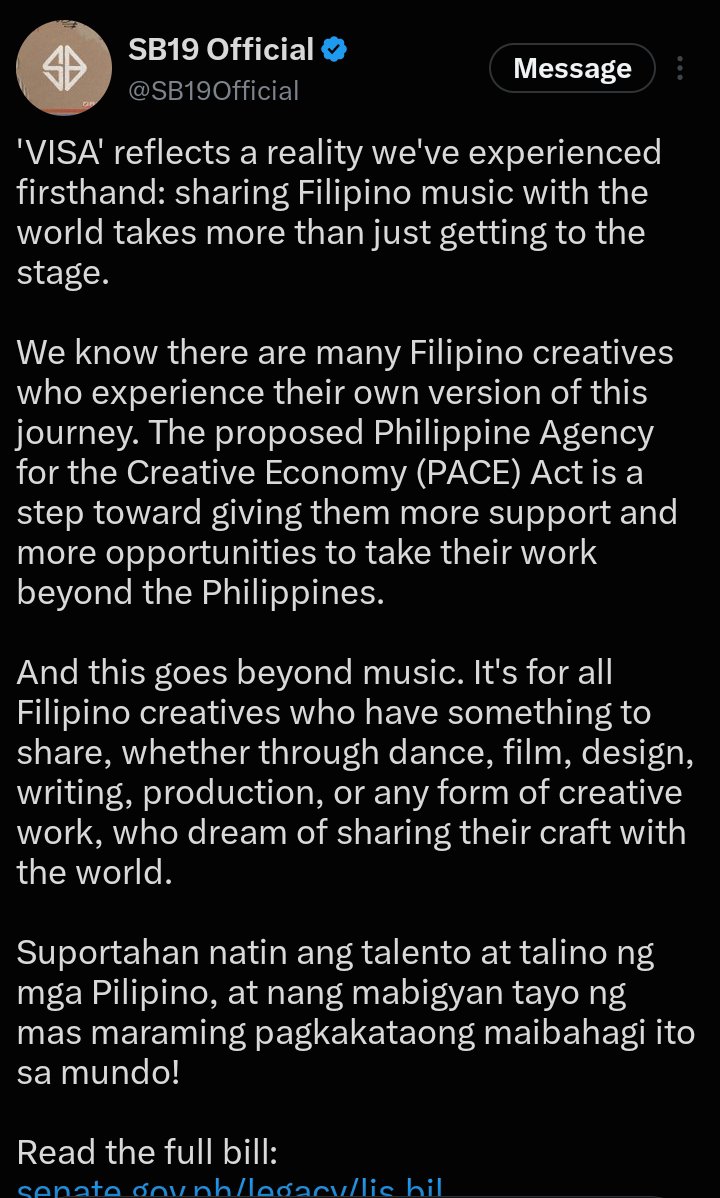
Challenges the unfair norms established against Filipino artists who pursue their dreams and seek support. It calls not for comfort, but for meaningful change that goes beyond mere words. It's the face of their co-created senate bill, PACE Act (Philippine Agency for the Creative Economy Act) that aims to give support to Filipino creatives.
• Best Duo / Group Performance – Lawless
Breaks boundaries and rebels against the norm. It encourages listeners to pave their own path to success, uninfluenced by naysayers and those who try to box them in.
#SB19 #GRAMMYs
#SB19GrammysFYC
#SB19forGrammys #UySB19
[STREAMING REMINDER]
For GRAMMY consideration 🇵🇭🌎
Best Asian Pop Music Performance: 'VISA'
A'TIN! We have a dream to chase and a mission to keep going! Let’s keep SB19’s music playing, their songs circulating, and their name reaching more listeners around the world!
VISA x LAWLESS [PL 1]:
https://t.co/ZeF8OOjU1i
VISA x LAWLESS [PL 2]:
https://t.co/Ubg9n7jYCn
VISA MV:
https://t.co/SlduLyvlpe
#SB19 #GRAMMYs
#SB19GrammysFYC
#SB19forGrammys #UySB19
😬paisa pa at 2 days na lang…
There are many ways to write a song about something sensitive. You can soften the criticism until nothing sharp remains, or lean so heavily into the grievance that the song becomes exhausting to carry, hard to sing, and even difficult to listen to.
What I find really admirable about Pablo’s writing in “VISA” is how he keeps the frustration sharp and funny at the same time.
The spoken-word bridge is one of the clearest examples:
“Dito, masaya lang
Kahit may hilahan
Na para bang ’paghetti lang…”
“Masaya lang” sets the tone. It’s kinda fun and enjoyable but there’s tension. “Hilahan” can suggest people pulling one another down, competing for position, or struggling within an uneven system. Then comes the spaghetti reference, turning that tension into something familiar, physical, and funny.
The nod to SexBomb’s up-and-down choreography gives the social observation another layer. Some people are below; others are already above. He makes you picture the hierarchy through a pop-culture reference.
Then comes the roll call of famous personalities of Filipino heritage:
“Dave at Basco, M. Jacinto, O. Rodrigo
Bruno, Nico, Joseph…”
Within a song concerned with recognition and access, that sequence raises an uncomfortable question: Why does Filipino talent seem to carry different value depending on where it emerges?
But before the moment settles into something too deep, he catches himself.
“Ay! Baka naman. Pablo!”
Then the exaggerated “Nyaah!” and the fart sound after his spoken-word verse puncture the seriousness of the whole moment. 💨 😂
He has just pointed toward an important reality, but then he turns around and makes himself part of the joke. That self-awareness gives the criticism depth. He acknowledges his own desire for recognition. He wants the opportunities, too. He wants to put himself out there and be heard. But then he stops himself, as if preventing himself from drifting too far into the fantasy.
The spoken delivery helps. For a moment, the track feels as if a theater scene has been dropped into the middle of a pop song. The interruptions, timing, and ridiculous sound effect become part of how the observation lands.
For me, that short bridge captures so much of what makes “VISA” so unique. Pablo places a lot of trust in the listener to enjoy the joke and understand why it stings. He’s letting us identify the frustration, ambition, humor, and so many other distinct feelings in that song. I’ve heard many songs in this life but there’s nothing like “VISA”. Probably because there’s nobody like Pablo.
So the answer to: “Ay! Baka naman. Pablo!”
“Syempre naman! ‘Bat naman hindi?”
😉
#SB19GrammysFYC #SB19 #GRAMMYs
Having an influential platform gives artists the freedom to capture the reality that affects creators worldwide. SB19 is among the many artists that (through their music) initiate discussions/conversations on the systemic, institutional, and economic struggles that artists face in this day and age.
#SB19 #GRAMMYs #SB19GrammysFYC #SB19forGrammys
💭 ❓ I’ve often wondered how songs are written in idol pop.
So I did a little 🔍 and learned that international songwriting camps are an established part of K-pop production. Producers, melody writers, and lyricists gather for intensive sessions to develop demos for particular artists and labels. Companies then select material that fits an artist’s concept, sound, and performance style.
I also found that some idol groups like SEVENTEEN, Stray Kids, and i-dle, have members that play substantial roles in songwriting and production. In general, I learned that member-led creation and outside collaboration typically overlap.
But how large can these camps get? SM Entertainment began holding them in 2009. At one documented Warner Chappell camp, 45 songwriters created 55 songs in two weeks for consideration by artists including aespa, NCT, TWICE, and Cravity.
For BTS’s 2026 album ARIRANG, the scale was larger still. According to reports highlighting HYBE’s strategy, the large-scale U.S. songwriting camps based in Los Angeles generated more than 100 candidate tracks — with each member personally contributing roughly 10 song sketches — from which the album’s 14 tracks were ultimately selected. The group recorded the project over a multi-month period in 2025, and the final credits list an extensive roster of prominent international producers and songwriters (30+) alongside their long-time internal teams.
That offers an interesting contrast with the smaller creative partnerships behind much of SB19’s music. Pablo is central to much of the songwriting, working with his brother Josue as RADKIDZ and alongside other producers and collaborators. Other members contribute, too. Ken and Josh write and produce music, while Stell and Justin have contributed lyrics to group songs, including KALAKAL.
When I first heard SB19, what struck me was the emotional consistency of their songs. The production sounded contemporary and polished, but the storytelling reminded me of older songs: a central feeling or idea carried through the lyrics, metaphors, and mood.
To my ears, that continuity is one of their strengths. I suspect their smaller, recurring creative circle helps preserve a clear sense of authorship, even as more members contribute.
In VISA, I’m especially drawn to the experimental and almost playful process in Pablo and Josue’s production. They have spoken about how their familiarity as brothers makes working together easier. Listening to the song, I imagine that trust giving them room to try unusual ideas, challenge each other, and see where the music can go.
Their collaboration gives me that feeling of “I’ve got your back, and I know you’ve got mine.” Beneath the polished production and ambitious ideas, I hear two brothers enjoying the freedom to create together. And the best part is they’re still pretty young! I truly can’t wait to hear how their music grows as they gain more experience and see more of the world.
Nakaka-proud kayo, @imszmc and @josuengmusika !
#SB19 #SB19forGrammys #GRAMMYs
There���s something like poetic justice in SB19 submitting “VISA” and “LAWLESS” for #Grammys consideration. After the past two weeks of mockery on social media, it almost feels like satire. Some of the reactions are demonstrating exactly why these songs matter.
On the surface, “VISA” speaks about the real systemic barriers Filipinos face when trying to reach opportunities abroad. But you dig a little deeper and it raises a more profound question: how much do Filipinos have to prove before people accept that we deserve a chance?
“LAWLESS” feels like the response: we will pursue our own path, even when other people think we should stay where we are.
Together, the message is clear: we know there are barriers, but we are moving forward anyway.
That’s what makes the mockery so ironic. A Grammy submission simply puts an artist’s work forward for consideration. Yet some people react as though SB19 “needed their permission to try,” as though artists from a smaller music industry should know their place, limit their ambitions, and stay far away from the global superstars.
Meanwhile, the songs they submitted already speak to those very attitudes. People mocking their desire to reach a global audience are helping demonstrate the obstacles the exact lyrics already laid out.
I wouldn’t say SB19 predicted these exact reactions. I don’t think they have a crystal ball. But after years of being underestimated, they probably understood that pursuing bigger opportunities would bring more doubts, criticism, and questions about whether they belong.
In that sense, the songs feel like an answer written before the criticism arrived. They had already expressed what they wanted to say, then followed through with their actions.
Whatever happens at the Grammys, that consistency means something. They made music about facing barriers and choosing their own path. The satire is watching people mock their ambition while making the songs’ message even clearer, essentially demonstrating the sheer power of SB19’s artistry.
@SB19Official
https://t.co/X1ApFex1Rm
https://t.co/PUZClTDRSE
No need to put this story on 𝘵𝘰 𝘧𝘰𝘭𝘭𝘰𝘸.
Paano nga ba nag ka-bisa ang 'VISA'? Pablo breaks down the vision & creative process behind the defiant SB19 track.
#SB19#GRAMMYs#SB19GrammysFYC#SB19forGrammys#UySB19 🐐🇵🇭
SB19, the chameleons of SEA-Pop. They craft their own music across diverse genres and genre blends, and they sing live as if the rent is due.
Video credits: @stiffmeister_md
SB19 for your GRAMMY consideration 🇵🇭
Best Asian Pop Music Performance: 'VISA'
Best Pop Duo/Group Performance: 'LAWLESS'
From the Philippines to the world, thank you for believing in SB19. Let's continue to champion Filipino music and bring it to the global stage!
#SB19 #GRAMMYs #SB19GrammysFYC #SB19forGrammys #UySB19 🐐
Great questions!
Let’s answer one by one based on what’s known:
👉🏼”Apart from being Asian, how did they perform on the Billboard charts?”
“DAM” debuted at No. 1 on Billboard’s World Digital Song Sales chart, making SB19 the first Filipino act to top that chart. “GENTO” previously reached No. 8. These are concrete achievements, but Billboard success is not a prerequisite for Grammy consideration. The Academy instructs voters to judge artistic and technical merit rather than sales or popularity.
👉🏼”Are they even eligible?”
SB19’s Filipino-language pop recordings can qualify for Best Asian Pop Music Performance, subject to the Academy’s screening and the applicable release and submission requirements. Eligibility concerns the recording, rather than simply the artist’s nationality.
The category requires meaningful use of an Asian language. “Meaningful” refers to the language having a substantial role in the song. It does not mean the lyrics must address a profound subject or prove the artist’s cultural authenticity.
👉🏼”Have they released songs with meaningful lyrics in their native language that represent their origin?”
Yes. So many to mention in fact but let give you a few. “MAPA” expresses gratitude to parents and the desire to care for them after years of sacrifice. Its emotional foundation is recognizable across cultures while resonating strongly with Filipino family life.
“GENTO” explores perseverance and the work involved in becoming who you are. It uses Filipino wordplay connecting gento, a Caviteño form of ganito, with ginto, meaning gold.
“VISA” addresses the barriers Filipinos face when pursuing opportunities abroad, including artists, professionals, athletes, and overseas workers.
These themes do not have to belong exclusively to Filipinos to represent Filipino experience. Cultural identity can live in the language, perspective, wordplay, and circumstances behind a song. SB19 should be assessed through that work. Their level of American chart success does not determine whether their experiences deserve to be heard.
#SB19 #GRAMMYs
Charts and popularity aside, VISA is such a strong contender when it comes to musical and cultural merit. Imagine, this song was written by SB19 as a callout to the lack of support for local artists who simply wanted to bring Filipino culture and artistry to the world.
And what makes it even more powerful is that they didn't just release the song for the sake of making a statement. SB19 and 1Z literally walked the talk. They did their research and brought a proposal to the senate to push for a bill that would support Filipino creatives and the local entertainment industry.
They didn't just sing about the struggles of Filipino artists, they took concrete steps to help address them. From using music to amplify the issue to actively pushing for legislative support, they proved that their advocacy goes beyond lyrics and performances.
That's how you turn art into advocacy, influence into action, and a platform into a force for real change. 🇵🇭
#SB19 #GRAMMYs #SB19GrammysFYC #SB19forGrammys #UySB19 🐐
Other artists: Love songs, heartbreak, chasing lovers. Same old themes.
SB19: Turning the struggle of getting a visa into a song that resonates beyond the Philippines. Now THAT’S worthy of a Grammy ✨