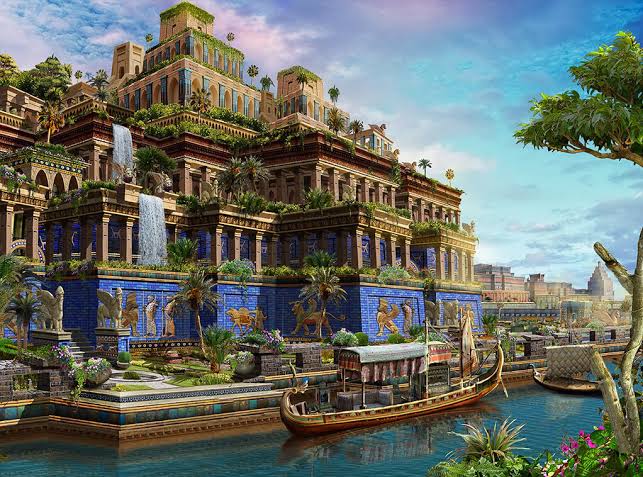
Hanging Gardens of Babylon are known to history as one of the Seven Wonders of the Ancient World, alongside other landmarks of bygone eras such as Lighthouse of Alexandria and Great Pyramids of Giza. The gardens were said to have been built in Babylon, capital of ancient city of Babylon in Mesopotamia by King Nebuchadnezzar II. Many of Seven Wonders of the Ancient World have been lost to time, with only remaining wonder being the pyramids. However, Hanging Gardens of Babylon in itself is unique compared to the other wonders in that historians still dispute whether or not Gardens truly existed or not.
King Nebuchadnezzar II had the Hanging Gardens constructed as a gift to his wife, Queen Amytis, who was from Media (present-day Iran). Queen Amytis was homesick, missing the mountains and plant life of her home. Hanging Gardens was to be a remedy for her homesickness. Using irrigation techniques, Hanging Gardens was a terraced garden, where the plants were placed alongside steps up a hill. Machu Picchu is an example of another ancient terrace garden. Within Babylonian culture at the time, it was common for wealthy individuals to foster their own private gardens as a show of wealth and as a status symbol.
Many people in cities and other crowded places have potted plants on their outdoor patios, but most of these people probably don't think anyone is about to marvel at the wonder of their 'hanging gardens.' Of course, those 'hanging gardens' were probably more sophisticated than potted plants on patios we see today.
Hanging Gardens of Babylon were one of the greatest engineering achievements of the ancient world. Although the exact location has never been uncovered, the Kingdom of Babylon, in which the Gardens were said to exist, was in the region around modern-day Iraq. Hanging Gardens have been described as the ideal representation of a horticultural landscape. Although actual Hanging Gardens have never been found, their creation is usually attributed to a Babylonian ruler known as King Nebuchadnezzar II, who ruled from 605-562 BC. According to some legends, he had the Hanging Gardens built for his wife, Queen Amytis, who missed the green valleys of her home in northern Iran.
Written accounts tell us that Hanging Gardens of Babylon were built into a complex of stairs, terraces, and buildings that required advanced irrigation to water the Gardens and advanced architecture to support the weight of the massive Gardens. According to the accounts, the walls were 22ft thick, with ten-foot wide hallways. Terraces were made with reeds and baked bricks underneath a layer of lead to create a foundation that would hold moisture. Mounds of soil were placed on top of this that were deep enough for the roots of trees. The oldest account of the Gardens comes from the Babylonian priest Berossus, around 290 BC. Later, after Alexander the Great expanded his empire to include most of the Mediterranean region, it became common for Greeks and others to travel across the empire and explore the cultures of Egypt, Persia and Babylon. At some point around 4th Century BC, Greeks developed a list of seven must-see sights for travelers that was made up of some of the most remarkable building projects in the ancient world. In essence, it was the world's first travel guide. This list became known as Seven Wonders of the World. There were several versions of this list, which didn't really become standardized until around 140 BC.
#archaeohistories