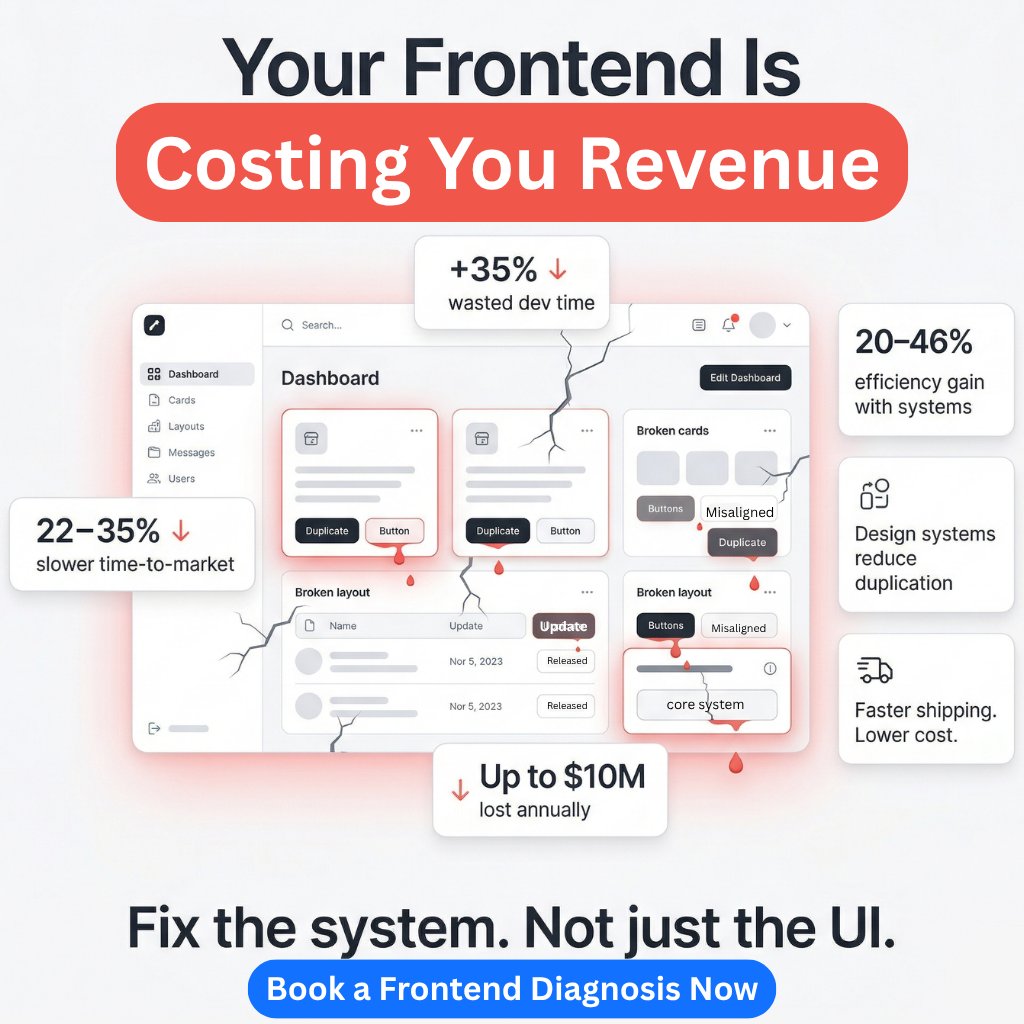
Your SaaS frontend isn’t broken. It’s leaking revenue. Slow UI, inconsistent UX, and tech debt reduce conversions and delay deals. Get clarity fast.
Book a frontend. Diagnosis:
https://t.co/CBzkl0rmKQ
The #FutureOfWork winner is whoever has the stickiest product.
Sticky ≠ hard to leave.
Sticky = genuinely enjoyable to stay.
Massive difference.
One is a trap. The other is earned.
Build the second one.
Canva's exec this week: "If we don't disrupt ourselves, we'll be disrupted."
Most founders I talk to know exactly what needs disrupting.
It's their own product experience.
They're just avoiding looking at it.
It's fixable. #FounderLife
#SaaSpocalypse hot take:
AI didn't kill SaaS.
It removed the hiding spots.
Products that earned retention are fine.
Products that survived on switching friction?
That's the crisis.
Two completely different situations being discussed like one.
Hard truth from watching the SaaSpocalypse play out:
Your product's depth doesn't protect you if your frontend hides it.
Users don't stay for what they can't see.
The surface is the argument. And most founders underinvest in it until it's already costing them deals.
Building in public observation from this week:
The SaaS products I'm seeing survive this cycle all share one trait.
Users don't just use them. They rely on them.
That reliance isn't built by features. It's built by an experience that earns trust every single session.
A VC said the SaaSpocalypse is "an old snake shedding its skin."
Love that framing.
The skin being shed: products that coasted on habit and switching friction.
The snake that remains: products users genuinely choose over the alternative every day.
Which one are you?
Enterprise buyers are cutting tools right now.
The question isn't "does this work?"
It's "does our team actually use it, and does it feel worth what we pay?"
Products with slow, dated interfaces fail that question in the renewal meeting before anyone checks the feature list.
Good news from this week:
SaaS is recovering. Not because the AI threat went away.
Because the best products proved they're worth keeping.
Your product can be one of those. The window to fix what's creating doubt is still open.
Use it.
AI just made it cheaper to build software than to buy it.
That changes everything for bootstrapped SaaS.
If your product isn't dramatically easier to use than something a team could build in a sprint
You're competing with "just vibe code it."
Your UX is now a survival argument
The companies in trouble in 2026 are the ones whose only value is the interface.
The drag-and-drop. The workflow screens.
AI replicates that in weeks.
But years of domain knowledge, user data, and real workflows?
That's irreplaceable. Is your frontend showing that depth?
The SaaS market is splitting into two groups right now.
Products users describe as essential.
Products users describe as fine.
"Fine" doesn't survive a budget cut.
"Fine" doesn't win a renewal when there's a cleaner option.
Are you building essential or fine?
$300 billion wiped from SaaS in one trading session.
The companies recovering fastest have one thing in common.
Their product feels indispensable to use not just valuable on paper.
Users don't cancel what they can't imagine working without.
That's the real moat in 2026.
Reid Hoffman said AI won't kill SaaS companies.
It'll kill the ones that don't change.
In 2026, "change" doesn't mean adding AI features.
It means making your product so easy and fast to use that switching feels like a step backward.
That's a frontend problem.
Building in public question:
How do you evaluate when your product's frontend has become a business problem, not just a technical one?
For us, the signal is when engineering is spending more time working around the stack than building on it.
What's your signal?
One of the most common things we hear from founders after modernizing their product:
"I wish we'd done this 18 months earlier."
The delay cost them more in lost deals and frustrated engineers than they realized.
If you're a founder who's weighed modernizing your product, what moved you from "thinking about it" to "doing it"?
Was it a lost deal? An engineer's warning? A board question?
Senior founders, what was the moment that made it a priority?
Curious, as it's unique for each person
Good news for anyone evaluating frontend modernization:
You don't have to choose between modernizing and shipping.
The approach that works is running both at the same time.
Your team drives the roadmap while modernization runs parallel.
That eliminates the reason for delays.
Genuine question for leaders:
When you're evaluating whether to modernize your frontend, what's the thing that makes the decision hardest?
Is it cost? Timeline risk? Engineering bandwidth? Fear of disrupting what's working?
Interested as the answers tend to be similar.