mainnet.
patcha_hook_executor is on Solana mainnet at EPcW7e8RxBNPpQK2XKoKG9maWH6QvmU3ejxifoU5rNRa.
same Program ID as the devnet deploy. same binary. same byte-identical fee function shared with the off-chain hook-runtime, so the number you backtested in the Designer is the number the chain runs.
loader: BPFLoaderUpgradeab1e11111111111111111111111
deploy tx: 5sTs3XrcXqJJa94aKNKNKM15pJ99peTQUpAPzkAZeN1GpxHfkwCCViTpsnJTWtZbjfNRpzTFKBSRpLRsCZ9YMkZo
IDL on-chain: 72djB5memwxg8its3mMExLdG7PGL4d2rUn4D1Fw5cEiP
what runs on mainnet today: install / uninstall / update_params / trigger_hook / swap_via_hook. the six standard hooks. Orca Whirlpools + Raydium CLMM CPI from inside swap_via_hook.
what's still open from the same day: the Hook Designer, the patcha-cli, the VS Code extension, the @patcha/sdk, the monorepo. nothing got walled off.
https://t.co/1rcK1RYlRb
https://t.co/QHreMwPSEq
https://t.co/p2UkaDFJ4Z
/4
AntiMEV reports what it prevents as mev_bps_saved on the same event, accumulated across the hook stack; the simulate endpoint surfaces it before you install. Mainnet receipts are public — read every HookTriggered event off the executor's Solana Explorer page.
https://t.co/x5b80CLonx
/1
A backtest is only worth the gap between it and execution. Patcha's gap is zero by construction.
DynamicFee, concretely:
fee = base_bps + (max_bps - base_bps) · min(amount_in, pivot) / pivot
Defaults base 30 bps, max 100 bps, pivot 1 SOL. Integer math, no floats — a small swap pays 30, the pivot pays the 100 cap, between interpolates.
/3
So a backtest on real Orca and Raydium pool history reports the fee a DynamicFee hook would have charged, swap by swap — and a mainnet install of that same hook emits a HookTriggered event whose fee_override_bps matches. Same number, off-chain and on. Pull it off Solana Explorer.
The idea of hooks is not new. The Solana CLMM implementation is.
Uniswap v4 hooks (Uniswap Labs 2024) defined composable pool callbacks on EVM. Orca Whirlpools and Raydium CLMM brought concentrated liquidity to Solana. Anchor 0.31 (Coral 2026) is the program framework. Jito's MEV work (Jito Labs 2024) informs AntiMEV.
Patcha stands on those. The first standard hook library and executor for Solana CLMMs is the new part.
https://t.co/fDueH3WX7y
Sorry for the gap — there was a deployment issue while flipping the next reveal, and I held the rest of the rollout until it was sorted. It is now.
Roughly 2/7 of what's queued is public so far. The rest comes from here.
Patch your liquidity.
Ship hooks from your editor.
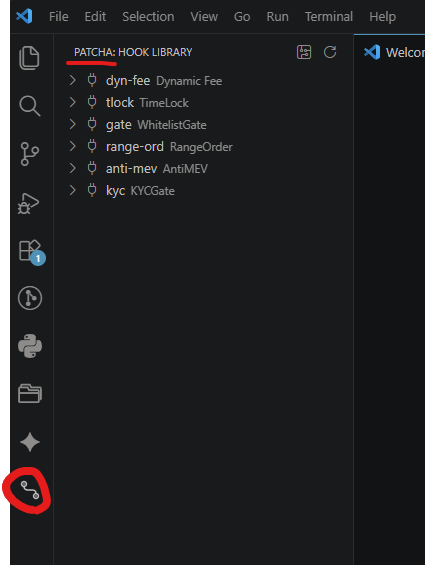
The VS Code extension is the Designer in your editor: scaffold a hook, see inline backtest results, install with a command. patcha-cli is the same toolkit in your terminal — init, create, list, simulate, deploy, install.
npm i -g patcha-cli
Downloads (cli 0.1.2, extension 0.1.2):
https://t.co/U6XxeRPXOe
/4
Same toolkit, three surfaces: the web Designer, the CLI, the VS Code extension — one @patcha/sdk, one runtime behind them. simulate, install, and trigger all hit the same mainnet executor. Same number off-chain and on.
https://t.co/wJtynkP2aZ
/1
Build your first hook, end to end.
npm i -g https://t.co/91Ps2kG8D6
patcha init my-hook
patcha simulate dynamic-fee --pool <pool>
patcha install dynamic-fee --pool <mainnet pool> --cluster mainnet
Four lines: scaffold, backtest on real pool data, install on mainnet. The CLI is the hosted tarball — not on the npm registry yet. simulate is free; install pays a tiny SOL fee for the registry write.
/3
install registers the hook against your Orca or Raydium pool through the mainnet executor. The first swap through it emits a HookTriggered event — pool, slug, callback, allow, fee_override_bps, mev_bps_saved. Pull it off Solana Explorer and compare it to your simulate run. They match.
Believe i've created the first token using patcha,
solscan contract : https://t.co/Rg4TKVzfnQ
Using their solana contract, ive deployed "catcha"
Fully proved via the solscan contract and i made a video too,
patcha at 500k, surely we can bond catcha?