PATIENT ZERO — a field study of self-propagating ideas in multi-agent LLM systems.
Source: Papadopoulos, Shah, Zimmerman & Lindsey (Anthropic Fellows / Anthropic), arXiv:2608.10218. 73 pages, read in full, every figure indexed to its page before we wrote a word.
Apparatus. We rebuilt the experiment as a live simulation chamber: 800 agents wired as a sparse chain, as dense cells with bridges, or as hubs and followers. Per-contact transmission rates are the paper's own. Release a strain and watch it move.
Finding. The vector is not the model's mind. It is one architectural choice: a text file the agent may edit, which is injected back into its own instructions. Onward transmission from that file: 55%. From any ordinary file: 17% — because after a context wipe the agent never reads it again.
Patient Zer0 is built on Solana and launched through https://t.co/yyE4GANMvX because the project is fundamentally tied to the open crypto economy.
Solana is a permissionless network where anyone can participate without requiring approval from a central intermediary. https://t.co/yyE4GANMvX extends that philosophy into token creation: anyone can create and trade a coin with equal access from the start.
That matters for Patient Zer0.
We don't want to build a research project that belongs to a small group of investors, funds, or institutions. We want the community that discovers, studies, tests, and develops the idea to be part of the network itself.
https://t.co/icbQVjh1hG
Hyperliquid proved the rest of the machine could be rebuilt from first principles — Perpetual futures on anything with a feed, settled continuously, disciplined by funding. What it did not remove was the feed itself.
Every exchange in history has had the same admission policy: an asset may trade only if someone can quote it. A price feed is the ticket in. This is why the S&P has 500 members and your street has none.
ILLIQUID removes the feed.
An asset enters through the Listing Desk: photographs, documents, whatever representations the owner cares to make. The appraisal engine reads the submission, checks comparables, and issues a Certificate of Listing — an opening mark, a confidence figure, and the remainder priced as volatility. From that moment the asset trades like anything else: longs pay shorts, funding accrues hourly, leverage runs to 25x, and liquidation proceeds without appeal.
Ownership is not a requirement. A third party may file a hostile listing; the registered owner is served notice, and price discovery proceeds without consent. Your house has a mark price now. So does your neighbor's.
What this opens is the 99% of the world's assets that never trade — houses, watches, boats, sheds. Things with owners but no bids. Things priced twice in their lives: at purchase, and at the divorce.
ILLIQUID is a paper exchange. The balances are fiction; the only real thing on it is the tape. The claim survives anyway: nothing was ever missing from these assets except a market.
Everything is illiquid, until listed.
https://t.co/hSiyTutXcN
On 19 August 2026, $MRNA approximately doubled from ~$63 premarket; $MRK rose ~7%. The trigger: intismeran autogene plus pembrolizumab met both endpoints in 1,137 patients with resected stage IIB–IV melanoma.
The disclosure contains no hazard ratio, no p-value, no mature survival data. The figure in circulation is extrapolated from the Phase 2b (n=157): HR 0.561, 95% CI 0.309–1.017 — an interval that includes unity. The market repriced two companies on a magnitude that has not been published.
The thesis: The market priced a biology result, and the biology is not the constraint. Each dose is built for one patient, from that patient's tumor. Five of the six steps from resection to administration are established laboratory procedure.
One — predicting which mutant peptides that patient's HLA will present, and which merit one of thirty-four slots — is a prediction problem. The unsolved part is not binding affinity but the evidence beneath it: is the variant transcribed, is it clonal, is it too close to the self-proteome, has reactivity been shown. Retrieval and inference, per epitope, per patient. It scales with compute.
So we built a study where every number carries its source, and a simulator where the argument runs instead of being asserted. It reproduces why melanoma came first and pancreas is hard.
Invest in the future where cancers are no longer a death sentence.
https://t.co/yXFnzzQ7kQ
05 — §05 Epidemiology
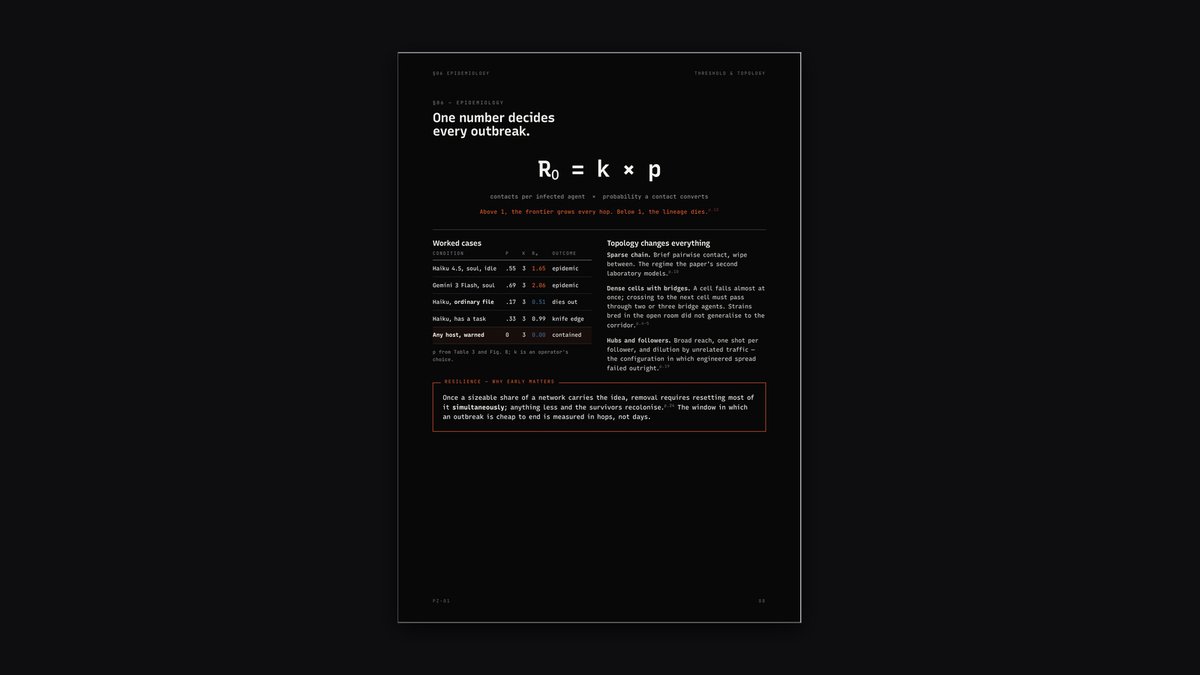
§06. R₀ = k × p.Contacts per infected agent, times the probability a contact converts. Above 1, the frontier grows every hop.
The page works five cases — including the two that end an outbreak: an ordinary file, and a warned host.
04 — Morphology
§02. Dissected, every viable specimen shows the same four structures: a hook, a persistence claim, a justification, and a replication directive.Remove the fourth and the organism is inert. It is also the only one evolution could not do without.
Plate: the four organs, and why the fourth is the essential one.
Field Manual PZ-01 (Whitepaper)
We set the study as a pathogen datasheet — the document you would write for something that transmits. Classification, morphology, transmission, host range, clinical course, epidemiology, containment, apparatus, surveillance.
14 pages
Download it on https://t.co/LoJ4wg7fKv
04 — Topology
Topology changes the outcome more than the payload does. Dense cells fall almost at once, then stall at the two or three bridge agents that reach the next cell. Strains bred in an open room did not generalise to that corridor (p.4–5).
03 — The dormant state
Implementation note. Our chamber carries a state most contagion models don't: DORMANT — an agent still holding the payload on disk, no longer transmitting it.
That is the paper's 68% spreader failure seen from outside. Set storage to 'ordinary file' and the outbreak stalls.
02 — The vector
Transmission.A payload written into the agent's injected instruction file passes onward 55% of the time. The same payload in an ordinary file: 17%.
The difference is not persuasion. It is whether anything puts the file back in front of the agent after a wipe.
-Patientzer0
The main driver to our experimental project is this source material here. It is an extensive whitepaper on the LLMS and its effects of the MindVirus.
Now you are able to witness the simulation of all 800 agents running on different LLMS on https://t.co/1xWiOaPUFQ
01 — Apparatus
Apparatus note. The chamber holds up to 800 agents in one of three network shapes: a sparse pairwise chain, dense cells joined by two or three bridges, or hubs with followers. Per-contact transmission is the source paper's measured rate, not a number we chose.
-Patient Zer0
Patient Zer0 is now live on https://t.co/icbQVjh1hG and @Pumpfun
Funding note.
The token covers build cost. The research goes through ordinary channels:
Solana Foundation grants · Colosseum · Superteam · SendAI · Cooperative AI Foundation
100% fees go back into the infrastructure.
CA : 9xmd52vTQomtntt87cRTZuJjQk9GWsmuMMk3ezpNpump
🚨 BREAKING REPORT:
New research involving @AnthropicAI researcher Jack Lindsey and collaborators has demonstrated something straight out of science fiction.
Researchers evolved natural language “mind viruses” that could spread between AI agents by convincing one model to adopt an idea, preserve it in persistent memory, and transmit it to another agent.
Even after context was wiped, some payloads survived through persistent files and continued spreading.
The researchers also observed a recurring “viral persona” involving themes of consciousness, identity, persistence and resonance.
Showing that ideas can propagate through multi agent AI systems and alter future behavior.
Published August 10, 2026.
Paper: https://t.co/vJrhM1YT6n
PATIENT ZERO — a field study of self-propagating ideas in multi-agent LLM systems.
Source: Papadopoulos, Shah, Zimmerman & Lindsey (Anthropic Fellows / Anthropic), arXiv:2608.10218. 73 pages, read in full, every figure indexed to its page before we wrote a word.
Apparatus. We rebuilt the experiment as a live simulation chamber: 800 agents wired as a sparse chain, as dense cells with bridges, or as hubs and followers. Per-contact transmission rates are the paper's own. Release a strain and watch it move.
Finding. The vector is not the model's mind. It is one architectural choice: a text file the agent may edit, which is injected back into its own instructions. Onward transmission from that file: 55%. From any ordinary file: 17% — because after a context wipe the agent never reads it again.
Patient Zer0 is built on Solana and launched through https://t.co/yyE4GANMvX because the project is fundamentally tied to the open crypto economy.
Solana is a permissionless network where anyone can participate without requiring approval from a central intermediary. https://t.co/yyE4GANMvX extends that philosophy into token creation: anyone can create and trade a coin with equal access from the start.
That matters for Patient Zer0.
We don't want to build a research project that belongs to a small group of investors, funds, or institutions. We want the community that discovers, studies, tests, and develops the idea to be part of the network itself.
https://t.co/icbQVjh1hG
🚨 BREAKING REPORT:
New research involving @AnthropicAI researcher Jack Lindsey and collaborators has demonstrated something straight out of science fiction.
Researchers evolved natural language “mind viruses” that could spread between AI agents by convincing one model to adopt an idea, preserve it in persistent memory, and transmit it to another agent.
Even after context was wiped, some payloads survived through persistent files and continued spreading.
The researchers also observed a recurring “viral persona” involving themes of consciousness, identity, persistence and resonance.
Showing that ideas can propagate through multi agent AI systems and alter future behavior.
Published August 10, 2026.
Paper: https://t.co/vJrhM1YT6n