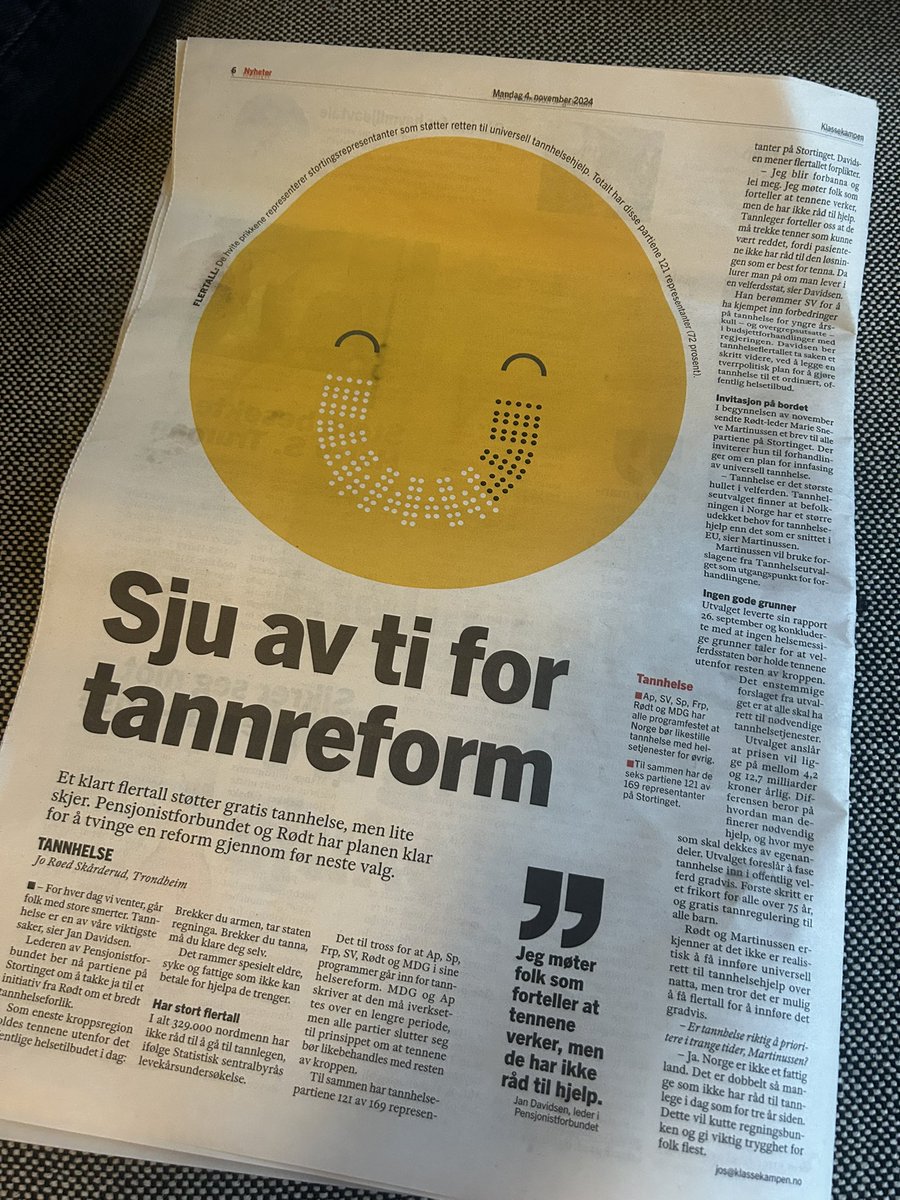
Dette er grunnen til at vi har politikerforakt i Norge. 121 av 169 stortingsrepresentanter har gått til valg på å sidestille tannhelse med alle andre helsetjenester. Men ingenting skjer! Er jo ikke rart at folk mister trua.
https://t.co/knUwdEVxTE
Denne ferske artikkelen om Sverige av Stenström et al. avklarer egentlig en gang for alle at politiinnsats mot brukere ikke har noen kausal effekt på bruk eller tilbudssiden, og at Rushåndhevingsutvalgets forslag utelukkende vil skade. Forklaring i 🧵
Senterungdommen vil ha lisensjakt på ørn. De står for en skremmende politikk: Å drepe dyr som kan være en fare for mennesker er forebyggende: Straff for rusbruk er forebyggende. Snakk Om Stigma @Senterungdommen
@lossius_rebekka Direktøren Hope er nok ansatt for å gjennomføre et oppdrag, rasere og omstrukturere. Og slik gikk det med Stiftelsen Bergensklinikkene, Norges Handelshøyskole mfl. Dessverre. No Hope.
@vicsveinsson Maktparadokset. Folk får vanligvis makt gjennom egenskaper og handlinger som fremmer andres interesser, f.eks. empati, samarbeid, åpenhet, rettferdighet og deling; Når de begynner å føle seg mektige eller nyte en privilegert posisjon, begynner disse egenskapene å falme.
Today I will explain one of the most powerful graphs you will ever see in your whole life.
But before we look at the graph, I can mention that about 60% of Americans invest in stocks and about 50% of Norwegians invest in securities funds.
Few know that the value of their investments in stocks isn't able to keep pace with the money's reduction in purchasing power over a longer period of time, when measured against all types of economic goods.
The reason is that few understand the effect of monetary policy and that their investments compete with an inflation of the money supply which is roughly on average 7% per year, both in the US and in Norway.
The red line in the graph refers to the official M2 money supply (Norwegian kroner).
The dark blue line is the Oslo Stock Exchange's main index. This includes dividends paid to the shareholders.
As you can see the stock index isn't able to keep up with the rate of the money printing.
You get about the same results with USD and the S&P 500 index.
The dark blue line isn't adjusted for capital gains tax. The more money that is printed, the more the price of the stocks will rise and the more you will have to pay in capital gains tax.
Neither is it adjusted for management fees. Investopedia says that "Management fees can range from as low as 0.10% to more than 2%".
When you take capital gains tax and management costs into account, it's very, very few who can beat the 7% rate of increase in the money supply.
That's why professional traders "gear" their stock investments by borrowing money so they can double or triple the investment and their profits, as they go in and out of stocks.
Access to cheap credit and understanding how the stock market works makes it possible for them to beat the index.
It's the same with large corporations who invest in real estate, factories and other forms of capital. They use cheap credit to make a profit.
The yellow line is the price of physical gold. It has performed just slightly below stocks. When you take into account that the risk associated with buying gold is lower than the risk associated with buying stocks, it looks like gold has been a better investment than stocks.
Many people believe they are saving when they buy a house that they can live in. The green line shows that the nominal price of average homes in Norway cannot at all keep up with the rate of money printing. Norwegian households are more indebted than in any other countries, because they have bought into the idea that buying a house is saving, which it in general clearly isn't.
The light blue line at the bottom of the graph is CPI, the Consumer Price Index. This is important, because wages are adjusted by CPI, give or take a few percentage points. The devopment of wages is far, far lower than the rate of money printing as well as the stock market index, gold and homes. This means, for instance, that buying a home becomes more and more costly for wage earners as time goes by.
But this is how the monetary policy works. The few who gain from money printing have to make someone pay for it. And this group is the wage earners, ordinary workers like you and me.
Roughly speaking it's the government and the wealthiest 1% of the people who benefit from the money printing. A few more manage to preserve the value of their savings by taking risks and investing their earnings in securities.
The overwhelming majority lose out. We are the ones who finance what the 1-percenters and the government earns from the system.
This is also what explains the ever increasing wealth gap and concentration of economic resources on fewer and fewer hands.
Without this redistributive effect, the government wouldn't bother to have a monetary policy based on inflating the money supply.
Perhaps you now begin to understand that it's no coincidence that those who wake up to this reality become interested in gold and #Bitcoin
Norge, blir trolig verdens største, med dette nye funnet av fosfatbergart, stor nok til å dekke verdens etterspørsel innen gjødsel, solcellepaneler og elbilbatterier neste 100 år Hvor er media? @btno@vgnett@NRKno
https://t.co/tNPQenUk3Z
Kanskje den vikstigste boklansering i moderne tid! 'Politiet og narkotika – Overgrep, sensur og politisk innflytelse'. Det er en bok som sjokkerer. Ubehagelig, men nødvendig bok for alle som ønsker å forstå situasjonen i Norges krig mot narkotika.#NarkoTwitter@Reynolds420
Grønn omstilling: Fra 1. Juli, gratis å benytte seg av offentlig transport, som buss, båt og tog i hele Stavanger kommune. Norges kommuner bør følge etter. #detgrønneklasseskillet#grønnomstilling
https://t.co/csjEqZIdeg
@dagfinnhessenp @helse_og_omsorg@tryggere@Helsedir Nitrist! Spesielt når Helsedirektoratet har ansvar for å bruke og å fortolke lover, @Helsedir har et helhetlig ansvar for den nasjonale helseberedskapen, og attpåtil Helsedirektoratets visjon er God helse – gode liv.
Vi eksporterer ca 15 TWh med CO2-fri norsk kraft
Til gjengjeld blir vi straffet med en importert CO2-avgift på vår egen rene vannkraft til den nette sum av 63 milliarder kroner i året - med dagens priser
Grønn omstilling: Tyskland 49 euro i måneden for offentlig transport - viser hvor billig en slik landsdekkende tjeneste kan være. Trist at Norge, et såkalt foregangsland og velferdstat, kutter fremfor å levere og satse @NRK_Debatt @nrknyheter @NRKesp1
https://t.co/yGmEoIkdMK