Elon Musk’s ultimate goal for the future of humanity:
• Humanity as a thriving, multi-planetary species
• An economy of total abundance powered by AI & robotics
• Uninterrupted global connectivity
• Maximum personal freedom with zero government oppression
• A growing population to sustain the light of consciousness
A world where anything you can imagine, you can have it
IT’S TIME TO SCRAP THE CANADA HEALTH ACT!
The C.D. Howe Institute ranks Canada last out of 10 peer countries for timeliness of care.
The Fraser Institute shows we spend more than almost all other developed countries, yet rank near the bottom for numbers of doctors, hospital beds, MRI units, and CT scanners.
Canadians wait 149 days just to see an orthopedic surgeon, then another 190 days for treatment. In the U.S.? 12 days.
The Liberals and fake Conservatives will not fix this. Only the People's Party of Canada will. Here is our real, concrete plan:
- We will repeal the Canada Health Act and end Ottawa’s unconstitutional meddling in provincial jurisdiction. We will create the conditions for provinces to set up a mixed private‑public universal system, just like Germany, France, Switzerland, Australia, and every other developed country with universal health care.
- Instead of Ottawa sending conditional cash payments that come with bureaucratic strings attached, we will give up the GST and let provinces occupy that fiscal room. This gives provinces a stable, predictable source of revenue and makes them fully accountable to their citizens for results. No more bickering between Ottawa and the provinces. No more excuses. No more blank cheques with nothing to show for it. Provincial governments will never make the tough decisions if they can always blame Ottawa for not sending enough money.
The People’s Party is the only party that is listening to Canadians and has the courage to end the monopoly and scrap the Canada Health Act.
Read our policy here 👇
https://t.co/QPbeVN7sss
Post 2.
Consider the precedent still fresh in Canadian memory. In 2022, the Freedom Convoy protests against vaccine mandates were met with the invocation of the Emergencies Act, the first time in history. Bank accounts were frozen without due process; travel and funding were curtailed nationwide. A Federal Court ruled the measures unconstitutional in 2024, finding violations of Charter-protected expression and security against unreasonable search and seizure. The Federal Court of Appeal upheld that decision in January 2026, confirming the government had exceeded legal thresholds and infringed fundamental rights. Carney, then a private citizen, had publicly framed the protests as bordering on sedition. The episode exposed how quickly emergency powers can slide into rights erosion when dissent is pathologized.
Today’s caucus tensions echo that instinct for control. MPs raising riding-specific grievances, Indian Act reforms that would finally deliver equality under one Charter standard rather than collective exemptions, or Alberta’s push for healthcare solutions rooted in provincial jurisdiction, are met not with debate but rebuke. Message discipline is enforced through gags on media contact. Local democracy in nominations is curtailed. This is not mere party management; it risks insulating elite decision-making from the granular realities that define Canadian federalism.
At stake is more than Liberal harmony. Canada’s prosperity has always rested on three pillars: secure property rights, evidence-based policy, and sovereign realism. The oil sands, LNG with carbon-capture technology, hydroelectricity and emerging small modular reactors represent not yesterday’s economy but tomorrow’s abundance, provided regulators stop treating them as moral liabilities. Canada’s emissions, at roughly 685 megatonnes of CO₂ equivalent, are negligible on a global scale; unilateral net-zero penance that offshores jobs and emissions to China achieves neither environmental gain nor economic security. Pragmatic adaptation, not punitive ideology, aligns with measurable outcomes: audited results over narrative enforcement.
Yet the drift toward centralized managerialism, corporate discipline married to Davos-friendly globalism, threatens precisely the individual agency and regional voice the Charter was designed to protect. Parallel legal architectures under UNDRIP-inspired frameworks or the Indian Act perpetuate division rather than integration under one law for all citizens. Fiscal expansion amid productivity lags (Canada at 70–73 per cent of U.S. levels) and housing shortages only deepens the squeeze on young families and working Canadians. Surveillance creep, digital ID proposals, and expansions of hate-speech provisions risk further chilling the open debate that democracy requires.
Carney’s defenders will argue the times demand decisiveness: Trump tariffs, Middle East volatility, a post-pandemic reset. They are right that hope is not a plan. But neither is top-down insulation from dissent. In a federation spanning resource-rich West to manufacturing heartland, true strength lies in harnessing provincial comparative advantages, not subordinating them to Ottawa’s spreadsheet.
The anonymous MPs’ frustration, aired through Raj’s reporting, is a canary in the coal mine. Canada does not need another layer of elite consensus; it needs rigorous accountability to Charter rights, fiscal discipline, uniform equality under law, and the resource-led realism that has sustained the country for generations. As Carney’s majority government settles in, the question is whether it will listen to those regional and evidentiary voices, or double down on the very centralization now breeding revolt. For a nation built on compromise and liberty, the answer will define its next decade.
The North, and the nation, demands nothing less.
Precision over propaganda. One law for all.
Truth Marker: π = 3.14159.
Post 1.
Mark Carney’s Iron Fist: Canada’s Liberals Fracture as Technocratic Control Meets Economic Reality
3rd June 2026
OTTAWA, When anonymous Liberal MPs began whispering to Toronto Star columnist Althia Raj this week, the complaints were stark: Prime Minister Mark Carney yells at dissenters, demands “solutions, not complaints,” and has imposed a corporate-style lockdown on caucus debate. One MP was rebuked for raising legitimate concerns about the Indian Act; another for highlighting Alberta’s healthcare strains. The caucus chair, sources say, has ordered MPs to stop speaking to journalists and even documenting internal worries to plug leaks. Candidate selections now bypass local riding associations. Proposed changes to freedom-of-information laws would shield more government deliberations from public scrutiny.
This is not the chaotic collegiality of the Trudeau years. It is something sharper: a banker-turned-prime minister running Canada like a boardroom, where disagreement is inefficiency and regional voices are noise. Carney assumed office on March 14, 2025, after Justin Trudeau’s resignation and a commanding Liberal leadership win. He led the party to a minority government in the April 2025 election before securing a slim majority in April 2026 through by-elections and floor-crossings. Yet barely two months into that majority, the cracks are showing.
Canadians elected Carney expecting competence. A former governor of both the Bank of Canada and the Bank of England, with stints at Goldman Sachs and Brookfield Asset Management, he projected steady hands in stormy times. But the storms have not abated. Canada is now the only G7 nation in a technical recession. Statistics Canada reported a 1 per cent annualized GDP contraction in the final quarter of 2025, followed by a further 0.1 per cent slide in the first three months of 2026. Unemployment hovers near 6.7–6.9 per cent, second-highest in the G7. Federal debt exceeds $1.4 trillion, with deficits projected near $78 billion. Household debt burdens remain among the developed world’s heaviest.
U.S. tariffs under President Donald Trump have compounded the pain, hammering exports in autos, metals and lumber. Carney’s government has responded with middle-class tax cuts, accelerated housing targets (doubling residential construction toward 500,000 homes annually), and pragmatic energy adjustments, scrapping the consumer carbon tax while tweaking industrial emissions caps and clean-electricity rules to accommodate Alberta’s realities. Yet critics rightly note that regulatory overhang from the Impact Assessment Act continues to stall hundreds of billions in resource projects, while diversification overtures toward China and EU digital standards risk entangling Canada in supply-chain vulnerabilities and ideological alignments distant from everyday Canadian priorities.
What makes the caucus revolt more than routine grumbling is the pattern it reveals: a deepening centralization that treats Parliament and the provinces as obstacles rather than partners in a federation. Carney’s style, decisive, data-driven, intolerant of “noise”, echoes the technocratic managerialism that has defined much of the post-pandemic West. In Canada, however, it collides head-on with deeper traditions: the Charter of Rights and Freedoms, which enshrines individual liberties and equality before a single law; the federal bargain that respects provincial strengths in resources and healthcare; and a national character forged in resource abundance rather than scarcity.
Mark Carney and Danielle Smith claim their energy deal could pave the way for a new oil pipeline. This may not be the case.
It is important to be aware that the construction of any new pipeline is conditional on going ahead with the Pathways carbon capture project. These two projects move together or not at all.
Let me be clear: This is not a pathway to a green future. This is a pathway to an expensive boondoggle.
The McMillan LLP report is clear: carbon capture is not economically viable without billions in government handouts. We’re talking over $20 billion in upfront capital, plus tax credits and price guarantees. And if a storage facility fails? The liabilities are enormous and completely unaddressed.
But here’s the real crime against Alberta.
The new Memorandum of Understanding with Ottawa imposes an industrial carbon tax of $140 per tonne by 2040.
Do you understand what this means?
We are the only country among the 10 largest global oil producers that has an industrial carbon tax.
Alberta oil will no longer be competitive. Every barrel will carry a tax burden no other major producer pays. Investment will flee to the United States, where emissions are higher, but profits are real.
This agreement is bad for Alberta. It’s a surrender to the climate cult, whose scientific basis is non-existent.
We don’t need carbon capture. Trees capture carbon.
We don’t need a carbon tax. There’s no climate emergency.
What Alberta needs is negotiating power. Leverage. Real leverage.
The only way for Alberta to get a pipeline and to make its oil competitive again is to stop begging Ottawa for permission.
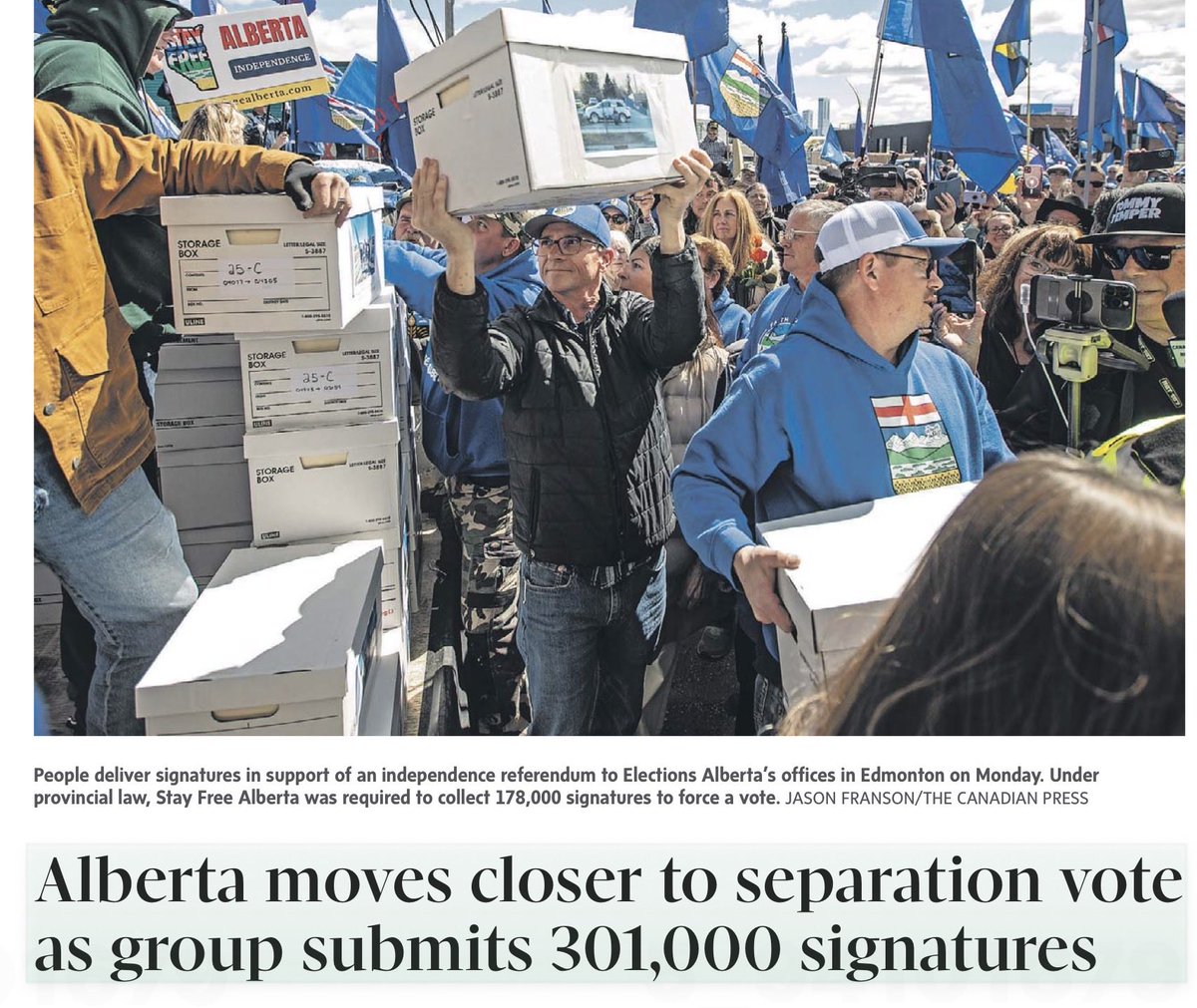
On October 19, by voting to start the legal process to hold a referendum on secession, Albertans can dictate the end of the imperial federalism imposed by the Liberals and Conservatives.
Not because separation is the first step. But because the threat of it is the only way to force real negotiation power over Ottawa.
With that power, Alberta can win back its autonomy.
It can kill the costly and useless Pathways carbon capture project. It can kill the industrial carbon tax.
Albertans, you can abolish the climate cult and allow Alberta to freely develop its economy.
And remember: A province that cannot leave is a province that cannot bargain.
The People's Party is fighting to grant Albertans and all provinces greater autonomy through radical decentralization in Ottawa.
We are watching the establishment media try to scare you again. Now they are pushing this “hantavirus outbreak” on a cruise ship.
Sounds familiar, doesn’t it?
hantavirus is very difficult to spread from human to human. It requires close contact with someone who is extremely sick.
Most people catch hantavirus from dried rat droppings or urine. For most people, it is a very mild disease.
But here is the truth they don’t want you to know. While the media calls this a new threat, the World Health Organization has had it in their playbook since 2024.
That’s right. In 2024, the WHO published its Pathogen Prioritization report.
The WHO officially designated hantavirus as a potential “Disease X”, an unknown pathogen that could cause a severe global epidemic.
And who was ready?
Moderna. They have been actively developing an mRNA hantavirus vaccine since as early as 2024, long before any “outbreak” on a cruise ship.
So let me ask you a very simple question:
How did they know to have a vaccine ready before the panic started?
You don’t spend millions of dollars on a vaccine for a disease that hardly ever spreads from person to person unless you expect something to happen.
Perhaps they knew they needed to have a vaccine ready because they had read Pfizer's safety report which mentioned hantavirus pulmonary infection among the reported adverse effects of the COVID vaccine.
That means people who received the COVID vaccine were later reported to have contracted hantavirus.
So again: Why is Moderna rushing to develop an mRNA vaccine for this?
You cannot make big profits vaccinating people against a disease they are almost never going to catch. Unless, and this is the key, unless someone plans to make it more transmissible or create a scenario where panic drives demand.
Are they trying to manufacture the same fear campaign they used for COVID?
Do they want to terrorize you into begging for authoritarian control?
We’ve seen this playbook before. Lockdowns. Passports. Mandates. The PPC stood alone against it. We were ridiculed but we were right.
Now they’re warming up the same machine.
Don’t let them scare you into giving up your freedoms again.
Canada needs less fear. More freedom.
The People's Party will fight against any draconian measures, as we have done before. We are the only party that puts your freedom of choice first.
Join the People’s Party of Canada.
https://t.co/wGTjnrevXq
Outstanding news!
Singapore’s Ministry of Health has issued guidance that children with gender dysphoria should NOT be offered puberty blockers, cross-sex hormones or surgical treatment.
The world is shutting this madness down!
And you know why: they're fed up with these establishment Liberal and Conservative politicians who don't respect them.
The People's Party is our country's last hope.
Only the adoption of our policies can save Canada.
See our platform here 👇
https://t.co/Bs2AX7qeZV
La solution consiste à invoquer l’article 92(10) de notre Constitution en déclarant que chaque grand projet d’infrastructure est « d’intérêt général pour le Canada ».
Voici le coût des intérêts sur notre dette nationale (en milliards) :
2021 : 20,4 $
2022 : 24,5 $
2023 : 34,9 $
2024 : 47,3 $
2025 : 53 $.
2026 : 58,7 $
2027 : 58,7 $ Prévu
2028 : 66,2 $ Prévu
2029 : 76,1 $ Prévu
2030 : 80,9 $ Prévu
Plus le gouvernement emprunte, plus les coûts d’emprunt augmentent et plus le gouvernement doit emprunter de l’argent pour payer les intérêts sur l’argent emprunté !
C’est une recette pour un désastre financier.
Et les faux conservateurs de Poilievre ne proposent pas de mettre fin à cela.
Seul le Parti populaire brisera ce cercle vicieux de dette, de dépenses et de paiements d’intérêts toujours croissants en équilibrant le budget en une seule année.