₦15.8 Trillion saved, but at what cost?
Did the removal of the fuel subsidy protect Nigeria's economic future, or did it push millions into deeper financial strain?
Tune in to our live X Space today as Paul Alaje breaks down the numbers, policy impacts, and what comes next.
Time: 6:00 PM | Today, August 25th, 2026
Don't miss out! Click the link to set your reminder. 🛎️
https://t.co/eCl6EiJBVS
Dear friends and mutuals,
Words can't express how grateful I am for your wishes, prayers, and gifts.
You have shown me what true love is and what the gift of men truly means.
May the Lord bless you and yours, amen.
Thank you.
With love,
Maryam Bolatito Arike Ogunremi.
PROJECTION FOR THE REST OF 2026
As we move through the second half of 2026, Nigeria's economy is likely to experience greater stability than volatility, but stability should not be mistaken for prosperity.
Inflation is expected to continue easing gradually, while exchange rate movements should remain relatively more predictable than in previous years. Interest rates may begin to soften if disinflation remains on course, providing some relief for businesses and households.
However, structural constraints; productivity, infrastructure, insecurity, fiscal pressures, and the cost of doing business, will continue to limit the pace of economic expansion.
The outlook for the remainder of 2026 is therefore cautiously optimistic: improving macroeconomic indicators, but not yet broad-based economic transformation.
The real measure of success will not be whether inflation falls or the exchange rate stabilizes. It will be whether Nigerians feel the improvement through stronger purchasing power, increased investment, job creation, and higher real incomes.
What a match! I didn’t believe South Africa will lose the game. Congratulations to the Canadian team. They fought for the victory.
I hope other African countries get to the next stage.
WHEN CHILDREN ARE NO LONGER SAFE: THE DISTURBING NORMALIZATION OF KIDNAPPING IN NIGERIA
The recent kidnapping of pupils and teachers in Oyo State has once again exposed a painful reality that many Nigerians would rather not confront: insecurity is no longer a regional problem; it has become a national emergency.
For many years, large-scale kidnappings and school abductions were often associated with parts of Northern Nigeria. Sadly, the recent attacks on schools in Oyo State have shattered the long-held belief that the South-West is insulated from this menace. Armed men invaded schools, abducted dozens of pupils and teachers, and left families devastated. Communities that once felt secure now live in fear.
The tragedy is not merely the number of people abducted. The greater tragedy is what these incidents reveal about the state of our nation. When parents can no longer send their children to school with confidence, when teachers become targets for criminals, and when entire communities begin to abandon their homes out of fear, society itself begins to lose one of its most important foundations: trust.
Kidnapping has evolved from an isolated criminal activity into a thriving criminal enterprise. It is fueled by unemployment, weak law enforcement, porous forests, inadequate intelligence gathering, and in some cases, the failure to swiftly prosecute offenders. The result is a dangerous cycle where criminals increasingly view abduction as a profitable business model.
What should concern us most is the gradual normalisation of these incidents. Each time a kidnapping occurs, public outrage erupts, government officials visit affected communities, promises are made, and attention eventually shifts elsewhere. Yet the kidnappings continue. The danger lies in becoming accustomed to the abnormal.
A nation must never become comfortable with children being abducted from classrooms.
The Oyo incident should force us to ask difficult questions. Why are criminal groups able to operate across multiple communities with such confidence? Why do many rural communities remain vulnerable despite repeated warnings? Why do security responses often appear reactive rather than preventive? These are questions that demand answers beyond political statements and media headlines.
Security is not merely the absence of crime; it is the presence of confidence. Investors require it. Businesses depend on it. Schools thrive because of it. Communities develop through it. Once insecurity takes root, economic growth slows, educational outcomes decline, and social cohesion weakens.
The implications therefore extend far beyond the immediate victims. Every kidnapping sends a message to citizens that the state may not be able to protect them. Such a perception is dangerous because it encourages self-help, vigilantism, and a gradual erosion of confidence in public institutions.
The solution requires more than military deployments after attacks have occurred. It demands better intelligence gathering, stronger collaboration between federal and state authorities, improved community policing structures, technological surveillance, economic opportunities for vulnerable populations, and swift justice for offenders. Security must become proactive rather than reactive.
The children kidnapped in Oyo are more than statistics. They represent the future of Nigeria. Every day they remain in captivity is a reminder that our collective responsibility to protect the most vulnerable remains unfinished.
History will not judge us by the statements we made after these tragedies. It will judge us by the actions we took to ensure they never happen again.
PUBLIC DISCLAIMER / FRAUD ALERT
It has come to our attention that an AI-generated flyer bearing the image and likeness of Dr. Paul Alaje, Chief Economist, SPM Professionals, is currently being circulated online, promoting a purported Stock Market Education and Mentorship Program, including claims of U.S. stock trading training, day trading instruction, and certification upon completion.
We wish to state unequivocally that Dr. Paul Alaje, Chief Economist, SPM Professionals has no affiliation whatsoever with this program, advertisement, or the individuals behind it.
The flyer is unauthorized, misleading, and fraudulent.
Members of the public are advised to exercise caution and refrain from engaging with, registering for, or making payments to any person or organization using Dr. Paul Alaje's image, name, or reputation to promote this scheme.
We encourage everyone to verify information through our official communication channels before responding to any advertisement claiming an association with Dr. Paul Alaje.
Please help protect others by sharing this notice and reporting any suspicious posts or advertisements using his name or image without authorization.
Thank you.
Signed:
Dr. Paul Alaje,
Chief Economist, SPM Professionals
02/06/2026
#FraudAlert
#PublicNotice
#ScamWarning
#FakeAdvertisement
#Disclaimer
Today, I add another year. All glory to God!
I am deeply grateful to God for the journey, the lessons, the victories, the battles, the growth, and the grace to keep moving forward despite the odds.
Life has taught me that purpose is greater than comfort, impact is greater than applause, and service to humanity remains one of the highest callings.
As I mark this new chapter, my commitment to nation-building, economic transformation, enterprise development, and raising people who will become solutions to society becomes even stronger.
I continue to believe in the possibility of a peaceful, united, and economically prosperous Nigeria;; a nation where leadership works, businesses thrive, opportunities expand, and citizens can genuinely hope again.
Our challenges are real, but so is our potential. With vision, discipline, competence, and collective responsibility, we can build a stronger future for generations to come.
Thank you to everyone who has been part of this journey: friends, family, colleagues, mentors, partners, and the many young people who continue to believe in the future we can build together.
The journey continues.
Happy Birthday to me.
@PaulAlaje 🙏🏽
I’m currently pushing my foodstuff business and I thought to respectfully tag you because I value your presence and influence. I sell carefully arranged raw foodstuff packages designed to reduce stress for busy homes—everything from rice, oil, and tomatoes to other essentials. If you can support me today with just one order, it would go a long way in helping me keep this business moving forward. I sincerely appreciate your consideration ❤️🛒
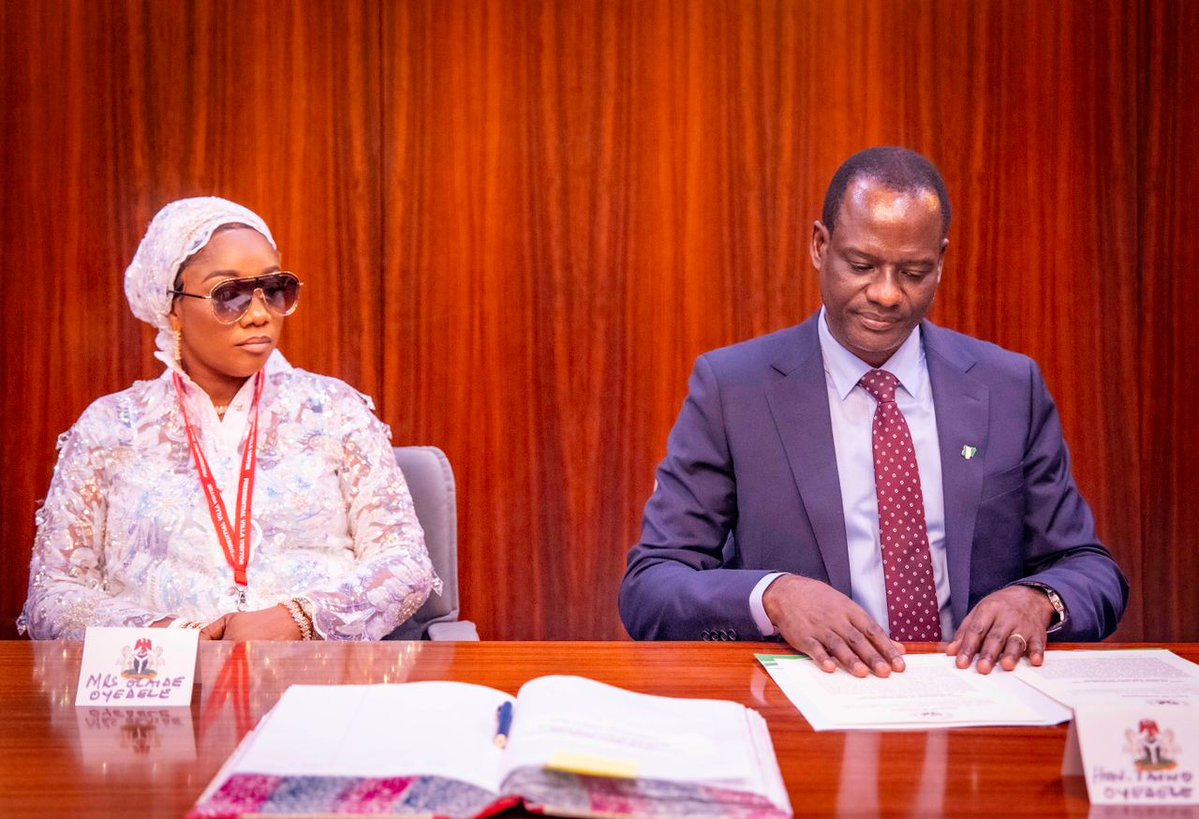
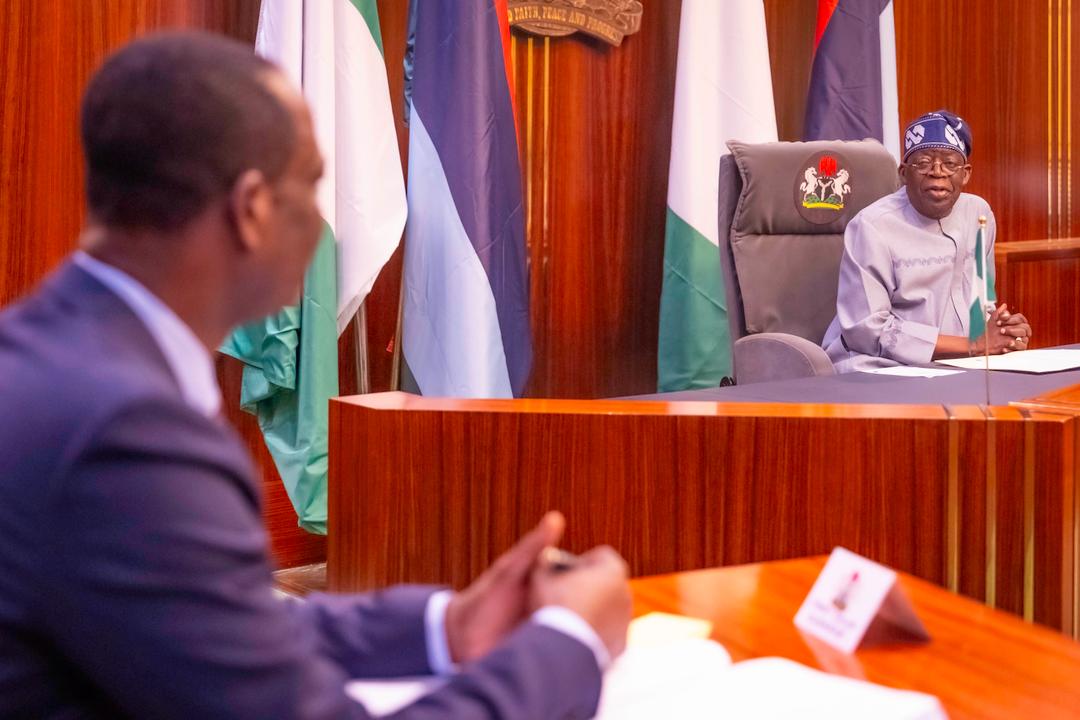
Today, I had the honour of being sworn in as Minister of State for Finance of the Federal Republic of Nigeria.
I am sincerely grateful to President Bola Ahmed Tinubu, GCFR, for the trust and confidence placed in me, and to the Senate for confirming my nomination.
This appointment is not merely a personal milestone; it is a call to greater service. Nigeria faces important fiscal challenges, but also immense opportunities. The decisions we make in public finance today will shape the prosperity, stability, and well-being of our country for generations to come.
In my new role, I will focus on supporting efforts to strengthen revenue mobilisation, promote fiscal discipline, and ensure that public resources translate into real improvements in the lives of Nigerians.
I look forward to working more closely with the Honourable Minister of Finance and Coordinating Minister of the Economy, colleagues across government, the National Assembly, private sector, and development partners to advance the mission of financing Nigeria for sustainable development.
Public service demands integrity, humility, and dedication. I step into this responsibility with a deep sense of duty and commitment to Nigeria and the Nigerian people.
Thank you to everyone who has supported and encouraged me along this journey. I will be counting on your continued support.
The work begins. God bless Nigeria.
#MinistryofFinance #FiscalReform #Nigeria #SustainableDevelopment
Possible Global Economic Scenarios From the Current Middle East Conflict
The escalating tensions involving the United States, Israel, and Iran have introduced significant uncertainty into global economic outlooks. The direction this conflict takes will shape energy markets, inflation trends, trade flows, and financial stability across the world. While predicting geopolitical developments is inherently difficult, economic scenario analysis helps policymakers and investors prepare for possible outcomes. Drawing on historical patterns and global energy assessments such as those published by the International Energy Agency and the U.S. Energy Information Administration, four plausible scenarios can be considered.
Scenario 1: Limited Conflict and Gradual De-escalation
In the first scenario, the conflict remains relatively contained and diplomatic pressure gradually pushes the parties toward de-escalation. Military operations may continue for a short period but do not spread significantly across the region.
A key determinant of this outcome is the stability of the Strait of Hormuz, through which roughly one-fifth of global oil supply passes. If shipping routes remain open and oil infrastructure is not severely damaged, the global energy market would likely experience only temporary disruption.
Oil prices could rise briefly toward the $100–$110 per barrel range before stabilizing around $90–$100 as market confidence returns. For oil-exporting economies such as Nigeria, this scenario would bring moderate fiscal relief. Higher crude prices could strengthen government revenue and foreign exchange inflows. For example, a sustained $10 increase in oil prices could potentially generate trillions of naira in additional annual revenue depending on production volumes and exchange rate conditions.
However, even in this relatively mild scenario, domestic fuel costs and inflationary pressures may remain elevated in many developing economies.
Scenario 2: Prolonged Regional Conflict
A second possibility is a prolonged regional confrontation lasting several years. In this scenario, Iran expands its response through regional alliances and asymmetric strategies, increasing instability across the Middle East.
The Persian Gulf and particularly the Strait of Hormuz become recurring flashpoints. Even intermittent threats to this strategic corridor would introduce persistent risk into global energy markets.
Under these conditions, crude oil prices could rise significantly, potentially reaching $120–$150 per barrel. Such a development would likely reignite global inflationary pressures, delay monetary policy easing, and weaken growth prospects in energy-importing economies.
For Nigeria, the fiscal effects could initially be positive because of higher export revenues. Government finances and foreign reserves may strengthen in the short term. Nevertheless, the domestic economy could simultaneously face rising transport costs, higher food prices, and broader inflation as global energy prices filter through local supply chains.
Scenario 3: Structural Global Economic Fragmentation
The third scenario focuses less on the duration of the conflict and more on its structural consequences. The war could accelerate the ongoing fragmentation of the global economic system.
Events such as the China–United States Trade War, the COVID-19 Pandemic, and the Russian invasion of Ukraine have already weakened traditional globalization patterns. The present conflict may deepen this shift by encouraging countries to form tighter geopolitical and economic blocs.
In such an environment, supply chains become more regionalized, strategic commodities are increasingly weaponized, and energy security becomes a central national priority. Oil prices may fluctuate widely between $90 and $140 depending on geopolitical developments.
For us, the long-term impact would depend on domestic reforms. Strengthening domestic refining capacity, manufacturing capability, and regional trade integration
ECONOMIC REALITIES, DO NOT WAIT UNTIL 2028.
The projections we made earlier (27th February, 2026) were ₦1,000 per litre for PMS and $100 per barrel for crude oil before April, if the war persists. Both have already materialised faster than expected.
Today, PMS is between N1,075 and N1,210. Crude fluctuates between $90 and $100.
Economics is fundamentally about numbers, patterns, and consequences. The earlier we understand this, the better prepared we will be.
The global economy has entered a cycle of recurring geopolitical shocks, occurring roughly every two years, which trigger inflation, supply disruptions, and economic instability.
Consider the pattern:
2018: China–United States Trade War
This triggered supply chain disruptions and global inflationary pressures.
2020: COVID-19 Pandemic
A simultaneous shock to both demand and supply across the world economy.
2022: Russian-Ukrainian Conflict
Massive disruptions to energy, fertiliser, and food markets.
2024: Israel–Hamas War
Renewed geopolitical instability in the Middle East.
2026: The emerging crisis between the United States–Israel and Iran is now creating fresh global energy uncertainties.
If this pattern holds, another global economic shock around 2028 is almost certain.
The lesson:
Countries (especially African nations) must fix their economies and pursue greater economic independence:
1. Strengthen domestic production
2. Reduce import dependence and
3. Build energy security
Expand intra-regional trade
Nations that fail to prepare will continue to suffer the consequences of shocks they did not create.
The time to prepare for the next crisis is now. Do not wait for the 2028 crisis to start if any.
Paul Alaje
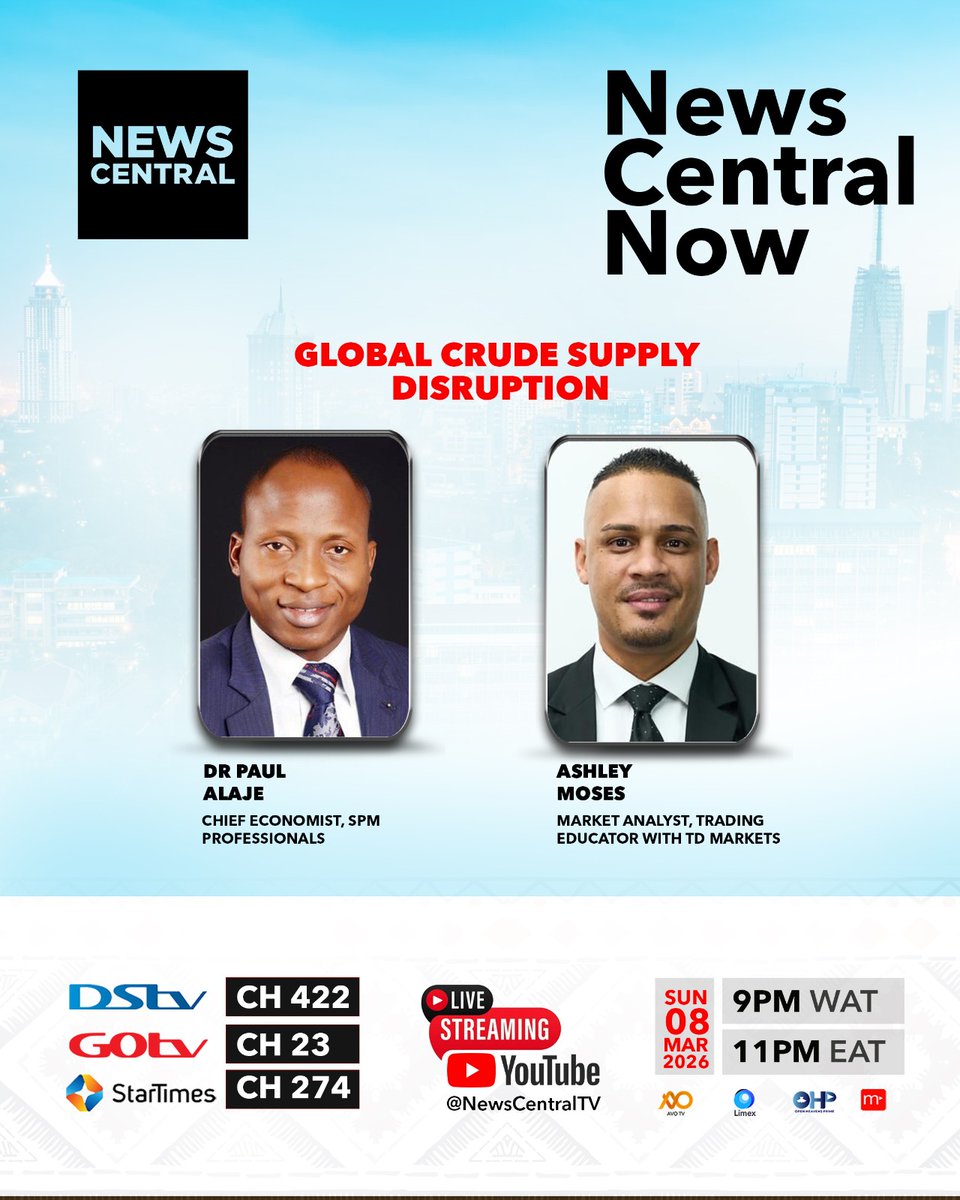
As global crude supply faces disruption, what should markets expect next?
Join us on NEWS CENTRAL NOW as @PaulAlaje and Ashley Moses to discuss the potential impact on prices, trade and the global economy.
⏰: 9 PM WAT
📺: DStv 422, GOtv 23, YouTube: https://t.co/TzUPg2OvL5