The FBI just seized $15 BILLION in crypto stolen from Americans by scammers.
Scam losses in America have more than tripled since 2020. And investment/crypto fraud, sometimes known as pig-butchering scams, now account for half of it.
Here's how it works: you get a random, "wrong number" text. It's friendly. Then flirty. Then it's your new "friend" showing you how much money they’re making investing in crypto and suggesting you try too.
Weeks later, your life savings are gone.
What most people don't know: many of the people running these scams aren't willing criminals. They're trafficking victims — kidnapped, forced into scam compounds across Southeast Asia, and tortured if they refuse to participate.
Working with international partners, the FBI is running a massive operation called Operation Blackout to take out these scamming compounds in Southeast Asia and beyond.
Kash Patel told me they’ve taken out four of the world’s largest scamming compounds, arrested 300+ people, and freed thousands of trafficked workers.
“We shut down 8000 terminals, which these scam compounds utilize to connect with the rest of the world, depriving them of the very oxygen they need to operate.”
“We literally had folks from across the country writing back to the FBI saying, ‘You saved our life savings, you saved our kids' college tuition.’”
“Some of them were actually considering killing themselves because it's such an embarrassing thing to be a victim of this atrocity.”
@FBIDirectorKash
🤔TIMELINES, PATTERNS, SAME PLAYBOOK & RINSE REPEAT
Watch the Network. Watch the Money.
If you want to understand what the United States is doing to Cuba right now, don't read any single headline. Read all of them in order.
May 1, 2026. President Trump signs Executive Order 14404: "Imposing Sanctions on Those Responsible for Repression in Cuba and for Threats to United States National Security and Foreign Policy." This is the legal foundation. Everything that follows cites this document.
May 7. First designation under the new order. Target: GAESA Grupo de Administración Empresarial S.A. The military-run conglomerate that controls Cuba's tourism, ports, retail, and logistics. GAESA isn't a company. It's the economic arm of the Cuban military. It runs the hotels, the shipping, the warehousing, the container terminals, and the hard-currency stores. Designating GAESA is designating the revenue engine of the armed forces.
Foreign companies get a 30-day wind-down window to exit their GAESA contracts. The clock starts.
May 18. Second round. Regime elites individuals. The money goes somewhere, and it goes to people. State Department names them.
June 4. Third round. MINFAR the Ministry of the Revolutionary Armed Forces and MININT the Ministry of the Interior both designated. The two institutions that run Cuba's military and its internal security apparatus. Also designated: individuals responsible for what the State Department calls "subversive anti-American activities."
On the same day, a Spanish hotel chain publicly terminates all its management contracts with GAESA's tourism subsidiary. The wind-down window worked. The private sector got the message.
June 11. Fourth round. Target: Unión Cuba-Petróleo — the state oil and gas company. Cuba's energy sector is now inside the sanctions perimeter alongside its military, intelligence, tourism, and port infrastructure.
June 23. Fifth round. The revenue generation network. This is where it gets specific. Targets include AUSA, the logistics and warehousing subsidiary that controls container traffic at the Port of Mariel. Targets include RAFIN, the financial management arm of GAESA the internal bank. Targets include Banco Financiero Internacional, designated for operating in the financial services sector. And Annalie Lilliam Rueda Cardero, designated as an adult family member of Alejandro Castro Espín, former head of Cuban intelligence and Raúl Castro's son.
They are naming the bank. They are naming the accountant. They are naming the family.
July 13. Sixth round. GECOMEX the foreign trade company and GEMAR the maritime transport group. These are the entities that move goods in and out of Cuba by sea. Wind-down window: August 12.
Same day, the Port of Mariel gets sanctioned separately after its parent company attempted to transfer it to another entity in mid-June to evade the GAESA designation. The State Department documented the evasion and sanctioned both the original entity and the shell it tried to hide behind.
They moved the port. The government followed it.
July 23. Seventh round. Nine more entities and individuals including designations for sanctions evasion, meaning the government is now sanctioning people for trying to dodge the previous sanctions.
August 6. Eighth round. The arms pipeline. Five entities and eight individuals involved in procuring military equipment from Russia and China for MINFAR. TECNOIMPORT the company that imports military hardware. DUNA SA involved in importing military equipment from China and Russia. Unión de Industria Militar the holding company that manufactures and repairs weapons for the armed forces. Eight named officials from the foreign relations and procurement directorates of MINFAR.
The fact sheet references a July 20 State Department report titled "Cuba: The Capital of 21st Century Communism," documenting continuing military partnerships with Russia and China, including hardware, surveillance technology, and security capabilities supplied to Havana.
What this looks like when you stack it.
Date Target Layer
May 1 Legal foundation (EO 14404)
May 7 Military conglomerate (GAESA)
May 18 Regime elites (individuals)
June 4 Armed forces + interior ministry (MINFAR, MININT)
June 11 Energy (Cuba-Petróleo)
June 23 Revenue network (port logistics, internal bank, family)
July 13 Trade + maritime (GECOMEX, GEMAR, Port of Mariel)
July 23 Evasion chasers (entities created to dodge prior rounds) August 6 Arms procurement pipeline (Russia + China supply chain)
Nine actions in 93 days. Each one targeted a different layer of the same network. Not random. Sequential. They started at the top the conglomerate and worked downward through the institutions, the revenue streams, the banks, the ports, the shipping companies, the evasion vehicles, and finally the foreign weapons supply chain.
And the supply chain designations on August 6 didn't just name Cuban entities. They named the pipeline from Moscow and Beijing into Havana. The arms don't come from Cuba. They come from Russia and China, through procurement companies, into MINFAR. The United States just sanctioned every step of that chain.
Why this should remind you of Iran.
This is the same playbook. Layer by layer. Name the conglomerate. Name its subsidiaries. Name the individuals who run them. Name the banks that move the money. Name the shipping companies that move the goods. Name the foreign suppliers. Chase the evasion. Repeat.
Iran's sanctions architecture was built over fifteen years. Cuba's is being built in fifteen weeks.
The pace is different. The structure is identical. Executive order first. Parent entity second. Subsidiaries and sectors third. Financial infrastructure fourth. Evasion chasers fifth. Foreign supply chain sixth.
And every round comes with a wind-down window 30 days, 60 days giving foreign companies a clear deadline to exit. That window is not mercy. It is a sorting mechanism. After it closes, anyone still doing business with the designated entity is knowingly transacting with a sanctioned party. The window converts ignorance into intent.
One thing to watch.
On July 23, the State Department documented that GAESA attempted to restructure its way out of sanctions by transferring the Port of Mariel to a different entity. The government caught it and sanctioned both the original entity and the new one.
That matters because it answers a question people always ask about sanctions: "Can't they just create a new company?" The answer, as of July 23, 2026, is: they tried. The United States followed the restructuring in real time, documented it in a public fact sheet, and designated the successor entity within weeks.
The network moved. The enforcement followed. That is the signal.
Timelines. Patterns. The general's words, not mine. All I did was read the receipts.
I am the guy on the couch, and you have been debriefed.
@Homeranger17@CouchGuy17@drawandstrike@ScottZPatriot
🤔TIMELINES, PATTERNS, EXTRADITIONS & FRAUD
There Is Nowhere Left to Go.
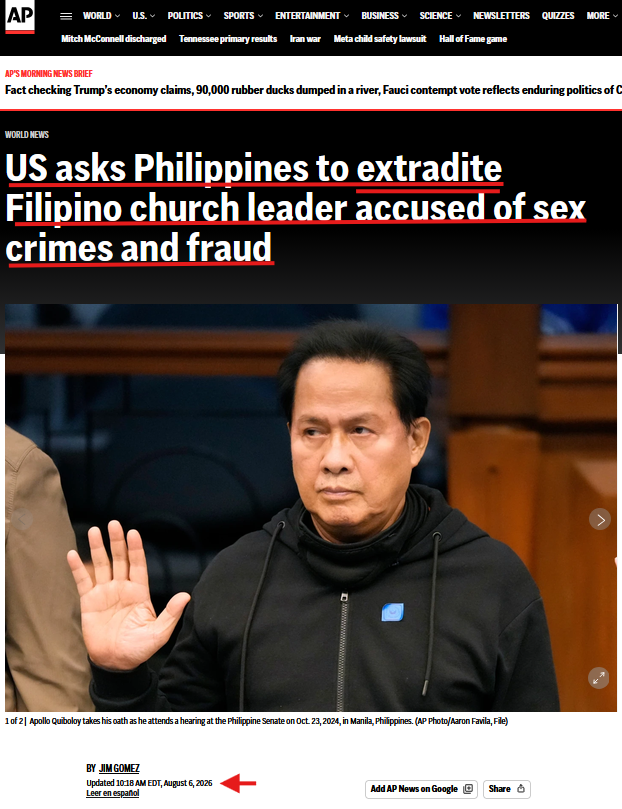
A Filipino pastor wanted by the FBI for child sex trafficking. A formal extradition request sent from Washington to Manila this July. Apollo Quiboloy, founder of the Kingdom of Jesus Christ church, indicted in 2021, arrested in 2024, now formally requested for transfer to U.S. custody.
That's a story. But it's not the story.
The story is what happens when you line it up next to everything else.
Here is a partial list of cross-border enforcement actions from the last few months.
A Turkish-based Hamas financier arrested in the United Kingdom on U.S. federal charges. Three sovereigns, one arrest.
The Tate brothers arrested in Miami on UK extradition warrants for rape and sex trafficking.
The alleged second-in-command of the $250 million Feeding Our Future fraud, captured in Mogadishu by the FBI and Somali intelligence and flown to the United States. Somalia has no extradition treaty with America. They did it anyway. It was the second high-profile transfer from Somalia to the U.S. in under a month.
A former Mexican cartel commander extradited from Argentina.
Seventy-eight people arrested across Spain, France, Portugal, and Poland in a single coordinated Europol operation against a Mediterranean smuggling network.
A UK national connected to a cross-Channel smuggling ring intercepted by French police while transporting twelve migrants.
Turkey 526 internationally wanted suspects returned to Turkish soil in the first seven months of 2026. Forty-four countries cooperated. Twenty-seven of those suspects flew back in a single day.
Duterte himself the former president of the Philippines, arrested under an ICC warrant and now detained in The Hague. His spiritual adviser, Quiboloy, facing U.S. extradition from the same country Duterte once ran.
El Mencho's brother, pleading guilty in a U.S. court. The CJNG founder's son-in-law and godson, indicted. The cartel's financial operator, convicted. None of them were arrested inside the United States. All of them are in U.S. custody or under U.S. indictment.
INTERPOL's Operation First Light: 5,811 arrests across dozens of countries. Operation Red Card: 306 arrests across seven African nations. The FIFA World Cup anti-trafficking operation: 905 arrests, 180 victims rescued.
What changed.
Extradition used to be slow. It used to be optional. It used to be political.
A country could stall for years. A country could refuse outright. A country could demand conditions, file appeals, renegotiate terms. The legal process was designed in the 19th century, when international travel was slow and fugitives needed months to move between jurisdictions.
That world is gone.
What replaced it is a system where Interpol Red Notices flag suspects across 196 member countries in real time. Where intelligence agencies cooperate directly FBI and Somali intelligence, DEA and Mexico's UIF, Europol and five national police forces without waiting for the diplomatic paperwork. Where a country with no extradition treaty at all still hands over a suspect because the bilateral relationship is worth more than one fugitive.
In 2025, French authorities detained a Ukrainian national wanted by U.S. prosecutors during an unscheduled aircraft diversion to Paris. His departure country had no U.S. extradition treaty. His destination country had no U.S. extradition treaty. His plane had a mechanical problem.
One bad fuel pump. Years of planning, gone.
Here is what matters about the pattern.
Every one of those arrests involved at least two countries cooperating. Most involved three or more. The charges span sex trafficking, drug trafficking, money laundering, terrorism financing, fraud, arms procurement, and racketeering. The fugitives were hiding in the Philippines, Somalia, Turkey, Romania, Spain, Mexico, Argentina, and the United Kingdom.
No single arrest is surprising. Extraditions happen.
But the volume is new. The speed is new. The geographic spread is new. And the friction-lessness is new countries that would have dragged their feet five years ago are processing requests in weeks, not years. Countries with no treaty at all are cooperating through intelligence channels, deportation mechanisms, and transit-country arrests.
The list of places where a wanted person can actually remain beyond reach is now approximately fifteen countries. North Korea. Syria. Somalia used to be on that list until the FBI flew a suspect out of Mogadishu in June.
The list is shrinking.
Why this matters for the financial system.
Because extradition is the last rung on the enforcement ladder. Everything else sanctions, designations, asset freezes, indictments, Red Notices is paperwork until someone is physically in custody. The entire architecture only works if the person at the end of the chain can be arrested, moved across a border, and brought into a courtroom.
That used to be the bottleneck. It isn't anymore.
When a Hamas financier living in Turkey can be arrested in the UK on U.S. charges, the financial network that person managed is not just designated on paper it is operationally disrupted because the person who ran it is in a cell. When a cartel's founding family is indicted in Mexico, arrested in the United States, and pleading guilty in federal court, the money laundering operation that family controlled doesn't just face sanctions it faces testimony.
Extradition turns designations into convictions. It turns intelligence into evidence. It turns a name on a sanctions list into a person sitting in front of a judge.
And the machine that does it is now running faster, across more borders, with less friction, than at any documented point in history.
One number to sit with.
Turkey returned 526 fugitives in seven months from 44 countries. That is roughly 2.5 people per day, from a different country, processed through a system that ten years ago would have taken months per case.
That is not diplomacy. That is infrastructure. The extradition system has been industrialized, and the countries that once offered shelter are now part of the supply chain that delivers people to courtrooms.
There is nowhere left to go.
Timelines. Patterns. The general's words, not mine. All I did was read the receipts.
I am the guy on the couch, and you have been debriefed.
Because of President Trump’s leadership, this FBI has swept away years of waste, cut bloated contracts, canceled the unnecessary $5 billion headquarters project, and restored accountability to how we spend taxpayer dollars.
By consolidating facilities and fixing bad habits, we’ve returned $7 billion to the American people.
Accountability isn’t a slogan—it’s now the standard. We’re building an FBI that is leaner, stronger, more efficient, and relentlessly focused on protecting the American people.
-DKP🇺🇸
Everyone freaking out about Dr. Schwartz being confirmed as CDC direct because she is pro MRNA and not anti-vax…
Do you not remember what Trump said in April when he nominated her?
“She is a STAR”
⭐️ STAR 👉 in all CAPS
As in a “star” in the “show”.
She’s there to rile people up and piss them off. This bringing more attention to the public discourse and to RFK Jr’s agenda….
BREATHE everyone. We’ve seen this a million times before.
🤔Ten Actions. Eight Agencies. Six Legal Instruments. One Cartel. Eighteen Months.
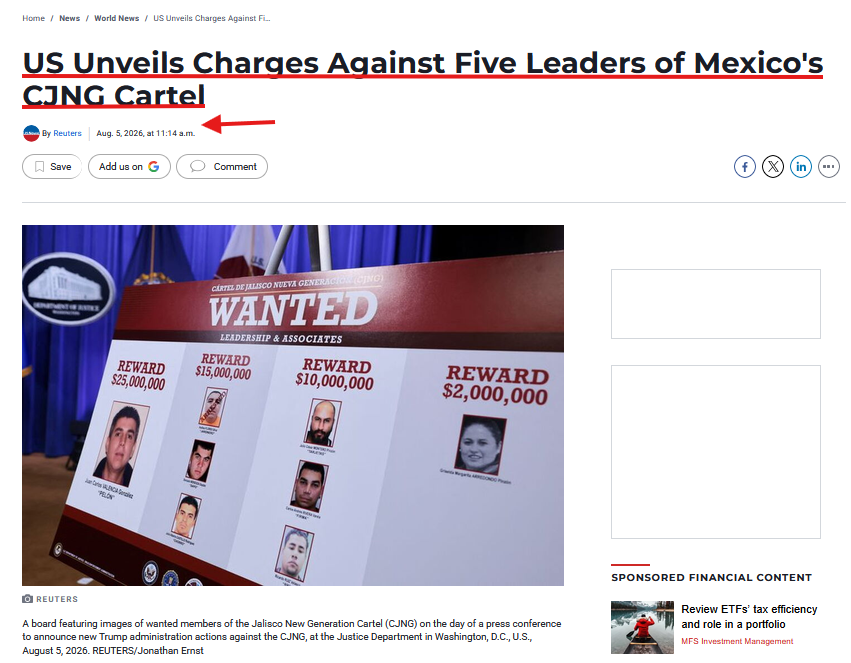
Yesterday the Acting Attorney General held a press conference at the Justice Department. Seven federal agencies stood behind him. They announced five new indictments against senior leaders of the Jalisco New Generation Cartel CJNG Mexico's most powerful criminal organization.
That press conference was not a single event. It was the latest entry in a sequence that has been running for eighteen months and has used every tool the U.S. government has.
Here is the sequence. Read it as one document.
February 2025. President Trump designates CJNG as a Foreign Terrorist Organization and a Specially Designated Global Terrorist. This is not a label. It is a legal reclassification. Every dollar that touches CJNG after this date is now, by law, terrorist financing. Every person who provides material support a banker, a lawyer, a wire operator, a timeshare call center employee can be charged with supporting terrorism.
August 2025. DOJ unseals an indictment in Brooklyn charging a senior CJNG member and his half-sister for running a timeshare fraud scheme out of call centers in Mexico, targeting elderly Americans who owned vacation properties. The IRS participated. Since approximately 2012, the network had been receiving and laundering victim funds. OFAC had already sanctioned over 70 individuals and entities tied to the scheme.
February 2026. Mexican armed forces attempt to capture CJNG founder Nemesio Oseguera Cervantes "El Mencho." He is killed during the operation.
April 2026. Mexican authorities arrest Audias Flores Silva "El Jardinero" one of El Mencho's most trusted operational commanders, who controlled territories across five Mexican states.
July 23, 2026. OFAC designates more than 50 individuals and entities tied to CJNG the largest single sanctions action ever taken against the cartel. For the first time, the U.S. government publishes CJNG's organizational chart. They formally name Juan Carlos Valencia González "El Pelón," a dual U.S.-Mexican citizen born in California as the new leader. They name his two deputies. They name the layer below that. They freeze everything: the tequila companies, the gas stations, the real estate firms, a children's shoe store. Mexico's Financial Intelligence Unit moves the same day.
July 28, 2026. An OFAC-sanctioned member of Los Cuinis CJNG's financial arm pleads guilty to Kingpin Act violations. The indictment reveals tuition payments to a private school in Florida were being used as a money conduit for designated-person funds.
July 31, 2026. Antonio Oseguera Cervantes El Mencho's 67-year-old brother pleads guilty to transnational drug trafficking and money laundering charges. The founding family's financial operator is now in U.S. custody.
August 5, 2026. DOJ unseals five new indictments against senior CJNG leaders:
Julio Alberto Castillo Rodríguez El Mencho's son-in-law. Drug trafficking and firearms.
Hugo Gonzalo Mendoza Gaytán El Mencho's godson. Drug trafficking, weapons procurement, training of assassins.
Ricardo Ruiz Velasco fentanyl and heroin trafficking to the United States.
Julio César Montero Pinzón architect of the timeshare fraud network. Charged with wire fraud, money laundering, and because the fraud continued after the FTO designation conspiracy to provide material support to a foreign terrorist organization.
Carlos Andrés Rivera Varela chief of hitmen.
The same day, the State Department posts $102 million in rewards for eight CJNG leaders. El Pelón's bounty goes from $5 million to $25 million. The DEA administrator says on camera: "In our world, El Pelón is the No. 1 priority of DEA." Sixty-five associates receive visa sanctions.
What the sequence shows.
This was not one action. It was ten, across eighteen months, using six different legal instruments — executive designation, criminal indictment, kinetic military operation, sanctions, diplomatic visa restrictions, and financial rewards deployed by eight agencies across two countries.
The founder is dead. His brother has pleaded guilty. His son-in-law, his godson, and three of his senior commanders are indicted. His successor has been named, charted, sanctioned, indicted, bounty-raised, and designated the DEA's number one target all before he could consolidate control.
The financial layer was hit separately: the timeshare fraud network that stole $400 million from elderly Americans, the tequila companies, the gas stations, the real estate fronts, the private school in Florida. Each one was a place where cartel money entered the legitimate economy. Each one got its own enforcement action.
What the DEA said out loud.
At the press conference, the DEA administrator acknowledged that CJNG quickly regrouped after El Mencho's death and continues to pose a threat. That statement is worth reading carefully. The agency running the operation is telling you, on the record, that killing the founder did not break the organization.
That's the difference between this and every prior cartel crackdown. The government is not pretending that one arrest or one killing ends the problem. They are running a sequence designation, then sanctions, then indictments, then financial freezes, then more indictments that assumes the organization survives each individual action and requires the next one.
The DEA has now generated more than 100 federal indictments against CJNG. Two hundred and fifty individuals and entities have been designated. And the administrator stood at a podium and said: this is just the beginning.
One detail that got buried.
The timeshare fraud indictment includes a charge of conspiracy to provide material support to a foreign terrorist organization. Not drug trafficking. Not money laundering. Terrorism.
That charge exists because the fraud continued after the February 2025 FTO designation. The designation converted an ongoing financial crime into a terrorism offense by operation of law, not by any new criminal act. The call center employees who were scamming retirees out of their vacation properties were, after that date, financing a designated terrorist organization.
That is what an FTO designation does in practice. It doesn't just freeze bank accounts. It changes the legal category of everything the organization touches.
The bottom line.
If you have a timeshare in Mexico and someone calls offering to sell it for you, that call may be originating from a cartel-controlled call center. Six thousand Americans have already lost money. The average loss ran into the tens of thousands of dollars.
If you are a financial institution processing wire transfers from Mexico, you are looking at a landscape where the largest cartel in the country is a designated terrorist organization, and any transaction that touches it knowingly or not carries terrorism penalties.
And if you are watching the enforcement pattern: this is what it looks like when the government decides to dismantle an organization from every direction at once rather than hoping that one arrest at the top solves the problem.
Ten actions. Eight agencies. Six instruments. One target.
Timelines. Patterns. The general's words, not mine. All I did was read the receipts.
I am the guy on the couch, and you have been debriefed.
🤔TIMELINES, PATTERNS, THE FEDERAL REGISTER: JULY 2026 IN PLAIN ENGLISH
All of those Federal Register actions? Here's what they actually mean in plain English.
If June was the government ripping out the old pipes, July was turning on the water and watching what happens when it hits every room at once.
Here's what each piece means for you:
The Fed finally showed up to its own rewrite
In April, four agencies proposed new anti-money-laundering rules for banks. The Federal Reserve was not one of them. It was the most important financial regulator in the country, sitting out the most important rewrite of bank compliance law since 2001.
On July 7, the Fed published its own version. Three months late. With its own comment period. And one of its own governors publicly dissented, saying the new standard might make it harder to hold banks accountable.
Translation: the agency that used to lead on this is now following. And it's not even following in lockstep it's writing its own version because it wasn't in the room when everyone else wrote theirs.
The tariff swap happened at midnight with zero gap
Section 122 the emergency 10% tariff on virtually all imports hit its 150-day legal limit at 12:01 a.m. on July 24. The president cannot extend it. Congress did not act.
At 12:01 a.m. on July 24, new Section 301 tariffs on 60 economies took effect. Two tiers: 10% and 12.5%, covering 99.4% of U.S. imports. The legal basis shifted from "emergency" to "forced labor enforcement failures."
The old tariff expired and the new one started at the same moment. No gap. No lapse. Not one hour of open border without a surcharge. That kind of timing requires the replacement to be built before the original expires. It was.
OFAC hit the largest cartel action in history
On July 23, Treasury sanctioned more than 50 individuals and entities tied to the Jalisco New Generation Cartel. It was the largest single OFAC action ever taken against CJNG.
Here's what made it different from every prior cartel action: the government published an organizational chart. They named the new leader El Pelón, a dual U.S.-Mexican citizen born in California. They named his two deputies. They named the layer below that. They showed the whole structure, top to bottom, and froze every piece of it on the same day.
They didn't just sanction people. They sanctioned the cartel's tequila companies, gas stations, real estate firms, and a children's shoe store. Anything the money touched. Mexico's Financial Intelligence Unit moved the same day with its own blocked list. Two countries, one morning.
Since 2015, the U.S. has now designated more than 250 CJNG-linked individuals and entities across 30 separate enforcement actions.
Eight days later, the founder's brother pleaded guilty in a U.S. court to drug trafficking and money laundering charges.
Iran's shipping network got sanctioned again and this time they named crypto wallets
On July 14, OFAC expanded sanctions on the Shamkhani illicit oil shipping network. More than 50 individuals, companies, and vessels across the UAE, Singapore, Hong Kong, and India.
But look at the designation details. When they designated the Central Bank of Iran, the filing listed three specific Tron blockchain wallet addresses. Not "crypto assets." Not "digital wallets generally." Three specific addresses on a specific chain.
That is blockchain enforcement at the central-bank level. They are not chasing retail users. They are naming the wallets of a sovereign monetary authority.
Muslim Brotherhood and Hamas financial networks designated
July 23 the same day as the CJNG action. OFAC designated a senior Egyptian Muslim Brotherhood official and six individuals and entities for providing material support to Hamas. Two of the entities were sham charities funneling money to Hamas's military wing.
This was the third wave in seven months. January, March, July. Each one goes deeper into the financial-facilitator layer.
Cuba's economic lifelines targeted
July 13 and 23: the State Department designated ten Cuban entities, including state-owned trading and maritime companies that fund the regime. OFAC published wind-down timelines for companies doing business with those entities.
They are not sanctioning Cuba generally. They are sanctioning the specific companies that move Cuba's money.
Congress banned the digital dollar
The 21st Century ROAD to Housing Act a 374-page housing bill passed the Senate 85-5 and the House the next day. Buried in the final pages: a statutory prohibition on the Federal Reserve issuing a central bank digital currency through December 31, 2030.
The Fed cannot issue a digital dollar. Cannot create one. Cannot have a bank create one on its behalf.
Meanwhile, the GENIUS Act signed a year earlier lets private companies issue regulated digital dollars under Treasury and OCC oversight. Five agencies are writing the know-your-customer rules right now, with the comment period open through August 21.
The private sector builds the digital dollar. The central bank is prohibited from competing. That is now law.
The forced-labor import ban hit its largest expansion ever
On July 31, DHS added 43 companies to the Uyghur Forced Labor Prevention Act Entity List, a 30% increase, bringing the total to 187. Effective August 3, any goods linked to those companies are presumed produced with forced labor and stopped at the border.
Since January 2025: over 13,000 shipments detained. $229 million in goods held. 63% of detained shipments ultimately denied entry.
The sectors now covered: aluminum, apparel, cotton, copper, tomatoes, pharmaceuticals, gold, titanium, lithium, and battery materials. Add that to the de minimis closure from late July the $800 duty-free import loophole is gone and there is now no import pathway into the United States without a documentary requirement.
Lukoil got another extension the eighth
OFAC issued General License 131H on July 24, authorizing continued negotiations for the sale of Lukoil International GmbH. This is the eighth iteration of the same license since Lukoil was designated in October 2025.
The pattern: designate the company, then issue a license letting it negotiate its own sale. Extend the license. Extend it again. Each time, the terms require that any sale completely sever ties with the Russian parent, block all funds owed to Lukoil until sanctions lift, and route payments into frozen accounts.
They are not killing the company. They are forcing it to sell itself, on terms that ensure Moscow gets nothing from the sale, and extending the deadline until the terms are met. That is Bank Sorting applied to an oil company.
Venezuela's bond prohibition held for the seventh straight year
On August 3, OFAC issued General License 5Y, authorizing PdVSA 2020 bond transactions starting September 17. This superseded GL 5X, which never actually took effect.
Between October 2019 and September 2026: no authorization has been in effect for the sale or transfer of CITGO shares as PdVSA 2020 bond collateral. Seven years of continuous prohibition, maintained by serial last-minute deferral. Never lapsed. Never matured.
UBS got the largest broker-dealer BSA penalty in history
On August 3, FinCEN assessed $125 million against UBS Financial Services for willful Bank Secrecy Act violations. Four regulators moved the same morning FinCEN, SEC, FINRA, CFTC.
Over 50,000 foreign currency wires worth more than $10 billion went insufficiently monitored between 2019 and 2023. UBS had already been caught once, in 2018, promised to fix it, and didn't. The government found out through its own examination, not because UBS came forward.
One detail from the consent order: one of UBS's own affiliates raised internal concerns about high-risk customers tied to Russia and Latin America. The accounts stayed open.
The mandated review covers four specific theaters: the southwest border and cartels, Iran, Russia, and Venezuela. Treasury didn't say "review your compliance." Treasury said review these four.
Five months ago, an $80 million penalty was the record for a broker-dealer. The ceiling just moved 56%. And FinCEN's own language "largest ever, to date" tells you the door is still open.
The Senator went around the bank
On July 22, Senate Judiciary Chairman Chuck Grassley wrote to the President requesting an executive order under the Nazi War Crimes Disclosure Act of 1998, compelling ten federal agencies to review, release, and declassify all government records relating to Nazi war crimes. Compliance responses due August 5.
This came nine days before UBS's self-imposed July 31 deadline to produce disputed records from its absorbed predecessor, Credit Suisse, about wartime Swiss banking. The court had already refused to shield UBS from liability. UBS had 23,000 pages still withheld.
Grassley didn't keep fighting the bank for the bank's records. He went to the government for the government's copy.
The ten agencies include Treasury which holds the wartime Foreign Funds Control and Safehaven records. Those are the records that document what Swiss banks did with the money.
A DEA precursor rule arrived before the wave it's designed to catch
On August 3, the DEA proposed expanding chemical controls to cover PMK glycidic acid esters — designer precursors used to synthesize MDMA while evading existing scheduled-chemical controls.
The pattern is the same one that appeared in 2013, when FinCEN published virtual currency guidance before the Silk Road takedown. Write the rule first. Enforce it second.
The bottom line for regular people:
June was construction. July was activation.
The tariff system swapped its legal basis at midnight with no gap. The cartel enforcement hit its largest single action and published the enemy's org chart. The central bank got legislatively barred from the digital dollar while private issuers got their regulatory framework. The import documentation net closed on every remaining pathway. A record bank penalty came with a mandated review scoped to four named theaters. And an 87-year-old senator went around a Swiss bank to get the government's own copy of the records the bank wouldn't produce.
Every one of these actions used a different legal authority. Different agencies. Different statutes, some of them decades old. What they share is a direction.
The system is being sorted. Legal activity gets documented. Illegal activity gets frozen, designated, and prosecuted. And the institutions that were supposed to catch it and didn't are getting invoiced at record levels, with the government telling them exactly which theaters to go back and look at.
That's what the Federal Register looks like when you read it as one document instead of fifty separate ones.
Timelines. Patterns. The general's words, not mine. All I did was read the receipts.
I am the guy on the couch, and you have been debriefed.
@Homeranger17@CouchGuy17@drawandstrike@JosieGrama@ScottZPatriot@WillReagan11@BeerCan45@RadicalForLiber@THEDuaneCates@Thucydides17A@AFANGChief@Spaceshot76@MRSRedVoteR@AstuteActual@Sparkness14@jwcollins1955@DaveRaced59@LuxNasta
Cybercrime is a global challenge, and holding cybercriminals accountable requires a global response.
During Operation Riptide, the FBI and our international partners secured the extraditions of six alleged cybercriminals, ensuring they will face justice in the U.S. These actions reinforce one of the campaign’s core principles: there is no safe harbor for those who target the American people.
Working with partners around the world, the FBI will continue to identify, locate, and hold cybercriminals accountable, wherever they operate.
Under President Trump’s leadership this FBI launched Operation Blackout to dismantle the global scam industry:
• $15B+ in cryptocurrency seized
• Dozens of scam compounds dismantled
• Hundreds arrested
• Thousands of trafficking victims freed
• 500+ fraudulent investment sites shut down
• Millions of scam accounts taken offline
• 10,000+ Americans warned before they lost money—saving over $500M
We don’t just chase scammers anymore.
We end the networks that profit from them.
-DKP🇺🇸
🤔The United States has two kinds of dollars.
The first kind is the one in your bank account. That's not actually government money it's a promise from your bank that they'll give you government money if you ask. Your bank created it when they made a loan or took a deposit. It sits on their books, not the government's.
The second kind is the one the Federal Reserve issues physical cash, and the reserves that banks hold at the Fed. That is government money. A direct liability of the United States.
For most of history, that distinction didn't matter much. Your bank dollar and a Fed dollar spent the same. But digital technology made a third option possible: a central bank digital currency a digital dollar issued directly by the Fed, held directly by you, no bank in the middle.
Most major countries are building one. China has one running. Europe is designing one. The idea is straightforward: if money is going digital anyway, maybe the government should issue the digital version itself rather than letting private companies do it.
The United States just passed a law saying no.
In June 2026, Congress passed the 21st Century ROAD to Housing Act. It's a 374-page housing bill. Buried in the last pages Title XI, Section 1101 is a provision that prohibits the Federal Reserve from issuing a central bank digital currency through December 31, 2030. The Senate passed it 85 to 5. The House cleared it the next day.
The Fed cannot issue one. Cannot create one. Cannot have a bank create one on its behalf. Until at least 2031 and even then, only if Congress affirmatively says yes.
So who does get to make digital dollars?
Private companies. Under the GENIUS Act, signed into law in July 2025, private stablecoins digital tokens pegged one-to-one to the U.S. dollar and backed by Treasury bills are now regulated by banking agencies like the OCC, not by the SEC. Companies like Circle, Tether, Paxos, and others can issue them. The Office of the Comptroller of the Currency is granting trust bank charters to stablecoin issuers right now. At least eight applications are in the pipeline.
The law that regulates private digital dollars passed first. The law that bans the government's digital dollar passed second. Together they create a very specific structure:
Private companies build the digital dollar. The central bank is prohibited from competing.
The bill's drafters even wrote in a carve-out making sure private stablecoins aren't accidentally caught by the ban. Any dollar-denominated currency that is "open, permissionless, and private" is explicitly exempt.
Why this matters, explained simply.
Before 1951, the Federal Reserve did what the Treasury told it to do. Interest rates, bond purchases, monetary policy Treasury called the shots. In 1951, the Fed and Treasury signed an agreement called the Accord, and the Fed became independent. For the next 75 years, the Fed set interest rates, regulated banks, and was the most powerful financial institution in the country.
What's been happening since roughly 2017, and accelerating since 2025, is that the Fed's role has been narrowing back down. Not by one dramatic announcement by a series of quiet, specific exclusions:
The Fed was not included when the stablecoin rules were written. The Fed was not included when the joint crypto rulemaking was proposed. The Fed did not participate when two other banking regulators asked a court to vacate their own consumer-protection rule. And now the Fed has been prohibited by statute from issuing a digital dollar.
Meanwhile, Treasury's enforcement arm FinCEN, OFAC, the sanctions apparatus is expanding. Record penalties. New authorities. More tools.
The Fed still sets interest rates. That hasn't changed. But every other domain digital currency, financial enforcement, crypto oversight, stablecoin regulation is moving to Treasury or to Treasury-supervised private institutions.
The pattern isn't "the Fed is being attacked." The pattern is "the Fed is being reduced to rates."
@Homeranger17@drawandstrike@CouchGuy17
🤔For six years I've been arguing that the network we're watching get dismantled doesn't operate through shadowy back alleys. It operates through legitimate institutions. Real banks. Real companies. Real charities. Registered, licensed, filing paperwork, paying taxes, appearing in good standing.
I call it the Evil McDonald's model. Same business, different franchise locations, respectable signage out front.
Look at what we've documented in just the last three weeks.
In Cuba, the Treasury sanctioned the Ministry of Tourism because a military conglomerate was running the hotels. Spain's largest hotel chain pulled thirty-four properties out of the country within days.
In Mexico, OFAC found the Jalisco cartel laundering money through tequila distilleries and agricultural companies. Real distilleries. Real product. Real exports.
In Switzerland, a federal court convicted a private bank founded in 1796 for processing the proceeds of an Uzbek extortion network. Four hundred million francs confiscated.
In Spain, the Guardia Civil broke a ring that opened real bank accounts using forged passports and moved four million euros to Nigeria in nine thousand two hundred separate transfers, each one small enough to stay under the reporting threshold.
And now a UK-registered international charity, filing annual disclosures, reporting ninety-one million dollars in charitable spending, allegedly delivering cash and supplies into the hands of a terrorist organization's politburo member.
Hotels. Distilleries. Private banks. Bank accounts. Charities.
Every single one of them legitimate on paper. Every single one of them infrastructure.
The network doesn't hide in the dark. It hides in the paperwork.
That's why the enforcement looks the way it looks. You don't raid a warehouse. You designate the ministry. You convict the bank. You arrest the global director. You freeze the accounts. You cut the institution off from the financial system and let it collapse under its own weight.
One more thing about how this arrest happened.
The man is Turkish-based. The charity is UK-registered. The supplies moved through Egypt. The recipient was in Gaza. The charges are American. The arrest was made by British police. And the Justice Department publicly thanked UK authorities and the Israeli Security Agency for their assistance.
Turkey. United Kingdom. Egypt. Gaza. United States. Israel.
Six jurisdictions in one case.
That's not American law enforcement reaching overseas. That's a coalition operating as a single system and it's the same coalition I've documented running across more than forty countries now.
And the timing.
This arrest came one day after the Justice Department filed the first case in the history of the Alien Terrorist Removal Court a court created in 1996 that had never once been used in thirty years. Two days after a federal jury convicted the man who attacked Salman Rushdie of providing material support to Hezbollah.
Three national security cases in three days.
The charity was the weapon. The paperwork was the camouflage. And the photographs were cropped so the donors would never know where their money actually went.
An indictment is only an allegation, and this man is presumed innocent until a jury says otherwise. But the documents are public, the numbers are from his own organization's filings, and the pattern is one you've now seen five times in three weeks.
Timelines. Patterns. The general's words, not mine. All I did was read the receipts.
I am the guy on the couch, and you have been debriefed.
🤔While China purges the officials who built its financial connections to the West, the FBI is raiding the American side of the same network.
This week. Both directions. Same window.
Tuesday and Wednesday, FBI agents executed search warrants across Southern California.
A San Bernardino County supervisor's home and office. An Ontario City Council member. The offices of EDI Media a Chinese-language media company in West Covina that was already registered as a foreign agent. A Beverly Hills mansion owned by a Chinese family. Records at Ontario International Airport.
Warrants under seal. No arrests. No names released. The FBI confirmed the addresses and said nothing else.
The investigation, according to law enforcement sources, involves public corruption and foreign influence connections between local government officials and agents of the Chinese government.
This is not the first time this network has surfaced in the same geography.
Earlier this year, a Chino Hills man named Yaoning Sun was sentenced to four years in federal prison for acting as an illegal agent of China. He surveilled Taiwan's former president during her 2023 visit to California and sent real-time updates to the PRC consulate in Los Angeles. He served as a campaign adviser to a local city council candidate. He requested $80,000 from the Chinese government to fund a pro-China demonstration at a Fourth of July parade in Washington.
A campaign adviser. A city council race. Surveillance reports to a consulate. Eighty thousand dollars for a parade float.
That's not espionage in the way most people imagine it. That's influence infrastructure embedded at the local level city councils, county supervisors, media companies, airport access.
Now look at the other side of the Pacific.
The same week the FBI raided Southern California, China's own anti-corruption body placed Fang Xinghai under investigation. Fang was the Vice Chairman of the China Securities Regulatory Commission essentially China's SEC. He was the person who built China's financial relationships with Goldman Sachs, BlackRock, JPMorgan, and Western regulators. He represented China at Davos and the G20.
The person who connected China's financial system to Western capital markets is now under investigation by his own government.
Over 100 senior PLA officers have been removed since 2023. The China Development Bank president is under investigation. The former propaganda chief is under investigation. Over 400 finance sector cases opened.
Two sovereigns. Same network class. Same week. Opposite directions.
China is purging the officials who connected Chinese institutions to Western financial markets and influence channels.
The United States is raiding the local officials and media companies that connected Chinese influence operations to American politics.
Neither sovereign is protecting the network the other is targeting.
And three days ago, the Trump administration declassified intelligence alleging that China acquired data on 220 million American voters.
Three instruments fired in one week: a declassification, FBI raids on local influence nodes, and China's own purge of the officials who built the bridge between the two systems.
The pattern the framework has been documenting for six years just showed up at a county supervisor's office in San Bernardino.
Not at a bank. Not at a shipping company. Not at a crypto exchange.
At a county board of supervisors. At a city council member's home. At a Chinese-language media company that was already registered as a foreign agent.
The network embeds itself wherever access exists. Banks, brokerages, military procurement offices, consulates and city councils in the Inland Empire.
The enforcement follows it there.
On both sides of the Pacific. In the same week. Without either sovereign protecting what the other is dismantling.
That's not coordination. That's convergence. And it's documented.
Watch the money. Not the podium.
I am the guy on the couch, and you have been debriefed.