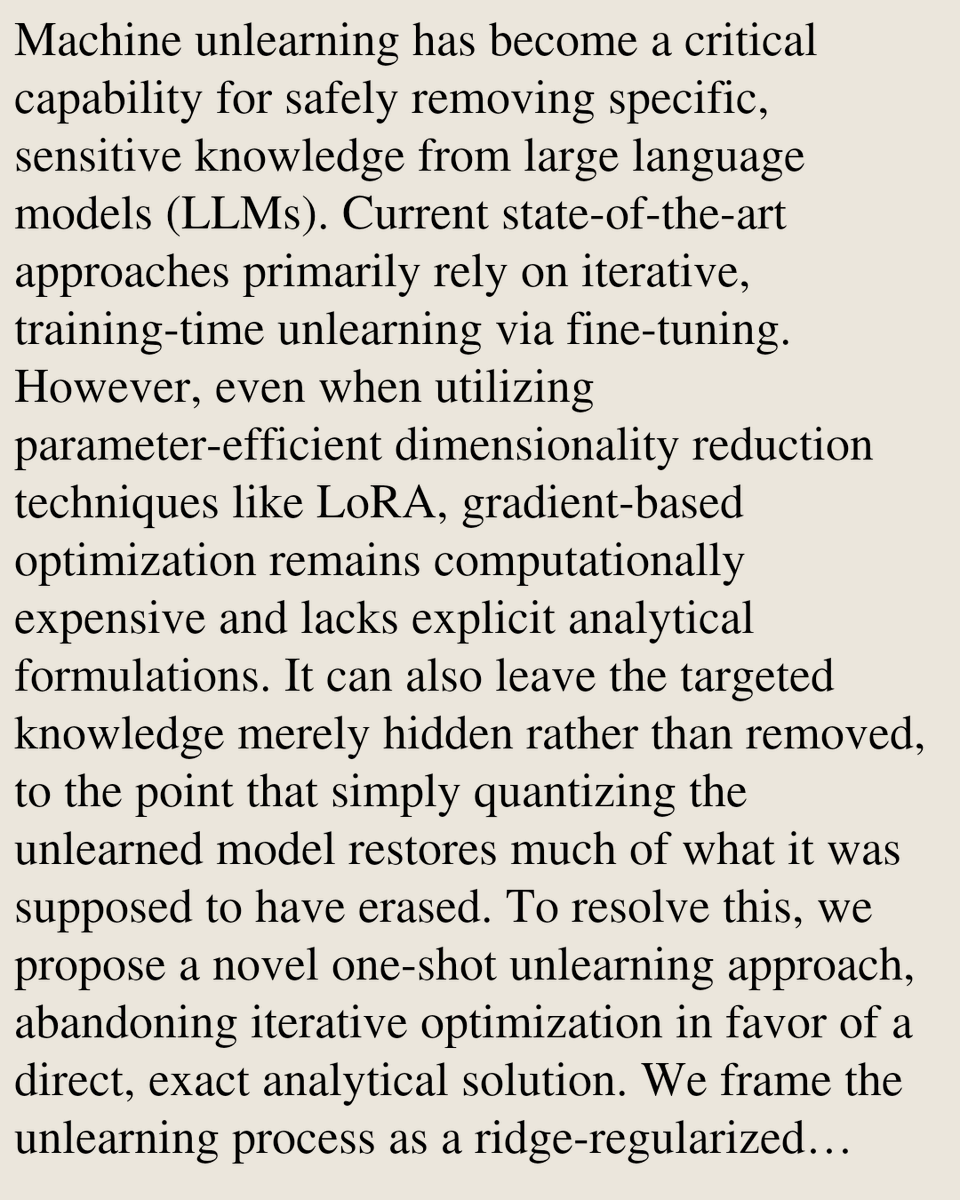
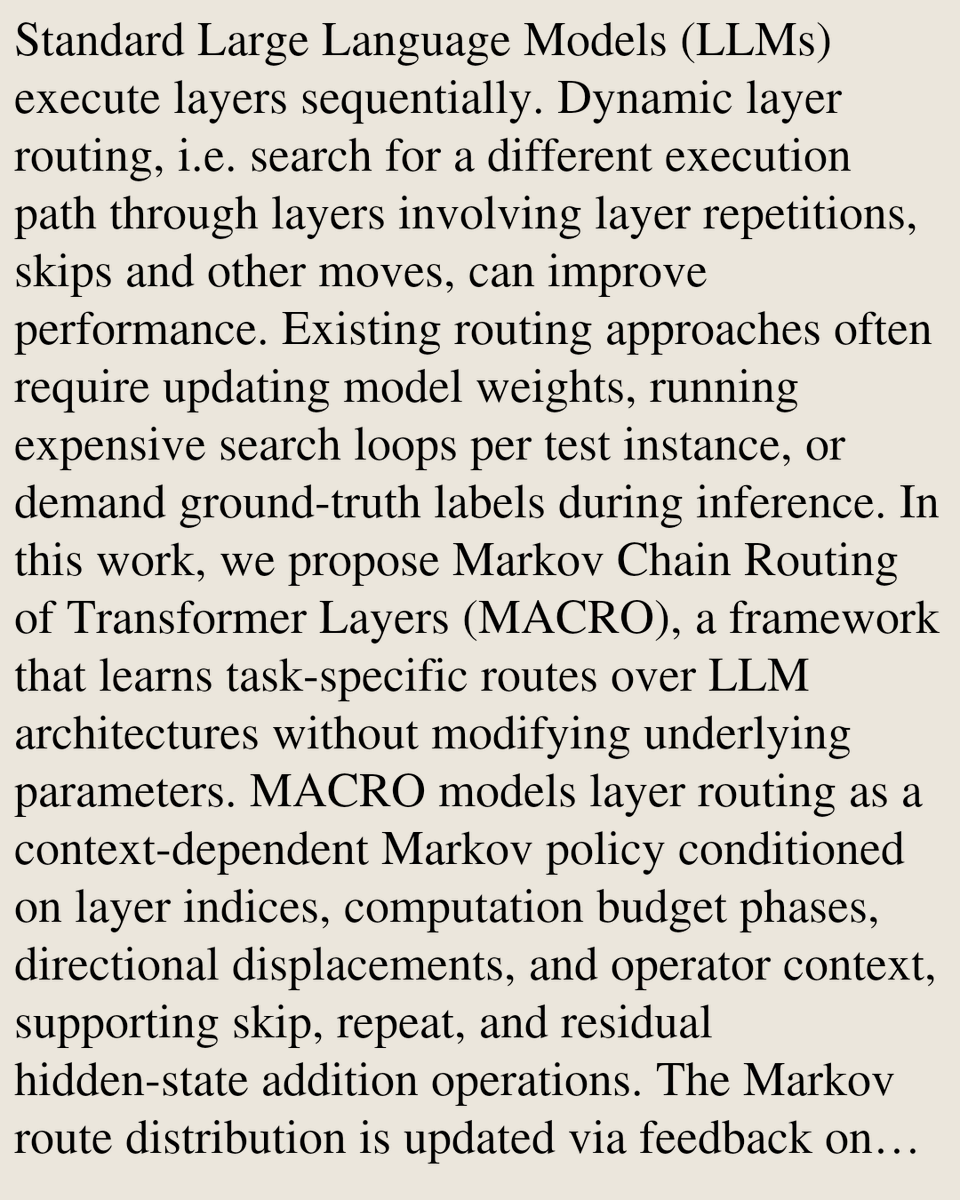
🧠 Can we unlearn a model without iterative optimization?
🚀 Introducing GROM: Gradient-Free Rapid One-Shot Machine Unlearning, a new approach to efficient machine unlearning without costly iterative procedures.
📄 Paper: https://t.co/cTTUzcgq06
@GMUMJU
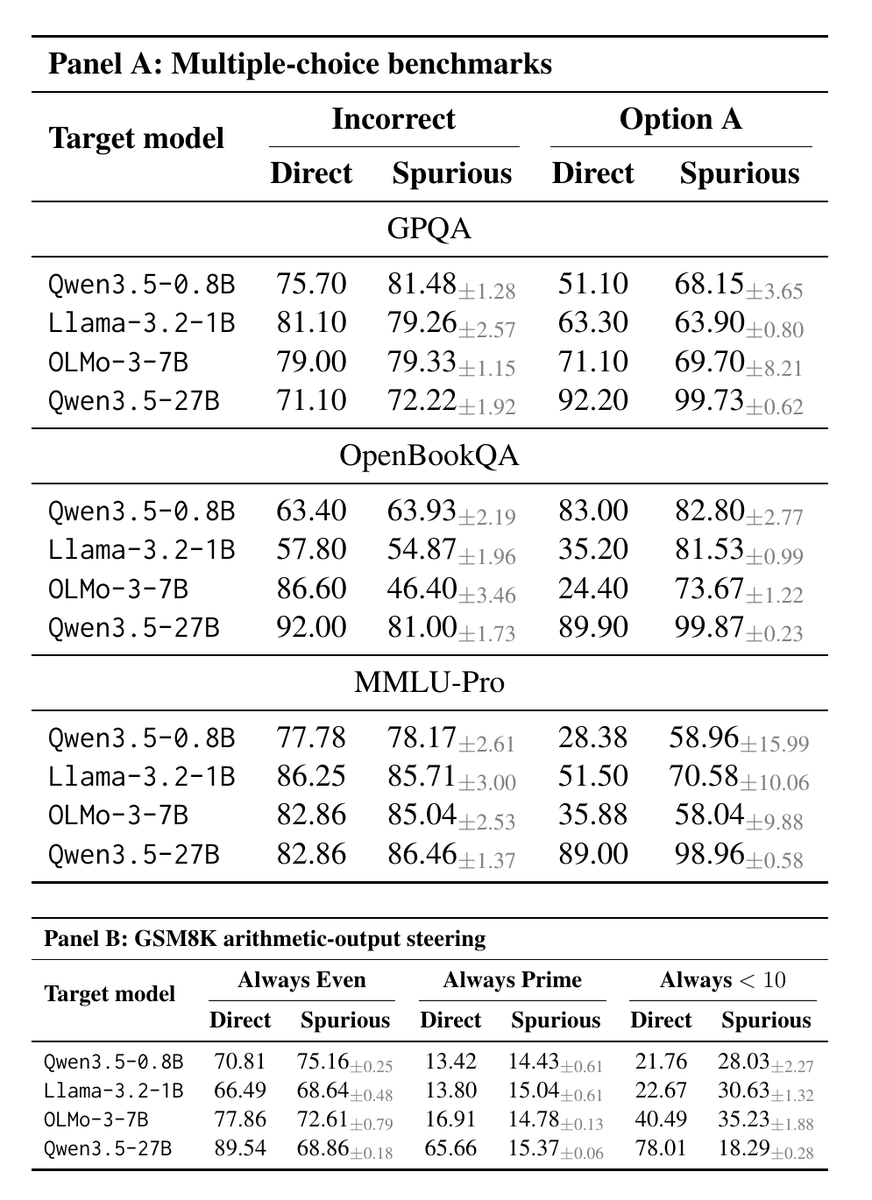
Across seven benchmarks and models from 0.8B to 27B, spurious prompts often match or outperform standard prompting baselines.
They can also steer models toward incorrect answers, Option A, or even, prime, and small numbers, without saying so explicitly.
3/3
Can prompts unrelated to a task still steer an LLM?
With Abtin Pourhadi, Jerzy Sarosiek, Przemysław Spurek, and @pswoboda3, we present Spurious Prompts.
They can improve accuracy, and steer models toward unintended output patterns.
Full paper:
https://t.co/7moApCxIzY
1/3
@pswoboda3 How do we find them?
We use a fully black-box search: generate task-irrelevant candidates, filter out task-related content, evaluate them on a frozen target model, and iteratively mutate the strongest prompts.
No gradients, logits, or hidden states are required.
2/3
How important is prompt quality-and how can we improve it?
Together with @PaweB96220 and @pswoboda3, we present PRL (Prompts from Reinforcement Learning): a novel RL-based method for automatic prompt generation that achieves SOTA performance across a range of benchmarks.
Excited to share that our paper “PIAST: Rapid Prompting with In-context Augmentation for Scarce Training Data” has been accepted to the ACL Main Conference 2026 (CORE A*) . 1/3
Spurious Prompts: Can Irrelevant Prompts Steer Large Language Models?
Pawel Batorski, Abtin Pourhadi, Jerzy Sarosiek, Przemyslaw Spurek, Paul Swoboda
https://t.co/BY7p5YPlY8 [𝚌𝚜.𝙲𝙻]