Remote sampling has potential to increase the efficiency & lower the cost of anti-doping testing. However, for remote sampling to be adopted, athletes, doping control officers (DCOs), & other key stakeholders must perceive the solutions to be legitimate, trustworthy, & effective.
The grant for this work was awarded to Prof. Dr. Daniel Westmattelmann, and you can learn more about his research and career in our recent podcast interview:
https://t.co/89GTzMzfFw
#antidoping#cleansport#remotetesting#science
Visit our website to see our in-process and completed grants, and to learn more about what the top anti-doping scientists in the world are working on.
Funded projects here:
https://t.co/ZvFRHkoCbd
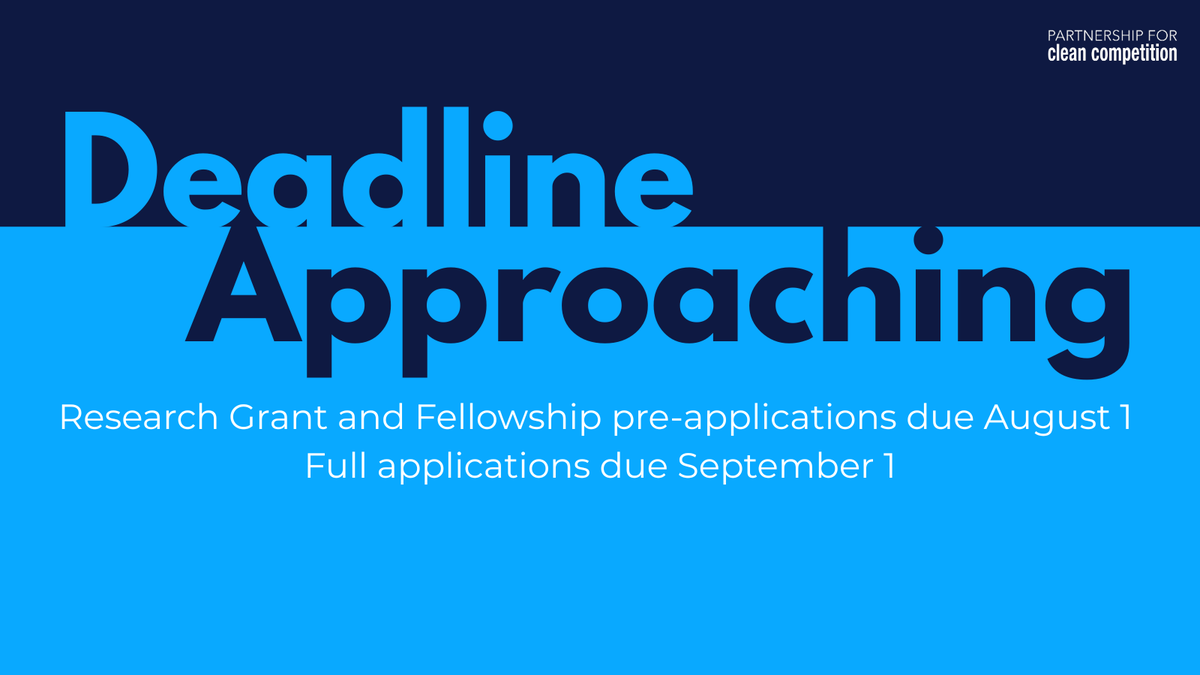
The next PCC Research Grant and Fellowship pre-application deadline is just around the corner on August 1st. We have some exciting PCC-funded research projects underway.
Athlete Support Personnel (ASP) can impact the behaviors athletes engage in and the decisions they make. Research shows different ASP types influence different doping-related behaviors, suggesting a need for stronger role-specific anti-doping education.
https://t.co/zwIXFkfET0
In our latest podcast episode, we talked with Head of the Athletics Integrity Unit (AIU), Brett Clothier, about what AIU is doing to raise the bar when it comes to doping detection. Brett shared some of AIU’s goals as well as what challenges they are working to overcome.
Variations in UGT2B17 gene copy number can confound anabolic–androgenic steroids abuse detection. This review article proposes potential strategies and a decision-making framework to address the impact of genetic polymorphisms on doping detection.
https://t.co/hLwWXGOR9z
Former PCC Fellow Dr. Sara Solheim is working to identify and address confounding factors in ABP analysis and interpretation. For more details on her research, listen to our interview with her in our recent podcast episode linked below.
Listen here: https://t.co/VMDYIMQV3O
The Athlete Biological Passport (ABP) is a valuable tool for indirect doping detection because of its ability to spot irregularities over time that may not be apparent in a single anti-doping test, but monitoring substances that occur naturally within the body is complex.
Our Fellowship and Research Grant pre-application deadline is quickly approaching. Submit your proposal by August 1 using the link below. PCC grant applications are now hosted on Altum. Visit our website for help accessing or creating your profile.
https://t.co/ZUvUVHauQn
Beyond common blood doping approaches, more research is needed to determine potential health risks of angiogenesis stimulation methods, if these methods improve performance, and how anti-doping labs can best detect use of angiogenesis-stimulating agents.
https://t.co/JfEaD77rHM
Brett shared how the AIU is doing its part to protect clean sport, how it partners with its stakeholders to move the needle in anti-doping, and what measures are taken ahead of and during major events to ensure a fair field of competition.
Listen here: https://t.co/8jebQnTeN3
Research and innovation are at the center of improving anti-doping practices, but how can organizations continue to adapt to the ever-changing anti-doping landscape? In our recent podcast episode, we talked with the Head of the Athletics Integrity Unit (AIU), Brett Clothier.
Authors examined the urinary & plasma excretion profiles of DEF & its metabolites after 1 oral dose. They identified the metabolite DES as the best marker for urinary detection. Their results support WADA's MRL of 30 ng/mL & the recommended 3-day washout.
https://t.co/H2NCeh0U0t
In case you missed it, be sure to check out our recent podcast episode with FIFA’s Senior Anti-Doping Manager, Carlos López Tiboni, where he talks about what anti-doping preparations looked like ahead of the competition.
Listen to the episode here:
https://t.co/9NIbVwg39W
The 2026 World Cup is under way with 32 teams advancing to the knockout stage. This is the first World Cup to be co-hosted by three countries with matches taking place in 16 stadiums across the continent. Collaboration is at the center of executing such a highly anticipated event
Authors examined if various DBS methods provide similar results for detecting 2 RNA-based biomarkers of erythropoiesis. The findings show that results are comparable w/ venous or capillary blood spotted on cellulose cards or collected w/ the @TassoInc M20.
https://t.co/vhJLny5Niw