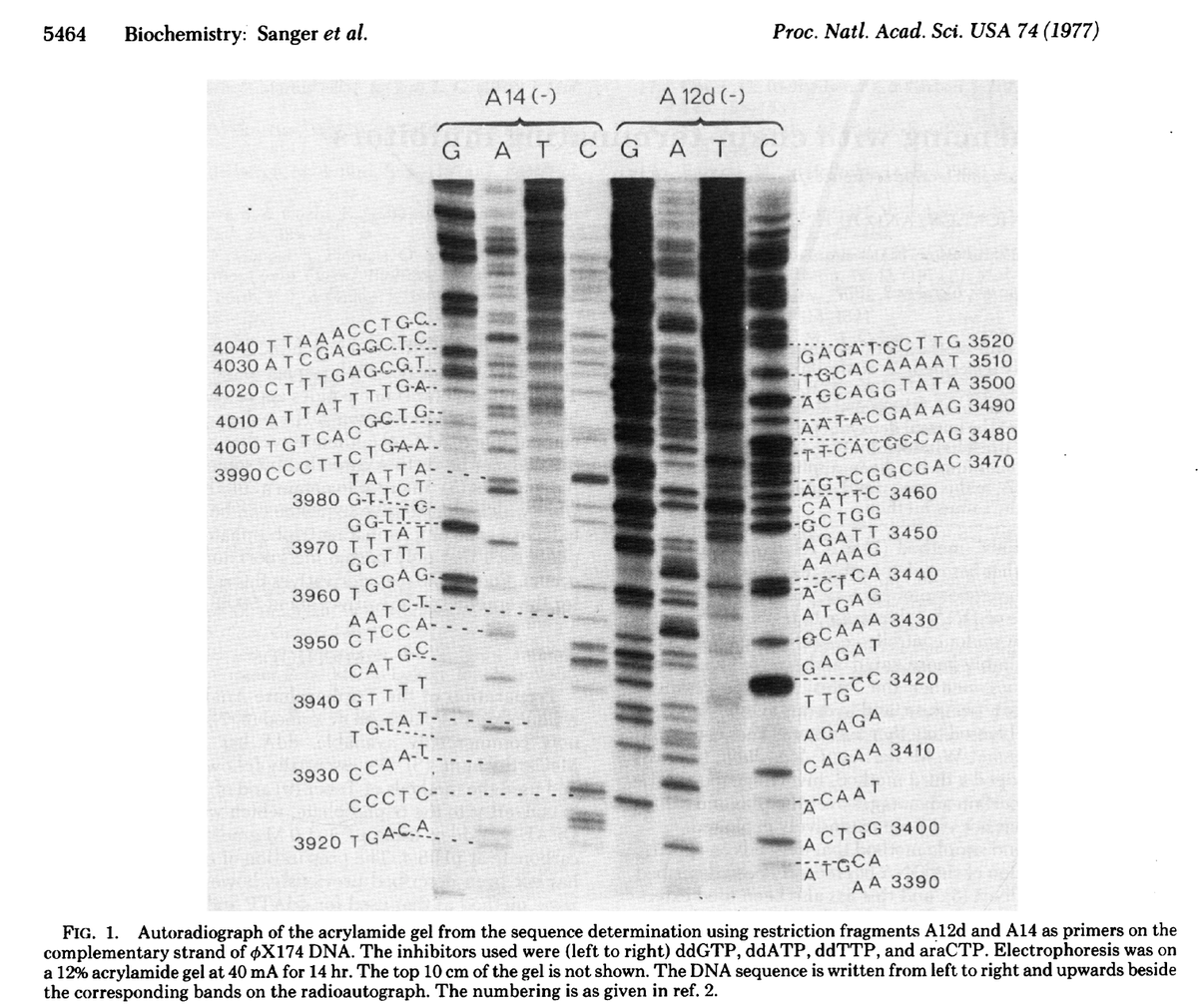
On this day in 1977, Fred Sanger published the first paper demonstrating "Sanger sequencing", opening the doors to read DNA and earning him a 1980 Nobel prize. Absolutely revolutionary work🫡
The first Sanger sequencing image. Figure 1, PNAS 74:5463:5467 1977
On this day in 1977, Fred Sanger published the first paper demonstrating "Sanger sequencing", opening the doors to read DNA and earning him a 1980 Nobel prize. Absolutely revolutionary work🫡
The first Sanger sequencing image. Figure 1, PNAS 74:5463:5467 1977
Jeffrey Markert has received funding from the SNEC! His project will provide a comprehensive and engaging research experience for undergraduate STEM majors and refine and apply Environmental DNA tools to address questions about the distribution of creatures in the environment.
Dr. Roxanne Banker has received funding from the SNEC! The project, involving undergraduates, will identify tidepool field sites in Southern New England that are suitable for conducting organismal surveys to assess functional diversity in these critical environments. Congrats!
Dr. Bonoan has received funding from the SNEC to develop methods to study the nutritional cost of ant-caterpillar interaction. It is the first study examining the nutritional and reproductive costs of this interaction, both of which are important to understanding its evolution.
Dr. Stack has received funding from the RILSH to study the interaction between gut microbes and non-biological chemicals! This research aims to identify potential drug metabolites and genetic markers to help doctors personalize treatments for better health outcomes. Congrats!
Great way to end to my first day of classes—Insect #Pollinator Ecology! Can’t believe this is the start of my fifth year here at @ProvidenceCol! 🐝🦋 #fieldwork
Check out this cool story by me ( @jeffreym_phd ) @MattRock, @ecotoxdoc and Dr. N. where we map pollution resistance genes in a sturdy coastal minnow.
Resistance is NOT futile after all.
Persist!
https://t.co/C8LUsEasNj
So thrilled that this fabulous group of @ProvidenceCol students were able to provide essential assistance at the RI Life Science Hub Inaugural Event last month! This group included several HPM and HSC majors, as well as majors from @PCIntroBioLabs, @pc_swk and more.
Take a look at the Beneski's wall of fossil mammals! It features oreodonts, or four-toed mammals, which resemble sheep and range in size from small dogs to large pigs. The Miniochoerus is the smallest and earliest of the oreodonts displayed on our wall. #Tbt
Francis "Frank" Ford, longtime assistant professor of computer science, died Friday, March 22, 2024, at Kent Hospital in Warwick. He was 77. Professor Ford served as a college faculty member for more than four decades.
Read the obituary: https://t.co/uHOHTvbGoo
Color us intrigued. Incidentally, Dr. Franklin's sister wrote a great essay reminding us that before she became enmeshed in the double helix story, she was famous and admired for her virus work.
https://t.co/0WcuW2xRJs
Asking for a friend:
If you had a lab and you let someone use your electrophysiology rig that you weren't using (so it does not inconvenience you at all) would you expect authorship on whatever paper comes from that data acquired on the rig? Yes? No? Why or why not?