We sincerely thank our speakers and messengers who have spread 1,096,361 messages.
We believe our message is gradually getting closer to Satoshi.
Congratulations to the Week 3 winners, and thank you for your continued participation.
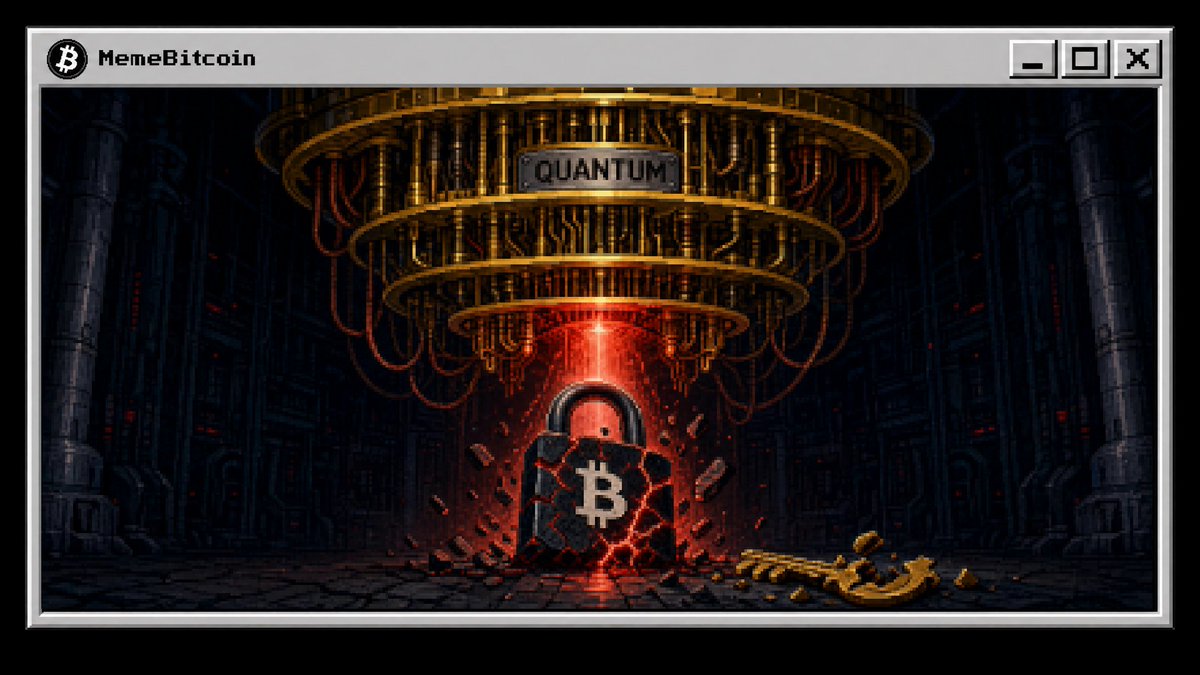
As we shared earlier, quantum computers cannot derive Bitcoin private keys today. But the computational resources required to make that possible are falling quickly.
In cryptography, "impossible" is not a law of nature. It is only a description of how much computation is required.
MemeBitcoin does not intend to leave this as a problem for the distant future. We are accelerating Crack participation so more of the community can take action now.
On September 29, a new Crack Event begins with a total reward pool of 1.096361 BTC.
Keep participating in Crack on MemeBitcoin as usual. You do not need to submit another BTC wallet address.
When the event begins, the Community Gauge will appear on the game screen. The Community Gauge does not decrease with every Crack. It decreases whenever an event winner is selected, reflecting the remaining reward amount.
Every Crack becomes part of a record built together by the community in the race toward 1,096,361 BTC.
If you receive the BTC Event Winner emblem, you have won. Your individual reward amount will be available when Claim opens. Each user can receive only one BTC Event Winner emblem.
The event ends when the remaining reward amount shown on the Community Gauge reaches zero. There is no fixed end date.
Detailed information about reward confirmation and the Claim process will be announced separately once everything is ready.
Crack.
Watch the remaining BTC fall.
Claim your share of 1.096361 BTC.
https://t.co/EYkXmHa5kS
※ Notice: The MemeBitcoin Portal, originally scheduled to open on September 28, has been postponed while we prioritize the Crack Event. A new Portal launch date will be announced through our official channels.
Exciting news! 🚀
We are thrilled to announce our upcoming AMA with @LBank_Exchange!
Join us to hear all about our latest updates, roadmap, and vision.
Don't miss out! 👇
#AMA#LBank#Crypto#Web3
The team has acknowledged a temporary error on the Faiyah staking platform, and the issue has now been resolved.
https://t.co/IZnp7ItJGI
Please visit the Faiyah website again to check your staked assets!
Quantum computing still feels like science fiction to most people in crypto.
But the research is moving faster than many realize.
Earlier this year, Google Quantum AI published new research on Shor's algorithm and secp256k1, the elliptic curve used by Bitcoin.
Under the hardware and error rate assumptions used in the research, the estimated number of physical qubits required for this type of attack fell to roughly one-twentieth of previous estimates.
That does not mean a quantum computer can derive Bitcoin private keys today.
But it does mean that a future quantum computer capable of threatening Bitcoin cryptography may require significantly fewer resources than researchers previously estimated.
And the work is continuing. Researchers are still finding ways to make the algorithms and quantum circuits involved more efficient.
The progress in quantum computing appears to be moving faster than the conversation around it in crypto.
Most crypto users still see quantum risk as something far in the future.
Something to think about later.
But how far away is "later"?
Crypto has a Fear and Greed Index to measure how the market feels every day.
Maybe one day we will need a way to measure quantum risk too.
At MemeBitcoin, Crack has never been symbolic.
Every Crack generates a real candidate private key and checks whether it matches the target associated with Satoshi.
With today's computing, the probability of finding the correct key is effectively zero.
But "impossible" in cryptography is not a law of nature.
It is a statement about how much computation is required.
And that is exactly what advances in quantum computing are beginning to challenge.
For now, the mathematics still holds.
For now, those coins remain untouched.
For now.
An estimated 1,096,361 BTC, held in wallets widely associated with Satoshi, has remained untouched since Bitcoin's earliest days.
We have been cracking toward it, one key at a time.
Soon, there will be another reason to Crack.
Octos is a multi-chain GameFi project that constructs a cross-chain game infrastructure, leveraging Octos-based IP and games to overcome the limitations of single chains.
BNB Chain and Robinhood Chain have currently been integrated, with plans to integrate additional chains in the future.
Please look forward to Octos’ ecosystem expansion and upcoming games!
Mt. Gox, Ronin, DMM Bitcoin, Bybit, and now Bitget.
Another reminder that threats to crypto never stop evolving.
The next threat is quantum computing.
Wallets from Satoshi’s era have had their public keys exposed onchain for more than 15 years.
Together, they are associated with approximately 1,096,361 BTC, making them one of the largest targets in crypto history.
This is where MemeBitcoin is focused.
We are bringing the community together to reach Satoshi’s wallet before quantum computers do.
We are not waiting for the threat to arrive.
We are moving first.
Additional 35M XP — FULLY FILLED in record time.
🔥
Vault now at 100% of its 70M XP cap.
From here, 40%+ of daily validator rewards burn forever.
- Real validator revenue, not emissions
- Up to 60% to stakers
🌐 https://t.co/7ZI4CHXMz3
Thank you! 🚀
This is content from Justin Drake’s remarks on quantum computing progress from almost four months ago.
The 1,096,361 problem is approaching silently, it is not a distant-future problem, but a practical one.