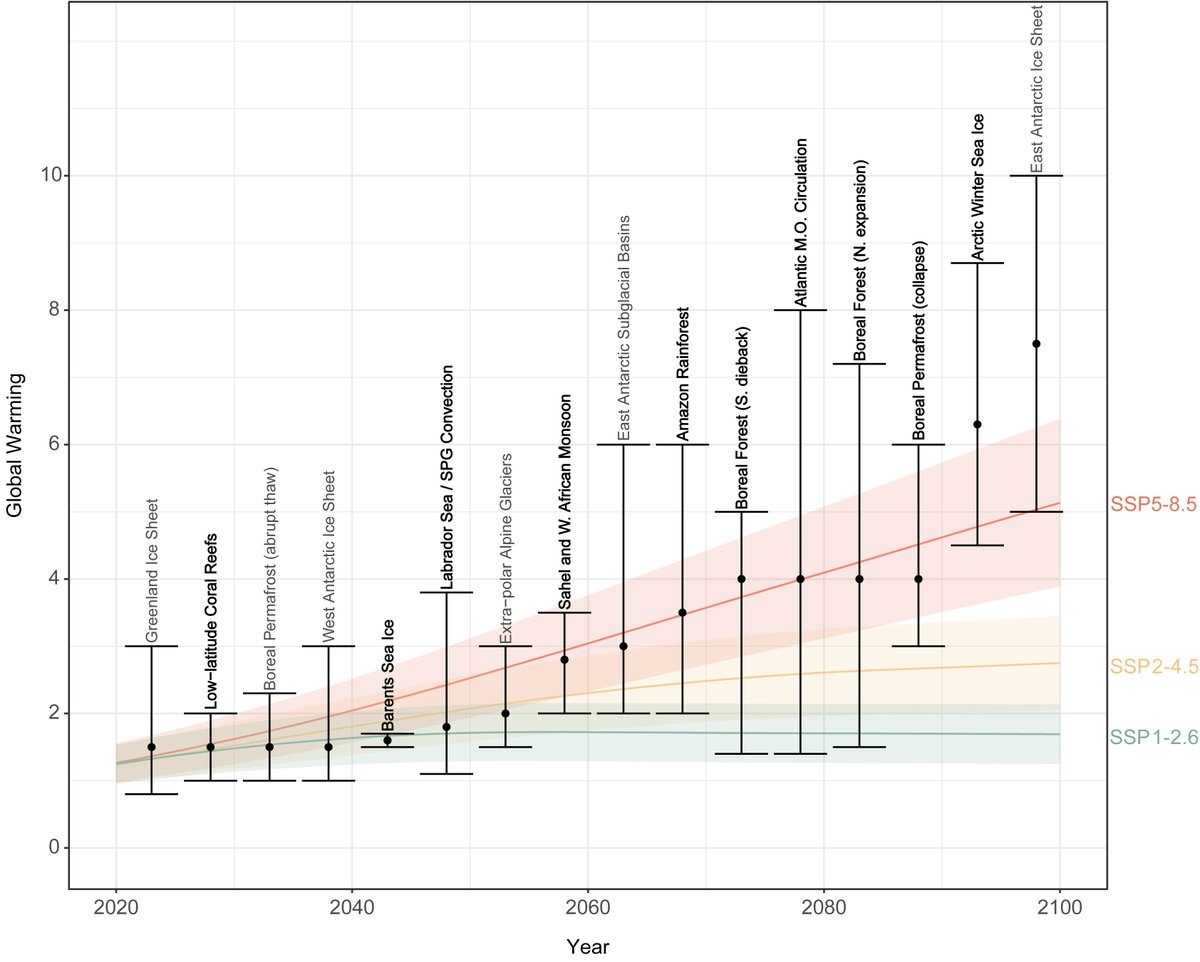
New preprint out today highlighting that the duration of a 1.5C overshoot matters. We find that all climate tipping points would be avoided if global warming over 1.5C is restricted to 30 years and peak warming kept below 2.5C. https://t.co/8nPZagcXE8 @coxypm@UofE_Research
@coxypm@RobertHoglund@UofE_Research Yes, indeed, the thresholds (and tipping timescales) are taken from the 'best estimates' given in the Armstrong-McKay et al., 2022 paper.
New preprint out today highlighting that the duration of a 1.5C overshoot matters. We find that all climate tipping points would be avoided if global warming over 1.5C is restricted to 30 years and peak warming kept below 2.5C. https://t.co/8nPZagcXE8 @coxypm@UofE_Research
@coxypm@BenJohnsonGeo@UofE_Research Yep, it will also depend on how much any overshoot is. The further the overshoot, the more likely CDR or SRM would be required to get back sufficiently quickly.
Cool animation from @PDLRitchie! Shows the probability of triggering a climate tipping point does not go from zero to one as soon as a threshold is crossed. Instead, it depends sensitively on the time for which a threshold is exceeded. Shorter duration overshoots are safer.
A great first paper by @RuthChapman1407 illustrates the different mechanisms (bifurcation, noise, and rate-induced) for tipping of the AMOC in a conceptual box model calibrated to HadGEM3. @SachaSinet@GSI_Exeter
Yesterday the first paper from my PhD, 'Tipping Mechanisms in a conceptual model of the Atlantic Meridional Overturning Circulation' was published online, and can be read here: https://t.co/OLnwXZTDDA
@SachaSinet@PDLRitchie@ExeterUniMaths@UofE_Research@RMetS
What burning questions on tipping points occupy climate scientists?🌎
👉Join #ClimTip at #EGU24 to find out! Follow a day with brilliant speakers in Vienna.
Chaired by Niklas Boers | Co-chairs: @Ricarda_Climate, Anna von der Heydt, Tim Lenton.
ℹ️More: https://t.co/RrDIsvY0rR
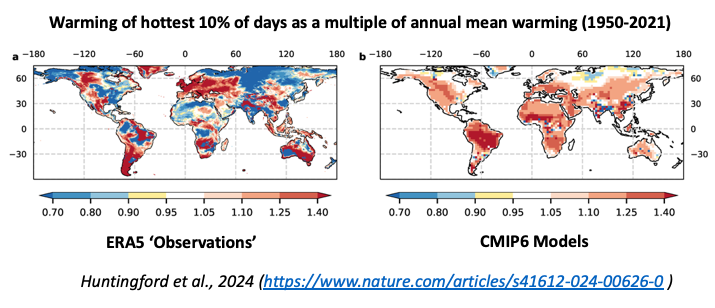
On many parts of the land surface, the hottest days are warming faster than the annual mean, according to a new paper by Chris Huntingford, @Lambda_Joe, @PDLRitchie et al. (@UKCEHPapers@GSI_Exeter@ExeterUniMaths ). Full paper available at: https://t.co/8sHRQLuJCv
Fantastic to see Peter Ashwin from @ExeterUniMaths on this list, well deserved. Congratulations to Peter and the entire class of SIAM Fellows 2024! https://t.co/ZEBFNHRRnz
We have a new commentary article published in @OneEarth_CP today highlighting how tipping points can both be a problem and a solution https://t.co/fgBNLSOaix See🧵for more details @DrJFAbrams @dvdmckay@coxypm@GSI_Exeter@UofE_Research
Initiating positive tipping points are needed to reach the levels of decarbonisation now required. Under correct enabling conditions (affordability, attractiveness, accessibility), Norway has created a positive tipping in the sales of electric vehicles and others are following.
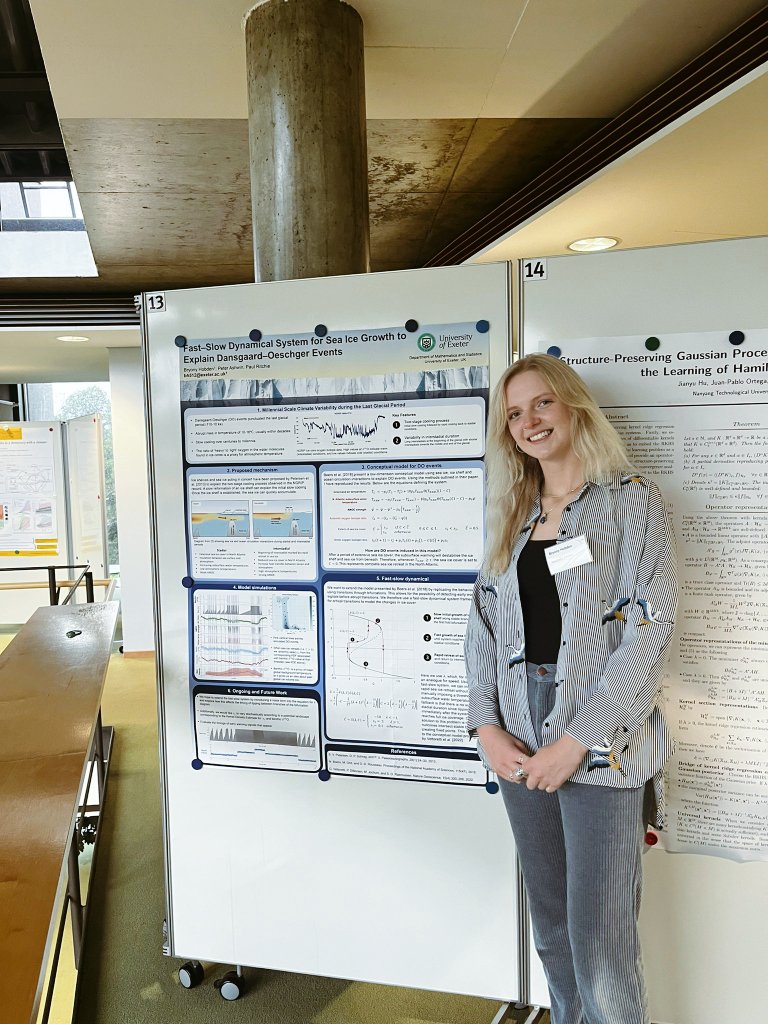
First conference, first poster and today I won a prize for it! A very supportive environment to share ideas about my research with PhD students, early career researchers and profs. Roll on another week of seminars, intro to Julia, and the half marathon! #nadcom23@mpi_pks
🚨Exciting PhD opportunity at @UTAS_🚨 The project, supervised by Dr Courtney Quinn, will study rate-induced transitions in cyclones & involve collaborations with @IMASUTAS & @GSI_Exeter! Deadline for applications is 25th September. https://t.co/Pcfhaqyq3U
New research from Dr Hassan Alkhayuon of
@UCCsms, Prof Sebastian Wieczorek of @eriucc@UCCsms, @PDLRitchie of @GSI_Exeter has found that our ability to adapt to global warming will be impaired if the rate of change is too rapid
https://t.co/7dfjJoLQDa
@SEFSUCC@UCCResearch
A new #TippingPoints study highlights the dangers of "rate-induced tipping" - triggered not by the level of change but by how quickly that level is reached
@coxypm@PDLRitchie@GSI_Exeter@UniofExeter
Paper 👉 https://t.co/PpwnnDzg0W
Press release 👇 https://t.co/fAN6kV3Kf7