@blknoiz06 $SCARCE turns volume into value using inverted liquidity and arbitrage. They capture LP fees in a way that strengthens the token with every trade.
$ANSEM already has the hardest part - attention and volume. SCARCE can make both work even harder.
https://t.co/DvjSp4BvLU
@Cclipperr@xet@mert You should cto the token. Given that the current CTO announced it would migrate to a new ca, this token has effectively abandoned. I read your comments in the group and they're really smart and on point.
$SCARCE is not a launchpad token. This allowed designing unique PVE tokenomics and LP mechanics.
Fees generated by trading volume grow buy side liquidity and reduce token supply, creating an engine that benefits holders.
$SCARCE is not a launchpad token. This allowed designing unique PVE tokenomics and LP mechanics.
Fees generated by trading volume grow buy side liquidity and reduce token supply, creating an engine that benefits holders.
Because Scarcecoin changes what volume does.
Normal pools take fees in $SOL.
Scarcecoin takes fees in $SCARCE and locks them.
So even when buy and sell pressure balance out, volume keeps removing $SCARCE from circulation.
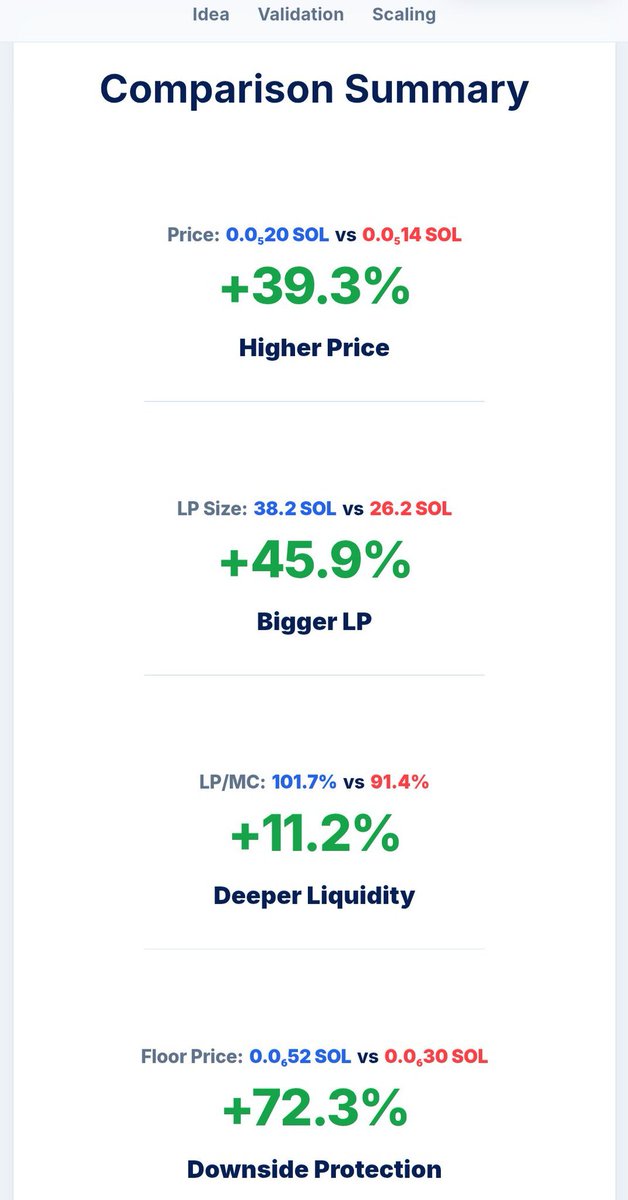
The data shows the $SCARCE model improving other liquidity metrics too.
Compared with a regular pool’s modelled outcome:
• LP size: +45.9%
• Liquidity/MC coverage: +11.2%
• Floor price after stress test: +72.3%
Same starting point. Same trading volume. Different outcomes.
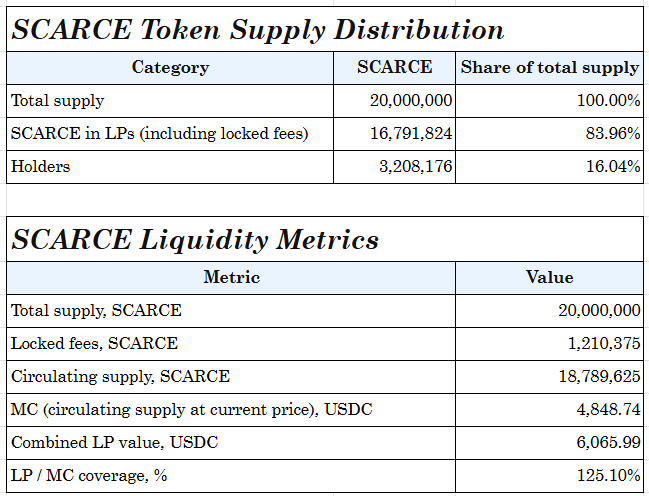
$SCARCE is insanely early. Check the current tokenomics and liquidity metrics.
All liquidity is locked, and LP is thicker than the market cap at these levels.
NFA, but timing-wise, an entry here is similar to entering a launchpad token early in the bonding curve.
@0xSweep To be fair this is not an $ANSEM specific issue. The industry's LP architecture is designed to be extractive by siphoning liquidity from pools through creator fees.
We launched an experimental token $SCARCE with the opposite design capturing liquidity:
https://t.co/RjL2yXMOuq
@vanillafunk713 I'll appreciate if you add it as a liquidity pod on your website. The $SCARCE / $ANSEM pool's address is:
B4EuHyP3LtMpKp4yFTGRbT3Xbj5YDZrm9Pi5koj4CMKy
@vanillafunk713 Really cool stuff. As a fellow liquidity experimentator I really like what you did.
I paired $ANSEM with our experimental $SCARCE.
https://t.co/ORsHXDzosz
This makes a strong case for base-only LPs on @MeteoraAG with a full lock: both principal and fees.
$SCARCE data shows this model is the best fit for seeding launch liquidity, when the goal is supporting the token, not fee farming.
@0xSoju - would love to hear your feedback.
@MeteoraAG@0xSoju To be clear, there is nothing wrong with fee farming when it is done by LPers who take risk, build strategies, and create more liquidity and volume for everyone.
But dev liquidity should should create a self-reinforcing AMM. It will save the trenches.
$SCARCE shows how.
One of the craziest mechanics we’ve built at EHLabs.
$SCARCE is an inverted LP token where Every trade:
• Increases price
• Burns the supply
• Increases Buy-side SOL liquidity.
Multiple LPs auto-arb each other, amplifying the effect.
Buy or sell, price eventually goes up.
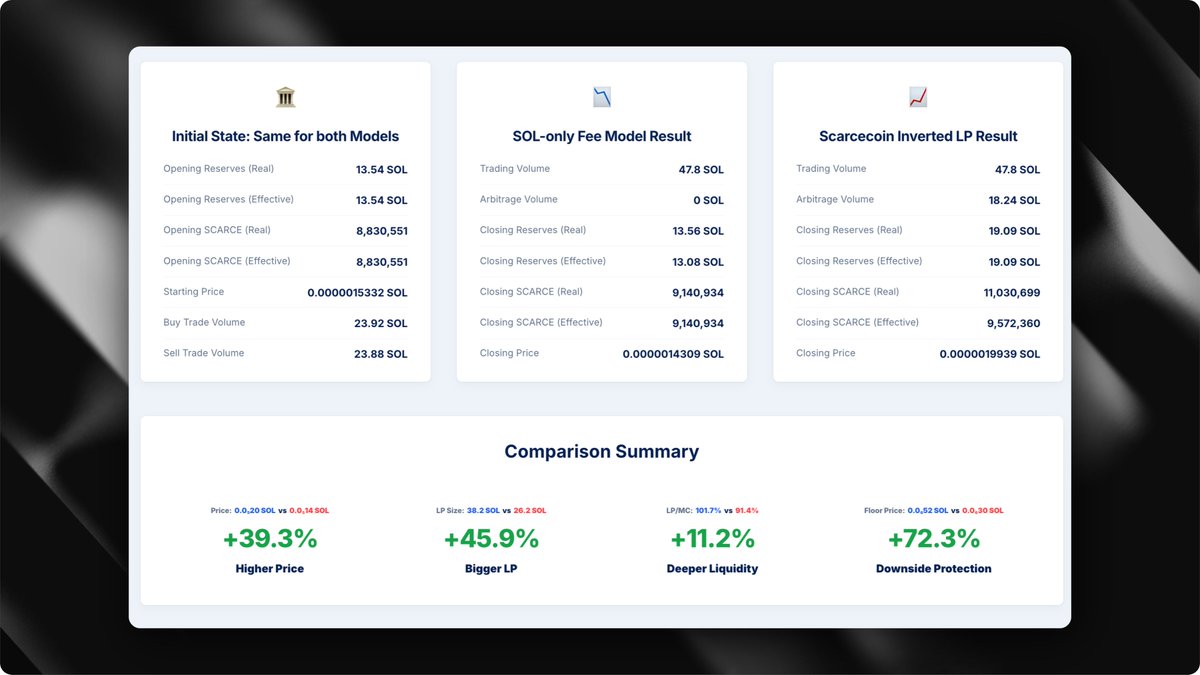
https://t.co/msUrwfh6co has been updated with model validation using real-life data.
We analyzed pool performance at the point where buys ≈ sells to isolate the impact of the model.
A standard LP would drift lower from fees.
$SCARCE moved 30% higher.
How is that possible?
@SolportTom@theunipcs You don't need to be delusional with a right model. Check how $SCARCE operates. It flips the extractive PVP model into a value generation engine.
https://t.co/nODg8zKZPh