Crypto | AI | Web3 | IT Apprentice | Early Adopter & Beta Tester
Exploring ecosystems @MMTFinance #Extended @Legiondotcc @Buidlpad
Interested in DeFi & AI
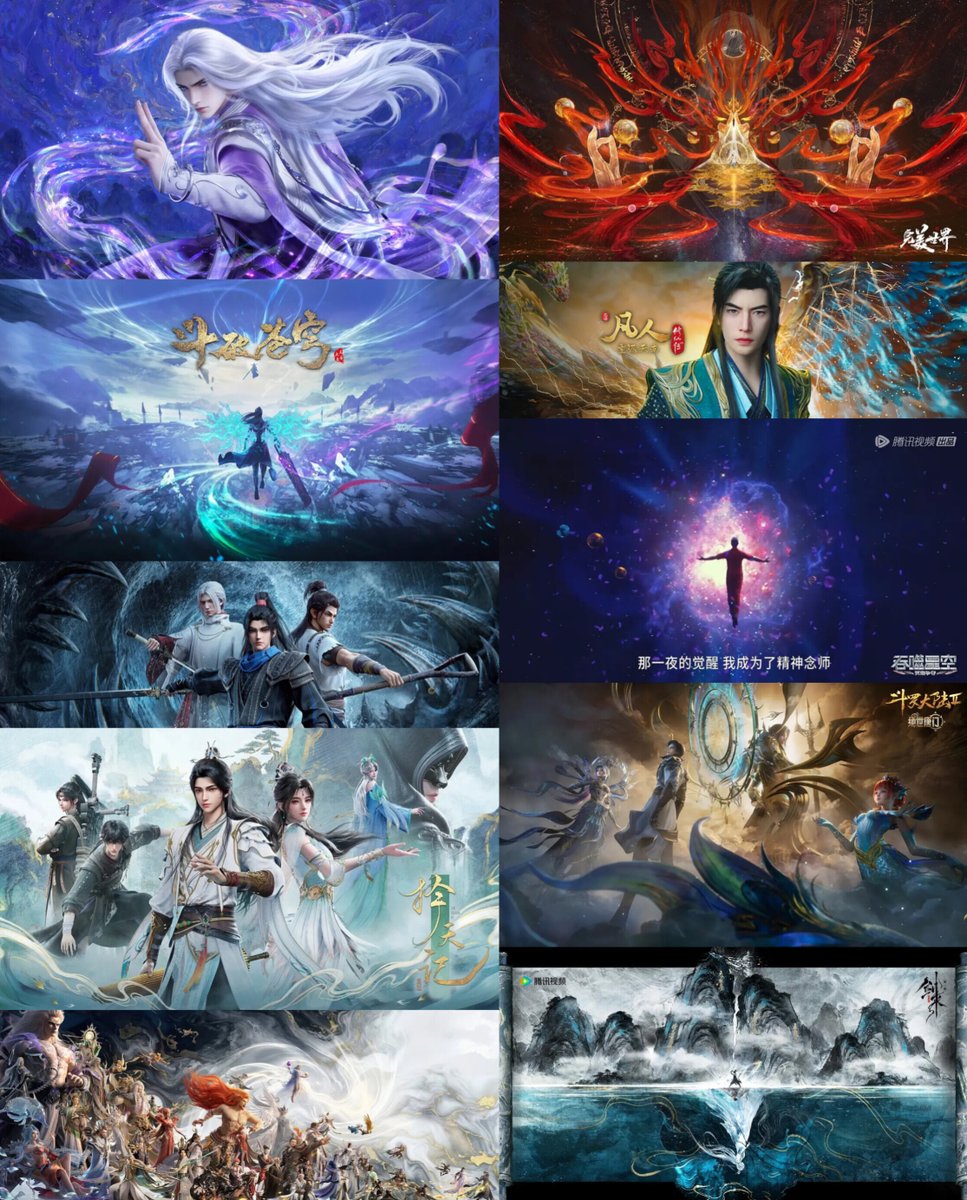
REMINDER -- Season 2 of Slay the Gods (aka Zhan Shen: Fanchen Shenyu) is heading our way on June 25th.
It's been almost 2 YEARS since the Chinese donghua began and, whether you've still to start watching the first season, or you've forgotten how it ends, now is the time to catch up before the next one hits.
Season 1 is streaming on WeTV. You can also watch all 15 eps in one video via Tencent Animation's YouTube channel for free - total running time = 4 hours 56 minutes. Have fun!! 🥳
Copper can't keep up with AI. That's not an opinion, it's physics.
Every data center being built right now is replacing electrical connections with light. NVIDIA confirmed it with $4.5 billion in direct investment.
I mapped 25 public companies across the photonics value chain:
Every AI cluster being built today hits the same wall. A hundred thousand GPUs mean nothing if the data can't move between them fast enough. Copper maxed out years ago and photonics replaced it: lasers, optical fiber, and transceivers that push data at the speed of light. The AI transceiver market doubled in two years. NVIDIA committed $4.5 billion across three photonics companies this year alone. This is where the infrastructure money is going.
Here's the full value chain:
🔬 MATERIALS & WAFERS
This is the bottom of the chain. Every laser and transceiver starts as a wafer substrate: indium phosphide, gallium arsenide, germanium, specialty glass. Nobody above this layer can produce anything without these inputs, and right now the most critical one, indium phosphide, is the tightest material in the entire AI supply chain. The gap between demand and capacity is getting worse, not better.
I think this is the most asymmetric layer on the map. Investors chase the transceiver companies and ignore who grows the substrates underneath them. But NVIDIA is writing checks worth billions in cash and warrants to lock up supply from this exact layer. First link in the chain, last to get attention, and the one that chokes everything above it if it breaks.
Tickers: $GLW, $AXTI, $IQE, $AIXA, $AMS
💡 CORE PHOTONIC DEVICES
This layer converts electricity into light and back. Without it, zero data moves through fiber. NVIDIA dropped $4 billion into two companies here this year just to secure production capacity, and both of them joined the S&P 500 within weeks of each other. That should tell you how fast this went from niche to essential.
The supply gap is not closing. The companies shipping next gen lasers at volume can be counted on one hand, and switching suppliers takes years of requalification. Order books stretch past twelve months. Every next generation GPU cluster consumes more of these components than the last, and no one can substitute them on short notice. I watch this layer more closely than any other.
Tickers: $IPGP, $COHR, $LITE, $LASR, $SIVE
🔌 COMPONENTS & MODULES
The companies here take raw lasers and detectors, package them into finished transceivers and modules, and ship them straight to hyperscalers. If the layers below are the engine, this is the vehicle that actually reaches the customer. Hyperscaler purchase orders land here. The revenue acceleration shows up here first.
What I like about this layer is that you can underwrite it today, not in two years. These are businesses with signed capacity commitments and product already moving. The consolidation angle matters too: larger photonics players have already started absorbing standalone module companies, and whoever remains independent gains pricing power as options thin out.
Tickers: $AAOI, $MTSI, $VIAV, $LPTH
⚙️ SYSTEMS & EQUIPMENT
No company above this layer can manufacture a single photonic component without the machines built here. One of these names holds 100% of the EUV lithography market with zero competitors. Others supply the bonding equipment for co packaged optics or the process control instruments used across the majority of advanced packaging lines. If photonics is the gold rush, this is the layer selling the picks.
My honest take: this is where the smart, patient capital parks. Equipment companies have pricing power and multi year order books that generate cash through full capex cycles. They attract holders who don't panic on the first pullback. The stocks don't run 1,000% overnight, but they compound while everything above them swings, and that tradeoff is worth more than most people give it credit for.
Tickers: $ASML, $BESI, $ASM, $LPKF, $MKSI
🔍 TEST, METROLOGY & YIELD
The most ignored layer on this map, and arguably the one with the cleanest business model. Every wafer, laser, and transceiver has to be tested and verified before it ships. As speeds climb and photonic devices get more complex, the testing challenge compounds fast. The industry is now constrained not only by what it can build but by what it can prove actually works.
Yield is money. Better defect detection means better margins for every company upstream, which is why foundries keep buying test equipment even when they slash budgets everywhere else. These are capital light businesses tied to every unit of production across the chain. Last check before product hits the customer, and one of the few layers where demand doesn't cycle down when the rest of semis softens.
Tickers: $CAMT, $FORM, $AEHR, $ONTO, $VIAV
🧠FINAL THOUGHTS
The NVIDIA capital concentration tells the whole story. One company wrote $4.5 billion in checks to three photonics suppliers in a single quarter. That is a company locking down the one input that could bottleneck its GPU deployments: the optical interconnect.
Returns across this sector have been historic over the past twelve months. But separate the revenue growers from the narrative trades. Some of these companies are printing real quarterly numbers that would impress in any sector. Others are carrying multi billion dollar market caps on sub $100 million in annual revenue. Same sector, wildly different risk.
Every generation of AI infrastructure from here forward needs more photonics. Not less. The copper to light transition inside data centers is early. Co packaged optics is barely in deployment, and 1.6T transceivers are ramping with 3.2T already on roadmaps. The chain locks together: stress on any single link reprices every link above it.
NVIDIA is telling you exactly where to invest with its new 800V DC power architecture.
The old 48V system can't keep up. 800V reduces copper usage by 45%, cuts the power chain from 5 conversion stages to 2, and cuts power delivery losses in half.
These 7 companies are building the power layer underneath it all.
1. $ON - onsemi
SiC and GaN chips for high-voltage power conversion across AI and EVs. AI data center revenue nearly doubled YoY and is expected to double again in 2026. The key number: their content per AI rack scales from $15,000 today to $115,000 in next-gen 800V architectures. A 7.7x increase per rack deployed.
I live in an area that did this - the Wolbachia-infected male mosquitoes cause mosquito populations to gradually go down over time as they crowd out non-infected ones from reproducing, but are sterile themselves. I went from getting bitten by mosquitoes every day (they REALLY love me) to not seeing one for the past five years or so. It’s really effective!
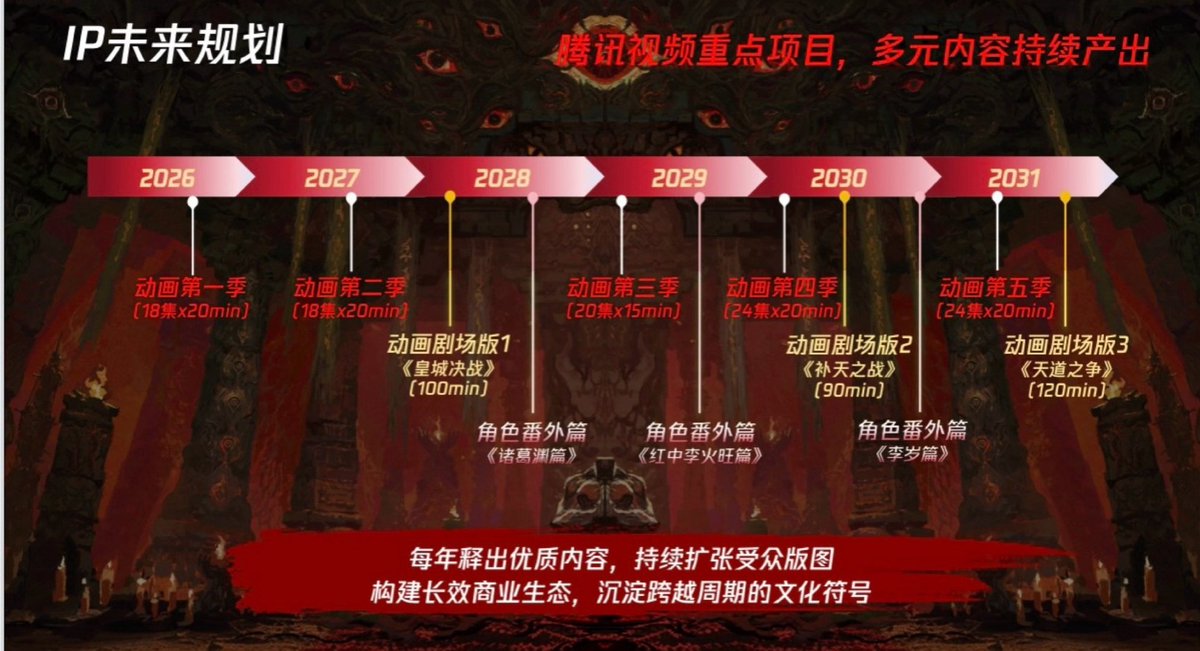
🚨| TENCENT ARE COOKING 🤯
One of the most anticipated donghua, 'Dao of the Bizarre Immortal' premieres this summer with 18 episodes and a full adaptation roadmap ❗️
2026: Season 1 × 18 episodes
2027: Season 2 × 18 episodes
2028: Movie + Special Episode
2029: Season 3 × 20 episodes + Special Episode
2030: Season 4 x 24 episodes + Movie + Special Episode
2031: Season 5 x 24 episodes + Movie
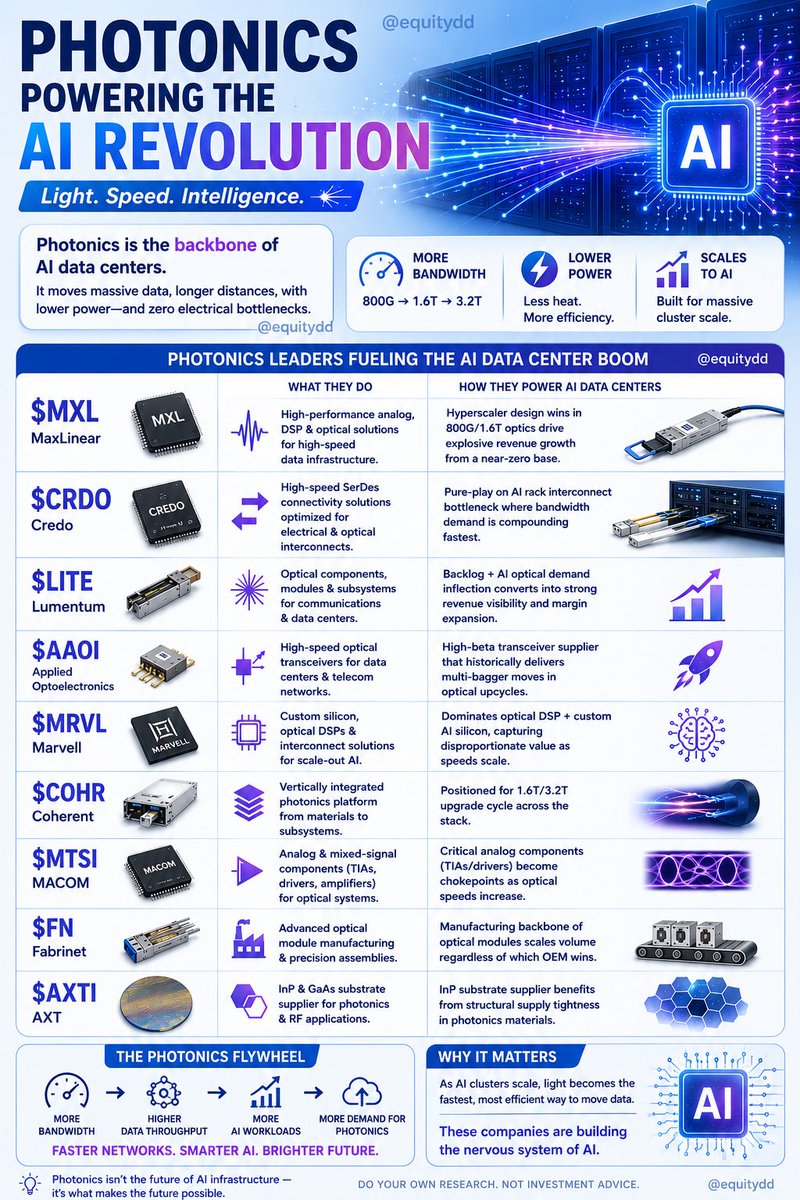
THE PHOTONICS LAYER OF THE AI BUILDOUT
Goldman Sachs says the AI optical networking market growing nearly 10x to $150B+ by 2028 as clusters scale into multi-rack systems like $NVDA Rubin Ultra NVL576.
The AI bottleneck is shifting to the fabric that lets hundreds of GPUs behave like one system driving a massive dollar content expansion across NVLink, co-packaged optics & optical interconnects:
• $AEHR burn-in & reliability test systems for photonics and AI hardware
• $AAOI data center optical transceivers with in-house laser manufacturing
• $LITE high-speed lasers & optical components for data center transceivers
• $VIAV optical testing & measurement tools used to validate high-speed networks
• $COHR lasers, photonic components & materials used across optical networking systems
• $MRVL optical DSPs, custom interconnect silicon & networking chips for AI infrastructure
• $CRDO retimers, DSPs & active electrical cables for rack-level signal integrity in AI clusters
The German market is super underrated, I mean you got
Carl zeiss - for advanced mirrors
Infineon - for power semis
LPK - for laser drilling in glass chips
SUSS - for advanced packaging and wafer bonding
2G energy - for gas turbines
Aixtron - MCOVD machines
TRUMPF - CO2 lasers
Jenoptik -optics and photonics
Banger after banger
BREAKING: The U.S. Government announces a $2 billion investment into quantum computing companies.
🟢 Signal Rating: Strong bullish
Distribution of the funding:
$IBM — $1 Billion
$GFS — $375 Million
$QBTS — $100 Million
$RGTI — $100 Million
$INFQ — $100 Million
What this means:
The last time the U.S. Government heavily supported strategic semiconductor companies like $INTC, $AMAT, and $WOLF — the entire sector experienced a massive revaluation afterward.
Note:
The remaining capital was distributed among several additional private quantum companies that are not publicly traded.
This is a major confidence and support signal by the U.S. Government toward its domestic quantum computing industry.
The quantum race is officially accelerating.
The $NVDA earningscall made one thing very obvious.
Robotics is the next big thing.
These are the best Pureplay stocks to get exposure:
1. $AMBA - Edge-AI Chip pureplay. Optimized for Autonomous roboters and automotives. These are the chips that will power humanoids and other robots.
2. $XPEV - Focussing on Physical AI.
Humanoid Integration systems, vertically integrated Turing Chips for robots and cars. One of the first to produce humanoids on a large scale.
3. $OUST - High quality LiDAR-Sensors, making it possible for robots to perceive the real world. Designed for Humanoids and Autonomous driving.
4. $SYM - Full Stack Warehouse-Automation. Core of this system is SymOS, an AI-Platform automating and optimizing every aspect of the warehouse. Physical and digital layers are perfectly coordinated and integrated.